vip in the city, page 62

PEN/Beyond Margins Award

PEN American Center is the largest of the 141 centers of International PEN, both the oldest human rights organization and the oldest international literary organization in the world. Their Beyond Margins Award is awarded annually to five authors of color for outstanding book-length works published during the previous year. It is presented through the PEN Open Book Program, whose mission is to “encourage racial and ethnic diversity within the literary and publishing communities.” The program works to increase the literature by, for, and about African, Arab, Asian, Caribbean, Latin, and Native Americans, and to establish access for these groups to the publishing industry.

The 2006 winners were chosen by a jury of professional writers, editors and educators, out of a pool of more than 130 titles, submitted by nearly 60 publishers.

Richard Blanco for Directions to the Beach of the Dead
Andrew Lam for Perfume Dreams: Reflections on the Vietnamese Diaspora
Ed Bok Lee for Real Karaoke People
Caryl Phillips for Dancing in the Dark
Jennifer Tseng for The Man With My Face

The event honoring the writers was held at the Donnell Library Center and titled “Something to Declare: Celebrating Writers of Color.” The last time I recall being in the auditorium, I was on stage, performing Beethoven’s Sonata Pathétique. These days, I don’t think I’d get past the first few measures. I should try get back into playing the piano more – all those years of lessons!

After introductions by author Elizabeth Nunez (chair the PEN American Open Book committee) and poet Sonia Sanchez, special guests were brought in to read the writers’ works: lauded author Russell Banks (Rule of the Bone, Cloudsplitter, The Sweet Hereafter and Affliction — the last two of which were adapted into award winning films); poet, playwright, and screenwriter Jessica Hagedorn (Dogeaters); and actress Lili Taylor (of Factotum and Say Anything fame.)
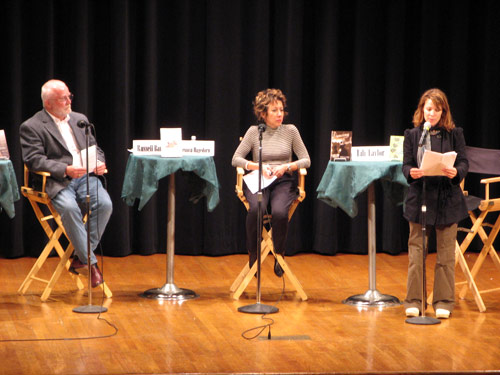
Readers

Banks epitomized the older white-haired gentleman author in his tweed sportjacket, jeans and cowboy boots ensemble, so it was interesting to hear Andrew Lam’s Vietnamese immigrant youth experience recounted in his New England tones.

After the readings, three of the authors, Lam (Vietnamese), Lee (Korean) and Blanco (Cuban) participated in a lively panel discussion, moderated by Sanchez, about translating ideas and experiences between languages and cultures. A brief question and answer period followed, during which Sanchez posed questions that she had screened from handwritten cards submitted by audience members, eliminating the almost inevitable ridiculous questions.
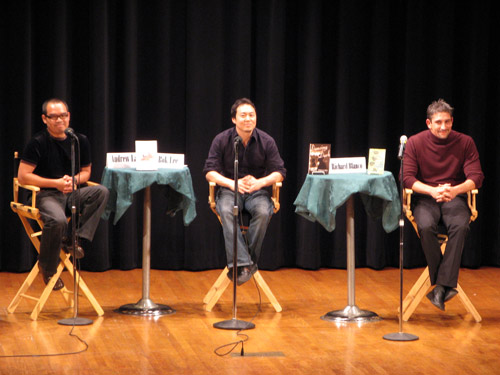
Writers

[This has nothing to do with the event, but I remember one of the first presentations I had to make for work, years ago, to an audience of teachers and school administrators. After speaking for about 45 minutes, I opened the floor to questions, and was asked by one fellow: “So, are you… Chinese ?” Seriously. I could have used Sanchez’s pre-screening then.]

I would have liked to see some female representation — Tseng was unable to attend — but the men held their own, and seemed genuinely engaged with the audience.

There was a small reception afterwards, where the authors circulated gamely among the guests and the stacks of books. There’s something about libraries after hours — libraries and museums — that strikes me as very romantic.

About the Donnell…

The original Winnie-the-Pooh, Tigger, Eeyore, Piglet and Kanga are displayed in the library’s Children’s Room upstairs. Yes, Pooh was a real stuffed bear, given to Christopher Robin Milne — son of Pooh author A.A. Milne — as a present for his first birthday. Eeyore, Piglet, Kanga, Roo (since lost) and Tigger were acquired in that order over the next several years. The stuffed toys have traveled in exhibits around the world, having been kept for many years at the offices of Milne’s publisher. In 1987, they were moved to a glass case at the Donnell Library where they remain on view to the public in their original well-loved condition.
The Great Read in the Park

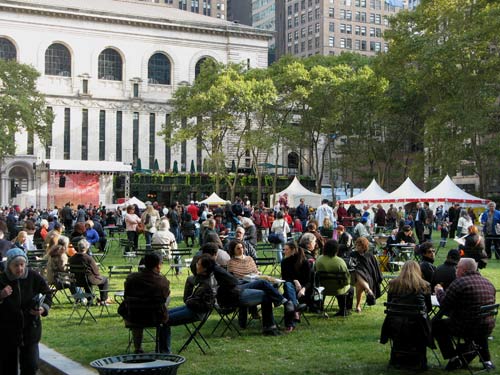
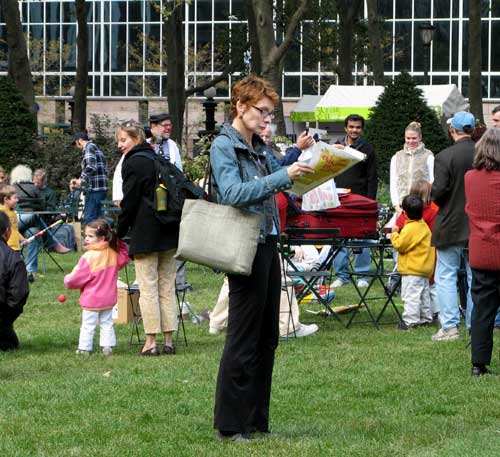
SYB and I parted ways after the brunch adventure: he, off to support his friend, who would be performing at CultureFest 2006 in Battery Park; I, to attend the second annual Great Read in the Park, hosted by the New York Times. Last year’s inaugural event commemorated the 70th Anniversary of the New York Times Best-Seller list; the event was such a success, that the Times brought the “extraordinary literary celebration for book lovers of all ages” back to Bryant Park for another year.

Multi-colored tents and one main stage were set up inside the Park behind the New York Public Library for the simultaneously scheduled events, which included author book signings, themed panel discussions, interviews, readings and live music and dance performances. Over 120 authors had signed up to participate, catering to a wide range of interests: from food, to fiction, to business, to politics, to college admissions, to sports, to health and wellness…

The Great Read

Last year’s lineup featured more of the performances and authors I wanted to see. I remember: the Broadway cast of Wicked; Doubt’s Cherry Jones and Brian O’Byrne; Anthony Bourdain; Nicole Krauss; Jonathan Safran Foer; Mark Kurlansky; Rick Moody; Will Shortz… none of whom were making a return appearance this year.

The Great Read

Still, there was plenty on the slate of interest. I arrived just in time for the “New York Writers, New York Stories” panel taking place in the Green Tent. At least, I thought so. As it happened, by fifteen minutes before start time, the tent was already filled to capacity and security was not letting anyone inside past the velvet rope. There’s always a velvet rope in New York City. Who knew that Post gossip columnist Cindy Adams could draw such a crowd?

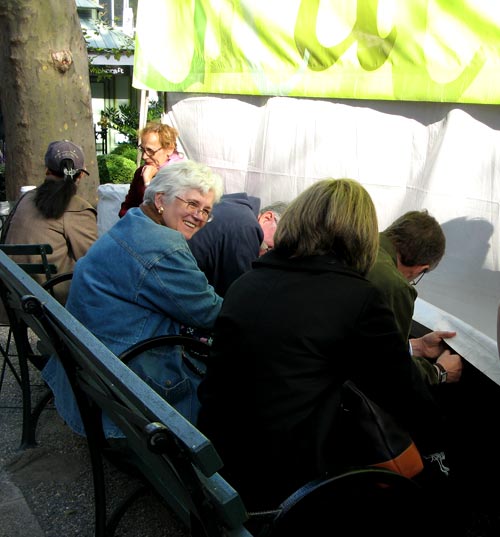
A determined few, similarly shut out of the main event, resorted to eavesdropping from the other side of the tent canvas.

Eavesdroppers

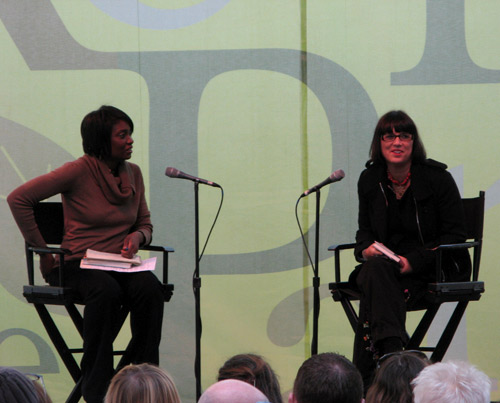
Not I. I gave up and wandered into the Eve Ensler interview, taking place on the New York Times Stage. Here, Ms. Vagina Monologues herself discussing her new book, “Insecure at Last: Losing It in Our Security-Obsessed World.” Part memoir, part criticism, her work explores how the pursuit of security in and of itself creates an environment of insecurity, isolating individuals and thwarting opportunities for dialogue, hope, and change.

Eve Ensler

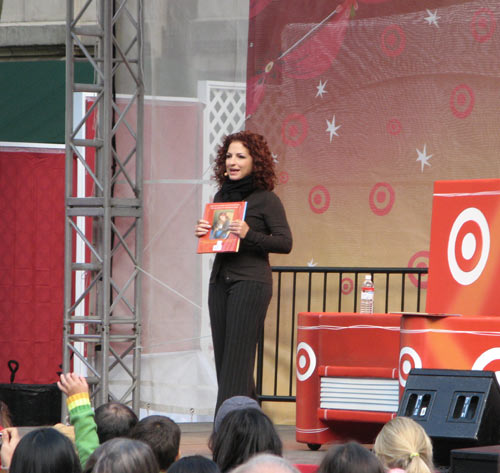
In another part of the Park, Grammy Award-winning singer songwriter Gloria Estefan (sans Miami Sound Machine) was reading from her children’s book “Noelle’s Treasure Tale”:

Gloria Estefan

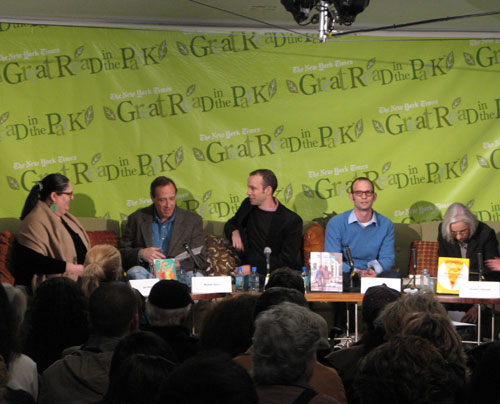
Not wanting to be shut out twice, I went to stand on line for the panel I wanted most to see: “Food Writing: Cuisine with Personality,” featuring New York Times writers and brothers Matt Lee and Ted Lee (in glasses), and Gourmet magazine’s husband and wife columnists Jane and Michael Stern. Florence Fabricant (far right), food writer for The New York Times, moderated the panel for another capacity crowd.

Food Panelists

It was interesting to hear how the two teams approach their food discoveries differently. The Lee bothers admitted to a decidedly NYC-centric view, and they talked about the “heat-seeking culture” of the New York Times. They and Fabricant commiserated about the constant pressure to find the Next Great Thing, or the super-secret source, which by virtue of their writing about it becomes not-so-secret anymore. The Sterns, by contrast, consider themselves more food preservationists, traveling around the country, shining their spotlight on chefs and dishes that would perhaps otherwise fade away without notice or fanfare.

Matt Lee told a funny story of how in Summer 2000 he wrote a piece for the New York Times (which made its way to a National Public Radio feature) about Hamburg Inn No. 2 in Iowa City. At the time, he waxed poetic about the “secret” menu item of the otherwise unremarkable diner: the pie shake — a slice of crusty fruit pie blended into a milkshake. Pie! In a shake! Brilliant. (His favorite combination: strawberry rhubarb pie and vanilla ice cream.) Perhaps obscene, but ultimately “a triumph of design and flavor — a pie à la mode smoothie — and evidence of the heartland’s inspired practicality.”

Lee’s piece created such a sensation – in Iowa City! – that the Inn was unable to keep up with the demand. Rather than do what any diner in New York City would have done, i.e., start charging $10 a shake, so that only a manageable few would continue to order it, the Hamburg Inn flat out refused to fulfill any more orders for the pie shake — which had never been on the menu to begin with. Diners who made the trek and request for a pie shake after the owner’s edict came down were told firmly that no such item existed. And so the pie shake disappeared into legend, a victim of its own runaway success. Naturally, other diners attempted to mimic the seemingly simple menu item — and don’t think I’m not going to try this at home! — but could never recapture that initial pie shake magic.

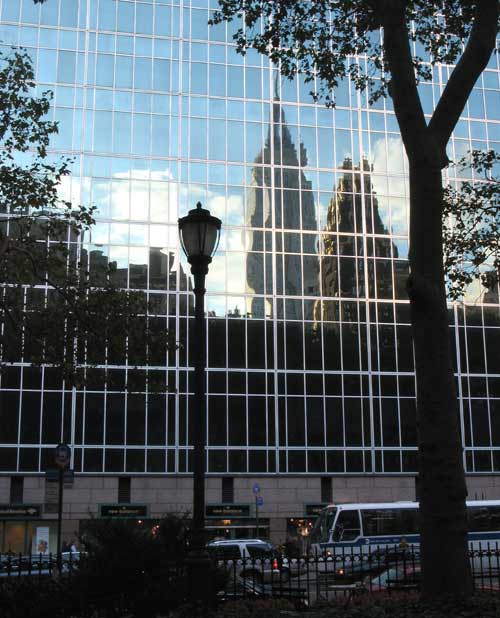
An alternate view of the Empire State Building, as seen from the north side of Bryant Park:

ESB Reflection

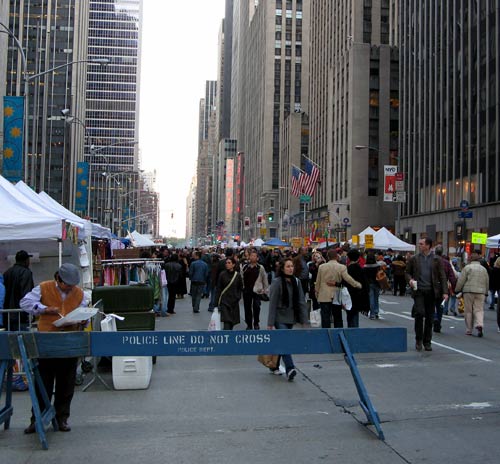
And on the way home, another street fair. This one along Sixth Avenue beginning at the Library, and extending uptown, past Radio City Music Hall for as far as I could see.

From Wikipedia:

Although [Sixth] Avenue’s official name was changed to Avenue of the Americas in 1945 by Mayor Fiorello La Guardia, New Yorkers seldom use this term and calling the avenue by that name has even become a cliché of sorts for something a tourist in the city might do but not a resident New Yorker (such as mispronouncing “Houston Street”).

Sixth Avenue Street Fair

Prune Brunch

I was pretty exhausted from working until close to midnight last night, but managed to leave the house relatively early to brave the crowds at local favorite, Prune. I’d long wanted to try out the “phenomenal weekend brunch” at this little gem of a restaurant, christened with chef/owner Gabrielle Hamilton’s childhood nickname. Really, though, I had no occasion to make the trip, traversing the island for eggs. But what better occasion than a beautiful sunny Sunday?

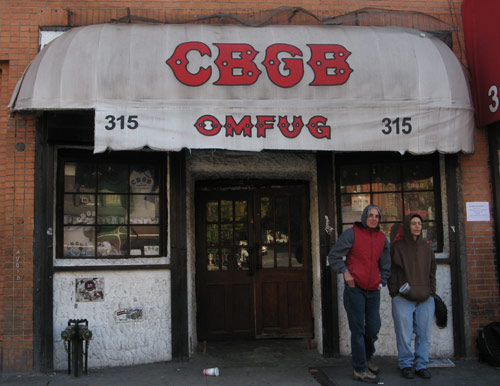
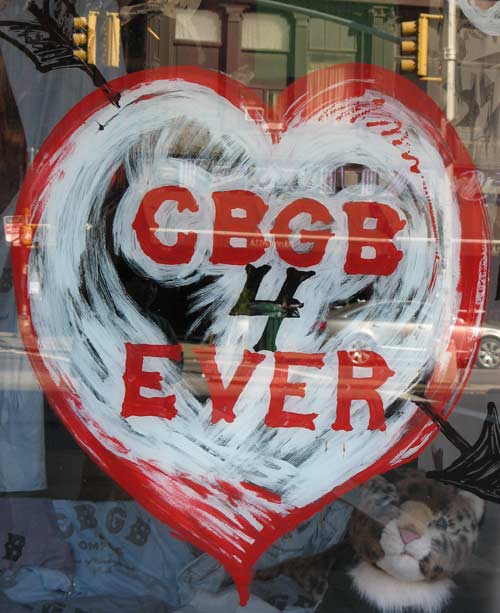
En route we passed legendary club CBGB & OMFUG (Country Bluegrass Blues and Other Music For Uplifting Gormandizers) on its final day. Even before noon, the grungesters and hipsters were out, paying homage to this 33-year old New York City punk rock institution which would be shuttering its doors after Patti Smith’s concert that night. A young couple was there, memorializing the occasion with a baby photo shoot in front of the “CBGB 4 EVER”-painted window, to which SYB and I had wildly different reactions. (“Awww!” and “Ugh!” — I will leave it to you to match the comment with the person.)

CBGB

CBGB 4 Ever

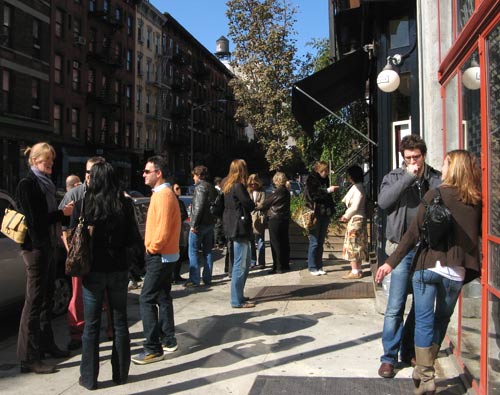
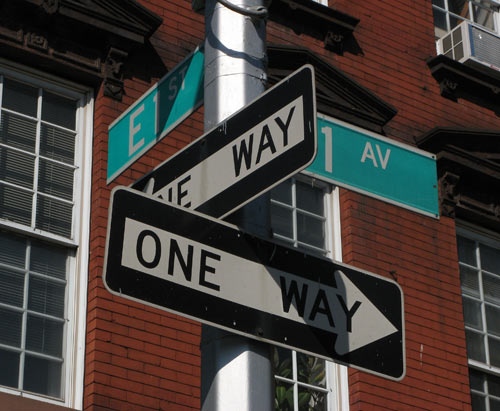
We turned onto 1st Street and spied the brunch line from down the block. What the… I mean, they’re just eggs, right? By that point, though, we had committed to going, so I marched in to add my name to the waitlist.

Brunch Line

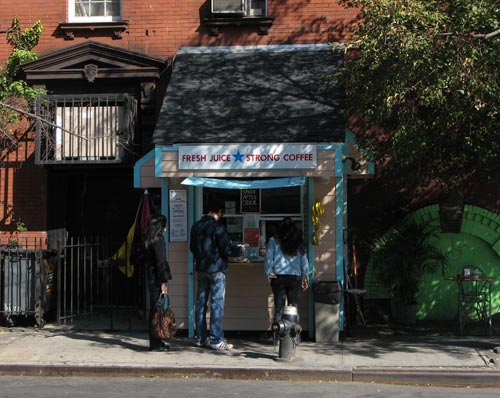
At the corner, Juicy Lucy’s juice bar kiosk, located at the nexus of the universe on 1st Street and 1st Avenue. The menu offered an assortment of juices, smoothies and caffeinated brews, in addition to a few vegetarian/vegan baked goods. We placed our order: two horchatas. When the young man working the stand asked, “Regular or Mexican?,” SYB and I looked at each other and shrugged.

“Uh… Mexican?” I offered.

That seemed like the right answer. (Aren’t all horchatas Mexican, after all?) The guy nodded confirmation, and continued assembling our seemingly very complicated drinks, whirring mystery ingredients in a blender, and steaming up… milk? This didn’t resemble any horchata I knew. But then again, having only discovered the drink recently, I claim no expertise.

We paid for our drinks, and cautiously accepted the pair of hot(?) paper cups. Hmm. A sip. Tasty, for sure, but not at all like what I expected. In fact, this tasted less like rice pudding and more like… hot chocolate. Mexican hot chocolate. Which, come to think of it, sounds a lot like “Mexican horchata.”

Ah.

Juicy Lucys

Well, that’s okay. We took our Mexican hot chocolates down the block, stopping to peek inside at famed NYC fish purveyor Russ & Daughters, and then returned to claim our places in the crowd in front of Prune.

Sooner than I expected, we were ushered in by the friendly name-taker, and seated inside.

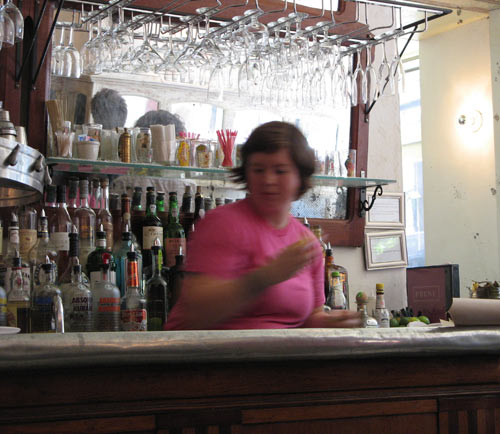
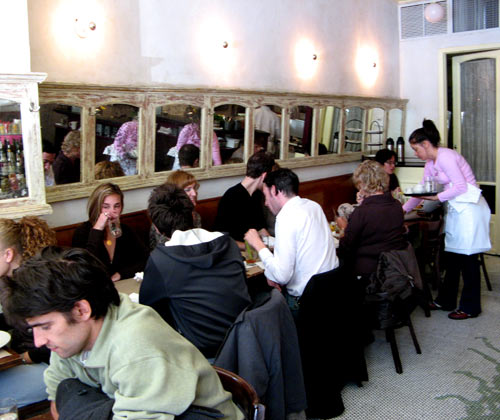
Prune

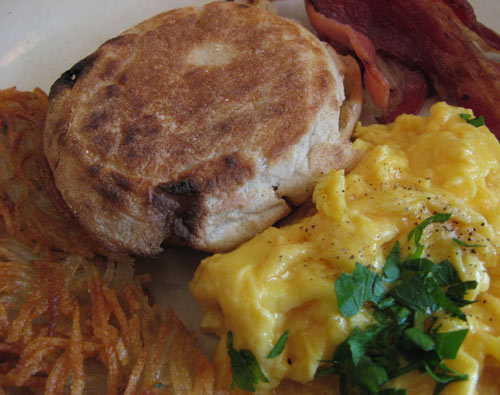
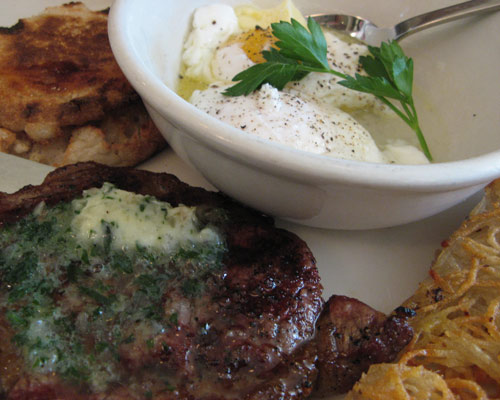
Intriguing offerings: an “expert” Oyster Omelette, a “fantastic” Eggs en Cocotte, Dutch pancakes, the Russ & Daughters Smoked Fish Plate (essentially: items picked up down the block and arranged prettily on a platter), and a famously tempting array of bloody marys. This morning, though, I opted to keep things simple: Soft Scrambled Eggs with Bacon, Toast and Potatoes. SYB went for the Steak & Eggs (poached).

Soft Scrambled Eggs

Steak and Eggs

Prune

Recently, one reader commented (off-site) that I seem to enjoy every meal I have, which for her, created suspicion that I may just be remarkably easy to please. Interesting idea — and if it were true, would that really be such a bad thing? — but I don’t think so. This isn’t intended to be a review site — more a log of the experiences I find notable… and I interpret that pretty broadly: good food, good value, good people, good times. I’m not all that interested in writing — and doubt any of you would be all that interested in reading — about the sausage kale fettucine I made at home this week, or the mediocre slice I grabbed for lunch. Also: although I consider myself pretty open about what I’ll eat, I’m pretty particular about avoiding meals I suspect may not be all that good. Because I enjoy food — a lot. I don’t have to be wowed each and every time, but I generally won’t just grab a turkey sandwich from the deli, if I know about a nearby street cart that serves amazing carne asada. All of which probably skews the food I eat more towards the “tasty” end of the spectrum… which is just the way I want it. So, friend, if what I’ve written about a meal or dish makes you wonder if the food is all that good, try it for yourself. Invite me along, I’ll go.

So the brunch at Prune: is it really that good? I say: yes. Aren’t they just eggs? Yes, again. But eggs, perfectly done. Are they worth waiting in line for 45 minutes? That’s probably up to you. If it’s a bright weekend morning, and you’re not doing much of anything else, put your name on the waitlist, and grab a coffee or horchata at Juicy Lucy’s kiosk down the block. (Just enunciate when you place your order.) Maybe you’ll stop in at Russ & Daughters and decide you’d prefer to take smoked salmon and bagels to First Park. Veselka opened an outpost there this summer: borscht and pierogis, maybe? Or hey, I just noticed that those grape leaves on display at Bereket across the street look pretty good. (They are.)

Just get out there and explore. It’s all in the adventure.

Nexus

The Gershwin Hotel

A couple of months ago, AC mentioned an event that takes place every Autumn on the rooftop of The Gershwin Hotel: The Finnish Sauna Fest. For one night, the hotel recreates a Finnish sauna under a massive tent, from which fest attendees sip chilled vodka, and admire the Manhattan skyline (and more discreetly: their fellow revelers’ towel-clad forms) while Finnish DJs spin tunes.

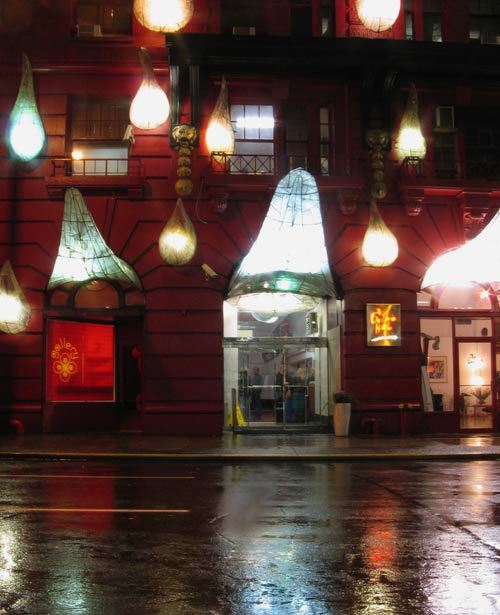
Montreal hotelier Urs Jakob, whose family immigrated to the United States from Switzerland, has a history of promoting the Finnish aesthetic. Jakob acquired what was in 1993 another condemned welfare hotel and renovated it over the next several years into its current form. In 1997, he commissioned Finnish artist Stefan Lindfors to create an installation for the building’s façade. And so was born the hotel’s now signature permanent exterior sculpture installation: “Tongues & Flames“: interior-lit stainless steel frames covered with fiberglass and clear-cast resin, that protrude whimsically out the front of the 13-story hotel, evoking… well, you know. The first two tongues/flames bracketing the Gershwin’s main entrance were unveiled in Summer 1997.

No information yet on Finnish Sauna Fest 2006…

Gershwin Hotel

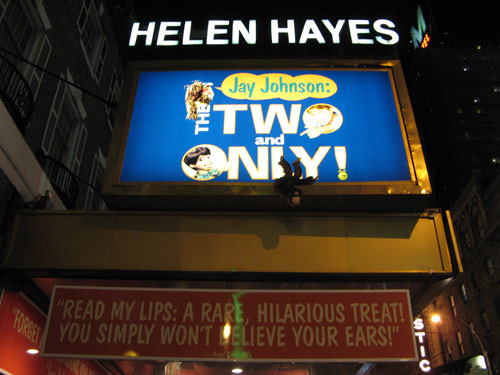
The Two and Only

I had a pair of tickets to see Jay Johnson‘s one-man, several-puppet show and invited along B, with whom I’d felt a bit out of touch these couple of weeks. It gave us a chance to reconnect, which was nice. He arrived at my apartment early, bearing gifts from his recent business trip to Austin: souvenirs from my favorite Texas barbecue joint, The Salt Lick. Sweet!

Jay Johnson

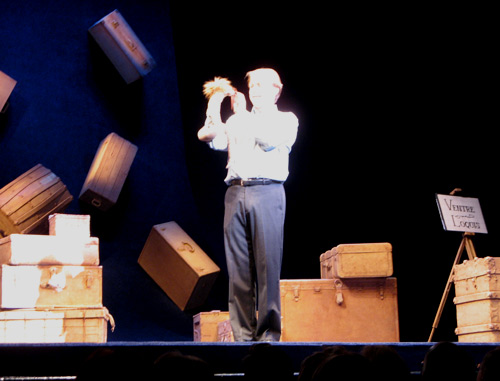
The Two and Only was advertised as a showcase for the ventriloquist, best known for his supporting role on the controversial 1970s sitcom Soap. I don’t generally have a lot of interest in ventriloquists — the whole artform seems a bit antiquated in this era of CGI special effects, and I’ll admit it: the dummies — sorry: “wooden Americans,” as Johnson offers — creep me out a little. But Jay Johnson was a true master of his craft. Over the course of the 90-minute intermission-less show, he played straight-man to a host of vivid characters that emerged from baskets and trunks — and in the most imaginative bit: a dry erase board — strewn about the Helen Hayes Theatre stage: a severed head, Amigo the snake (pictured below — poorly, but it was the best I could manage), Nethernore the vulture, Spaulding the tennis ball, Darwin the manic monkey, his first professional partner, Squeaky and his former Soap  co-star, Bob.

A hilarious sequence revolved around the fact that “Bob” was named by a writer who “obviously knew nothing about ventriloquism”. Well, not quite so obviously to an audience of similarly ignorant non-ventriloquists. But as Johnson explained: “B” is an implosive consonant, which forces one’s lips to move to pronounce it – the downfall of any ventriloquist. During one rapid-fire exchange between Johnson and Bob, enormous pains were taken to steer Bob from the letter “B.” (Johnson pulled it off eventually, though, and brilliantly. “Bastards!“)

Jay Johnson

Johnson delivered a brief history of ventriloquism and an explanation of the mechanics of “voice-throwing,” interwoven with an autobiographical account of his humble beginnings in show business as a kid working the lodge circuit in Abernathy, Texas. Aside from being enormously talented, Johnson came off as a genuinely friendly, sentimental guy. The most moving parts of the evening recounted his acquaintance and long distance mentorship under a retired vaudevillian named Arthur Sieving, who carved Johnson his first dummy.

Johnson appears to be one of that rare breed who manages to carve a successful career out of a childhood dream — and there’s quite an inspiration in that.

Manny & Mozart

Pianist Emanuel Ax was performing an all Mozart program with the Orpheus Chamber Orchestra at Carnegie Hall tonight, celebrating the 250th anniversary of the birth of Wolfgang Amadeus Mozart (1756–1791) and the 30th anniversary of Ax’s first collaboration with the conductorless ensemble.

Ax first came to the public’s attention in 1974 when, at 25, he won the first Arthur Rubinstein International Piano Competition in Tel Aviv. Since that auspicious start, Ax has gone on to win numerous awards, including the Avery Fisher Career Grant (awarded annually since 1982 to outstanding solo instrumentalists) and several Grammys: two for his solo recordings and five for collaborations with Yo-Yo Ma, Jaime Laredo, and Isaac Stern.

That afternoon, I placed a call to the Carnegie Hall Box Office and was surprised to learn that there were still seats available to that night’s performance. Better still, they were offering last minute $10 (cash only) tickets. At that price, it didn’t even matter where in the Hall the seats were: we were going to Carnegie Hall!

SYB left the office early to pick up the tickets. After he and I met up for a quick pre-concert bite — one booth over from Atoosa Rubenstein — it was off for an evening of Mozart.

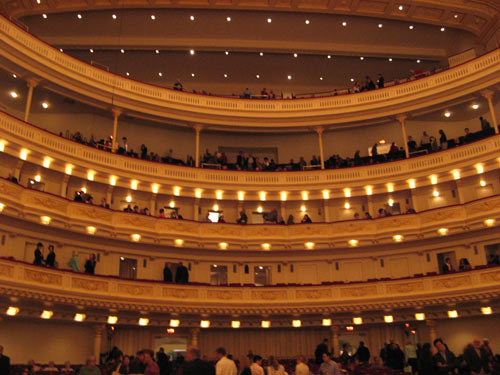
Tiers

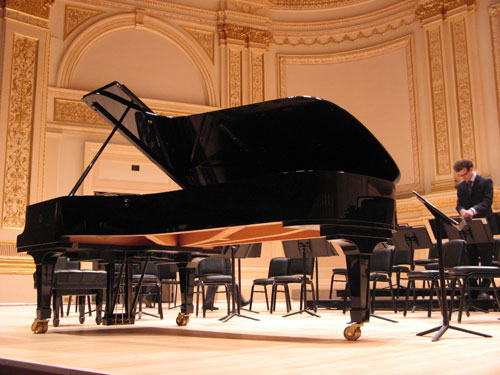
I don’t know why, I don’t know how… but here we are again: second row center! From our seats, we were close enough to see the flying hammers reflected in the propped, glossy lid of the grand Steinway.

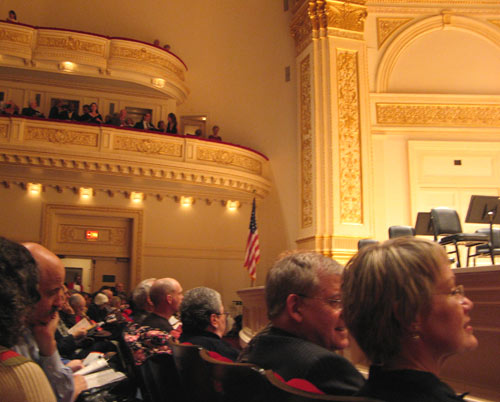
Audience

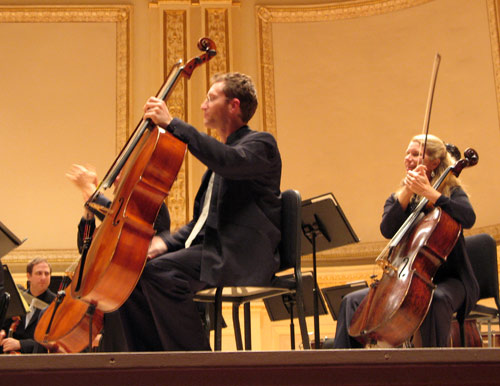
Ax’s playing was “fluid, elegant and refined,” as the New York Times noted in their glowing review of the concert. I was intrigued by how the leaderless Orpheus managed to keep their playing even and well-tempered, especially during some of the pieces’ more fluid, running segments. A different core group shapes each piece, shifting seating assignments and providing cues for their respective sections. The process requires almost twice as many rehearsals, but allows the individual ensemble players opportunities for input not possible in a conductored grouping.

Cellists

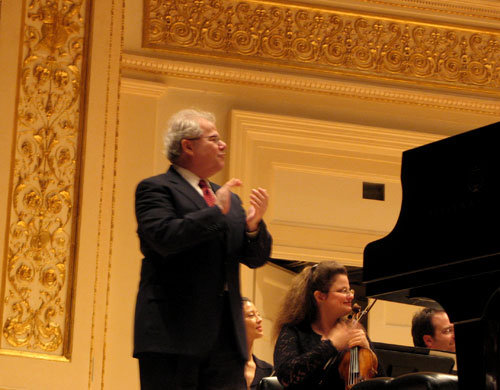
Emanuel Ax

Piano

Beginning on Friday, October 13, and through January 7, 2007, the Morgan Library is also celebrating the 250th anniversary of Mozart’s birth with an exhibition entitled “Mozart at 250: A Celebration,” tracing the great composer’s life through manuscripts, letters, and first editions of his works. Works among the always impressive collection include tonight’s “Haffner” Symphony, K. 385  [1782–83], in the velvet and silver case in which it was housed when it was presented to King Ludwig II of Bavaria in 1865. I remember this from the last time I was in the manuscript room, a couple of months ago. Also on display:

Other manuscripts from the Vienna years include those of the somber Fugue for Two Pianos in C Minor, K. 426, Mozart’s only keyboard fugue of any distinction; two of his best-known piano concertos — in C, K. 467, and D (“Coronation”), K. 537; Der Schauspieldirektor (The Impresario), the only manuscript of a Mozart opera in this country; the Piano Rondo in D, K. 485, known to piano students around the world; the Horn Concerto in E-flat, K. 495, written in four different colors of ink; and the arrangement for voice, violin, and piano of Cherubino’s aria “Non so più cosa son” from Le nozze di Figaro (The Marriage of Figaro), the only complete arrangement of an operatic number Mozart is known to have made.

The exhibition ends with the exceedingly rare first edition of the Requiem, K. 626, left incomplete at Mozart’s death.

I’m constantly amazed by the sheer depth of Mr. Morgan’s collection. Definitely checking this out.

A case of Russian

Having missed last week’s class, it was up to me to review on my own some of the materials we covered last Wednesday.

In Russian, the instrumental case (tvorítel’nyj padézh) is used to mark the means by which an action is done. The “instrument” can be a physical entity (“by car,” “with friends” or “with a pen“) or more abstract (“with enthusiasm“). It is also used to denote spatial relationships (behind, between, under), a time during which an action occurs (“in the evenings“), a change of state or status (“After eating all those apricots, I became ill“), or to emphasize a profession (“She works as a doctor.”) All this I ascertained from the supplemental Russian study guide I ordered through Amazon.com this week. Because the topic wasn’t covered in the textbook  we’re using for the course. Yes, this class is proving to be quite a challenge.

Someday… I want to read Tolstoy in the original Russian.

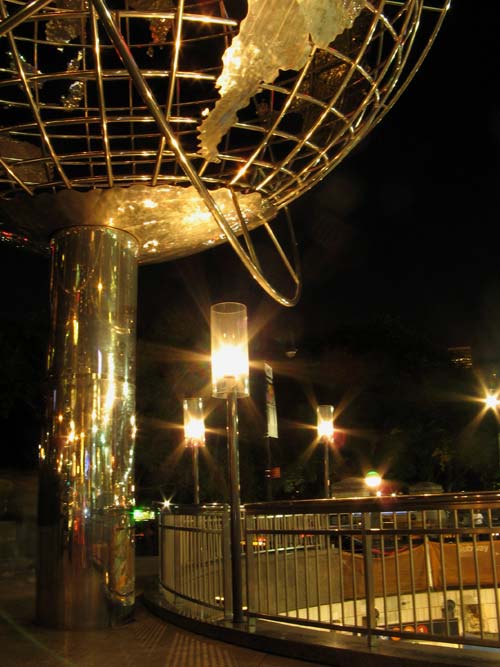
Trump Globe

The aim of an artist is not to decide a question indisputably, but to compel us to love life in all its countless, inexhaustible manifestations.

Lev Nikolayevich Tolstoy (1865)

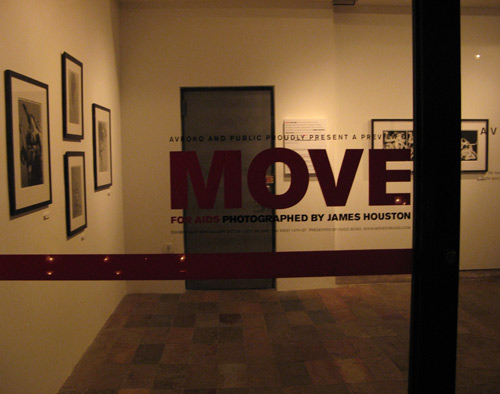
MOVE FOR AIDS at Public

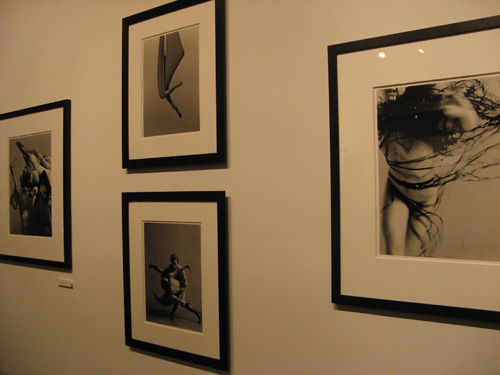
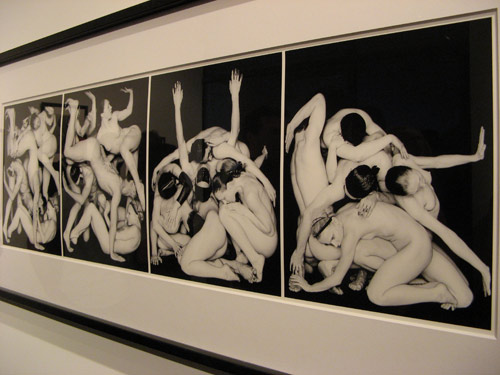
On Tuesday night, M and I attended Public and AvroKO’s preview showcase of acclaimed Australian photographer (and yoga enthusiast) James Houston’s latest artistic endeavor: MOVE FOR AIDS — for which Houston brought together over fifty of America’s leading dancers in a photography essay created to raise awareness and funds for AIDS charities.

The project incorporates the MOVE FOR AIDS book, published by DUMBO-based powerHouse Books (it’s Houston’s fourth, and the result of a collaboration with design house Hugo Boss), photographic exhibitions, a special documentary on the shooting of MOVE, and dance performances by some of the world’s leading dance companies to launch the project around the world. Houston will be donating all author royalties from book sales of MOVE FOR AIDS  to DRA (Dancers Responding to AIDS).

Houston’s background as a sculptor is evident in his shaping of the dancers’ sinewy forms — some of which may not be SFW. The full exhibition will be on view at Manhattan’s MILK Gallery from October 24 to October 29, 2006. After the New York launch, MOVE FOR AIDS will continue on to London to benefit the Elton John AIDS Foundation, and then to Australia to coincide with World AIDS Awareness Week. The exhibition preview was held in the brightly lit jewelbox gallery adjacent to the restaurant, and this night the overflow of attendees lined up along the restaurant’s entrance staircase and spilled out to the sidewalk in front.

MOVE FOR AIDS

MOVE FOR AIDS

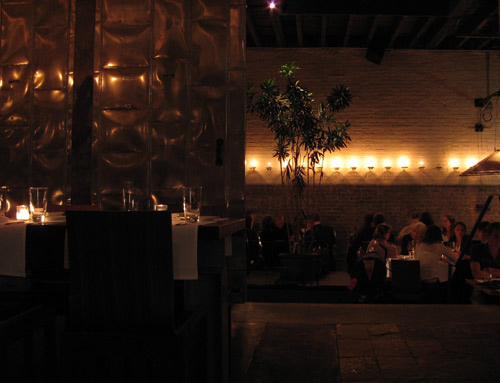
M and I snaked our way in through the room and after touring the small selection of photographs on display (which took all of ten minutes), we took our glasses of Shiraz inside the dining room for dinner. The terrace facing Elizabeth Street, where we were seated last time, was closed off on this brisk night.

Dining Room

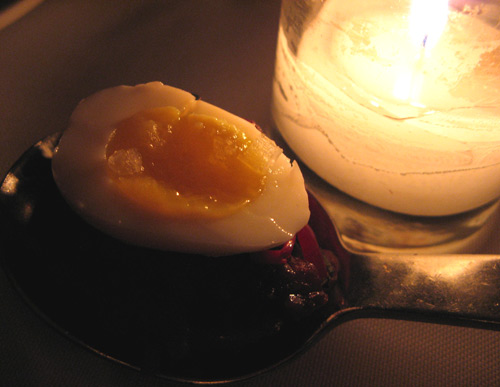
Amuse-bouche, which has been described as “little bites of food to amuse the mouth, invigorate the palate, and whet the appetite.” Indeed! Soft-cooked quail egg, atop an eel cabbage slaw.

Quail Egg Spoon

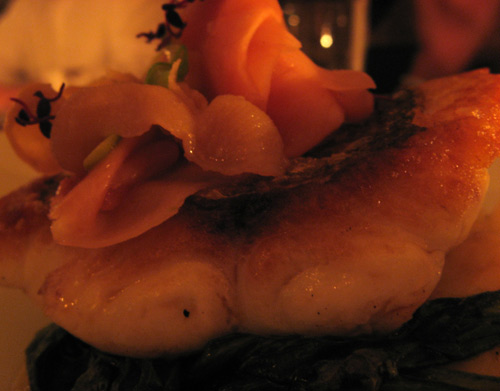
New Zealand snapper on wasabi-boniato mash with poached conch, pickled ginger, and yao choy:

Snapper Entree

Our meal was accompanied by a fine pinot noir, and finished off with Public’s ultra-rich, ultra-dense chocolate fudge cake, served with a stick of salty, sweet peanut brittle and a scoop of Guinness ice cream. M is still waiting for her favorite “Hokey pokey ice cream with a ginger snap” to make its return to the dinner menu. (Currently only available for brunch.)

Comforting to know that even after she defected to the other side of the river, my (lesbian) friend can still make time for us New Yorkers… even as she tries to recruit a select few over to the Garden State.

Skyway pearl noodles

Columbus Day! Controversy continues to surround this holiday, which is, in essence, a celebration of imperialist conquest. For now, though, I have the day off from work.

I scheduled an appointment with Tony, my latest hairdresser, and manager of a shop on Pell Street, a.k.a. Haircut Street. Does anyone other than the NYC guidebooks ever actually refer to it as such? (I don’t think so.) As usual, I was convinced into cutting my hair somewhat shorter than I had planned, but in the end, things worked out well enough. I don’t actually spend a lot of time thinking about my hair anyway.

I do spend quite a bit of time thinking about food, though, and earlier in the day, knowing that I was going to be in the neighborhood, I was already planning out what I would have for dinner. Beef noodle soup again? I do love them, but it seemed a bit much. Then I remembered a newish Malaysian place I had read about on the foodie boards — one, in fact, not too far from Super Taste.

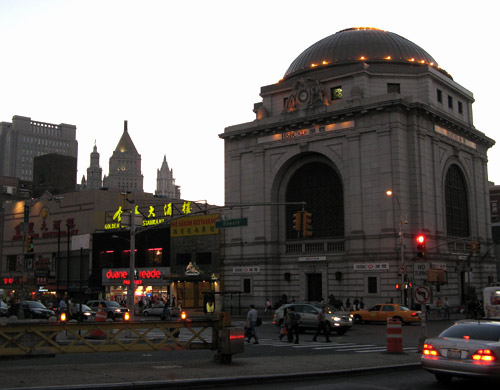
So it was back past the Manhattan Bridge for me, along the gritty section of Canal Street. Here, at Canal and Bowery: the bronze-domed Citizen’s Savings Bank building (1924), now a branch of HSBC:

Bowery

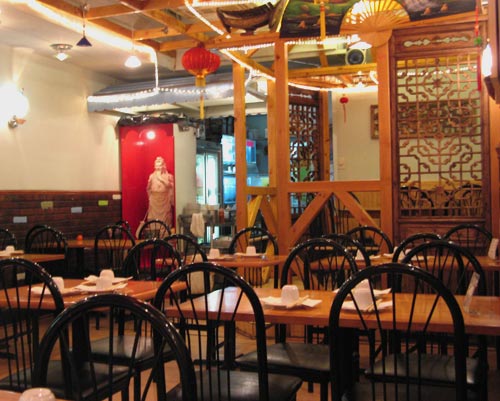
The restaurant is called Skyway, and it opened in the former site of another Malaysian Restaurant (now defunct Proton Saga) on the Chinatown/Lower East Side border off-Canal Street on Allen. It is named after the modernistic cable car system that opened in 1997, linking Malaysia’s Pahang lowlands with the Genting highlands resort. Seemingly odd inspiration for a restaurant, but hey, its predecessor was named for a car, after all.

Dining Room

Last year, the restaurant received a glowing review from the Village Voice’s Robert Sietsema. He dubbed the Fried Pearl Noodles “earthworms”-like in appearance, but “scrumptuous.” And Chowhounds agree that this unassuming, off-the-beaten path eatery serves up some of the best Malaysian fare in the city, at extremely gentle prices.

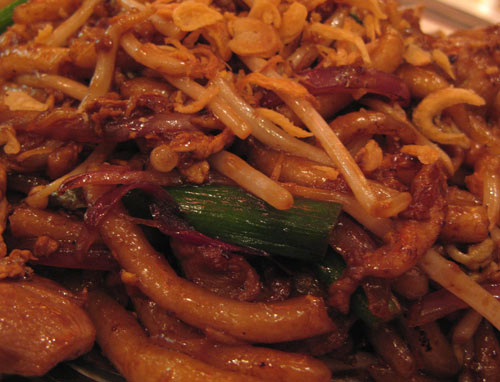
Creepy worm imagery notwithstanding, those noodles ($5.25) seemed as good a starting point as any. And they were as wonderful as advertised: plump and slightly chewy (in a good way), and thick with fried egg, squid, pork, shrimp, bean spouts, scallions and fried garlic flakes. Not being all that familiar with Malaysian food, I understand that the provenance of the dishes can vary widely: originating from several regions of Malaysia — from the more Thai-influenced west to the more Chinese-influenced east. Skyway’s menu appears to lean more heavily toward the Chinese end of the cuisine spectrum — and indeed you could just order a straightforward Chinese meal here — but the “traditional” Malaysian offerings (as I know them) are all represented, too: roti, satay, nasi lemak (“fatty rice” cooked in coconut milk, served with an array of accompaniments, like mashed chili anchovies, Malaysian pickle, fried egg and peanuts), asam laksa (asam = sweet, spicy and sour; laksa denotes a soup noodle-base, often spicy) and chili crab. Mmm… crab. Of note is the last (which by most accounts, is worth the relatively hefty $25 price tag), a baby oyster omelette and a spicy, crispy squid appetizer.

This night, though, I had only the stomach capacity for those noodles (and even then only half the dish) and a “Malaysian iced coffee” — which was potent, sweet and creamy, and served snow-cone like with a mound of shaved ice. Skyway also serves a wide variety of fruit juices: orange, watermelon, pineapple, carrot, lychee, rambutan, sooi pooi (sour plum), longan and coconut.

Pearl Noodles

I really must gather a larger group of friends together to get a proper sampling of this food, but so far, it all looks — and smells — very promising. The restaurant even has its own semi-private, bamboo-walled off table for just such a purpose. Who’s in?

Bonus photo feature: a shot I took as I was riding the skyway for which the restaurant is named. Back in late 2004, I rode those very cable cars, up… up… up… the steep, misty mountains to Genting, City of Entertainment. The system has been described as the “fastest in the world and longest in Southeast Asia”: the 2.1 mile journey takes just 11 minutes… interspersed, for me anyway, with 20-30 second intervals of sheer terror as the cars would creak and swing precariously over every pylon. But what a view!

Skyway

Edited to add : The Village Voice’s Best of NYC 2006 issue just named Skyway most “Marvelous Malaysian.” (Super Taste still holds the title for “World Best Noodles,” though.)

Mirror, Mirror

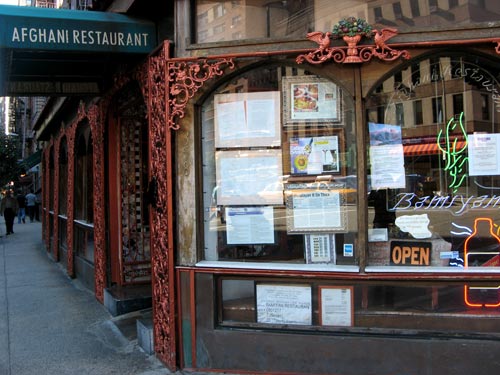
We were already in the neighborhood, and since SYB had seemed sad about missing out on the Afghani feast a week and a half ago, we decided to take a break from all the architecture tours to enjoy a leisurely tea at Bamiyan.

Bamiyan

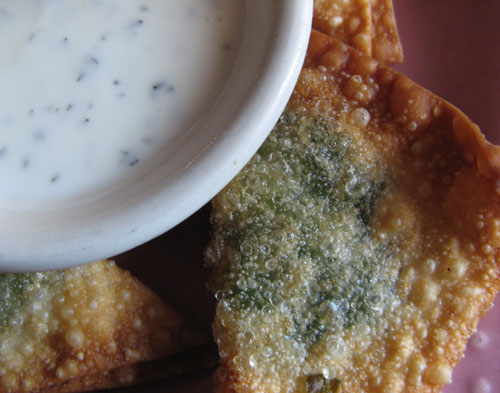
We ordered what were, in my opinion, the “greatest hits” of that night’s dinner: a steaming, fragrant pot of Shir-Chay (the traditional Afghan tea brewed with milk, sugar, cardamom and rose petals) and two varieties of hot, crispy turnovers: the Kadu (pumpkin) and the Boulanee (scallions), accompanied by the delicious tangy yogurt mint sauce. Perfect.

Boulanee

From the restaurant, we caught a bus uptown, along the route from which we would part: he, home to prepare the food for tonight’s dinner party; me, home… to relax before heading to tonight’s dinner party.

On the M5, we were struck by a sudden inspiration. One of the security guards at the Chrysler Building earlier that afternoon had highly recommended we try to check out the rooftop gardens at Rockefeller Center — one of the rare opportunities to wander the meticulously landscaped oasis atop the British Empire Building, normally closed to the public. The space features a topiary garden, a reflecting pool and dramatic views of St. Patrick’s Cathedral. At the time, we didn’t have any plans to be in that neighborhood, but as our bus crawled its way up Sixth Avenue towards 50th Street, we thought: Why not?
Well, for one: the site was scheduled to close at 4:00PM, and a quick glance at SYB’s watch informed us that it was at that moment, in fact, 4:00PM. We exited the bus, and raced east towards Fifth Avenue along tourist-clogged 50th Street. Or rather: attempted to race, as best we could without resorting to full body-checking of complete strangers. (“Welcome to New York. Now… move!”) By the time we made it to 620 Fifth Avenue, it was 4:10PM. Would the lobby guard let us upstairs, just for a peek? Please?

What do you think? (There’s always next year.)

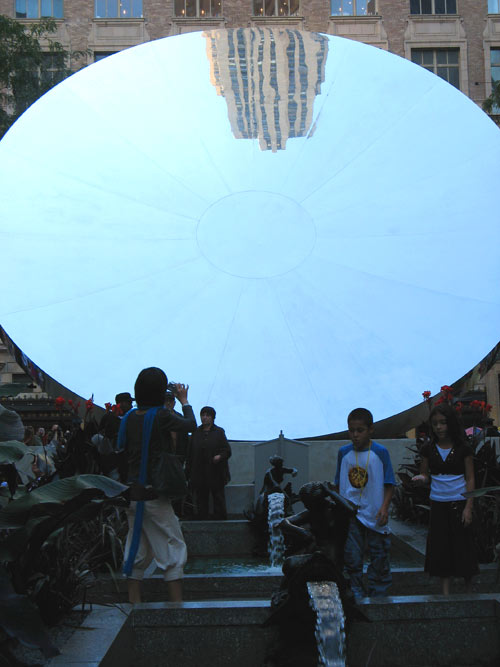
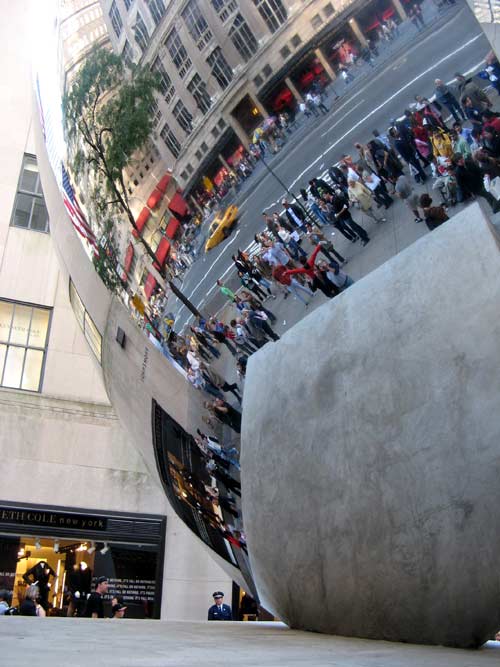
Since we were already in the plaza, it gave us the chance to check out Sky Mirror, the latest public art installation by internationally renowned British artist Anish Kapoor. The exhibition, unveiled in Rockefeller Center on September 19, was organized by the New York-based nonprofit Public Art Fund and hosted by Tishman Speyer.

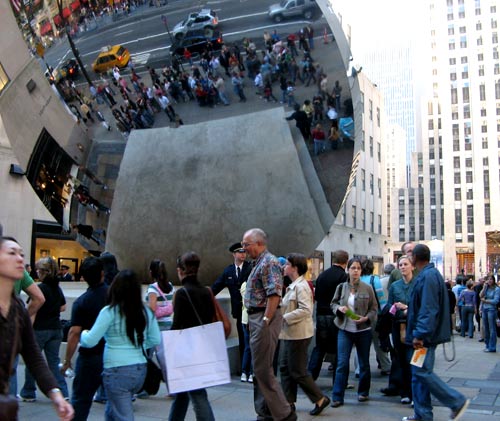
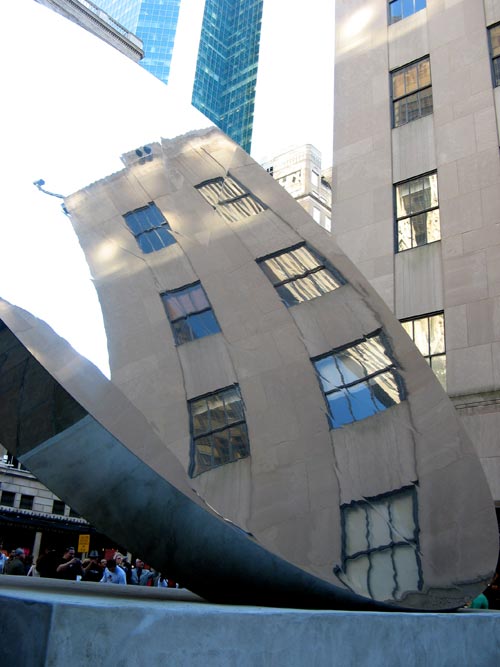
The 23-ton, 35-foot-diameter curved seamless mirror was made (in Finland) of highly polished stainless steel; it is a larger version of the one commissioned by the Nottingham Playhouse in 2001. The original cost £900,000 and was to date the most expensive piece of civic art funded by the United Kingdom’s National Lottery. New York’s Sky Mirror stands nearly three stories tall at the Fifth Avenue entrance to the Channel Gardens at Rockefeller Center. The concave side of this circular stainless steel sculpture is angled upward, facing 30 Rockefeller Plaza, reflecting an upside-down image of the skyscraper. The convex side, facing Fifth Avenue, reflects the mostly tourist crowds gathered, posing, snapping photographs or just staring, entranced by the passing streetscape.

Sky Mirror is on view at Rockefeller Center through October 27, 2006.

Sky Mirror

Sky Mirror

Sky Mirror

Sky Mirror

Dinner party went well: I met CS just outside my apartment, so she and I could travel into Queens together. AC, JL and of course, our hosts HYB and SYB, were also assembled, and the six of us shared deeply buttery filet mignons, cheesy baked squash gratin and chunky mashed potatoes with leeks. All organic vegetables, fresh from our farmer. AC, CS and I bonded over dark chocolate-dipped strawberries. The girl talk may have proved too much for JL, who escaped, claiming calculus homework, and HYB, who retired to his room, shortly after the meal.