vip in the city, page 60

Mom's birthday banquet

I messed up.

A bit of background: On all of my mother’s U.S. government-issued identification — driver license, passport, etc. — her date of birth is listed as September 24, 1946. This is not her birthdate. September 24 is the Gregorian calendar conversion of her actual birthdate, which was on the 24th day of the 9th lunar month. For those unfamiliar, the Chinese calendar is a lunisolar calendar, i.e., it incorporates elements of both lunar and solar calendars. (The only widely used purely lunar calendar is the Islamic calendar, whose year always consists of 12 lunations.) Although the Gregorian calendar is used by Chinese in day-to-day life, the Chinese calendar is firmly entrenched in the culture; it is used to determine the dates for traditional holidays like Chinese New Year and the Mid-Autumn Festival, and in astrology to select auspicious dates for important events like a wedding, a funeral or a business venture. In the Chinese calendar, the first day of the month is determined by the arrival of the new moon. The length of the month will vary between 29 and 30 days.

The Chinese calendar dates do not correspond to the dates on the Gregorian calendar from year to year; Chinese New Year (i.e., first day of the first lunar month) can fall anywhere between January 21 and February 20. In years past, trying to figure out Mom’s birthday would involve tracking down a Chinese calendar, and studying it to determine the date that year. The advent of the Internet has made this annual research somewhat easier, but… well, I’m getting ahead of myself.

The 60th is a milestone birthday in most cultures, so the family wanted to celebrate accordingly. At minimum, this involved the “children” all gathered in one place, which given the geographical distance and punishing work schedules, required quite a bit of advance planning. A few strokes of the keyboard and — Eureka! — I hit upon the official governmental Hong Kong Observatory (HKO) site for handy Gregorian-Lunar conversions — a quick reference to the years from 1901 to 2100. I clicked on 2006 to find the Gregorian calendar date corresponding to the 24th day of the 9th lunar month.

If you looked at the 2006 calendar, you may have noticed, as I did, that the 7th lunar month is repeated: 6th, 7th, 7th, 8th, 9th. I assumed this was an error, so made the adjustment accordingly. The 24/9 (on the calendar as 24/8) would fall on October 15. I sent the word out, and work schedules and tentative celebrations were planned accordingly.

What is the old saw about why one should never ass-u-me?

Had I done a little more research, I would have learned that each lunisolar year has 12 regular months, which are numbered in sequence (1 to 12). However, because a solar year does not have a whole number of lunar months, a lunisolar calendar must have a variable number of months in a year. There needs to be an adjustment every second or third year to keep in sync with the seasons. The adjustment is made in the form of an intercalary or embolismic month — something like a “leap month” — which may come after any regular month. It has the same number as the preceding regular month, but is designated intercalary. For 2006-2007, there are effectively 13 months.

It seems that the Hong Kong Observatory official Gregorian-Lunar calendar was correct in repeating that 7th intercalary month. Mom’s 60th birthday would be on November 14 — not October 15.

So I messed up.

J clued me into this discrepancy when she did her own — accurate — research. Mea culpas (mine) and mad schedule scrambling (theirs) followed, but in the end, since Mom hadn’t wanted an elaborate birthday blowout, I was spared at least from having to recall dozens of mailed invitations — for the second time in two years.

The family plus a few special guests gathered on Saturday night for a traditional Chinese banquet at East Manor in Elmhurst. Longtime friends ML and LL were in town visiting my parents from Vancouver — and also celebrating a birthday — so it became a joint celebration. We made the arrangements in advance, and the restaurant was able to put us in a private curtained area, set off from the fountain wall and familiar-looking ceiling mural. (Egads!)
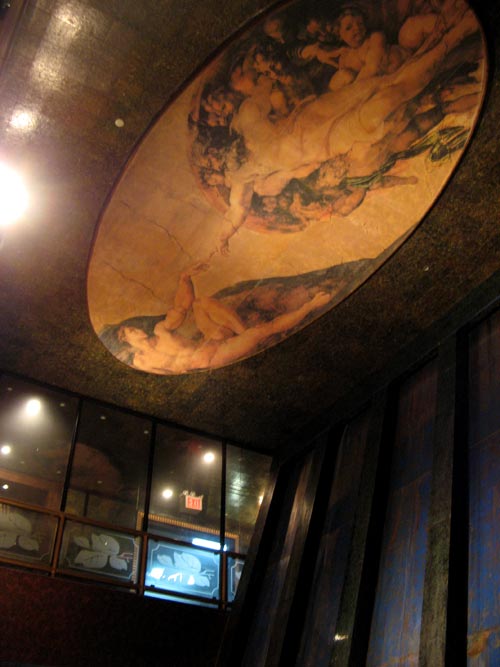
East Manor

Food, glorious food. We started off with plates of Chinese cold cuts, bitter melon and jellyfish…
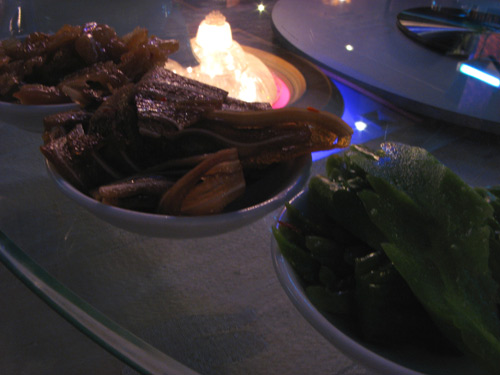
Appetizers

…followed by suckling pig…

Suckling Pig

… baked scallops on the half shell, with sea cucumber and other seafood…
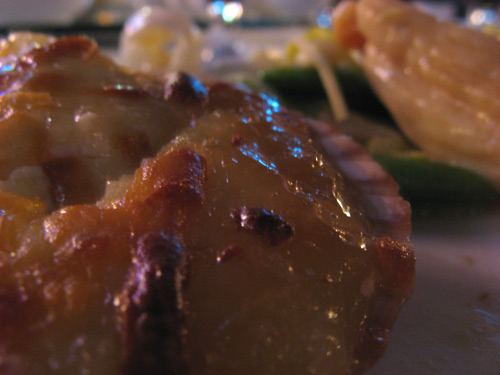
Scallops

…jumbo prawns (love the candied walnuts!), braised whole abalone with chinese mushrooms, crispy-fried whole chicken, sauteed lobsters, a whole steamed fish, and of course, my favorite: shark fin soup with crab meat.

After all these courses, we finished off the meal with giant platters of E-Fu longevity noodles and a dried fish and scallop fried rice, which was really quite delicious, despite the chef’s sneaky inclusion of golden raisins, which I abhor under almost all circumstances.

Three varieties of sweet dessert soup, and a plate of these lotus seed-paste filled longevity buns — the traditional Chinese birthday bun in the shape of a peach.
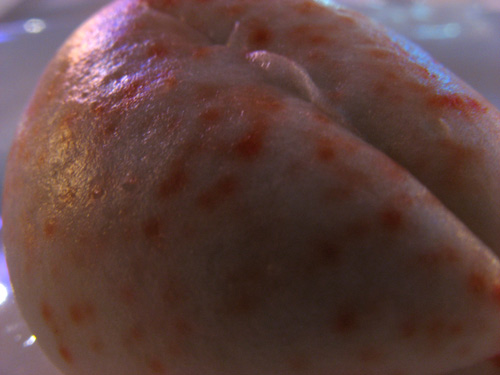
Longevity Bun

Our own Western touch: birthday cake. Well, not entirely Western: it was green-tea flavored.
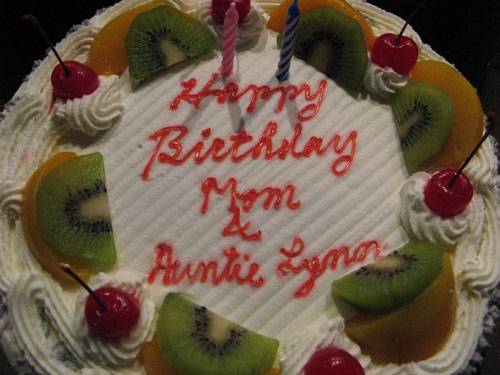
Happy Birthday Mom

From now on, I’ve proposed that we celebrate Mom’s birthday on October 18 — which corresponds to the Gregorian calendar date in 1946. Though perhaps we should get second party confirmation on that.
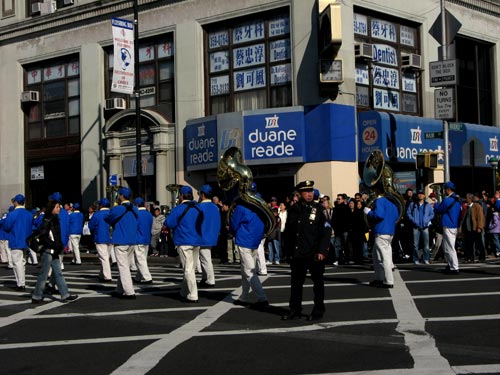
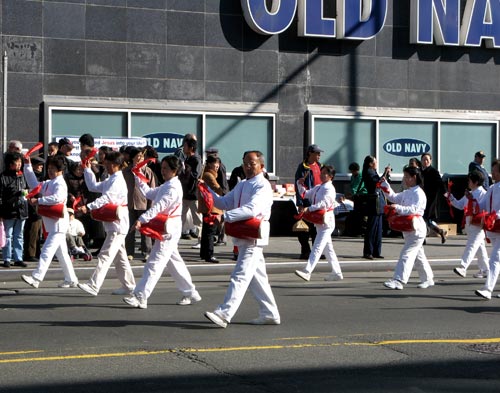
Nine Commentaries parade

In November 2004, the Chinese-language version of The Epoch Times published an editorial series entitled, “Nine Commentaries On The Communist Party,” offering a detailed account of Communist Party misrule in China. The Nine Commentaries has since been credited with sparking a wave of withdrawals from the Chinese Communist Party (CCP). The Nine Commentaries is banned in China.

Just nine months after the publication, there was a parade in Flushing to celebrate and support the withdrawal of 4 million people from the CCP, out of approximately 60 million members the party has garnered since coming into rule in 1949.

Two years after the publication, the number of party withdrawals reached 15 million. To celebrate the milestone, another parade in Queens’s Chinatown this sunny afternoon.

I emerged from the subway station to find Main Street blocked off to vehicular traffic from the Flushing Public Library to the Flushing Mall. Dancing lions led the charge, followed by marching musicians and Falun Dafa practitioners dressed in blue and white outfits. Participants in the parade held banners with the words “Supporting 15 million brave people who have quit the CCP,” “Only without the CCP can there be a new China,” and “Quit the Party to be safe.”

Main Street

Main Street

The party’s loss is further highlighted when one considers the challenges to freedom of expression in China, where strict controls censor websites promoting pro-democracy and anti-Communist sentiments.

See this related Frontline piece on the legacy of the 1989 Tiananmen Square uprising, which explores how the Chinese government has controlled and manipulated information about this historical event. Watch the entire piece here, including the disturbing clip where Frontline producer Antony Thomas showed the iconic “Tank Man” photograph to a group of undergraduates at Beijing University, one of the most prestigious universities in China. None of the students recognized what it portrayed. Comments included, “It might be a parade, or something” and “Is this a piece of artwork?”

Save Darfur

B and I headed downtown to the Astor Place for New Work Now!, the Public Theater’s festival of readings featuring new work from emerging and established artists. The festival kicked off last week with Jonathan Marc Sherman’s Things We Want, directed by Ethan Hawke, about a lovelorn cooking-school drop-out returning home. Tonight’s reading — untitled — explored the more serious subject of the crisis in Darfur.

Public Theater

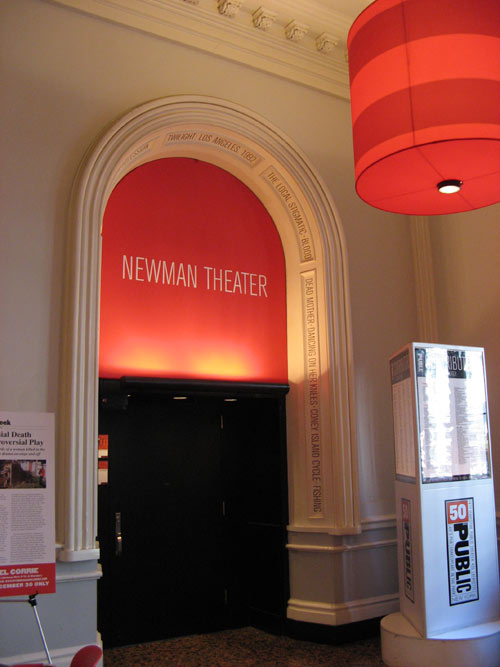
Newman Theater

Playwright Winter Miller chose to work with her colleague, New York Times columnist Nicholas D. Kristof in dramatizing the play’s subject matter. Miller’s previously produced work includes The Penetration Play, which I saw — twice, in fact… long story — at the Mint Theatre in 2004. Kristof won the Pulitzer Prize for Commentary in 2006 for his graphic, deeply reported columns on the genocide in Darfur.

In films dealing with genocide (Hotel Rwanda and Schindler’s List come to mind), directors can portray a sweeping scope of horrors on a widescreen. Limiting the action to the confines of a stage poses additional challenges. Miller personalized the story by centering it around a trio of characters of contrasting background and perspective: a New York Times reporter, a Médecins Sans Frontières (MSF) aid worker and a Darfuri woman, whose personal nightmare has been chosen to put a face on the ravages in Africa.

From SaveDarfur.org:

Darfur has been embroiled in a deadly conflict for over three years. At least 400,000 people have been killed; more than 2 million innocent civilians have been forced to flee their homes and now live in displaced-persons camps in Sudan or in refugee camps in neighboring Chad; and more than 3.5 million men, women, and children are completely reliant on international aid for survival. Not since the Rwandan genocide of 1994 has the world seen such a calculated campaign of displacement, starvation, rape, and mass slaughter.

The actors on stage embodied their characters fully, despite never rising from their seats. Following the affecting play was a panel discussion, which included Miller, Kristof and NBC’s Ann Curry (who sat behind us during the reading.)

I would have liked to stay on, but B and I had made plans to meet up with M and L for post-theatre drinks at Public. Drinks became dinner. (This time, I opted for the grilled lamb tenderloin and merguez sausage with ancho spiced chickpeas and a radish queso fresco salad.) M broke into her mailbox for a bottle of pinot and the four of us toasted to future plans as the considerable bling on display sparkled in the candlelight.

One hell of an Elixir

At the New York City Opera tonight.

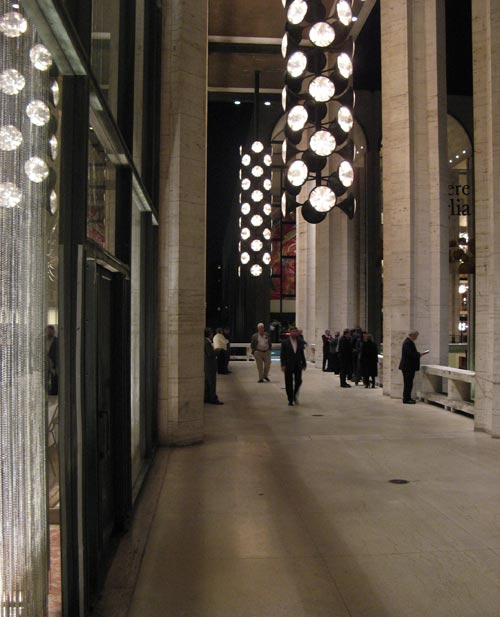
Met Opera House

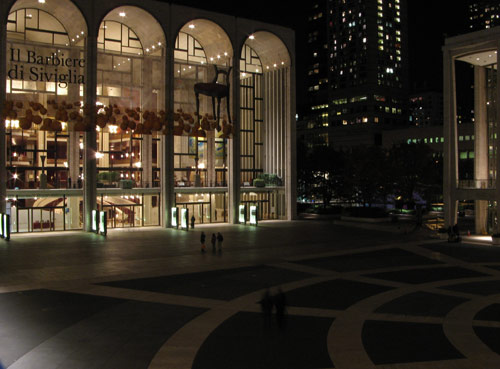
State Theater

SYB got us tickets to tonight’s performance of Gaetano Donizetti‘s L’Elisir d’amore (The Elixir of Love). Sir Jonathan Miller’s new production — shared between the New York City and Royal Swedish Operas — is another of the director’s signature updates; Miller transplants the action in this Elixir from a 19th century Italian village to a 1950s high desert truck stop. The young hero, Nemorino (John Tessier), is transformed from a local villager to the town mechanic, donning the occasional cowboy hat. The local beauty for whom he pines is Adina (Anna Skibinsky in her company debut), who runs the roadside diner emblazoned with her name. Nemorino’s rival in love, the pompous soldier Belcore (Paulo Szot), is clad in Korean War-era Army fatigues; Dulcamara (Jan Opalach), who sells the titular elixir — actually, as he informs us in an aside: Robitussin — becomes the proverbial snake-oil salesman in his shiny blazer. The rest of the cast was outfitted in fitted floral dresses, jeans, leather jackets, pompadours and curler-set hair; at one point, a massive, flashy-finned Chevy convertible rolled onto the stage.

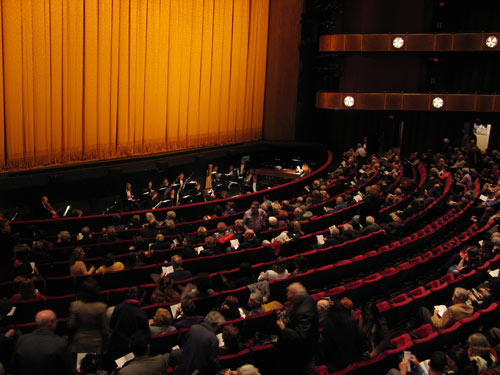
Our view from the first ring:

Orchestra Pit

I’d enjoyed these whimsical, contemporary touches in the past. J and I attended Miller’s Mikado several years back, which was reset in an Edwardian English seaside resort; his Rigoletto played like a Mafia drama, unfolding in 1950’s Little Italy. (“La donna è mobile” blared on a jukebox.)

The performers sang in the original Italian, hamming up the action pretty admirably (taking a break only for the tenor showpiece “Una furtiva lagrima), but the biggest laughs were elicited by the updated supertitles: lots of “dames,” “dolls” and “Daddy-O”s. To explain the legend of the elixir: “There was this chick named Isolde, and Tristan went ape over her.”

SYB noted that it was most fun he’d ever had at The Opera. Not for purists, though.

Balcony

Met Opera House

Nomadic Allstar Global Hip-Hop Throwdown

Continuing on with NYU’s (unofficial) distance learning program…

After cooking up yesterday’s collards, I sat at home, debating whether to venture out again. The night was still unseasonably warm, I had invitations in hand, and the venue was just two subway stops from my apartment.  I fought off entropy to meet SYB.

Nomadic Wax — the self-proclaimed “underground ‘guerilla-style’ record label — was in town for the NY Hip Hop Dance Convention‘s International MC Showcase at T-New York. The event featured international artists from all parts of Africa, Latin America and Asia culled from Nomadic Wax’s last CD, Nomadic Mixtape Vol. 2: East African Hip-Hop Beatdown.

As soon as I approached T on 52nd Street, I recognized it as the tri-level space formerly known as Temple, formerly known as Float. M and I attended the opening of its last incarnation in late 2004 — a night of free-flowing vodka tonics and much dancing, that I still recall with quite a bit of fondness, and a little queasiness.

T-Club

Korean-American rapper El Gambina (shouldn’t this be La Gambina?) was on the stage when we arrived. She is a member of Organic Thoughts, a New Jersey based hip-hop crew. El Gambina was a charismatic performer, and “cute” as SYB noted — an assessment clearly shared by the eager male fans in the audience. Still, there’s something about East Asian rappers I find oddly discordant.

Next up: Chee Malabar, one half of the hip-hop outfit Himalayan Project, from San Francisco by way of India. His style was more laid back than his lead-in’s… heavier on the beats and thick with sociopolitical commentary. Malabar’s was the performance I enjoyed most of the evening.

Chee Malabar

Balozi Dola, a hip-hop artist from Tanzania, performed a short, frantic set as part of a trio of rappers.

Balozi Dola

The acts were each introduced by the MC of the evening, a striking woman from Kenya, who promised to perform a song for those staying through to the end. We didn’t. Minutes into the set by LF (from São Paulo) and DJ Laylo (from the South Bronx) we quietly slipped out.

MC

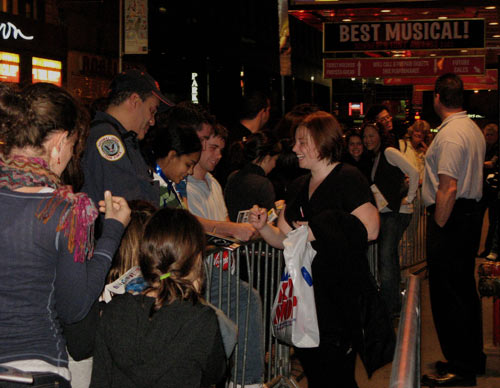
Strolling through the theater district, we passed the Neil Simon Theatre, where fans were gathered on the sidewalk outside, post-show. The stage door opened and we heard a buzz of excitement run through the crowd. Hairspray star Shannon Durig emerged, smiling and gamely signing autographs for those assembled.

Shannon Durig

I suspect that at least a few of the people there were waiting not for Durig, but for a glimpse of American Idol Season 3 runner-up Diana DeGarmo, who rejoined the Hairspray cast in September after a three month stint earlier in the year.

Halloween 2006

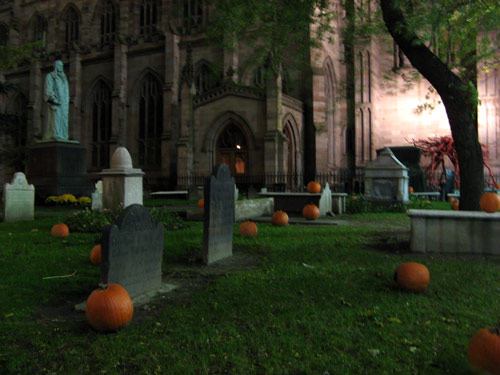
Trinity Church Pumpkins

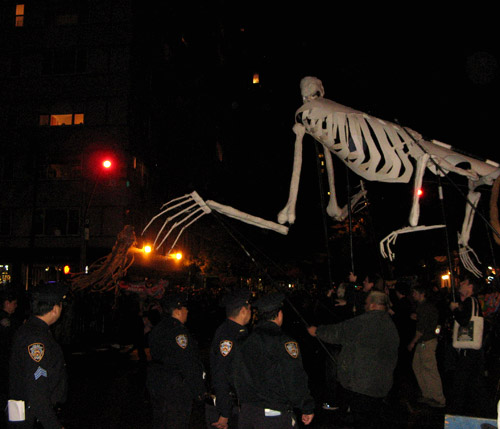
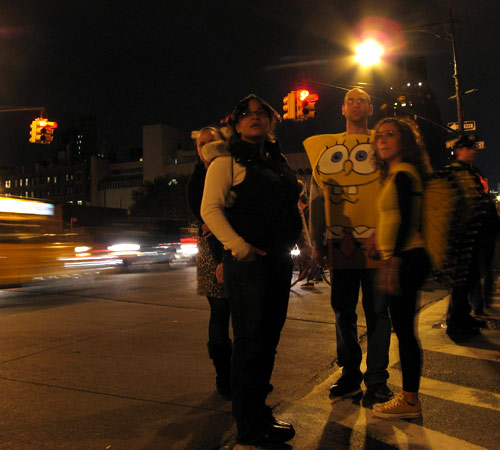
Tuesday night marked the 33rd Annual Village Halloween Parade in New York City. According to the parade association’s website, the parade is the nation’s largest public Halloween celebration, and the only major nighttime parade in the country. The parade was started in 1973 as a local, family-oriented promenade event for children — ironic, given how the event has evolved. Over the decades, it has grown to encompass almost 50,000 marchers, an estimated 2 million spectators along the mile-long route, and an audience of another 4 million for the televised broadcast — none of whom should be children.

Anyone in a costume is invited to join the puppets, floats and performers in the march up Sixth Avenue. This year’s theme was “The Village Hearth,” a reference to times when communities would gather around giant bonfires to mark the changing of seasons. Parade Grand Marshals Paul Stanley and Gene Simmons of KISS appeared on a KISS Float in full costume and makeup.

For old times sake, I went to observe the parade from SC’s and my former block. On the way downtown on the subway, we passed the usual assortment of ghouls and goblins, and the requisite saucy witches, Playboy-esque bunnies, sexy kitty cats and naughty nurses.

The parade had just started, and the crush of people at the intersections made it difficult to see (or photograph, or move) much. The excitement in the air was palpable, though, and I was happy to be out on this unseasonably warm night, taking small part in this NYC tradition.

Halloween Parade

I stayed only for a short while, apparently just missing out on RB, MP, BK and their band — bunch? — of roving bananas. Also somehow missed running into MB, her dad and L, who were watching the parade from a spot one block north of where I was. (And where a man was later stabbed — non-fatally — in the chest in one of those random NYC altercations. Some people don’t like to be asked what their problem is.)

We had dinner on Greenwich Street, from which we had a prime view of the rest of the night’s festivities. As we were leaving the Village, we witnessed a heartwarming moment on Seventh Avenue South when a man dressed as a giant penis passed a man dressed as a giant sperm. They called out to one another like long-lost friends, and posed with their arms wrapped around each other, as the flashbulbs of half a dozen cameras fired off to capture the magical workings of Fate.

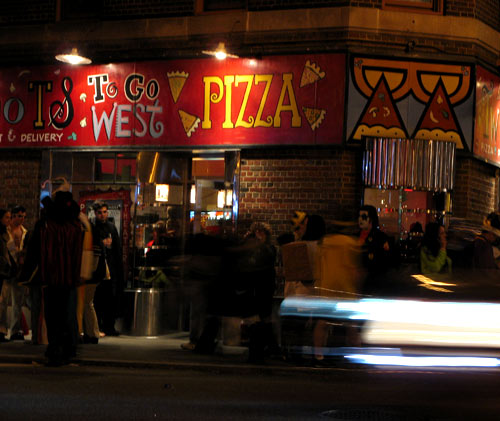
Two Boots

Seventh Avenue

Check out lots and lots more wild photos from the parade (via Gothamist) — and a Thriller-ific film clip. (via Gawker)

Find me a find, catch me a catch

Tonight: the culmination of the grand plans we made over filet mignons.

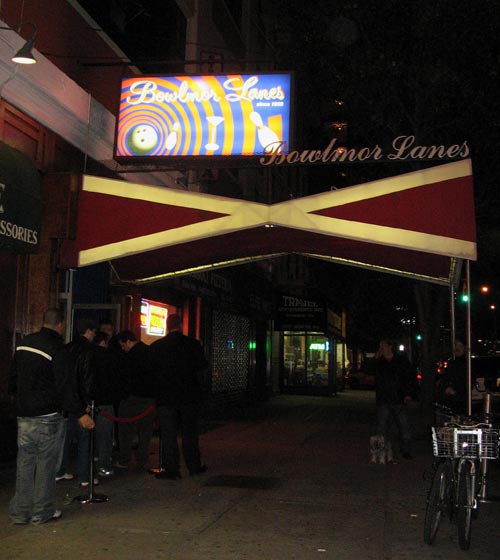
SYB and I went in for some liquid courage before the main event, pre-gaming at Cafetasia before setting out to meet AC and GK at Dean & DeLuca‘s University Place cafe across the street from Bowlmor Lanes.

Bowlmor has been a Village fixture since 1938. It was the site of television’s first bowling shows during the late 1950s. New York-based entrepreneur Thomas Shannon took over the bowling alley in 1997, after which his company, Strike Holdings, launched a multimillion-dollar renovation of the 42-lane bi-level space – later discovered to be funded in part by investments from Yasser Arafat. (Strike Holdings returned the money.)

Bowlmor

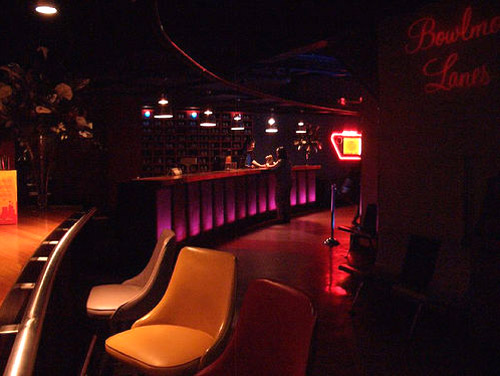
Back in the pre-renovation days, my high school’s bowling class was held at Bowlmor, though one would hardly recognize it as the same space. There was no neon back then; no retro lounge, no plush booths, no DJ or swanky bar… and bowling there was an altogether grimier experience than it is today. Still, for those less athletically inclined — you’d have to be, to select a gym elective during which you could simultaneously eat cheese fries — it was a fun opportunity to hang out downtown with your friends once a week for school credit.

We picked up our rented shoes, and claimed our lane. AC’s “new friend” M joined us just as we were about to get started, and promptly established himself as the ringer of our group. Didn’t help that I bowled by far the most abysmal game I’d ever bowled in my life. Can’t even blame the T & T, since I was abstaining that night. I was the only one not trying to impress a potential love interest, though, so in the end it mattered quite little. I like to think that I fulfilled my job in making the others look far more talented and desirable by comparison.

Bowlmor

SYB checked us out when we were done. Not for nothing is Bowlmor Lanes the world’s highest-grossing bowling alley… The popular Monday “Night Strike” is a far more economical option, offering shoe rental and unlimited bowling from 10PM to 3AM for $20 per person.

Afterwards, the five of us dined at Saigon Grill on summer rolls, eggplant, steak cubes and pho. AC and GK told some funny, if slightly disturbing, dating horror stories. I demurred from contributing, not so much because I’ve had such uniformly positive experiences, but because there was nothing I could say to top having contents from my refrigerator co-opted as souvenirs by a particularly bold overnight visitor.

So was the night a success? Stay tuned…

Pierless nano love

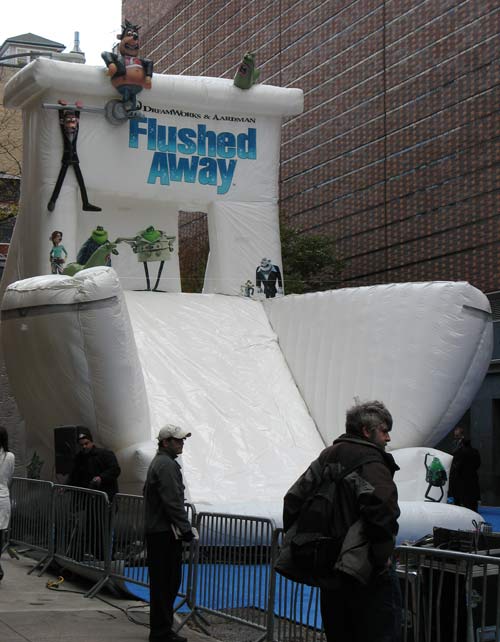
Chilly, clear Sunday morning. B met me at the apartment and as we stepped outside for brunch we could not help but notice the giant inflatable toilet that had taken over 68th Street.

Apparently the toilet slide was set up for DreamWorks’ new computer animated movie, Flushed Away. Voiceover stars Kate Winslet and Hugh Jackman were scheduled to make trips down the 30-foot inflatable slide onto the red — actually: 2000 Flushes-blue — carpet for the afternoon premiere.

I was going to make the joke that this event really should have been held in Flushing, but Gothamist beat me to it.

Flushed Away

After our steak con huevos, we finished off the last of the milk teas I brought back from Hong Kong, and basked in the warmth of the apartment, before braving the gusty elements.

Our first stop: the Apple store on Fifth Avenue — my first time inside this shop, since its May opening. Quality photos abound of the $9 million 32-foot glass cube designed and paid for by Apple CEO Steve Jobs, so check them out on the Apple site. The entirely subterranean shop is located in the underground concourse of the General Motors building, opposite the Plaza Hotel, The store is open 24 hours a day, 365 days a year.

It is also the site of several marriage proposals. On opening day, James Lee, a Yale medical student, took advantage of the live timelapse photographs Apple webbroadcast that morning, arriving at the store in time for the 5:00AM launch. Once there, he held up three signs that read: “Uschi Lang. I love you. Will you marry me?” intended for his girlfriend, fellow Apple-devotee Lang, a student at Mount Sinai School of Medicine. (It was no hoax, as some had initially speculated. She said yes.)

Among the weekend shoppers, I ran into PL and ML with their baby boy M, out shopping for a new computer. B took the opportunity to slip away, to scope out the sweet iPod nanos on display. Ooh — a surprise!

And now this is me – still firmly ensconced in Phase I, a.k.a. the “OH MY GOD IT’S SO SMALL AND SHINY” phase. (via Digg – thanks, B!)

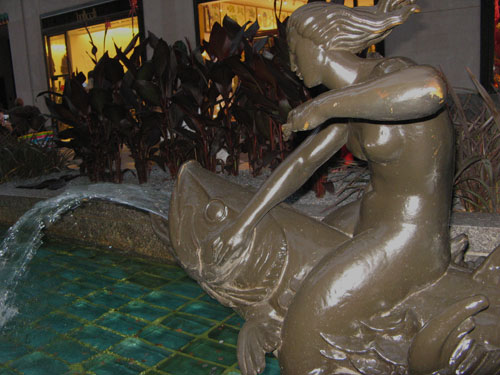
Statue

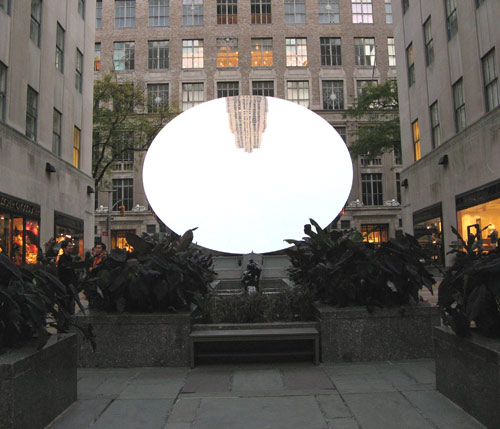
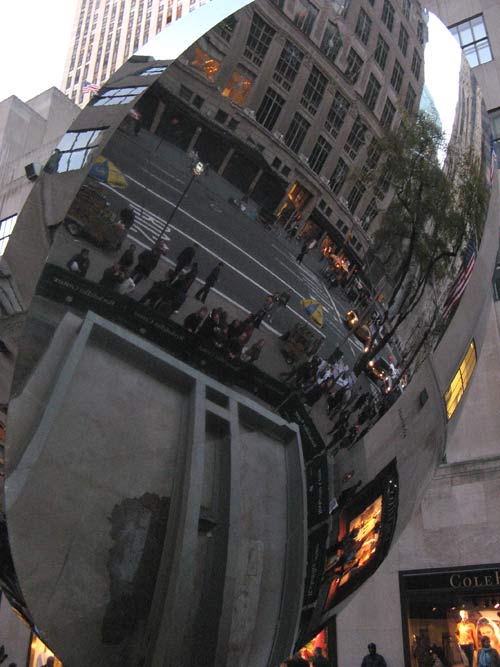
B hadn’t yet seen Anish Kapoor’s Sky Mirror at Rockefeller Center — which I checked out briefly during openhousenewyork weekend — and we were unsure about whether it was still on view. As it happened, the mirror was scheduled to be taken down on October 27, two days earlier, but dismantling a 23-ton circular stainless steel sculpture takes some time, so we were able to get one final peek.

Sky Mirror

Sky Mirror

Finally, what we’d been anticipating all week: the Pier! Of! Fear!

This Halloween event was taking place on Saturday and Sunday at Hudson River Park‘s Pier 54 for the seventh year in a row. According to the press release:

Hudson River Park’s Pier 54 becomes Halloween party central for a two-day festival featuring Halloween activities designed to thrill and chill children and adults of all ages. Returning to this year’s Pier of Fear is one of Manhattan’s best haunted houses. This enormous and eerie attraction is a guided tour through the haunted hallways and rooms of the Maze of Horrors featuring live actors and spectacular special effects. As night falls, the maze becomes even spookier for adults and older children.

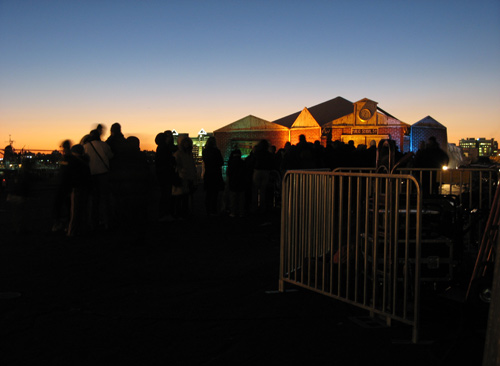
All of which sounded like good fun. We arrived at the windblown pier as night rapidly fell, fully expecting to find the festivities in full swing. Instead, we came upon the rather desolate docks, where a couple of sad-looking stands (and one gyroscope ride) were set up to entertain. It was bitingly cold and dark — which seemed to have no dampening effect on the enthusiasm of the many kids who had descended upon the pier in their costumes.

The haunted house looked somewhat more promising, but the long line to enter discouraged us. We quickly assessed that it would not be worth our while to wait, and left, disappointed.

Pier of Fear

We trudged over to Westville, for a deliciously comforting dinner, so our trip to the West Village was not in vain. Their “smoky mac n’ cheese” — consistently ranked one of the best in the city — warmed our stomachs and raised our spirits. Marring the experience ever so slightly was that the cafe ran out of B’s favorite dessert: German chocolate cake.

After a bit of research, I learned that German Chocolate Cake is nicht Deutcher. The “German” refers to German’s sweet chocolate — which is itself named for Englishman Sam German, who created the mild baking chocolate bar for Baker’s Chocolate Co. in 1852. After a recipe incorporating the bar was published by a Dallas newspaper in 1957, the chocolate-buttermilk cake with coconut-pecan topping became immensely popular. General Foods, which then owned Baker’s Chocolate, reported sales of their brand jumped 73 percent that year.

Today, of course, most supermarkets carry ready-made mixes for German (possessive “s” dropped) chocolate cake. The original recipe doesn’t look too complicated, though, so I’m keeping it in mind as the mercury drops and I’m more in the baking mood.

Less complicated still (and probably just as warming): the German Chocolate Cake cocktail.

Saturday in NJ

The winds blew hard, driving sheets of rain onto Columbus Avenue, as I left the apartment for Penn Station early this morning. We arrived in plenty of time for our train and settled into our damp seats for the long, sad ride to Westfield.

As the decidedly dreary Jersey landscape rolled by, I wanted to sleep, but couldn’t.

M conducted herself with remarkable poise that morning — displaying far more composure than I would have been able to conjure under similar circumstances.

Much later in the afternoon, the sun finally emerged, in time for our trip back into the city, and to our respective obligations. When work was done, I trudged home, crawled into bed, and for the first time in what felt like several days, fell fast asleep.

Linden

Central Park

Machiavelli at the ArcLight

Instead of dinner, SYB went in for pre-theater tea at Alice’s Tea Cup. Since first discovering this place a couple of years ago – thanks, NL – it’s become my go-to place for when I’m craving a warm scone, or soothing pot of tea in the neighborhood. As SYB noted in the past, though, the estrogen runs thick in the air inside this quaint little shop/restaurant. It’s girly and dainty, but laced with an undercurrent of the bizarre that’s injected into the children’s story from which it draws its inspiration.

As a young girl, I found Alice’s Adventures in Wonderland — the Lewis Carroll original, not the Disneyfied rendering — quite perplexing, and a little scary. Check out the text with the original Sir John Tenniel illustrations via Project Gutenberg.

We stepped inside and were immediately greeted with the warm smells of sugar and spice and everything nice. We ordered the “Mad Hatter” for two: a three-tiered tray piled with smoked salmon and lapsang souchong-smoked chicken tea sandwiches, three scones, chai-spiced creme brulee and assorted fresh-baked cookies. From the extensive tea menu we each selected a pot: Indian chai and “Wedding chai” — both of which were highly aromatic, and brewed with milk and honey.

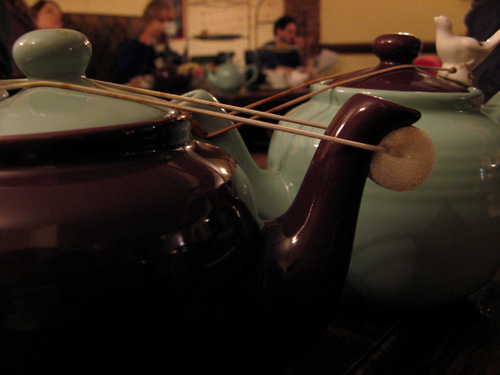
Teapots

The food and drink was served in quaint mismatched china dishware with pastel flowers painted along the gilted edges.

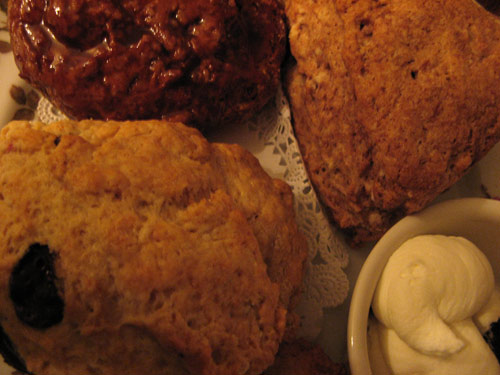
And oh yes, the wonderful scones — my favorite in the city — dense and warm, accompanied by a ramekin of fresh cream and sweet berry preserves. The chocolate-strawberry scone was chock full of sweet, melted chunks; the pumpkin, glazed moist.

Scones

CS slipped in to join us toward the end of the tea service, finishing off the cookies and the vanilla-cinnamon scone. From Alice’s it was a short walk to the ArcLight Theatre, where we were meeting SC and JG for tonight’s play, Richard Vetere’s Machiavelli.

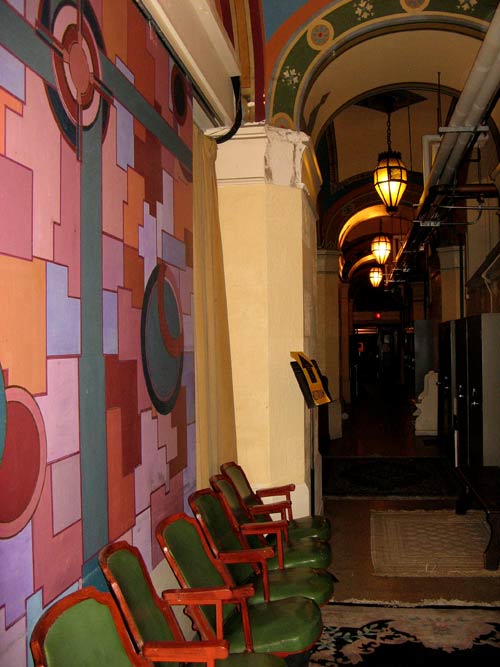
The 99-seat theater is located on the lower level of the 1887 Blessed Sacrament Roman Catholic Church on 71st Street between Broadway and Columbus Avenues, and modeled on the 14th century French Gothic Sainte-Chapelle in Paris.

Arclight Theatre

The title refers, of course, to Niccolò di Bernardo dei Machiavelli, the 16th century political philosopher. Playwright Vetere offers a sympathetic portrayal of the man most closely associated with the phrase “the ends justify the means,” suggesting instead that Machiavelli may have been a product of his turbulent times, adapting his stated views to survive the rotating regimes of the Medici empire. Machiavelli, incidentally, never penned those famous words – the phrase is an arguably misleading oversimplification of the tenets expressed in The Prince.

Machiavelli wrote his seminal work in late 1513 (through it was only formally published posthumously in 1532) furthering the notion that power is independent of morality, and that authority and leadership are independent of virtue.

In his most famous passage:

Upon this a question arises: whether it be better to be loved than feared or feared than loved? It may be answered that one should wish to be both, but, because it is difficult to unite them in one person, is much safer to be feared than loved, when, of the two, either must be dispensed with. Because this is to be asserted in general of men, that they are ungrateful, fickle, false, cowardly, covetous, and as long as you succeed they are yours entirely.

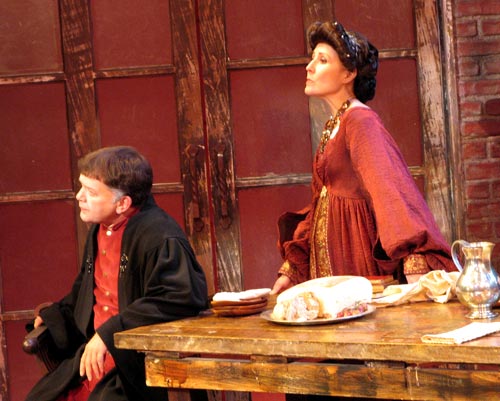
Relatively little is known about Machiavelli’s early life compared to the other important figures of the Italian Renaissance, leaving the events open for liberal interpretation. The play’s action opens in a Florentine prison, where Machiavelli is being tortured under suspicion of conspiracy against Giuliano de Medici. Machiavelli’s quick thinking enable him to escape these circumstances, launching a pattern where adaptability becomes the key to his and his family’s survival. By focusing the action on Machiavelli’s home life — his relationship with his devoted wife, Marietta, and his daughter Baccina — rather than his political maneuverings, Vetere’s comedic portrait offers a somewhat more sympathetic treatment of the infamous man.

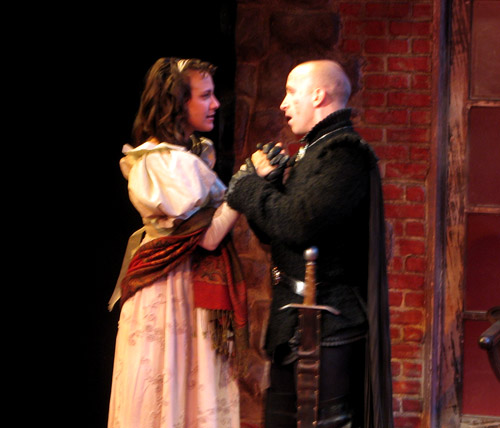
The acting was solid — I most enjoyed the interactions between Machiavelli (James Wetzel) and his fiesty wife, Marietta (Liza Vann). And our group was particularly interested to see Giuliano’s nephew Lorenzo, as portrayed by Jason Howard, whom CS met at the bus stop a few weeks ago. Howard is presumably less twitchy, prone to violent rages and boil-y in real life.

The play’s weakest parts were the narrative interludes as delivered by Alfonso (Lex Woutas) to introduce, break and conclude the performance. The rhyming couplets of his soliloquies didn’t quite scan — or rhyme: “reptilian”/”Machiavellian”? — but the writing wasn’t the fault of the actor, and all things considered, Woutas did a reasonably good job in the thankless task.

Machiavelli and Wife

Lorenzo and Baccina

Afterwards, the five of us commiserated on the rainy street outside, and discussed plans for upcoming holidays parties, while offering directions to the occasional European stranger.