vip in the city, page 59

Best things and Bann

The owners of Flatiron’s Bottlerocket Wines take the mystery out of picking a wine by organizing the stock around theme-based displays (a la Best Cellars). Several of the 18 islands suggest pairings not just by types of food, but by types of take-out: Chinese, Thai, and BBQ, for example.Yes, they know how New Yorkers live. Category subsets offer suggestions for “Third Date” and “Someone you barely know.” At the back of the store, is a seating area with a library of wine and cookbooks for sale and reference, where the shop hosts occasional events. Tonight, as part of the Bottlerocket’s Eclectic Salon series, a wine tasting, discussion and book signing for The Best Things to Do in New York City: 1001 Ideas by New Yorkers Caitlin Leffel and Jacob Lehman.

Leffel, a native New Yorker, teamed up with Lehman, a recent transplant to the city and former Rizzoli employee, to put together this compendium of city bests. I gave the book a quick flip-through and found several of the items already covered on this site these past five months. No doubt there will be more to come.
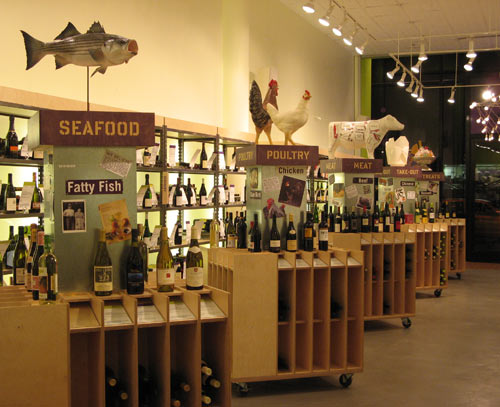
Bottlerocket Wines

There followed a brief Q&A with the shop owner, during which Leffel revealed that her idea for a section on “Worst things to do in New York City” was vetoed by the editors. On that list would have been: Take a cab crosstown at 4:00PM on a weekday and Wait on line for Magnolia cupcakes. No arguments from me on either point. I would also add: Go to Times Square on New Year’s Eve and Attend the Christmas tree lighting ceremony in Rockefeller Center.

Leffel’s favorite New York thing to do? Take the subway to the beach. I appreciate the quirkiness of the idea, more than the actual practice.
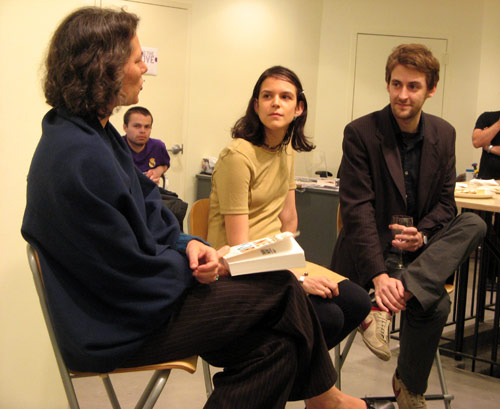
Leffel and Lehman

Afterwards another group dinner at Bann. Despite a shifting cast of characters, and much discussion over the venue, we managed to pull to gather a group of seven for Korean food in Hells Kitchen. HN swore by the smokeless barbecue and black cod, so there we were.

The evolution of black cod is something of an interesting story. The fish’s true name is skilfish, and in gastronomy, it goes by different names, depending on the preparation: sable when smoked; black cod or butterfish (for its high fat content) when filleted. For decades, sable was known primarily as the stuff of Jewish delis; in the mid-1990s the silken, pristine white fish picked up a fashionable new name, and Chef Nobu Matsuhisa introduced New York foodies to his namesake restaurant‘s signature dish: black cod with miso. Soon the fish, in its various iterations, started appearing on haute tables at Daniel and (since closed) Lutèce.

CS and I arrived at Worldwide Plaza at the same time, and started off with glasses of wine at the bar as we waited for the rest of our party. Soon enough, they trickled in: HN and his visiting friend S, followed later by SC, and eventually JG and LR.

The New York Times’ 2005 review of the restaurant focused on the decor, rather than the food, noting the “paucity of people in a dining room airy and pretty enough to attract a decent crowd.”
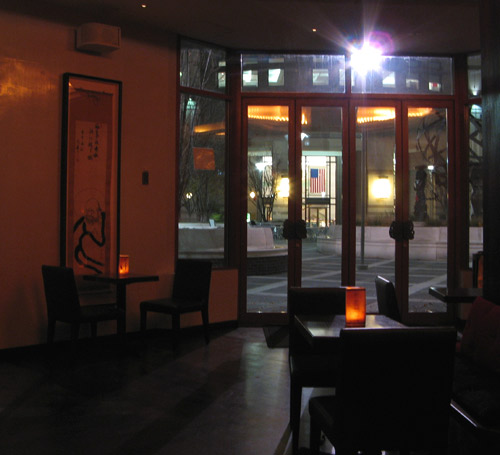
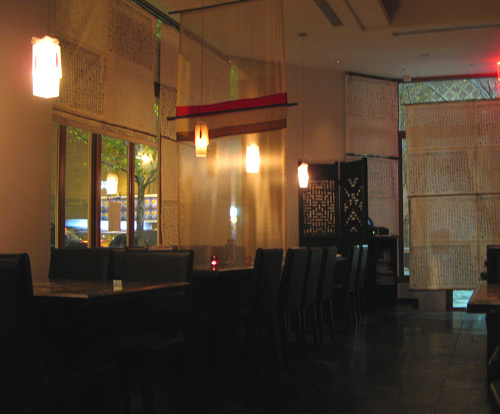
Bann

Bann

I had some reservations going into the dinner, half-expecting one of those trendy faux-Asian experiences. (I noted with some incredulity that Bann charges $3-$5 for the plates of lettuce and miso paste, kimchi and pickles that almost all Koreatown restaurants include complimentary with every meal.) But perhaps due to the somewhat removed location in the Worldwide Plaza, the restaurant was much less sceney than I would have expected from an offshoot of SoHo’s Woo Lae Oak. The food was tasty… and less expensive than I had anticipated. Our group stuck solidly to the standbys: Pa Jun (traditional Korean pancake with scallion), Kimchi Chi Ge (kimchi and tofu stew), Jap Chae, Bul Go Gi, Kal Bi and of course, that black cod and daikon radish (Un Dae Gu Jo Rim). As advertised, the smokeless grills were just that. For once, I didn’t leave a Korean barbecue reeking of marinated meats.

Afterwards, CS, HN, S and I continued the evening over caipirinhas at Azucar, catching the tail end of a live music set. For authenticity, we really should have been ordering mojitos at this traditional Cuban restaurant, but I wasn’t about to quibble. Later still, S was swapped out by HN’s friends, S and R, who joined us after their own night out on the town.
N.I.C.E. Festival

The mid-19th-century mansion on West 12th Street, known as the Casa Italiana Zerilli-Marimò is home to the Department of Italian Studies at New York University. The space sponsors Italian-based cultural events like concerts, art exhibitions, films and lectures, such as tonight’s program for the N.I.C.E. ( New Italian Cinema Events) Film Festival, sponsored by the Italian Cultural Institute and the Tribeca Film Festival.

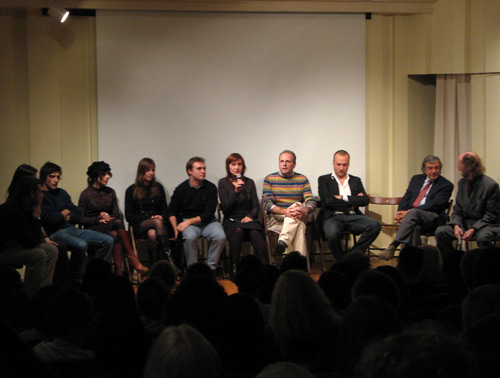
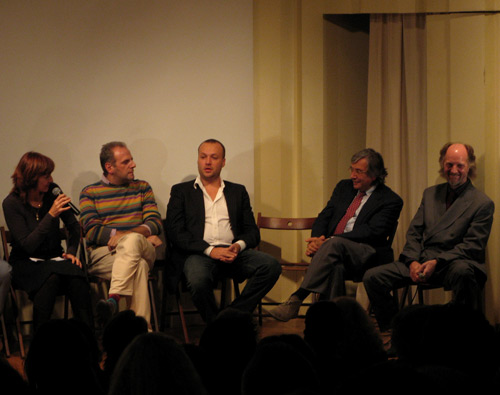
The panel discussion was on “The Future of Italian Cinema,” and featured directors, producers and actors from the films included in the series. The group was moderated by Deborah Young, a film critic for Variety (at center, with microphone.)

NICE Panel

Quite a impressive number of guests had turned out for the event, which indicated a far healthier interest in Italian cinema than I would have expected. Things have certainly changed from the post-World War II heyday of foreign cinema, and Italian cinema in particular. Up until the mid-1940s, foreign films were a cottage industry, evolving out of two distinct camps: arthouse films (usually French and Soviet) marketed to a coterie of highly educated cinerati; and films in German, Greek and Italian, usually shown without subtitles to audiences of recent immigrants homesick for their home country fare. There was a shift after the war: GI’s returning home from their first time abroad maintained residual interest in the cultures of Europe and Asia–and particularly in the women they had encountered. American producers catered to this burgeoning interest in the exotic (or erotic) by importing actresses from Europe, and especially Italy: Gina Lollobrigida and Sophia Loren among them. Among leading men, Marcello Mastroianni achieved international fame as the screen symbol of the modern European.
Directors Federico Fellini, Bernardo Bertolucci and Pier Paolo Pasolini were near household names. Some of their films became mainstream hits, like Fellini’s La Dolce Vita; the image of Anita Ekberg wading into the Trevi fountain, remains iconic to this day. Suddenly Italian cinema was all the rage. In the years after La Dolce Vita, dozens of Italian films played the big cities to crowds of foreign-film fans who sought them out for a glimpse of their exotic beauty.
Trends do run their course, though, and by the mid-1960s the foreign-language film wave started to ebb. The arthouses that had regularly promoted foreign cinema switched to homegrown independent movies. Foreign-film revenue gradually dropped from its 1960s high of about 5% of the total United States box office. Today it is .5%—one-tenth what it once was.

With a few breakout exceptions (Life is Beautiful, Crouching Tiger, Hidden Dragon), foreign films have become marginalized as they were before World War II–patronized by a small group of Americans, and by a significant slice of first- and second-generation foreigners: the Indian diaspora that still seeks out its Bollywood musicals.

In the meantime, Italian films have suffered from lack of interest outside Italy, which in turn, impacts financing and, by most accounts, overall quality. The driving pop cultural force in Italy is television, which is infamous for its broad humor and scantily-clad girls. The panelists commented that despite the continuing popularity of such shows, there is a backlash forming from viewers craving more substantial fare. Italian independent film strives to address that deficiency.

One of the barriers to widespread international (read: American) appeal, it was suggested, is the necessity of subtitles. The classic retort about foreign film is that Americans don’t go to the movies to read. The question was posed: Might Italian filmmakers be better served by catering to an English-speaking audience?

NICE Panel

The most enthusiastic applause of the evening was reserved for young film director Francesco Amato who declared, “I am an Italian film director. I make Italian films. I will never make an Italian film in English!

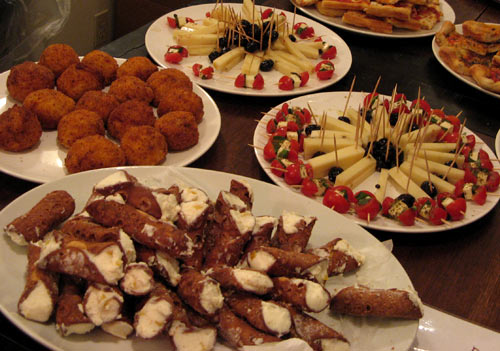
Afterwards, there was reception in the first floor of the mansion with wine and food provided, courtesy of East Village wine bar Cacio e Vino. The restaurant is named for the traditional Roman pasta dish, cacio e pepe, which is basically pasta sprinkled with pecorino romano, salt and freshly grated pepper.

No cacio e pepe tonight–but I did enjoy the riceballs.

Cacio e Vino

Hazy Sunday

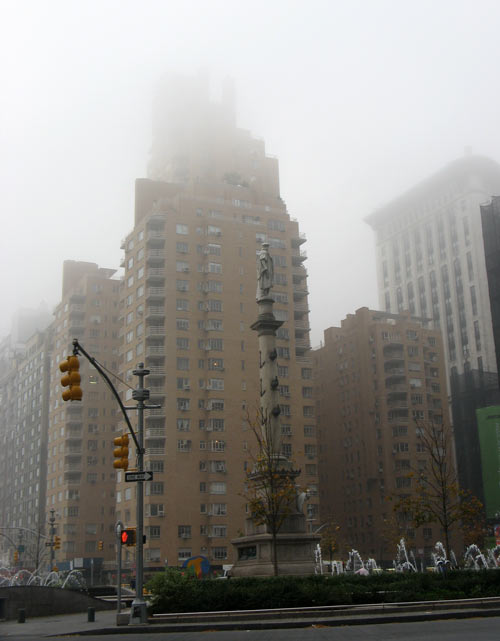
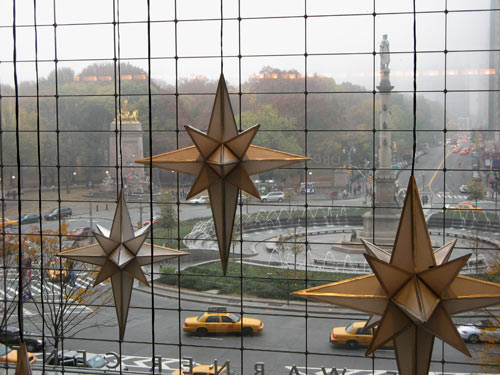
I woke up this morning to find Columbus Avenue awash in a misty haze. Strange to see the buildings lining the streets disappear into the clouds. The twin columns of the Time Warner Center were completely shrouded from view.

Columbus Circle Mist

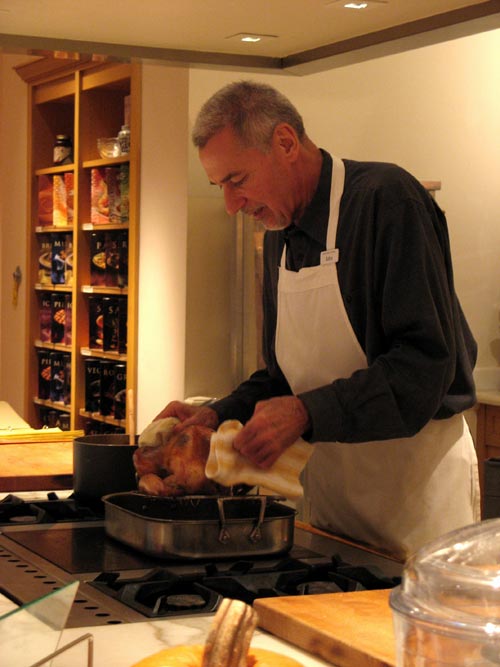
Sunday morning cooking class with John at the Williams-Sonoma. This week, in preparation for Thanksgiving, a primer on roasting a turkey.

The key to a juicy, flavorful turkey is in the brining. The additional step keeps the bird moist and tender: sugar and spices added to the brining liquid enhance the meat’s flavor; the salt breaks down some of the meat proteins, allowing more liquid to be absorbed into the bird. When the turkey is roasted over a long period of time, the proteins coagulate, preventing the liquid from escaping, resulting in overall increased moisture content–hence, a juicier turkey.

John with Turkey

After class, coffee at Bouchon and some more photos from the upper floors.

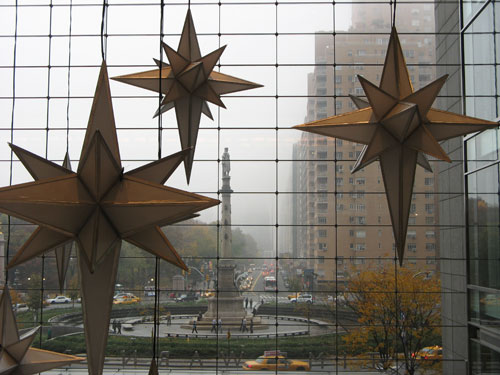
These holiday stars were strung up at the TWC just the evening before; I saw the crew working late into the night, as I walked home. The Time Warner Center debuted this “Under the Stars” installation last November. Brooklyn-based Holiday Image Inc. designed, built, and installed the dozen brushed aluminum stars; each 14-point, 12′ x14′ star weighs 987 pounds. Ted Mather designed the lighting. The structures will eventually be lit from within by over 8,500 color LED’s, shifting colors to coordinate with interpretations of holiday music.

TWC Stars

TWC Stars

A quick bite with B near Herald Square, and then some shopping before the thunderstorms were set to roll in. But not at H&M

Dutch duo Viktor and Rolf unveiled their design collection at H&M on Thursday. This is H&M’s third foray into the elite-desiger/mass-market retail arena: their previous high fashion collaborations featured designs by Karl Lagerfeld (2004) and Stella McCartney (2005).

Such designer pairings ostensibly represent some democratization of design. Michael Graves, Philippe Starck and Isaac Mizrahi for Target come to mind. Unlike Target’s “Design for All,” which has featured several amply stocked lines by each designer, H&M’s lines have been focused on scarcity: extremely limited stock and one-off collections. The strategy had already proven successful: Lagerfeld’s limited edition collection was devoured the morning it hit the floor in 2004; the following year, McCartney’s line sparked riots (and all sorts of unbecoming behavior.) By most accounts, the entire 40 piece collection sold out of all New York City stores within 15 minutes to bargain-hungry fashionistas who had waited on line overnight–while the media giddily covered the frenzy.

Fortune aptly dubbed this marketing trend “mass-clusivity“: limited-edition items created by big chains to generate heat and sell out fast. For the retailer, there’s virtually no downside: the media coverage alone is priceless. And shoppers who arrive after the exclusive goods have sold out may resort to making other purchases. For the most part, what makes these clothes desirable is not their inherent quality–which is immaterial–-but the demand manufactured by their scarcity, i.e., their exclusivity, manufactured or otherwise. What H&M is selling, even more than designer clothes, is the designer experience. And by making their limited edition collections available to anyone willing to invest the hours on line and to throw themselves into the fray, H&M seems to be promoting the democratization of not just design, but designer shopping itself.

So they did it again: this time, to somewhat less insane effect (Viktor & Rolf being more a cult Paris-based label, lacking the label recognition of McCartney, and even Lagerfeld.) Still, there was plenty of madness to cover–not at all limited to the United States.

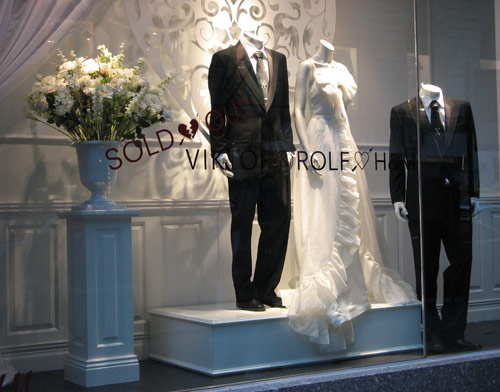
The centerpiece of the collection was this wedding ensemble: tuxedo and bridal gown (which was limited to an edition of 1,000 worldwide.) Needless to say, by the weekend every shred of V&R was snatched up–hence the “Sold Out” broken heart–though available for purchase on eBay… at a price-gouging markup, of course.

Sold Out

Nice cupcakes

Belated celebration for DK’s birthday tonight. After some back and forth, SYB, HH, DK and I finally came upon a date for which all of us were available. (All except LK, who passed on the festivities.) Dinner in Sunnyside!

These birthday gatherings are something of a tradition, though at various times, we have been lax in scheduling them, missing a couple of dates in the interim. But we still try.

SYB generously offered to prepare a home-cooked meal for the occasion, so I was tasked with bringing dessert. HH and I considered a few options (Mini-cake? Little pie? Beard Papa’s cream puffs?), but finally we decided on cupcakes. Who doesn’t like cupcakes? I made the trip to Crumbs Bake Shop after work. So many varieties….!

But, as we all know by now, DK does not eat nuts: no peanuts, no cashews, no almonds… as he put it: “nothing with ‘nut’ in the name,” which includes coconuts. According to the National Institute of Allergy and Infectious Disease, one in 200 Americans has this peanut or nut allergy; approximately 50 to 100 people die every year after accidental exposure. (As a result, almost all airlines have stopped serving peanuts on their flights.) Remember the crazy story about the Canadian teenager who suffered a fatal anaphylactic reaction after kissing her boyfriend, who had eaten a peanut-butter sandwich hours earlier?

The strict nut ban cut down on some of the dessert choices — no Reese’s Peanut Butter or Fluffernutter cupcakes — but there were still plenty of elaborate and tasty-looking options. HH and I had our eye on the Red Velvet Cupcake; SYB placed his vote for the Cappuccino.

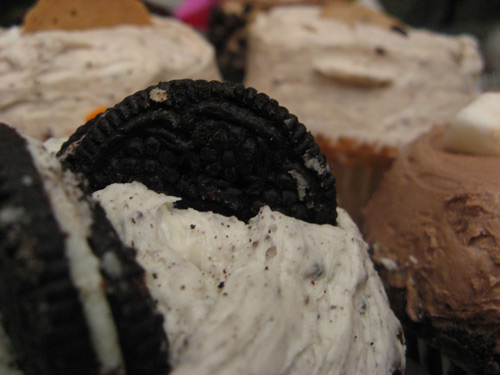
I made it to the glass counter at Crumbs, just ahead one dour Upper West Side matron, to find the bakery sold out of Red Velvet. Well, it is their best seller. So instead: Cappuccino, Oreo, Blackout, S’More, and Cookie Dough.

Crumbs Cupcakes

HH and I met at Grand Central and arrived at Chez B to find the cooking in progress. The menu tonight made full use of SYB’s and my organic vegetable share: Smothered Pork Chops with Spicy Collard Greens, Mashed Potatoes with Leeks and Orange-Glazed Carrot Ribbons.

After setting the pork chops and collards to braise on the stovetop, we caught up on some television. Actually, a lot of television. I probably watched more television that night than I had in the two weeks prior, combined. First: Celebrity JeopardyLaw and Order edition, featuring stars from all three current L&O franchises — which was filmed this season in New York at Radio City Music Hall. The obviously dumbed-down questions always remind me of the Saturday Night Live Celebrity Jeopardy sketches — there have been 13! — featuring the hilarious, and entirely fictionalized, feud between Alex Trebek (Will Ferrell) and Sean Connery (Darrell Hammond).

We zipped through the new-to-America game show 1 vs 100 with host Bob Saget (verdict: eh) and caught up on episodes of The Office and How I Met Your Mother — all in full HD glory. HH apparently had never watched The Office before (!), so we made a new convert that night. SYB should be earning a commission from NBC for all the new viewers he brings in.

Dinner was delicious, and afterwards, the five of us split up the enormous cupcakes, which the boys seemed to enjoy.

I went to the doctor, I went to the mountains
I looked to the children, I drank from the fountains
There’s more than one answer to these questions
Pointing me in a crooked line
The less I seek my source for some definitive
(the less I seek my source)
The closer I am to fine

— “Closer to Fine,” Indigo Girls (as sung by Jim “Big Tuna” Halpert and Andy Bernard on The Office)

Durango and late night Momofuku

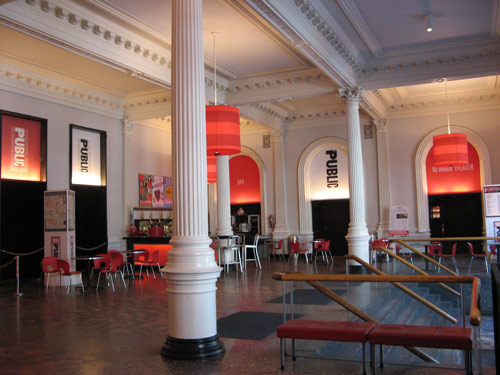
Left the Financial District at lunchtime to meet SYB at the Public Theater box office — my second time there in just under a week. As part of a special promotion, the theatre was offering same-day tickets to their new production of Julia Cho’s Durango for just $10 on Thursdays. The play officially opens on November 20.

Public Theatre Lobby

It was a brilliantly sunny day, and after picking up our three tickets for later tonight, we scored a table just outside the entrance to Cooper Union’s Engineering Building (where my crochet class was held this summer) and broke into the pulled pork tacos SYB had brought with him from the Vendley brothers “Calexico” cart in SoHo.

I felt like a woman of leisure, lounging at an outdoor table in the mid-afternoon, watching the world pass by. I continued the illusion by taking a brief post-lunch stroll along St. Mark’s Place, recalling all the while the street’s much grittier past.

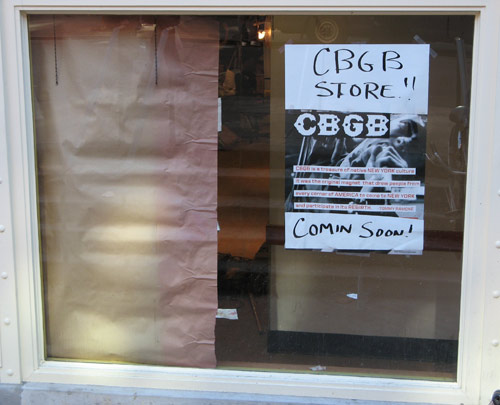
Case in point: a new CBGB store “comin soon”? Sharing space with — no lie — a Chipotle? (Last month, a new BCBG store opened up a block from my apartment — very different, for the dyslexic/careless readers among you.) Does the slide from punk legend to sell-out — complete with a possible move to Vegas — really take only one month? Just further evidence of the East Village’s degeneration into the amusement park version of itself. Good grief.

CBGB Store

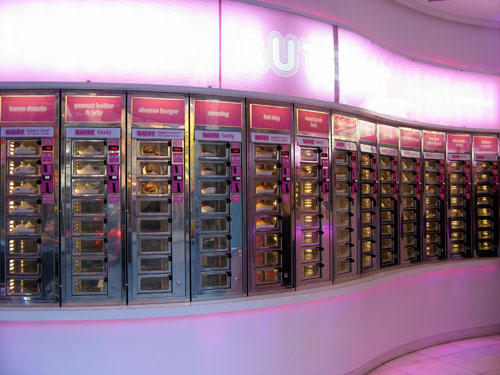
Farther down on St. Mark’s, we popped into Bamn — the Japanese take on 1950’s automats. Trippy, to be sure, and one senses that Bamn’s target diner is not an office worker on her lunch break: hot pink plastic and too bright lights, with a dancebeat soundtrack piped in. There is no seating, and the retro-futuristic space is dominated by a coin-operated vending wall with heated, see-through compartments, behind which sits a working kitchen. There’s also a fry-station, this afternoon manned by a real live, disaffected-looking Japanese hipster. Menu items slant toward American fast food classics with a Japanese twist, and cost only $1.50-$2.50. The selection, though, is pause (and possibly indigestion)-inducing: Teri burgers, hot dogs, PB & J and grilled cheese sandwiches, fried chicken, Spam musubi-teriyaki, pizza dumplings, chicken pot pie croquettes. I couldn’t resist sampling the mac and cheese croquettes… because I was still a little hungry, and a lot curious. Not terrible… for $2.00, that is.

Bamn is open “25 hours a day.” Rightly so.

Bamn

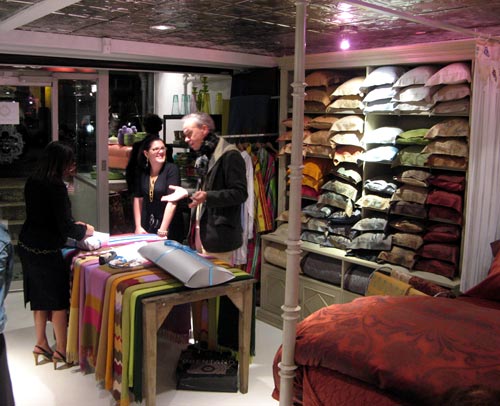
After work, we reconvened in SoHo for the Nancy Koltes at Home re-opening reception. The shop, which deals in high-end bedding, bath products, entertaining accessories and loungewear, recently expanded into the adjacent storefront. I examined the wares while indulging in some prettily dainty bites with elegant sparkling drinks, sprinkled with edible gold-leaf.

SYB, I think, found the environs a bit too effete (or perhaps the wafting scents within, a bit too overpowering) — so we collected our scented soap-stuffed gift bags before decamping across the street for the decidedly less rarified airs of Lombardi’s.

Nancy Koltes at Home

Despite a few transportation snafus, CS just made it to the theater just in time for Durango curtain time. We sat back and watched the story unfold of a widowed father who embarks on a spontaneous family road trip through the Southwest with his two sons. Along the way, there are flashbacks, fights and life-shattering secrets. The conceit is familiar, and according to SYB, so was the portrayal of some Korean-American family dynamics: the mixture of pride and shame, the guilt, the blame, the screaming recrimations. He spent a good part of the play muttering, “Just like my Sunday nights.” There wasn’t much for me to say in response.

The talented cast of five featured James Saito as the father, James Yaegashi and Jon Norman Schneider as his sons, and Ross Bickell and Jay Sullivan in smaller roles.

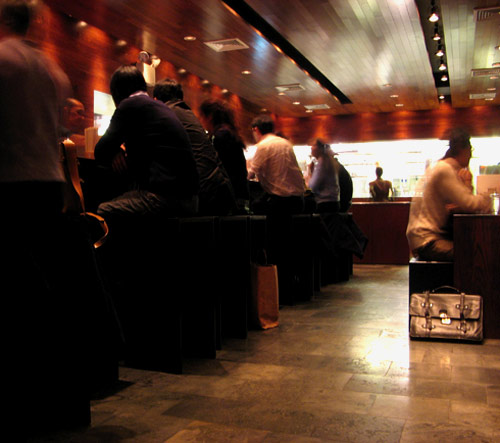
After the play, our trio took a leisurely stroll over to sample the late night menu at Momofuku Ssäm Bar. I’d been to the restaurant when it first opened — also after a performance at the Public — and had enjoyed the pork buns and ssäms then, but in its review two months later, the New York Times alerted me to the newly added, and now not-so-secret special late night menu:

Five nights a week, after the ssam bar closes, a spirited cast of chefs — Mr. [David] Chang, Mr. [Joaquin] Baca, Tien Ho, formerly of Cafe Boulud, and Joshua McFadden, late of Lupa — run a restaurant in a restaurant that goes far to explain the venture.

Most chefs working the witching hour offer abbreviated menus. Here, that equation is flipped with diverse, carefully crafted dishes, from fried cauliflower chat ($9) to spicy tripe stew ($11), emerging late. The restaurant’s transformation, which includes table service, a thumping kitchen and some well-paired beer and sparkling wine options, is as intriguing as watching a strait-laced wallflower reveal an inner wild child.

You knew we were going to have to check this out.

Momofuku Ssam

The late night menu, which starts at 10:30PM, already seems to have developed its own following. We arrived about 15 minutes early to find a short queue already forming on Second Avenue outside the closed restaurant door. At promptly half past, the doors opened and we were seated.

This time, it was an altogether different dining experience than the last. There was the attentive table service for starters, and a more varied menu this time around: those wonderful pork buns made the cut (but not the ssäm), plus a raw bar and a tempting list of small plates for sharing, with selections ranging from local produce and artisinal cheeses to spicy tripe, grilled sweetbreads and veal head.

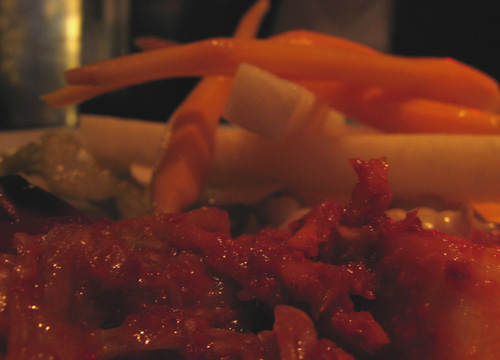
We were somewhat less adventurous this evening, but were still served well by our selections. There was the simply titled “Bread & Butter” to start: fresh toasted bread with Vermont salted and English goat’s butters. The “Steamed Buns,” of course. And here, the “Seasonal Pickles”…

Seasonal Pickles

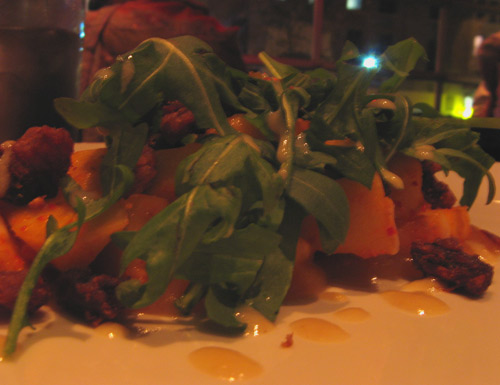
…the ‘Mutsu and Macoun Apple Kimchi” with crispy pork jowl and arugula…

Apple Kimchi

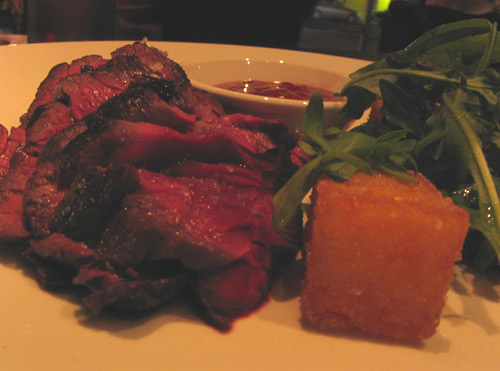
…the “Roasted Hanger Steak,” accompanied by arugula and cubes of hash-brown-like “rice fries”…

Hangar Steak

… and one of three platters of paper-thin sliced ham, served with toasted bread and apple butter — offered under the menu heading of “Pork.” What a delightful end to a full day.

Chef Chang was in the kitchen this night, as he was the last time — which makes me wonder just how much time he spends at his Noodle Bar.

Horton sees a Pollock

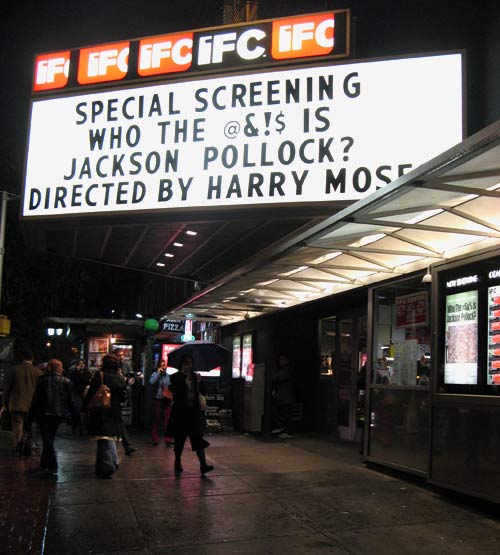
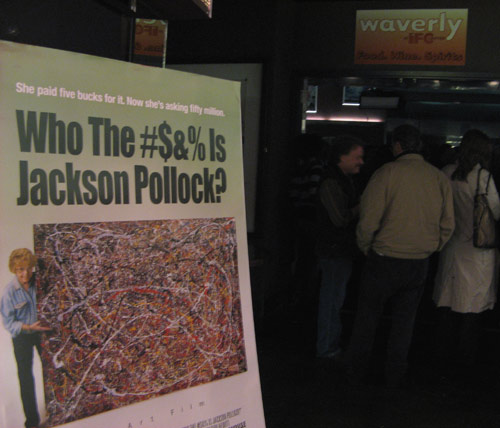
I attended the New York premiere for Harry Moses’ new documentary, “Who the #$&% is Jackson Pollock?” at the IFC Center.

Marquee

It tells the fascinating, often hilarious, story of retired long-haul truck driver Teri Horton, who has in her possession a 66″ x 48″ paint-splattered canvas which she bought as a gag for a friend, that may be an original Jackson Pollock painting worth tens of millions of dollars. That is, if it can be certified as a genuine Pollock, which it currently cannot.

In 1992, Horton picked up the painting in question at a San Bernadino thrift shop for $5 — she refused to pay $8 — and then lugged it to her friend’s mobile home in the flatbed of her truck. The friend got a big laugh out of the hideous present, but turned it down because it barely fit through her trailer door. The painting went into storage, and was later hauled out for a yard sale where it was spied by a local art teacher, who advised Horton that the painting bore a remarkable resemblance to work by the leading 20th Century American artist, Jackson Pollock. Horton’s response (in its uncensored form) gives the film its title.

What followed was an arduous quest to authenticate the unsigned, provenance-less painting, fleshed out by a colorful cast of mostly condescending and dismissive art world establishment players (former Metropolitan Museum of Art director Thomas P.F. Hoving comes off particularly insufferable, snooting remarks like “She knows nothing. I am an expert.”), wealthy dealers and businessmen, a master art forger, a slick-talking convicted felon, a Quebecois forensic investigator, guitar-strumming, cowboy-hatted friends and relatives and at the center of it all: a fiesty mid-septuagenarian with a whisky and cigarettes voice and a mouth like a sailor. New York Times writer Randy Kennedy explores the long, strange trip of Horton and her painting in a story that appeared on the front page of the Arts section the next day.

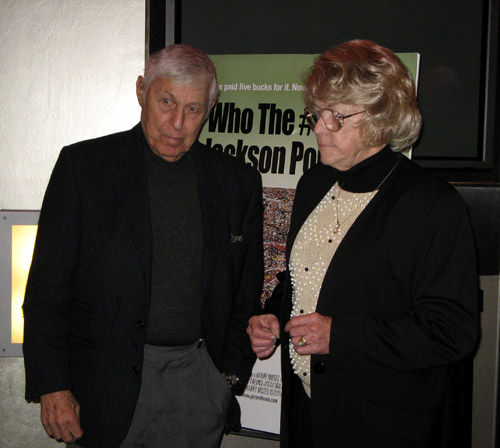
Director Moses and father and son producers Don and Steven Hewitt were also in attendance at the premiere, as were many of they key figures of the film. Horton included — along with her four grown children who, we were told that night, all met for the first time over the previous weekend. (One senses, and the film alludes to it briefly, that Horton has had a long and troubled life.) Hoving declined the invitation.

Don Hewitt, best known as creator and longtime executive producer of 60 Minutes, with Horton:

Hewitt and Horton

What struck me about the film, beside the fantastically improbable story, was how Horton has adopted the painting as her raison d’être. Early into the process, Horton turned down $2 million for the unauthenticated painting, much to the dismay of her family. She continued to doggedly pursue the matter, but despite additional evidence (including the discovery by forensic art expert Peter Paul Biro of a fingerprint in paint on the back of her canvas, matching one found in Pollock’s East Hampton studio), the established art world still refused to validate her Pollock… and perhaps by extension, outsider Horton.

The film’s closing credits reveal that Horton was offered $9 million for her painting by a Dubai art collector. She turned it down, flat — eliciting groans of disbelief from the audience. Horton continues to live in her humble Costa Mesa home, collecting social security checks. Clearly much more than the money is at stake here: at this stage in her life, $9 million is the same as $50 million. Horton, however, refuses to rest until the “experts” acknowledge her painting, or she is able to sell her painting for an “appropriate” and worthy sum.

Is it a Pollock? Is Horton a fool?

Afterparty

The week before the premiere, Sotheby’s reported that Hollywood entertainment magnate David Geffen sold one of Pollock’s earliest drip paintings, “No. 5, 1948“, for $140 million, the highest figure known to have ever been paid for a painting. If confirmed, it would break the record believed to have been set in June when cosmetics magnate Ronald Lauder purchased Gustav Klimt’s 1907 portrait of Adele Bloch-Bauer for a reported $135 million. (The latter was on display as part of an exhibition at New York’s Neue Gallery this summer.)

Pollock’s No. 5, with its intricate web of reds, yellows, blues and greys, was used in the film as a point of comparison with Horton’s. Shown side by side, the canvases were strikingly similar in detail, and Biro’s examination revealed that both have trace surface evidence of fine gold-flecked mist, presumed to be residue from a spraypaint can.

No doubt the number on the price tag in Horton’s head just went up.

Oh, at the afterparty at The Waverly, I was approached by a 60-ish film producer who offered me entrée to the film’s “after afterparty.” I politely declined. I guess I’m holding out for a better offer, too.

Cheese and macaroni

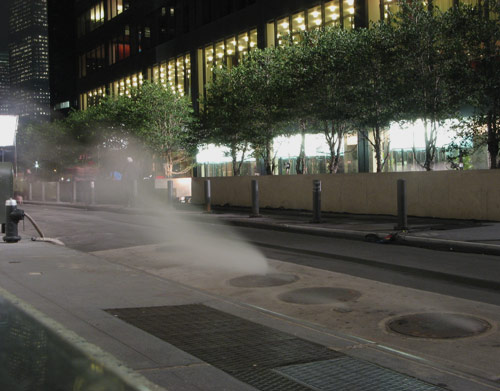
Steam

Back at Westville, this time with M. I hauled a canvas bag full of organic vegetables — included in this week’s share: brussels sprouts on the stalk, and the never-ending crop of kale! — and made my way down to West 10th Street through the light drizzle on Seventh Avenue.

Brussel Sprouts

As usual, there was already a small crowd gathered outside the restaurant door, so I promptly wrote my name on the clipboard quaintly hanging from the nail under the awning. M arrived just minutes behind me and together we waited on the sidewalk outside the cozy (read: tiny) restaurant, craning our necks for a glimpse of an opening among the tightly packed wooden tables.

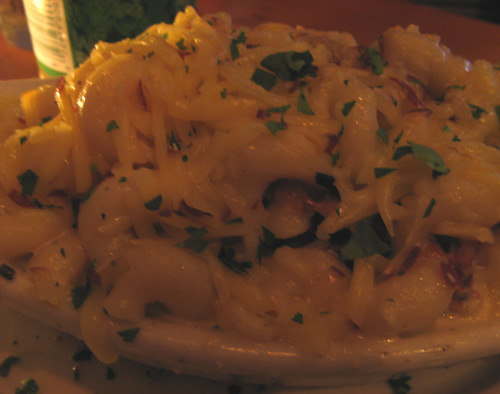
At last we were beckoned inside by one of the slacker waiters. Of course, M and I had to share an order of the smokey mac n’ cheese — this time with bacon. I’ve been a bit obsessed with macaroni and cheese lately, perhaps inspired by my last visit to Westville. By coincidence — or fate — the next morning, NPR featured a piece on the dish’s history and its many varieties. In it, commentator Joseph C. Phillips rails against the “artificial orange lab experiment” that is processed macaroni and cheese.

If I had a million dollars
We wouldn’t have to eat Kraft Dinner
But we would  eat Kraft Dinner.
Of course we would: we’d just eat more!

— “If I Had $1000000,” Barenaked Ladies — who performed this song, among others, at Radio City Music Hall last night.

Smoky Mac n Cheese

Popular folklore has it that Thomas Jefferson invented macaroni and cheese. The theory has since been discredited, but it’s documented that Jefferson served the dish (made with his preferred imported Parmesan cheese) at the White House in 1802, and American recipes for pasta with cheese can be traced to at least that time period. In The Man Who Ate Everything, lawyer turned food journalist Jeffrey Steingarten describes an 1802 recipe as the “very first recipe ever printed on the back of an American box.” The recipe was, in fact, printed on sheets of paper wrapped around bundles of dried noodles produced at the first American pasta factory in Philadelphia.

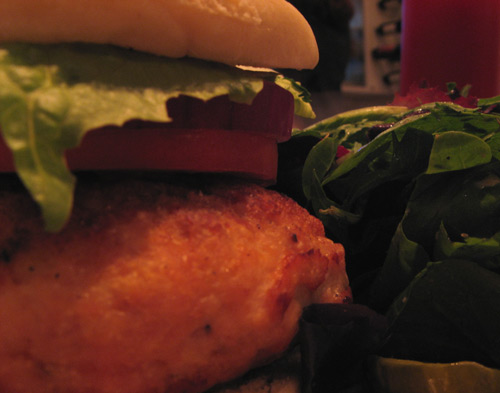
The cast iron turkey burger on a Portuguese muffin was supremely solid, as usual: lean, yet juicy, and served with a side of lightly dressed greens and juicy slices of onion and tomato. Best turkey burger in the city.

Turkey Burger

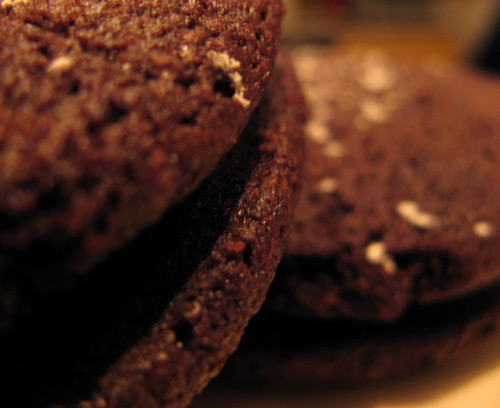
And for dessert: a pair of Westville’s homemade Oreos: hockey puck-sized, soft, chewy dark chocolate cookies spread with vanilla cream.

Homemade Oreos

I’ve yet to investigate, but I’ve read that Bouchon Bakery has its own version of the Keebler treat: the TKO (which stands for “Thomas Keller Oreo,” not “technical knockout”), made with Valrhona cookie wafers sandwiching white chocolate ganache. Mmm.

Jon Franzen's bird problem

Much of bird watching is about disappointment. Part of the appeal is that really, more often than not, you don’t see what you’re looking for. The great pursuits are more about failure than about success.

— Jonathan Franzen, Time magazine (August 20, 2006)

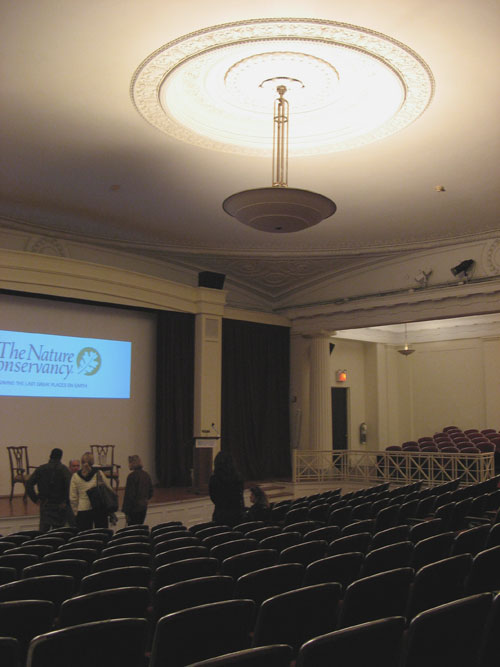
I added SYB’s “plus one” to tonight’s Nature Conservancy event, but en route up Columbus Avenue, he got a better offer from AC, so I ended up attending solo.

Author Jonathan Franzen was at the New-York Historical Society auditorium to share insights about his ornithological troubles. The event was an odd — or at least: not obvious — pairing; Jon was scheduled to appear, it seems, based on his essay, titled “My Bird Problem” which first appeared in The New Yorker earlier this year. The essay is also included in his recent memoir, The Discomfort Zone: A Personal History.

Theater

I’ve been reading Jon’s book in snippets, since picking up a copy at his last appearance at the 92nd Street Y. I’m ever more impressed by Jon as a writer; his work speaks of such intelligence and wry wit. At the same time, I can empathize with his anxious nerdiness. There are those, however, who are somewhat less entranced. New York Times book reviewer Michiko Kakutani, famously (and rather harshly) dubbed his memoir “an odious self-portrait of the artist as a young jackass.” Still, with a few glaring exceptions, reviews of the book have been generally favorable.

In “My Bird Problem,” Jon offers a genuinely funny glimpse into his adventures as a nascent bird-watcher, cleverly combining stories about his hobby with rueful remembrances of his marriage in collapse, life in New York City after 9/11, reluctant concerns over global warming (after attending a lecture by Al “Inconvenient Truth” Gore) and cultural criticism regarding upper-middle class environmentalism. Somehow, it works. To be sure, as Jon himself noted that night, the subject of bird-watching has high potential for comedy: the very idea of the special binoculars, the stealthy creeping, the self-imposed physical discomfort… all for a fleeting glimpse — or perceived glimpse — of some particular bird variety or another, for the primary purpose of checking names off of a master list.

But the titular problem is not the inherent ridiculousness of the venture. Rather, despite the author’s normally tight rein on his environmental consciousness, heretofore confined to the ten minutes per year when writing “guilt-assuaging checks to groups like the Sierra Club” — or The Nature Conservancy — he is forced to confront the idea of “not the world’s falling apart in the future, but my feeling inconveniently obliged to care about it in the present.”  The truth is inconvenient indeed.

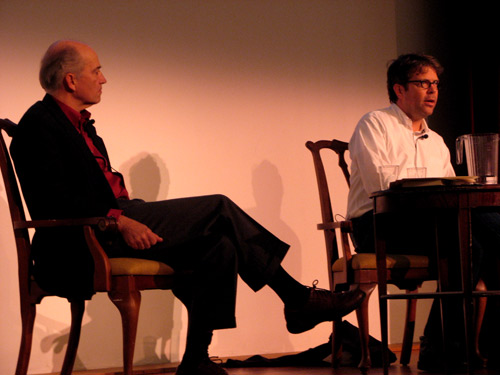
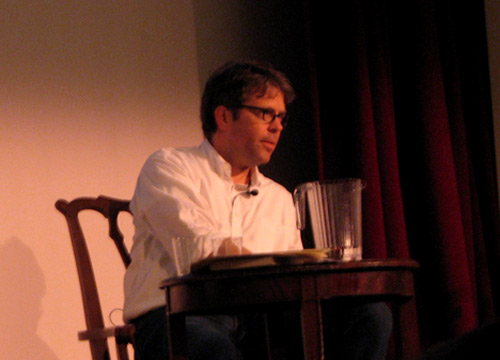
Jon was quick to point out by way of introduction, that he was no bird expert — more an enthusiast, and a recent one at that. The talk, moderated by the Nature Conservancy scientist and author, Phillip Hoose, was loosely structured around Jon’s discussion of three bird species he particularly likes — the piping plover, the LeConte’s sparrow and the bittern — and relating anecdotes about his experiences with them, complete with audio and visual aids.

Hoose and Franzen

Franzen

Apparently, Jon has an affinity for sparrows, which he likened to writers, in their quiet plainness — small, unobtrusive observers of the landscape, seeming too delicate for this world.

Incidentally, I didn’t quite grasp the night’s overarching theme — part interview, part presentation — though it did draw some necessary attention to grass roots conservation efforts.

Though it was not a literary event per se, Jon did stay on afterwards to sign books. I didn’t have one with me that night — and didn’t want to risk a repeat of our last meeting — so after the talk, I slipped out quietly for the short walk home.

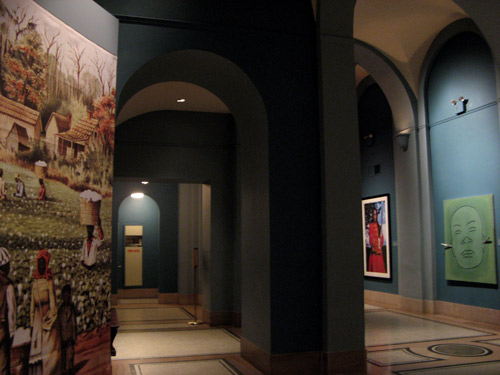
Halls

Marathon Sunday 2006

The New York City Marathon — since 2003, known as the ING New York City Marathon via a corporate sponsorship deal with the New York Road Runners — is held on the first Sunday in November. The race has been run has been run every year since 1970.
The first marathon had 127 runners participating in a 26.2-mile race that looped several times within Central Park. That year 55 runners crossed the finish line. In 1981, the course was redrawn to direct the 2,090 runners through all five New York City boroughs — a tradition which continues to this day.

In 2005, a record 87,625 people worldwide applied to run. Because of the popularity of the race, participation is limited to around 37,000 entrants, who are chosen largely by a random lottery system in June, with preference given to previous participants. NYRR members can also gain guaranteed entry by winning one, or completing nine, scored, qualifying races in the previous year, or by meeting qualifying time standards for a marathon (2:55:00 for men; 3:23:00 for women.)

In 1970, the entry fee for the marathon was $1. It has since been raised to $80-164 (based on residency and NYRR membership status), plus a $9 processing fee. Other costs include the mandatory ChampionChip scoring device ($35) for all entrants not already in possession of one.

The ChampionChip is a miniature transponder encased in a waterproof glass capsule, used for participant timing, identification and registration. It is the chip used in the biggest running events in the world (including the New York City, the Boston and the Rotterdam marathons) and a wide range of bicycle races, in-line skating and cross country events. The basis for the ChampionChip system is the radio-frequency- identification system (RFID) from Texas Instruments. This is the same technology that is also used for security locks in cars, admission control in buildings, credit card payment systems (MasterCard’s contactless PayPass and Chase’s blink card) and, it seems eventually for the NYC subway pass system.

Of course, the most famous runner in this year’s field of 38,368 starters was the 1999-2005 Tour de France winner, Lance Armstrong. Sunday morning’s television coverage followed the elite men’s and women’s runners and had one “Lance cam” fixed on Armstrong throughout the race.

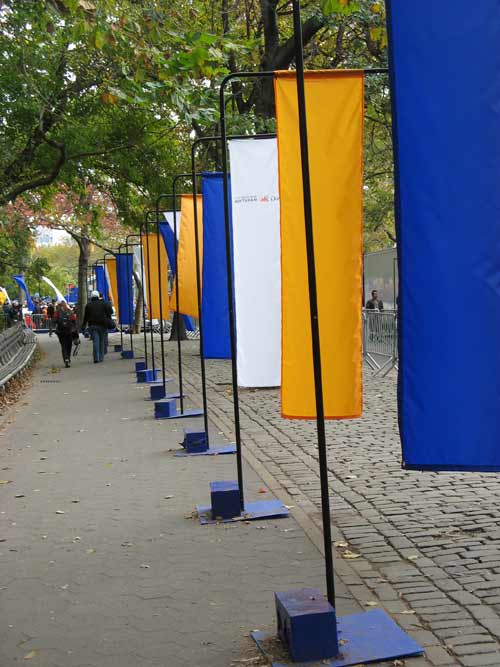
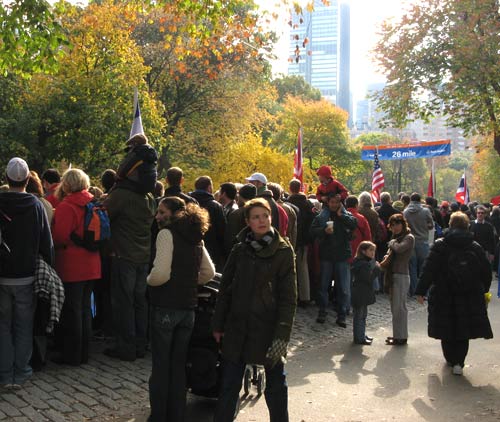
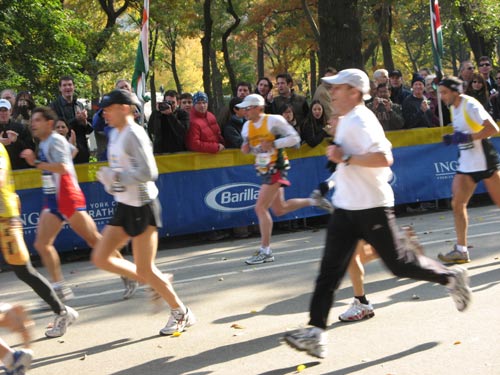
I made my way to Central Park, near the 26 mile mark, to cheer on the finishers.

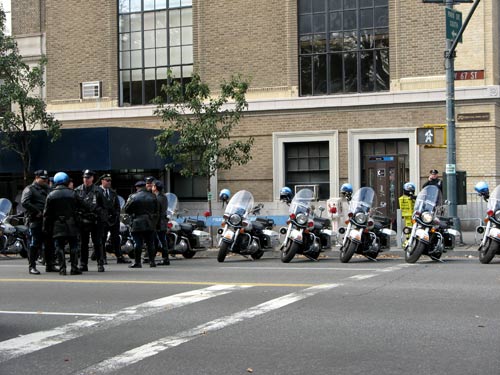
Police

NYC Marathon

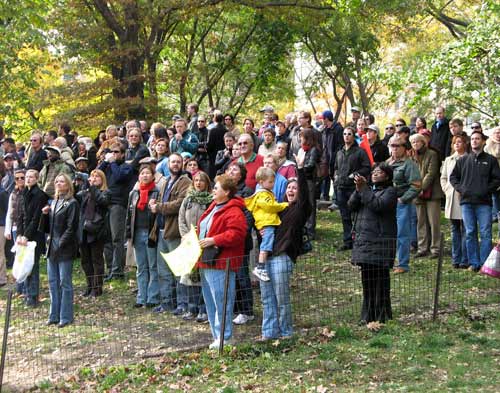
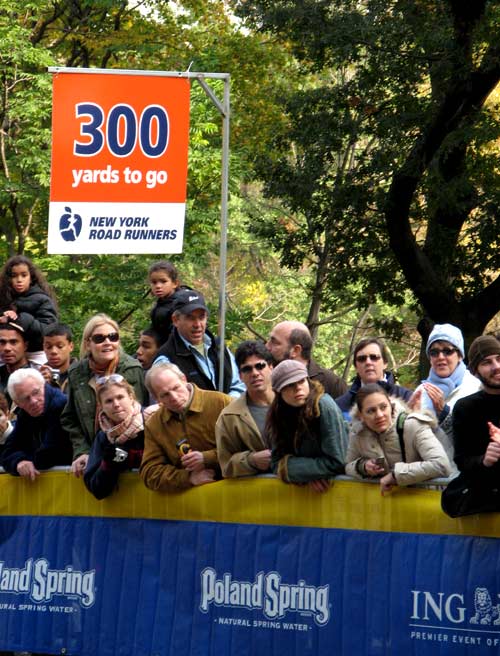
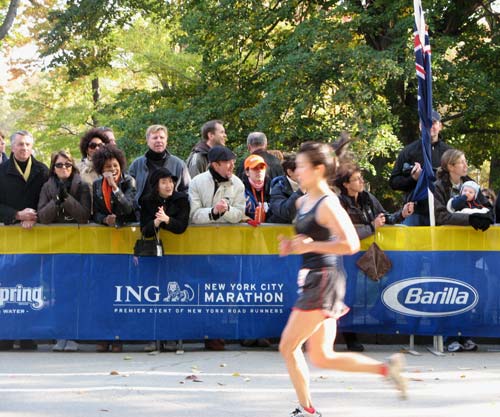
The crowd was in fine form, cheering away, and shouting encouragement by name to the runners who had identification emblazoned on their shirts. Go, “Mr. Awesome”!

Spectators

Spectators

I had just missed the winners by the time I arrived, but then came the announcement over the loudspeaker. Lance Armstrong had entered the park! An audible buzz of excitement shot through the crowd. Minutes went by, and then I heard the distant rumbling cheer. Closer, closer…

Spectators

There he is…

Lance Armstrong

…and there he goes.

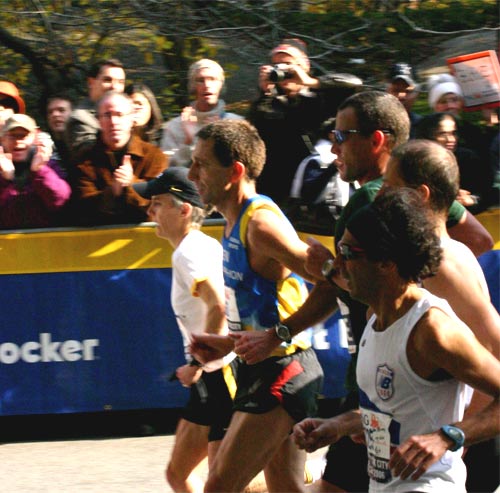
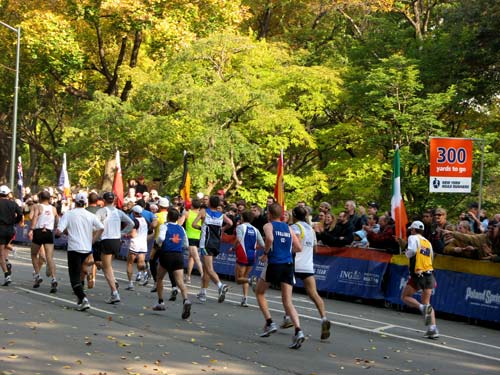
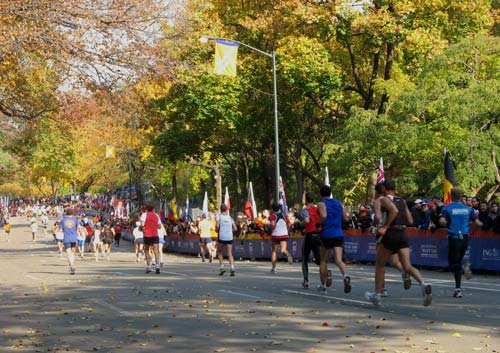
Marathoners

I stayed on for an hour more, to cheer on the rest of the field, most of whom looked remarkably spry, for having just run 26 miles.

Marathoners

Spectators

Marathoners

Jeļena Prokopčuka of Latvia repeated her 2005 NYC Marathon win in 2:25:05. Marílson Gomes dos Santos of Brazil won the male race in a time of 2:09:58, becoming the first winner from South America. (Armstrong finished 856th with a time of 2:59:36 in his first marathon.)

This year’s race had 37,954 finishers, the most ever — representing a 98.9% completion rate. Phenomonal.

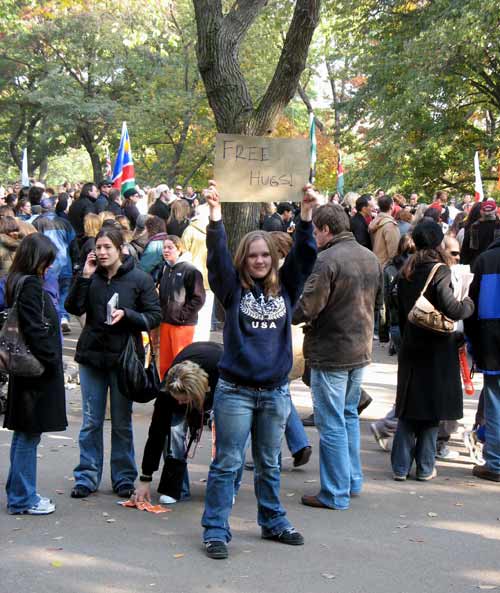
Free Hugs