vip in the city, page 54

Adrienne's Pizza Bar

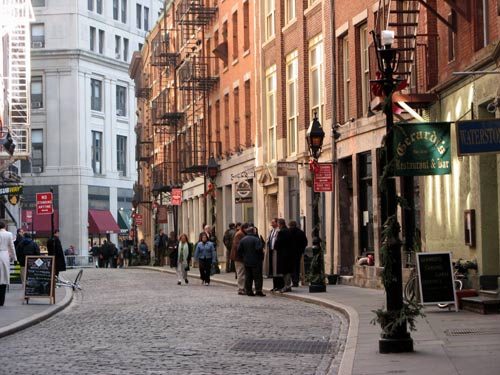
New Yorkers love their pizza. I am no exception, and I particularly love discovering excellent pizza in unexpected places. The Financial District is fortunate to have Adrienne’s Pizza Bar, a stylish joint venture between Forest Hills pizza purveyor Nick Angelis (of Nick’s Pizza) and the Poulakakos family, the father-and-son team many credit with the Old Stone Street renaissance.  Their mini-empire also includes Financier Pâtisserie and the perenially-packed post-work tavern, Ulysses. (Next up for the Poulakakos men: a 24-hour diner.)

Stone Street

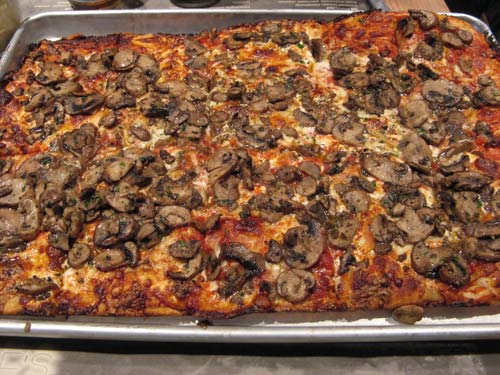
Adrienne’s is a solid notch or two above the typical Wall Street-area pizzeria. Weekdays at lunchtime, the elegant narrow space is packed with suits clamoring for a seat at the long, polished bar, or among the limited tables lining the wall. In front of almost every patron rests a flat tin tray of newly-popular grandma-style pizza ($15) with a dizzying variety of colorful toppings ($3 apiece): from the usual pepperoni, mushroom, roasted peppers and onions, to broccoli to prosciutto to sun-dried tomatoes.

According to Wikipedia, grandma pizza — a thin-crusted variation on a Sicilian pizza, made with fresh garlic and chopped tomatoes — owes its culinary origins to Long Island. Some attribute the “invention” more specifically to King Umberto’s in Elmont, though the pie’s true birthplace continues to be a matter of some debate.

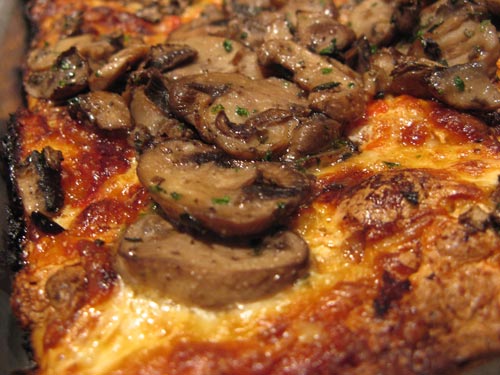
The Village Voice dubbed Adrienne’s the “Perfect Downtown Pizza” — and indeed, our thickly mushroom-topped pie arrived perfectly hot and crisp, with superbly charred crusts and creamy, fresh mozzarella over bright, tart sauce.

Adriennes Mushroom Pizza

Adriennes Mushroom Pizza

Like all the best pizza joints in the city — and in spite of what you may have read elsewhere — Adrienne’s does not sell its popular pizza by the slice. According to the manager (whom I asked that afternoon), it just “got too crazy.” And hey, they don’t have to.

Although pizza is the acknowledged headliner, the restaurant is not just about the pizza.

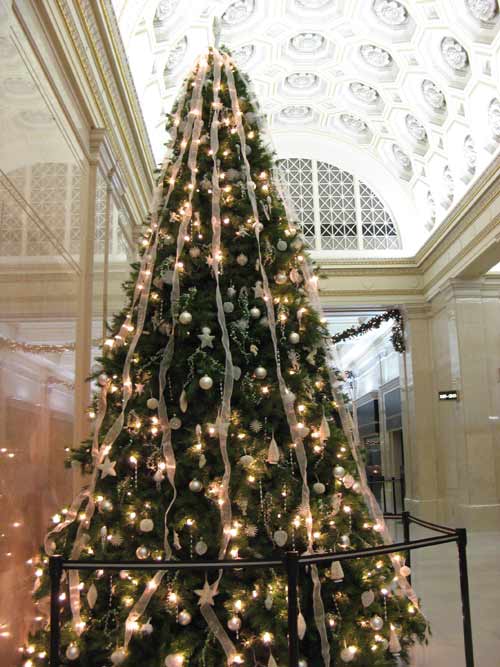
One last look at the Equitable Building tree on this, the 11th day of Christmas:

Equitable Life Tree

Tres Amigos

After our standby sushi and sake, we set out for the sold-out screening of Pan’s Labyrinth (El Laberinto del Fauno). Earlier in the week, I had confused the director of the R-rated fable (Guillermo del Toro) with the man who directed Children of Men  (Alfonso Cuarón). The two are actually longtime friends — Cuarón was also a producer for del Toro’s film — and part of a trio of Mexican directors, who have gained recent acclaim in international cinema. The third, Alejandro González Iñárritu, directed Babel.

The compadres, all born within three years of each other, shared a camaraderie long before they achieved early success with their debut features, Cuarón for Love in the Time of Hysteria  (1991), Del Toro for Cronos  (1993) and González Iñárritu for Amores Perros  (2000), which I had the pleasure of screening at the Toronto International Film Festival in 1999. The three appeared on The Charlie Rose Show  to discuss their strong creative partnership and frequent collaborations. Despite their similar backgrounds and socially conscious agendas, each director has found his voice through a starkly different form of cinematic expression. Del Toro is best known for his fantasy/horror work like Mimic, The Devil’s Backbone  and Hellboy, while González Iñárritu has focused exclusively on dark dramas with multiple, intersecting storylines, as in 21 Grams — prompting some critics to question whether he is capable of linear narration. Cuarón, the elder mentor of the group with the longest track record, has worked in multiple genres at every level of production, from the low-budget indie hit Y Tu Mamá También  to the major studio serial Harry Potter and the Prisoner of Azkaban.

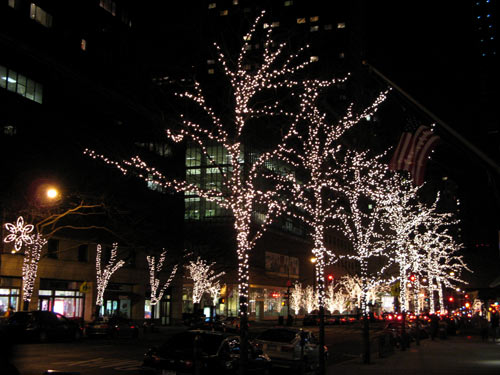
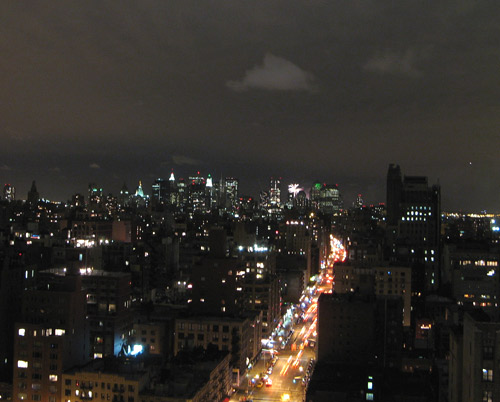
Columbus Avenue Lights

Pan’s Labyrinth  was remarkable and visually stunning, meshing hauntingly disturbing images with a complex story about the enchantment of youth, in the aftermath of the Spanish Civil War. I was surprised to read later that the film was shot on a budget of just $15 million. CafeFX‘s Everett Burrell, collaborating as a co-producer, provided the firm’s VFX services at a deep discount, which kept costs low.

Ivana Baquero is unnervingly convincing as young Ofelia, the girl caught between two worlds. Doug Jones plays both the titular faun (not Pan, as the English translation suggests) and the faceless, corpse-colored, child-and-fairy-eating Pale Man — roles he had to learn phonetically, as the only non-Spanish speaker on the set.

Critics are almost unanimously united in their raves of the film. And just this week, Pan’s Labyrinth  was named best picture of the year by the National Society of Film Critics. Cuarón’s Children of Men  was honored for best cinematography.

No LIta

Remember when Little Italy encompassed more than just a couple of blocks around Mulberry Street just North of Canal?

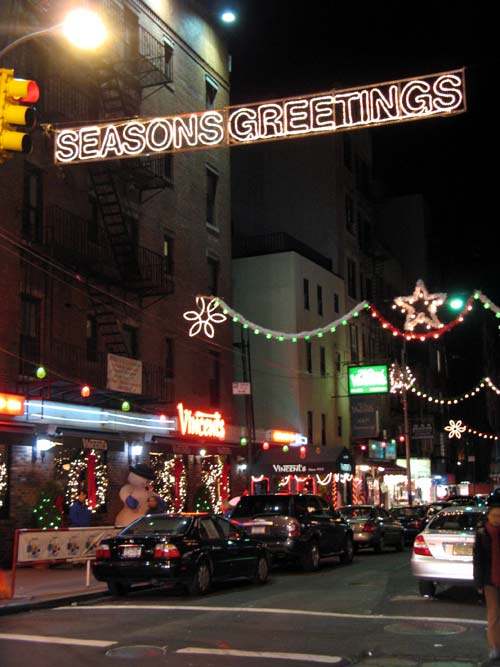
Seasons Greetings

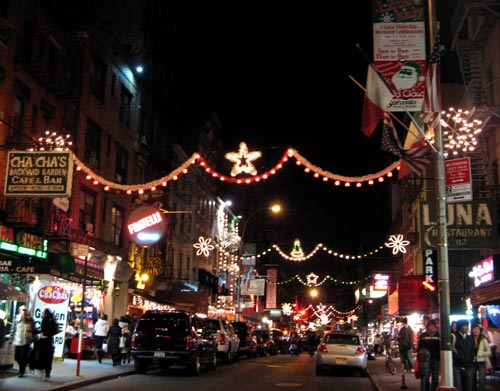
Little Italy Lights

When I was attending Chinese school in the 80s, Canal Street marked the border between Little Italy and Chinatown. With an influx of new immigrants from mainland China, particularly Fuzhou, Chinatown expanded to the North into the Old World enclave, and East along East Broadway and Canal into streets that used to be considered part of the Lower East Side.

The wretched 1987 film China Girl  dates to the bygone era when Canal Street was still in dispute. The film was promoted as a cross between Mean Streets and Romeo and Juliet — or West Side Story, without the music or dancing. In it, Chinese teenager Tyan-Hwa (Sari Chang) falls in love with Tony (Richard Panebianco), a pizza delivery boy from Little Italy. (He’s Eye-talian, see?) When a Chinese restaurant opens on the wrong side of Canal, tensions flare between the rival Chinese and Italian gangs, headed by Russell Wong and David Caruso, respectively. Yes, that  David Caruso.

Do I need to tell you how it all ends? Or which David Bowie song was used on the soundtrack? (Hint: it was named the “Best Male Video of the Year” at the inaugural MTV Video Music Awards in 1984.)

I was reminded when snapping these photos North of Canal that Joe’s Ginger, my onetime favorite source for pork-and-crab soup dumplings (xiao long bao), has closed — presumably not owing to Italian gang pressures.

Sleep. Brunch. Sleep.

I slept in the first day of 2007 — why not? — but did manage to rouse myself for dimsum in Chinatown by early afternoon. After a flurry of text messages and telephone calls, we (B, SC, JG, CS, MB and I) arranged to meet at Confucius Plaza.

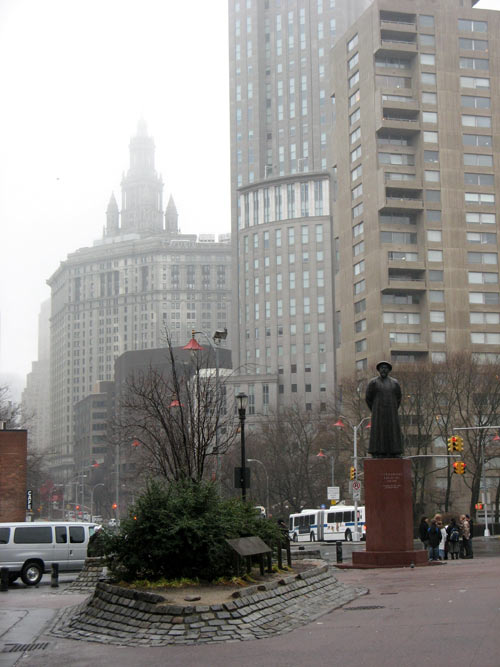
Wait, that’s not Confucius…!

It’s Lin Ze Xu (Li Tse-Hsu), the Fuzhou-native whose statue was erected in 1997 at the intersection of East Broadway and Chatham Square — about a block South of the actual Confucius statue at Confucius Plaza and Division Street. According to The New York Times, the Lin statue cost $200,000, which was financed by individuals and civic associations, in recognition of the area’s growing Fujianese population. The inscription reads: LIN ZE XU, 1785-1850, Pioneer in the War Against Drugs.

But who was this Lin Ze Xu? Lin was an Imperial Commissioner under the Qing (Manchu) Emperor Dao Guang, best known for his role in the events leading up to the Anglo-Chinese Opium War (1839–42). The British East India Company, banned by Chinese law from importing opium into China directly, ran its immensely profitable trade through a series of arrangements via its strongholds in India. Small quantities of opium had been manufactured in China since the late 15th century for the treatment of dysentery, cholera and other diseases. By 1729, the drug was being mixed with tobacco and used for distinctly non-medicinal purposes, prompting the first of many restrictions on opium’s use set in China. By mid-century, the East India Company had assumed control of Bengal and Bihar, the opium-growing districts of India. Within decades, the British managed to establish a monopoly on the opium trade, forbidding all poppy growers in India from selling opium to competitor trading companies, effectively shutting out Britain’s European capitalist rivals, Portugal and Holland. British exports of opium to China skyrocketed from an estimated 15 tons in 1730, to 75 tons in 1773. By the 1820s, the opium trade averaged 900 tons per year from Bengal to China.

Emperor Dao attempted to suppress the smuggling of opium which was debilitating the country and reversing its formerly favorable balance of trade. In 1838, he appointed Lin to head up the mission to eradicate opium in China. Lin approached the task with patriotic zeal, ordering all foreign traders to surrender their opium, setting up barricades at key ports to block foreign ships carrying opium… even writing a letter to Queen Victoria, entreating her aid to stem the illegal trade.

The volatile situation came to a head on June 3, 1839 when Lin confiscated over 2 million pounds of opium from 22 British ships, and supervised its destruction during a 23-day campaign in Humen, China — a scene immortalized on a 1985 Chinese postage stamp.

The action served to ignite the first of the Opium Wars with Britain. Three years later, China had lost the war and Lin his title. Under the Treaty of Nanking (1842), China paid a huge indemnity, ceded Hong Kong to the British Empire, and opened its ports of Guangzhou, Xiamen, Fuzhou, Ningbo, and Shanghai to British trade and residence.

Lin’s efforts, nonetheless, earned him the distinction as a symbol of moral resistance and patriotism.

Lin Ze Xu Square

Dimsum at East Broadway’s Nice Restaurant was a tasty retread of Christmas Day’s meal, with the addition of seafood pan fried noodles (and doufu fa!), and the omission of pig’s feet stew, much to SC’s disappointment.

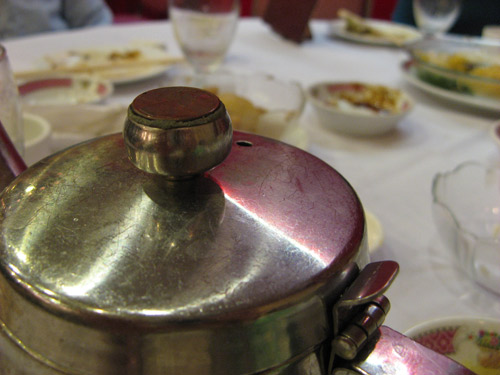
Lucky Penny Teapot

SC failed to convince CS to sample the tripe — when she doesn’t even eat pork — but succeeded in piquing my interest in the “World’s Longest Yard Sale,” taking place this year August 2-5 along a 450-mile stretch of Hwy. 127 from Covington, Kentucky to Gadsden, Alabama.

Hmm…

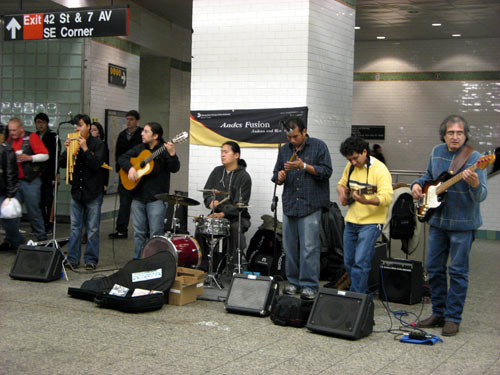
Andes Fusion

New Year's Eve travels

This morning, we received an early New Year’s gift from the City of Boston when the parking enforcement officer, instead of issuing us a parking ticket, alerted us to the sign near our car indicating that the street on which we had parked was reserved for Bay Village residents only. Oops. I had to suppress a smile when, as if on cue, she advised us in strong nonrhotic tones to “pahk the cah” not in “Hahvahd Yahd,” but on “Chahles.”

After services, JE and JC showed me to a Chinatown bánh mì shop, where I picked up some reinforcements for the Greyhound bus ride back to the city. After bidding adieu to the family, I was off.

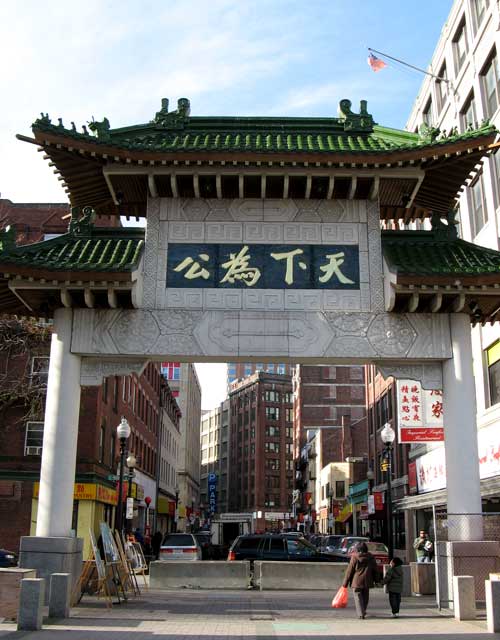
Chinatown Arch

I pulled into Port Authority in the midst of where the New Year Eve festivities were just beginning. The ambitious first wave of the expected million spectators had already arrived, securing their spots along the streets for the 100th midnight dropping of the ball in Times Square.

But not for me. First stop: the (farther) Upper West Side for DB and JS‘s party, where there was an open fire crackling on the garden patio and balls aplenty: risotto, meat, rice krispy, popcorn and donkey. (Well, the last was part of a party game.)

Some fruity champagne cocktails and vanilla bean-and-anise-infused vodkas later, we wished our hosts and new friends well, and set out once more into the night.

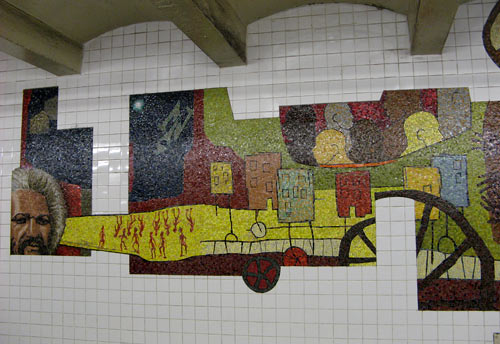
Migrations by Christopher Wynter (1999) at the 110th Street/Cathedral Parkway subway station. According to the artist, “the panels represent the ideas of uprooting, migration, and progress.”

In this spirit: onward, onward… to Chelsea!

110th Street Mural

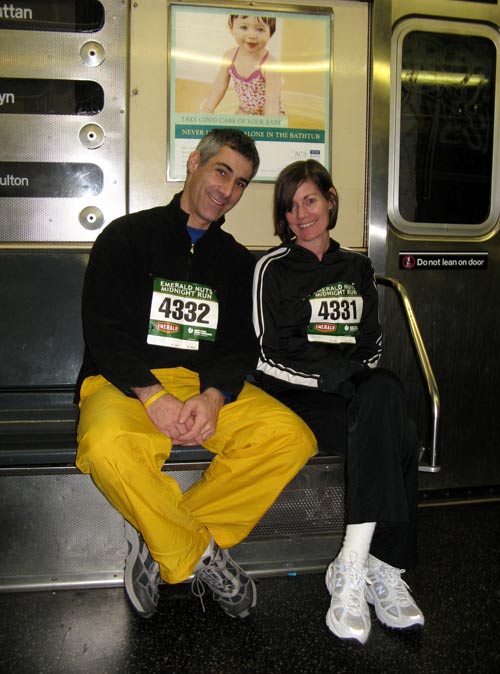
On the ride downtown, we met this hardy couple — one veteran and one newbie — all geared up to hit 2007 running at the Emerald Nuts Midnight Run in Central Park. This New Year’s Eve 4-miler has been a city tradition since the first running in 1979. The New York Road Runners Club hosts the late-night gathering of sneakers and sweat, which begins at the Central Park Naumburg Bandshell. The event is co-sponsored by Emerald Nuts and also features activities for non-runners: champagne toasts, a costume parade and contest, a live DJ spinning dance tunes, and finally, fireworks timed to launch precisely at midnight to kick off the start of the race. The event helps raise money for the NYRR’s community services programs.

Midnight Runners

We arrived at JK’s to find the party in full swing. Lots of familiar faces, and soon enough, MB, LW, AC, DF and E bounced in. What youthful exhuberance! With mere minutes to spare before the stroke of midnight, there was little time to mourn missed connections before we had to make our way through winding hallways, packed elevators and a final flight of stairs to the rooftop of The Chelsea Mercantile.

10… 9… 8…

Except not really. Nobody has a watch with a seconds reading anymore! Staring at a cellphone, waiting for “11:59” to become “12:00” isn’t quite the same. But then suddenly, the streets below erupted into cheers, and brilliant fireworks from Times Square lit up the sky. From our vantage point, we had a clear view of similar displays launched from downtown and in Jersey. I popped the cork on the bottle of Veuve JK had pushed into my hands downstairs, and among friends old and new, we toasted to a new year and new possibilities.

Happy 2007, everyone!

Downtown Fireworks

Jersey Fireworks

Out and about in Beantown

New York City’s unseasonably warm winter — with its longest snowless streak since 1878 — almost made me forget how icy late December can be in the Northeast. That night in Cambridge, the mercury dipped to the upper 20’s. Luckily we had our very own drill sergeant vigilantly monitoring that we all were properly geared for the wind and cold at all times.
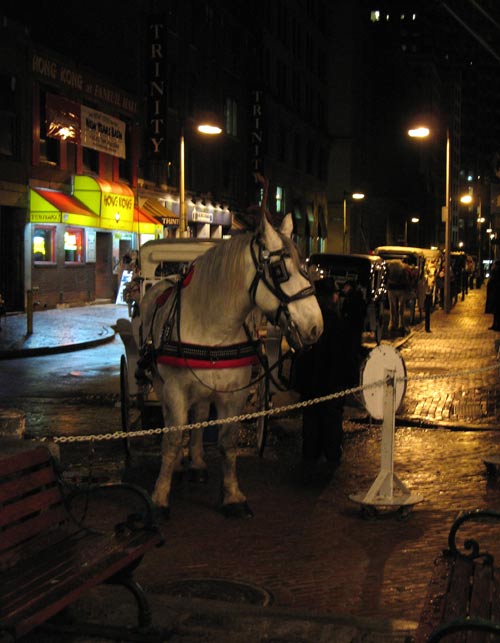
Boston Carriages

After assessing some of our options, we decided on a trip to Quincy Market for a little shopping among the post-Christmas lights. I like how the small, white bulbs delineate the outlines of the Greek Revival rotunda. The area has come a long way since its 19th century origins as a market for produce and freshly butchered meats — though the detritus of the nearby Haymarket manages to bring some of the gritty tradition back downtown on Fridays and Saturdays.
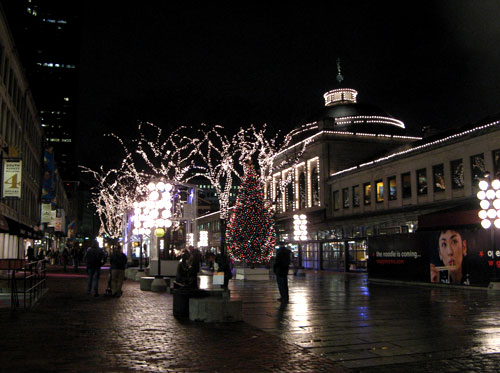
Quincy Market Tree

Mare in the North End was suspiciously devoid of diners, so JC suggested Giacomo’s Ristorante as an alternative. I later learned that the restaurant is something of a Boston institution for authentic Italian fare. Despite the early-ish dinner hour, we came upon a line of diners, huddling for warmth and stamping their feet in the biting cold, patiently waiting on Hanover Street for an opening inside the tiny, no-reservations dining room. We decided to brave it out, at one point seeking brief respite in hot coffee (no sfogliatelle this time) from Mike’s Pastry Shop down the block.
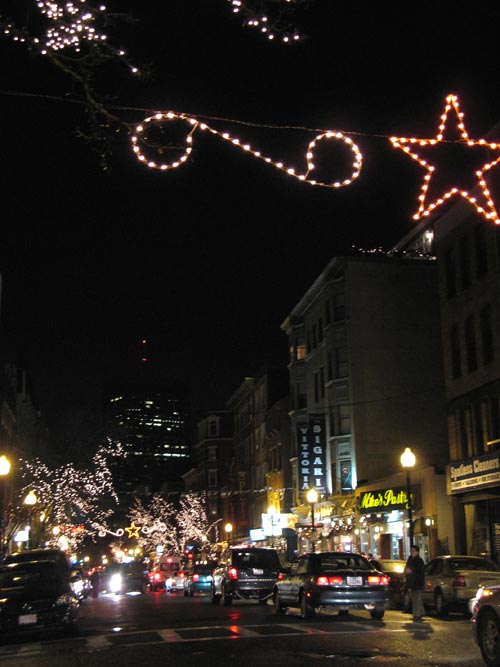
North End

JC pointed out to me the sign in the restaurant window, touting Giacomo’s appearance on Rachael Ray’s $40 a Day. Ray had the Pumpkin Tortellini, after which she no doubt left the server with one of her customary paltry tips.

Sooner than expected, we were ushered in through the set of double doors — open one at a time to keep out the chill! — to a wooden table from which we had a clear view of the open kitchen and the wall-mounted chalkboard menus. The waitstaff was friendly, yet brusquely efficient; we’d barely taken off our coats and listened to descriptions of the five house sauces when our appetizer order (Fried Calamari) was taken and shouted to the kitchen. It hit the table minutes later, piping hot and crisply battered.

The House Special Zuppa di Pesce platter is advertised for two, and features a whole top-split lobster, circled by shrimp, scallops, rings of calamari, whole clams and mussels, tossed in a steaming heap of al dente linguini with our chosen spicy, lobster-based Fra Diavolo sauce. Ha, I’d like to meet the two people who could finish this.
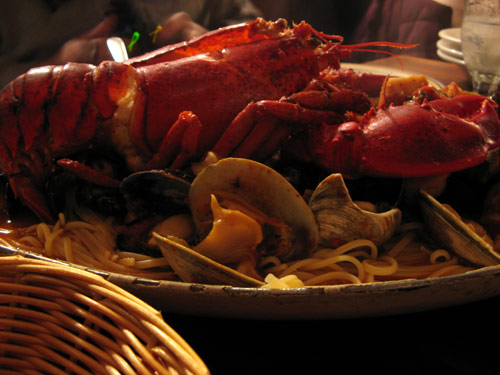
Zuppa di Pesce

We supplemented the seafood mountain with the waitress-recommended Butternut Squash Ravioli with diced Asparagus in a Prosciutto, Marscapone Cheese Cream Sauce, which was wonderfully sweet and creamy. The Chicken Marsala tasted strongly of sweet wine and was generously studded with mushrooms and pieces of prosciutto. With this meal, I officially joined the ranks of Giacomo’s devotees.

We were about 2/3 of the way through our Zuppa, when the waitress came by to ask nicely, but meaningfully, if our party would be needing anything else that evening. With table space at such a premium — and front windows offering full view to the sidewalk lined with impatient, would-be diners — the staff does not encourage lingering; Giacomo’s doesn’t even offer dessert.

We hastened our exit and with bellies full, drove through wintry streets, taking in the sights of Boston on the eve of First Night. JB had described the annual event, now in its 31st year, as “pretty corny, but sweet in its way.” Beginning the afternoon of New Year’s Eve through the stroke of midnight, the city hosts a large party with cultural activities in venues throughout downtown: live theatre, visual arts, dance and music performances, interactive exhibits and films. The grand finale features fireworks on Boston Harbor, a Mardi-Gras style Grand Procession and a midnight countdown on Boston Common. I alone would be missing out on the festivities this year, while the rest of the family stayed on in Boston to ring in 2007. Maybe someday.

Credit to Dad and his new Christmas camera for the two photos below.
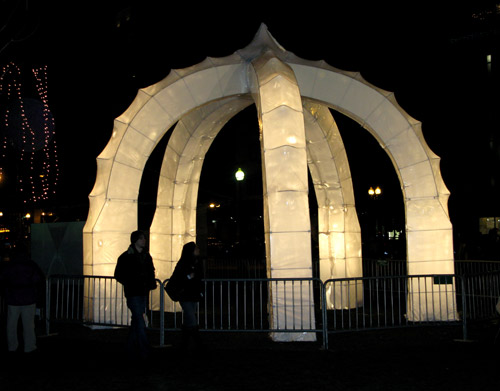
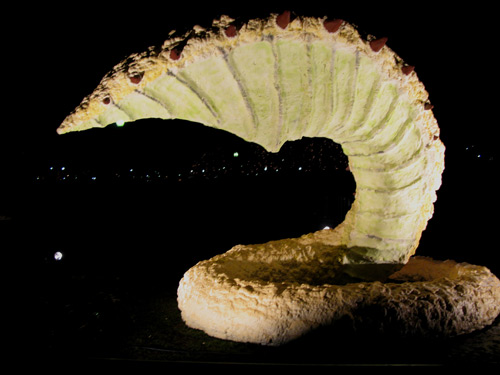
First Night Sculpture

First Night Sculpture

The Massachusetts State House (1798) with flag flown at half-mast. A bit of trivia (via Wikipedia): Highway signs indicating the distance to Boston are measured not to the city limits as is usual, but to this State House dome.
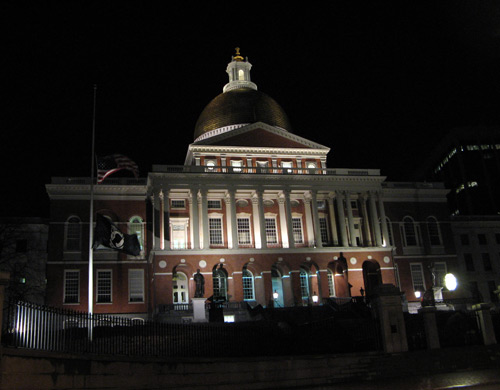
Massachusetts State House

On the drive up to Boston, I told Dad about my neighborhood Blockbuster Video’s recent closing (going the way of so many other video stores) and we got onto the topic of the Netflix business model, which was the subject of recent features on 60 minutes  and in The New York Times. Netflix’s site claims that the company is democratizing movie distribution, promoting small, well-made films as widely as major studio, big-budget films. One of its great success stories surrounds Hotel Rwanda, a small, critically-acclaimed film which made only $23.5 million in theater when it was released in 2004. Netflix subscribers rallied around Hotel Rwanda, rating it highly on the site’s recommendations system, which in turn raised the film’s profile, and launched it into becoming Netflix’s fifth most-rented movie of all time, outperforming such blockbusters as Wedding Crashers and The Bourne Supremacy. (2005’s Crash, which made a middling $54.5 million in the theaters, holds the title of Netflix’s most-rented movie of all time.)

Dad found inspiration in Paul Rusesabagina’s story of one man’s courage in the face of mass slaughter, and as it happened, none of us had yet seen the film either. Off we went to JE & JC’s (still open) local Blockbuster — and its Chagall-inspired murals outside.
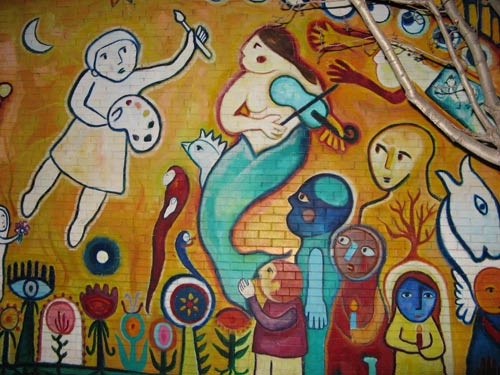

Chagall Inspired Mural

Chagall Inspired Mural

Of note… according to the New York Times piece, out of the 60,000 titles in Netflix’s catalog, the number of films that are rented at least once on a typical day is an astounding 35,000 to 40,000. (Most people vastly  underestimate the number to be about 1,000.) “Every day, almost two of every three movies ever put onto DVD are rented by a Netflix customer.” This statistical distribution model is further explored in Chris Anderson’s 2004 Wired  article and 2006 bestselling book, The Long Tail.

Hotel Rwanda  was gut-wrenching as we knew it would be, and Don Cheadle’s Academy Award-nominated performance was powerful and brilliantly understated. I’m convinced he would have taken home the Oscar that year, had he been up against anyone else but Jamie Foxx. Tough break. As the final credits rolled, we were so drained that we couldn’t even bring ourselves to start The Break Up, which we had rented as a palate-cleanser. Perhaps it’s just as well.
To Boston

Good-bye, Whitestone! 

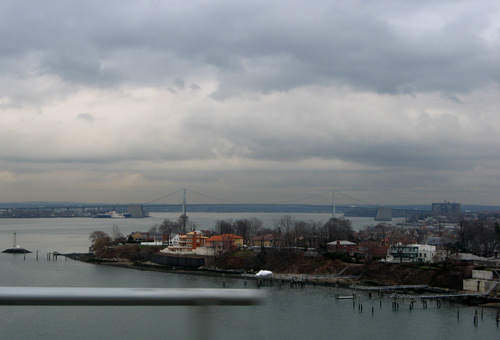
Throgs Neck Bridge

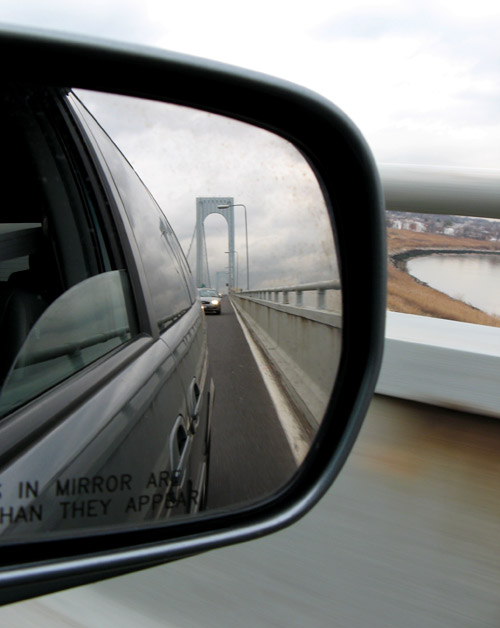
Met Mom and Dad this cloudy morning for the ride North to visit JE & JC in the 02138. Here’s the Bronx-Whitestone Bridge, as seen from our rear view mirror.

Whitestone Rear View

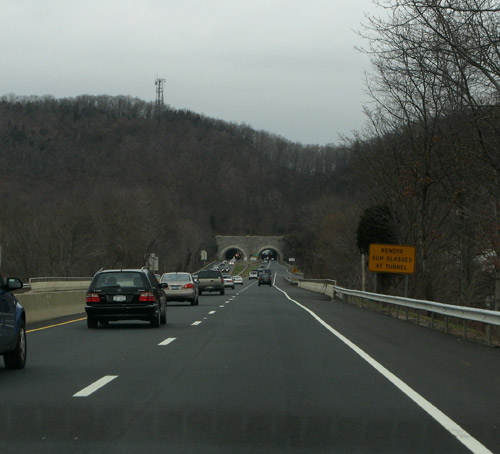
Putting our full faith in the GPS system directed us onto an unfamiliar route, through stone tunnels (“Remove sun glasses”) and winding Connecticut roads, lined with snow-dusted trees. The detour ended up shaving about 40 miles off the entire trip. Cheers to Garmin!

CT Tunnel

Gingerbread house

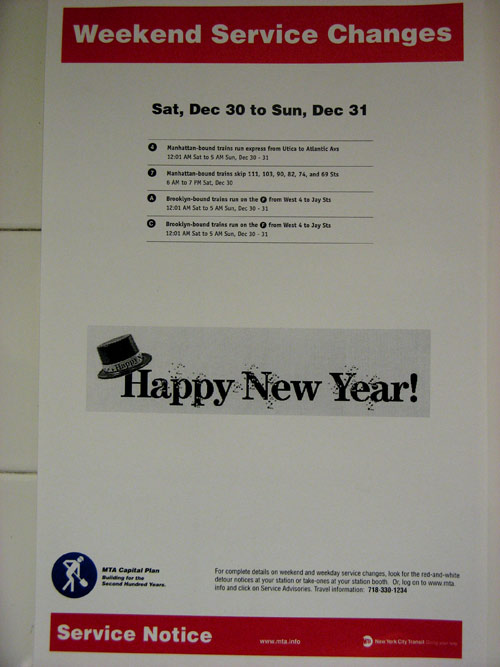
Even the MTA gets into the New Year’s spirit.

MTA Happy New Year

I arrived at work that evening to discover this gingerbread house on a low table in the lounge area — slightly worse for wear from the sweet-toothed attentions of my co-workers. I love gingerbread, but I like the idea of gingerbread houses more than the houses themselves. The pretty creations strike me as difficult to make and in my experience, are almost always stale by the time they’ve been showcased long enough for everyone to admire the handiwork.

Gingerbread House

Icing Snowman

From Fall 2002 through Spring 2004, the Brooklyn Academy of Music underwent an extensive renovation, which included an $8.6 million exterior restoration. Instead of erecting eyesore scaffolding during that time, BAM siezed on the opportunity to create public art. Brazilian artist Vik Muniz photographed a scaled gingerbread reproduction of BAM, complete with royal icing stained glass windows, jellybean arches and an M&M frieze, all crafted in intricate detail by my favorite neighborhood bakery, Soutine. The whimsical piece was dubbed CandyBAM and enlarged to print on a vinyl mesh screen for the 300 by 60 foot façade.

Muniz is known for his avant-garde works in edible (and unconventional) media. The artist once drip-painted Life magazine Hans Namuth’s iconic photograph of Jackson Pollock at work and Leonardo’s ”Last Supper” in chocolate syrup and created duo replicas of the Mona Lisa” in peanut butter and jelly. His work was the subject of a PBS Independent Lens feature.

Good Eats in Sunnyside

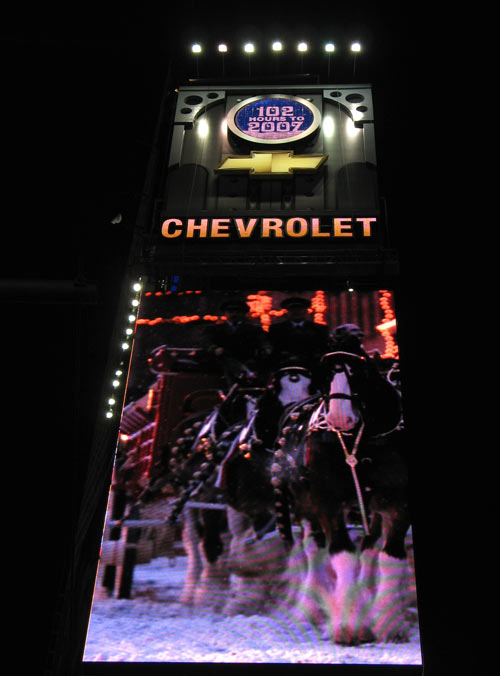
In Times Square on the way into Queens this evening. 102 hours to 2007!

102 Hours to Go

SYB had generously offered to prepare a dinner at his home in honor of my half birthday(ish). Yes, we pretty much will seek out any excuse for a celebration. When I arrived, the thick, cut-to-order pork chops from Faicco’s on Bleecker were just coming out of their paper wrappings, and the apartment was already warm with the smells of some serious cooking.

I settled in on the new couch to catch up on the comedies the B boys had recorded for me on DV-R. So much prettier than on my VCR at home!

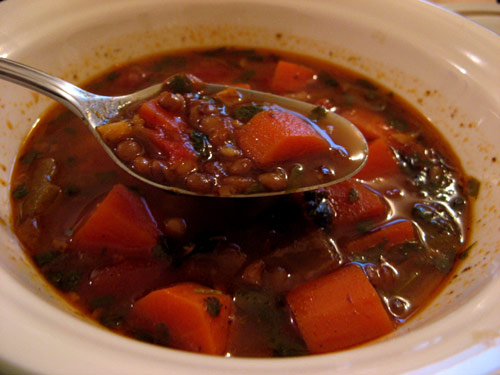
A couple of hilarious episodes of The Office  later, and dinner was served. A spicy lentil soup starter…

Spicy Lentil Soup

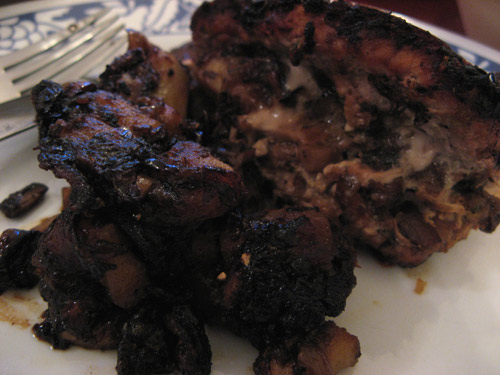
…and over the very special Christmas episode, Gothamist-inspired Roast Pork Chops stuffed with Apples accompanied by a beautiful bacon-studded Rösti :

Pork Chops and Apples

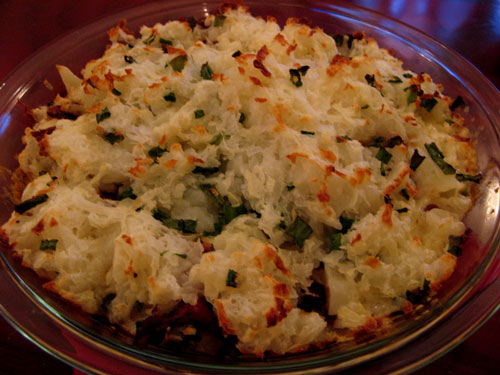
Rösti

Rösti (pronounced RAW-stee or ROOSH-tee) is the traditional Swiss dish of roasted shredded potatoes — similar to a large latke, or a hash brown platter. According to Barron’s Food Lover’s Companion, its name comes from the capital region of Bern, and derives from the words for “crisp and golden.”

Crisp and golden it was. And very tasty! Thanks, SYB!

The capper to the night: what could possibly be the funniest three minutes of fake music video ever aired on television, featuring the awesome vocal stylings of early 90’s Canadian pop star Robin Sparkles!

Be warned: one listen and it will be stuck in your head for days. Trust me, I know.

Everybody come and play
Throw every last care away
Let’s go to the mall… today