vip in the city, page 50

Ramen and Hellman

Ramen seemed just the thing for a frigid night, and Rai Rai Ken in the East Village is consistently ranked by noodle adicionados among the city’s best.
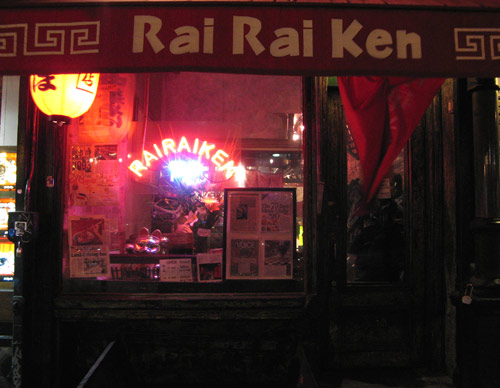
Rai Rai Ken

The cramped, narrow space consists of just 14 low stools along a scuffed, wooden bar facing into an open kitchen where the kerchief-headed chefs sling noodles from a pair of giant, steaming stockpots full of broth.

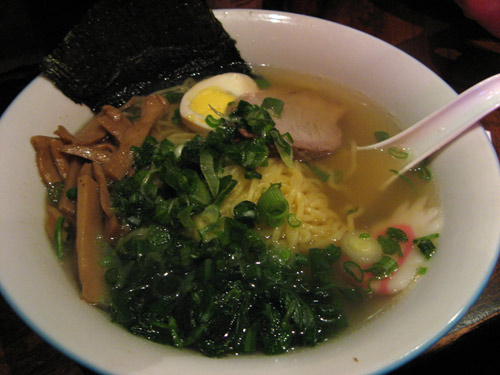
The restaurant offers three ramen varieties, each just under $7 a generous bowl: the Shoyu Ramen (soy sauce based noodle soup) and Shio Ramen (house special seafood based noodle soup) are topped with roast pork, spinach, fishcake, bamboo shoots, boiled egg, a leaf of dried seaweed and a sprinkling of scallion. A bowl of the Miso Ramen will set you back 45 cents more.  And for an additional charge, there are optional ramen toppings, which include corn, extra roast pork and… butter? (I passed.)
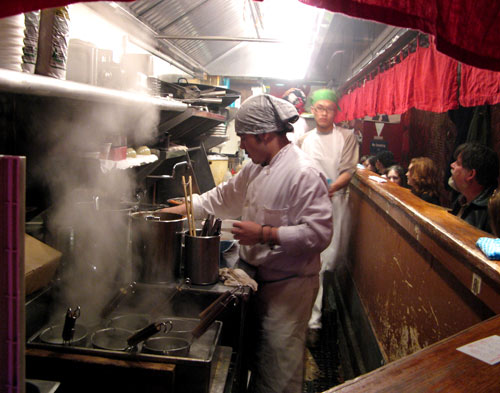
Rai Rai Ken

Rai Rai Ken Ramen

Quick, cheap and tasty. For those just not into ramen noodles — though I can’t imagine who those people would be! — Rai Rai Ken also offers curry plates, fried plates, edamame and pan-fried pork-stuffed gyoza.

Toys in the Attic was Lillian Hellman‘s last original work for stage. The original Broadway production, featuring Oscar winners Maureen Stapleton and Jason Robards, Jr.  in the starring roles, enjoyed a long and healthy run in 1960, eventually winning the Tony and the New York Drama Critics’ Circle Awards. A 1963 movie adaptation starred Dean Martin, Geraldine Page, and Wendy Hiller.  Still, the play lags in recognition behind the better-known and more frequently restaged The Little Foxes  and The Children’s Hour.  (It’s also the one of those three plays that was not on my required reading list in high school.)

The Pearl Theatre Company‘s  revival is directed by American movie, television and stage actor Austin Pendleton, whom I last saw on stage opposite Meryl Streep in this past summer’s Shakespeare in the Park production of Mother Courage.)
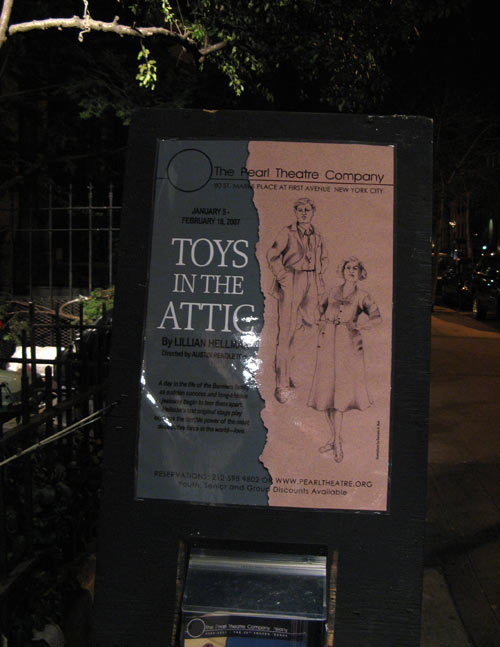
Toys in the Attic

Pendleton first met Hellman herself when he appeared in Mike Nichols‘s 1967 revival of The Little Foxes.  Fourteen years later, Pendleton collaborated with Hellman (and earned several Tony nominations) directing the same play, this time starring Elizabeth Taylor and Maureen Stapleton (again.)

With such a stellar Hellman track record, Pendleton was a solid choice to direct this most recent Hellman revival.  Set in the playwright’s birthplace of New Orleans, Toys in the Attic  is the story of Anna and Carrie Berniers, two unmarried, middle-aged sisters who toil away at menial jobs, carefully budgeting their meager earnings and dreaming of a grander life. The women are united in the decaying family home by their adoration and protectiveness of their charming but failure-prone younger brother Julian. The events of the drama unfold over one steamy day when Julian sweeps back into town, flush with new, unexpected and unexplained success, and the toll it takes on the family dynamic.  What happens when all you’ve ever wished is suddenly within your grasp? Which is greater: the need to be loved, or the love to be needed?  A strong dash of melodrama and theatrical convenience precipitates the kind of disaster to which so much overheated Southern Gothic eventually leads.  It is a meditation on many things: dreams, wealth, success, race, class, deception, jealousy, betrayal.  But underneath it all, it is a story about the ever-changing and sometimes frightening nature of love: love that desires, demands, and ultimately destroys.
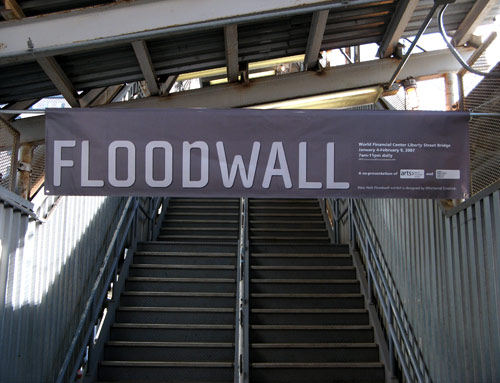
Floodwall

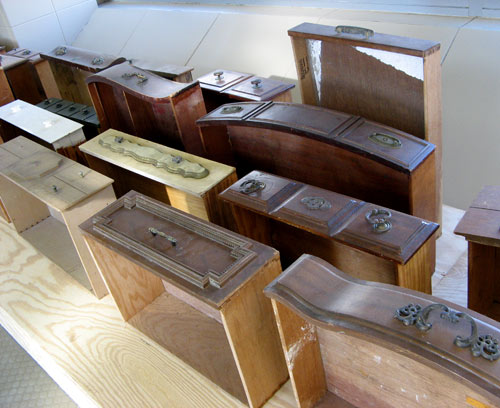
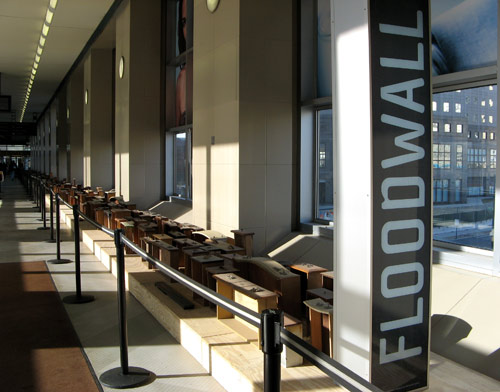
Floodwall, an exhibit by New Orleans artist and YA/YA (Young Aspirations/Young Artists), Inc. founder Jana Napoli was on display on the Liberty Street Bridge from January 4 through February 9, courtesy of the World Financial Center and the Lower Manhattan Cultural Council.

Floodwall

The installation consisted of just over half of the 610 drawers the artist salvaged from flooded streets in the aftermath of Hurricane Katrina. Returning to New Orleans a month afterwards, Napoli searched for drawers that had been dumped on the curb, sometimes collecting as many as 50 a day after removing their sodden personal contents.  All that remained was the pastered-on detritus: a piece of an address book here, rubber bands and paperclips there.  The address where each of the drawers was collected was written on the back. Napoli set out alone in her van each morning for months, randomly traversing every neighborhood in the city to collect her pieces.

In this exhibit the drawers sat upright along a platform, spanning the length of the pedestrian bridge as the words of some of their former owners scroll in red across electronic screens.

Floodwall

Floodwall

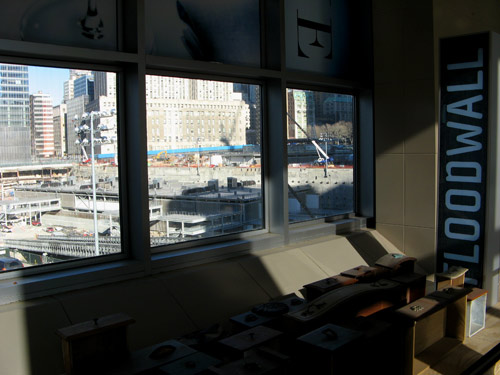
The idea of bringing Floodwall to the trade center site came from David Lackey of Whirlwind Creative, a company that plans and designs museum exhibits. Before 9/11, the Liberty Street Bridge connected the World Trade Center to the World Financial Center. Today it offers a direct view over Ground Zero, and all the construction currently taking place. This afternoon, it offered an eerie juxtaposition of two studies in loss and absence.

Floodwall

New Green Bo

I miss the soup dumplings at the now-closed Joe’s Ginger on Mott (though the Pell Street branch remains.)

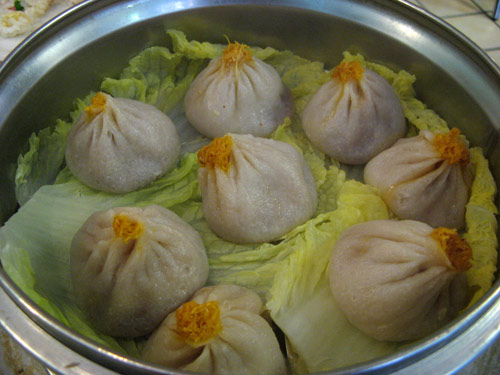
Soup dumplings, the Shanghainese onion-shaped pouches of crab, ground pork and broth, seemed to multiply across the city about ten years ago, with Joe’s Shanghai at the epicenter of the explosion. There were owner Joe Si’s sanctioned spinoffs and a huge resurgent interest in Shanghai cuisine overall, which benefited such restaurants as Goody’s (co-owned by Si’s sister, Susan Chan), Evergreen Shanghai Restaurant, and today’s lunchtime venue: New Green Bo on Bayard Street. Though the culinary fad may have cooled a bit since its turn-of-the-century heydey, the dumplings still inspire a diehard following, and debate continues to this day about the city’s best. (Tang Pavilion, really?)

Among their fans is Calvin Trillin, though perhaps for liability reasons, the scalding hot broth-filled dumplings are not a feature of Bud’s “Come Hungry” gastronomic walking tour of downtown, which for the past six years has been one of the most in-demand events of the annual New Yorker Festival.

The New York Times offers this bit of advice:

The safest way is to gently lift the dumpling with chopsticks, clasping it at the pleated area, the strongest part of the dough. Place it on a soupspoon, and carefully nibble a hole in the dumpling wrapper. The soup will flow out into the spoon. Then, use the chopsticks to pop the dumpling into your mouth, and drink the soup from the spoon.

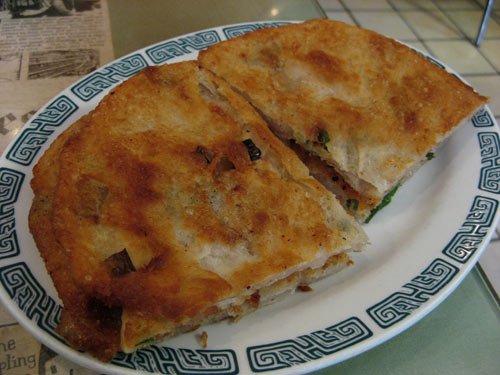
New Green Bo’s dumplings were voted the food most “Worth the Risk of Injury” in the inaugural Independent Food Awards in 2005. And their much-heralded scallion pancakes aren’t bad either.

Scallion Pancake

Soup Dumplings

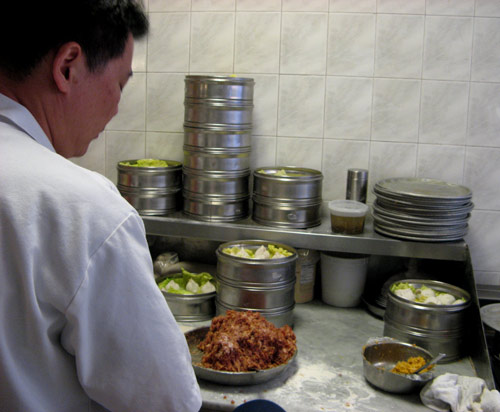
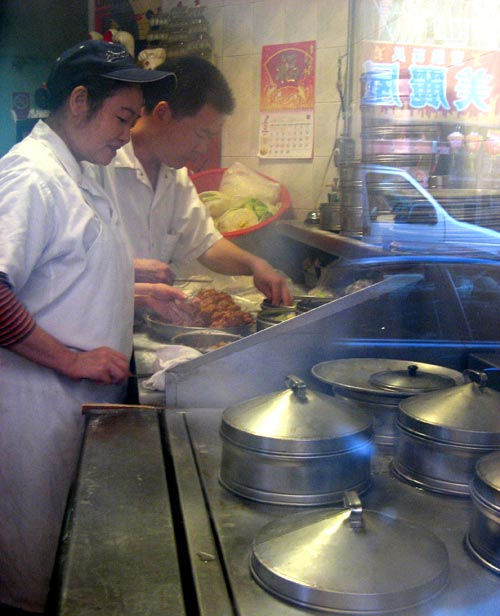
NGB’s workers, assembling stacked, cabbage-lined steamer trays of their authentically delicate-skinned dumplings for the dinner rush:

NGB Dumpling Makers

NGB Dumpling Makers

Scenes from the City

Filmmaking in New York was the topic at this book talk, slide show and discussion at the Museum of the City of New York.

Scenes from the City

Commissioner Katherine Oliver of the Mayor’s Office of Film, Theatre, and Broadcasting began the presentation, offering an overview of the 40-year history of the MOFTB. Last year, New York City hosted the highest number of film, television, commercial and music video shoots ever: 34,718 shooting days, up from 31,570 in 2005, and 23,321 shooting days in 2004. The city’s movie industry now employs 100,000 New Yorkers, and by the office’s calculations, brings in about $5 billion to the city’s economy every year.

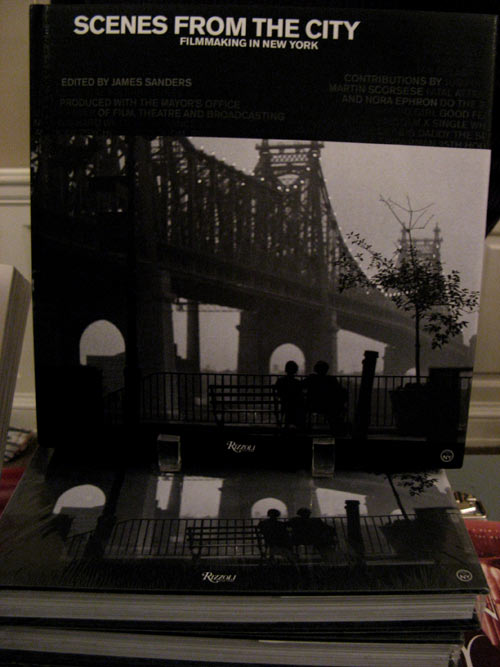
Up next, a slide show presentation by James Sanders, architect and co-writer of the Emmy Award-winning PBS series New York: A Documentary Film (the DVD set of which I received for my birthday last year, compliments of J & J), its companion volume, New York: An Illustrated History, as well as Celluloid Skyline: New York and the Movies (another present, this one from DH. Do my friends and family know me, or what?) Sanders’s new book Scenes from the City: Filmmaking in New York traces the evolution of filming in the city over four decades, contrasting the pristine New York of the Hollywood studio (Rear Window) with the gritty (Mean Streets, Do the Right Thing) and glittering (Breakfast at Tiffany’s, When Harry Met Sally, and so many others) New York of location shooting.

Some fantastic photographs, taken from movie sets, behind the scenes, or on the streets during shooting. Like Celluloid Skyline, there were rare and unusual production stills, taken from studio archives and private collections around the country.

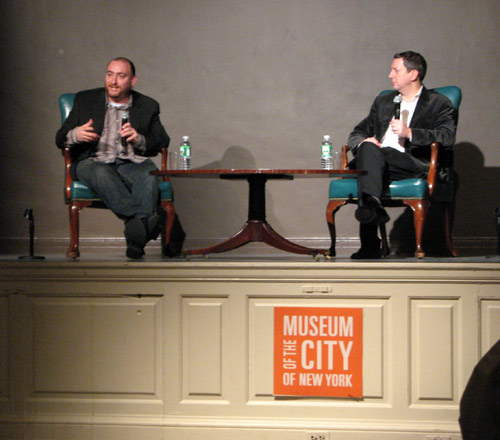
Afterwards, a talk with Rob Striem (on left, below), location manger on several recent “Made in NY” films, the MOFTB program which awards filmmakers a 15% tax break — 5% from the city and another 10% from the state — for projects where at least 75% of the overall production was made in New York City. Streim is currently co-location manager for Warner Brothers Pictures’s I Am Legend, a big budget, sci-fi thriller starring Will Smith, which famously took over the Brooklyn Bridge late last month.

Striem and Sanders

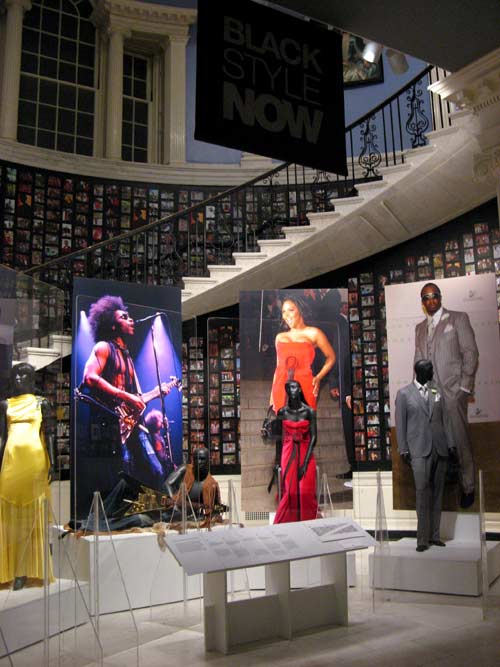
Upstairs, a glimpse of the MCNY galleries.

Black Style Now

To sleep, perchance to dream

SN just didn’t trust that the vegetarian ramen broth at Menchanko Tei was entirely pork-free, so we decamped a few doors west to Tang Pavilion, a restaurant I must have walked past dozens of times without ever dining inside even once.

I tend to eat my Chinese meals in Chinatown (Downtown Manhattan or Flushing); the Midtown focus on such niceties as a sommelier and dining room captain don’t particularly enhance a meal for me, and in some ways, almost detract from my enjoyment of the authentic pleasures. Which is certainly not to say that some solid Chinese food can’t be had outside of the ethnic enclaves. I like a pretty room as much as the next person; I suppose I’m usually just more focused on the food than on the decor.

Tang Pavilion’s reviews vary pretty widely, so I was entirely unsurprised by the average-ness of my meal that night. To be fair, I did not order from the recommended Shanghai menu, which features such chef specialties as braised baby eel and drunken chicken. If nothing else, though, the hushed calm of the dining room (free of clanking dishes and shouting waiters) gave us a chance to catch up in relative peace.

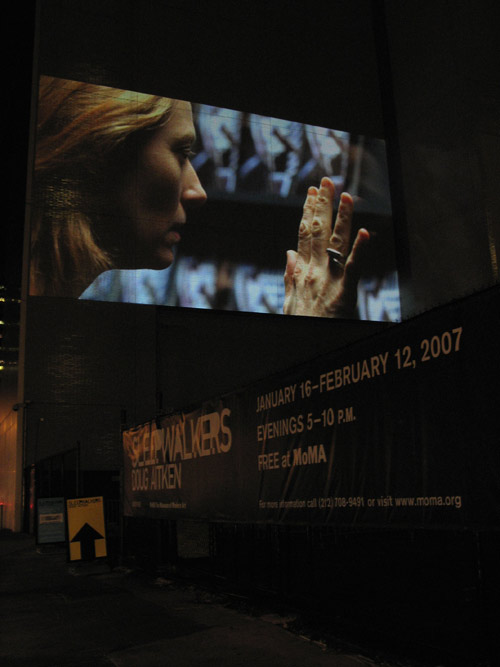
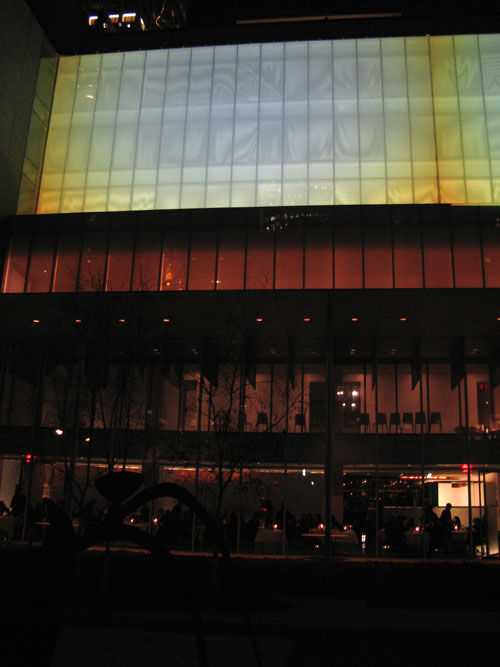
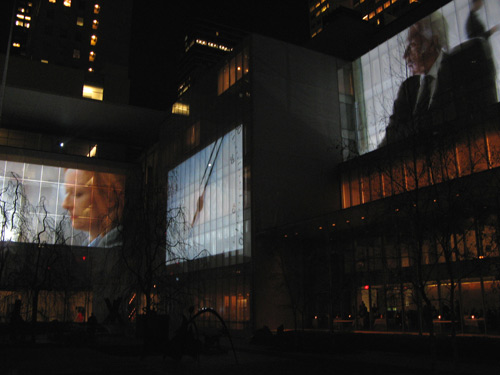
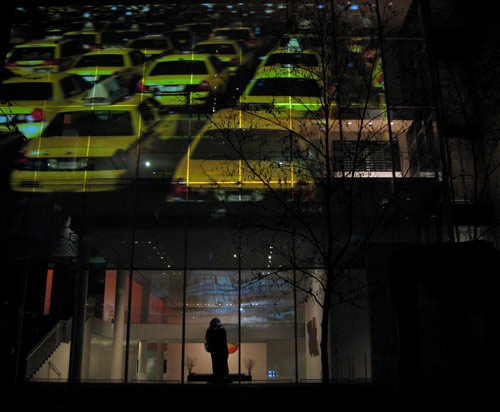
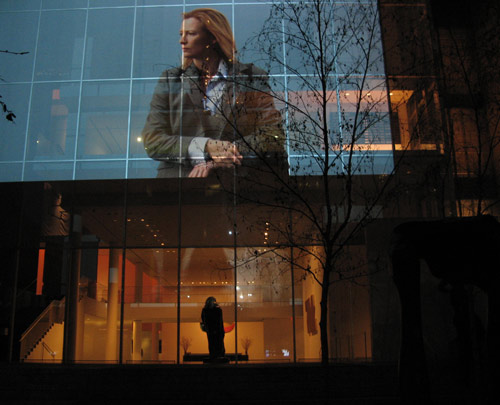
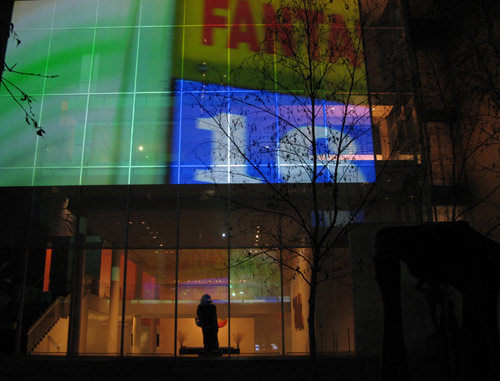
After dinner, I was among the few intrepid (read: foolhardy) enough to brave the frigid temperatures to check out multimedial artist Doug Aitkin’s sleepwalkers at the MoMA. The museum partnered with Creative Time, a New York-based public art organization, to commission, curate and present the large-scale installation. From January 16 through February 12, Aitken made a canvas of MoMA’s exterior walls, projecting the interwoven stories of five city dwellers on eight façades, transforming the Abby Aldrich Rockefeller Sculpture Garden into a vast outdoor multiplex.

Sleepwalkers

Each of the film vignettes follows a single character through one night in New York City, taking viewers to diverse locations throughout the city’s five boroughs, including the abandoned 19th century Atlantic Avenue subway tunnel, the heliport atop the MetLife Building (closed after a fatal 1977 accident back when it was known as the PanAm Building), a postal sorting facility in Queens, an ice skating rink in Staten Island, and behind the neon lights of Times Square. The characters move from the solitude of their personal and professional lives into the chaotic richness of their urban existence: a businessman, a busker, a postal worker, an office worker, and a maintenance man. The New Yorkers are played by Donald Sutherland, Tilda Swinton, Chan Marshall (Cat Power — hurray!), Seu Jorge, and street drummer Ryan Donowho (whom Aitken met in the subway.) The films taken as a whole have the feel of an urban symphony for the digital era, its characters rendered through the cityscape itself, silent but for the real-life soundtrack of the shouts, murmurs, rumbling cars and shuffling feet — and tonight: chattering teeth — of Midtown.

Sleepwalkers

Sleepwalkers

Sleepwalkers

Sleepwalkers

Sleepwalkers

Aitken gives the banal moments a surreal beauty, underscoring the loneliness and forced connectedness of urban life: utter hopelessness and ultimate possibility, ever-reaching connectedness and aching loneliness.

The Real Deal

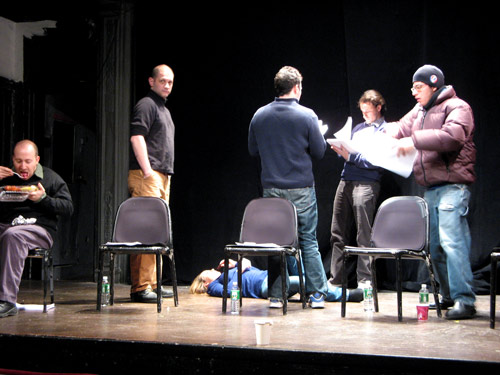
Back at the Rattlestick Playwrights Theater on the final day of the Dirty Works Festival, featuring staged readings of new works and works in progress. 

We took our seats early, which afforded us the opportunity to observe the players before showtime: one lounging on the floor stage right, another scarfing down his dinner, the others taking last minute notes from director Lou Moreno and playwright Sam Marks. Fellow alum GK was in the ensemble again, and in fine form, playing a character slightly less unbalanced than the last time.  Slightly.

The Real Deal

Super Bowl Sunday 2007

At the Public Theater for this month’s installment of 365 Days, 365 Plays — the yearlong, nationwide staging of works by Suzan-Lori Parks, who wrote one play a day from Nov. 13, 2002 to Nov. 12, 2003. (Hence the festival’s title.) Beginning November 13, 2006, nearly 700 theaters in more than 30 cities around the country began presenting Park’s plays. The drama experiment was the subject of features on both NPR and PBS.

Parks is the author of nine full-length plays, including Topdog/Underdog for which, in 2002, she became the first black woman to win the Pulitzer Prize for Drama. She is also the recipient of a MacArthur Fellowship genius grant.

I had missed out on the last two installments, so this time around I made sure to arrive at the theater early enough to secure a seat. No problem at all: the bone-chilling cold seemed to have kept many people at home that afternoon… plus there was that whole “Super Bowl” thing going on…

The 365 plays are distributed among theater companies in one week batches; the selected groups produce their own seven-play assignments, and the first Sunday of every month through mid-November 2007, the Public hosts a show in which each of the previous four weeks’ worth of plays are presented in one sitting.

So this afternoon, I sat back to take in 29 plays over two hours — Parks wrote two for Groundhog Day, naturally. The pieces varied widely in length and in subject; so too did the staging concepts by the 4 (of 65 participating) New York City theater groups: The New Group, Clubbed Thumb, Ars Nova and Barrow Street Theatre. Some scripts featured just two characters, others entire companies; some were acted out on a barren stage, others featured elaborate AV props and musical numbers; some pieces seemed date-specific, others were set in the distant past, or in an alternate reality.

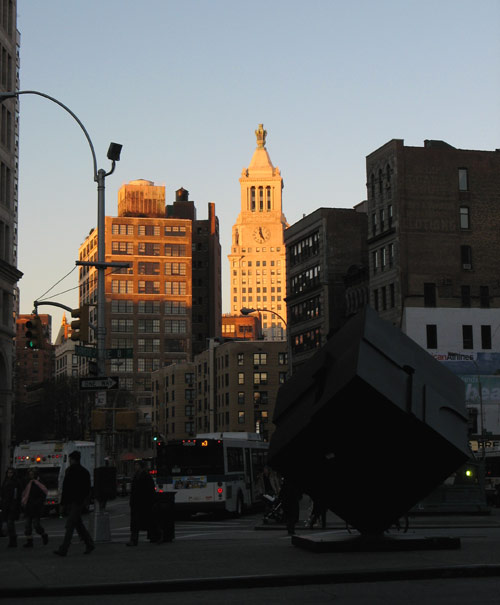
Astor Place at dusk, the site of an 1849 riot in which 22 people were killed outside the old Astor Place Opera House after a performance of Macbeth — the result of an ongoing thespian quarrel that catalyzed latent class tensions in 19th century Manhattan.

Astor Place

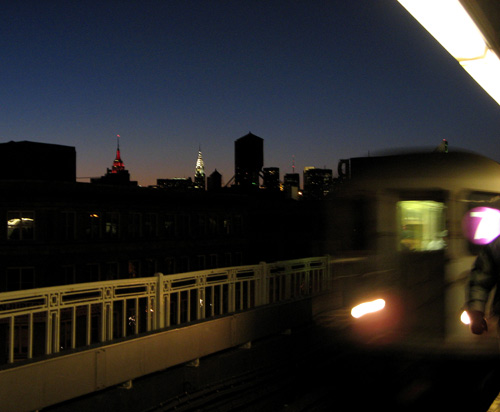
And then the long ride out to Queens for SYB’s party. Super Bowl XLI — that’s 41 for the roman-numerically challenged — Colts vs. Bears.

Queensboro Plaza

I made it to Sunnyside in time to hear Billy Joel sing the national anthem, after which I caught up with the newlyweds over cassoulet and brie. Made it through two quarters just to catch Prince’s halftime show, which was awesome, though I didn’t quite understand the random assortment of covers: Creedence Clearwater Revival, Bob Dylan and the Foo Fighters (?!) But The Artist can still shred a mean guitar, and by “Purple Rain” — in the rain! – I was glad I stuck it out, phallic shadow show or no.

Oh, the drama.

First Saturday at the Brooklyn Museum

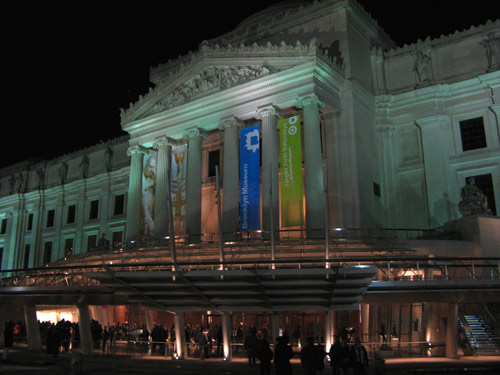
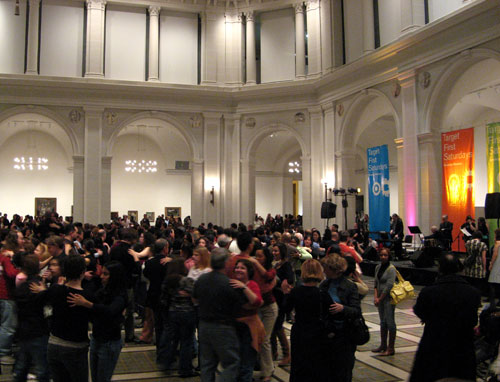
The Brooklyn Museum of Art hosts a popular event the first Saturday of every month, during which the museum schedules a range of events, from lectures to musical performances to films to dancing — all free and open to the public. The galleries remain open until 11:00PM on that night, drawing crowds from all around the city. For years, I’ve missed out on this great tradition, but a series of changes suddenly freed up my weekends, opening up a whole new range of possibilities.

It was the first time I’d been back to the museum since just after the Polshek Partnership Architects plaza redesign during that cruellest month in 2004.

Brooklyn Museum

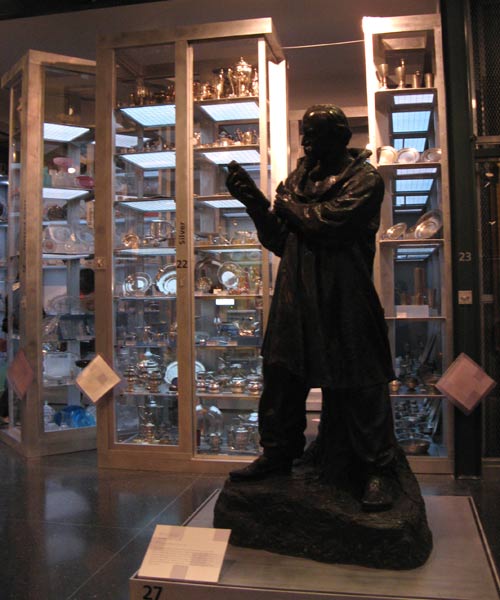
The museum was jammed with visitors: endless lines for the coat check, the café, the elevator… Tonight’s movie was one of my favorites, but we passed on the crowds to wander the galleries instead. Here, a part of the museum I’d never seen before: the Visible Storage Rooms — crammed floor to ceiling with encased treasures.

Brooklyn Museum Storage Room

This was the last weekend of London-based model artist Ron Mueck’s solo exhibition, after which the pieces would be traveling to the National Gallery of Canada in Ottawa (March 2 — May 6, 2007.) The visceral ultra-realism of the sculptures offered uncompromising facsimiles of the human form right down to their skin, hair, teeth, nails and facial expressions. Overscaled figures loomed threateningly large and almost grotesque (“Unititled” (Big Man), “Wild Man,” “A Girl,” the “Mask” series); I found myself both disturbed and moved by “Dead Dad”, which cast a pitiable, vulnerable figure, and the delicate miniature Spooning Couple. Like others, I stood quietly riveted before the two tiny, curled figures, pondering what it is to be human inside our isolating skins, in such close proximity to another, yet so achingly alone.

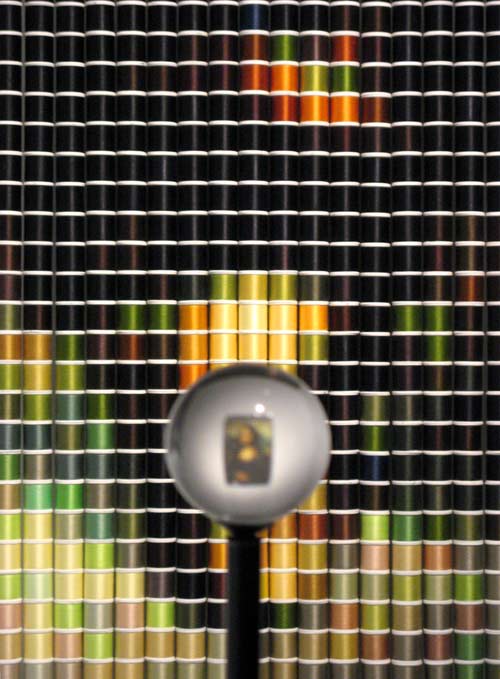
Downstairs, the Devorah Sperber exhibit (on view through May 6, 2007) was creating quite a stir. Oohs and ahhs (and some murmurs of confusion) filled the gallery where the New York-based artist’s multi-colored thread spool installations were on display. The large-scale installations explore personal vision and optics, light and perception, using ordinary objects to function as low-tech pixels. Viewers first perceive the spools of thread as a random arrangement of colorful cylinders, in front of which Sperber places a clear acrylic viewing sphere, to invert the image and condense the colored pixels into a recognizable image.

Here, “After the Mona Lisa 1”, which incorporates 425 spools of thread:

Sperber Mona Lisa

Also included are full-scale recreations of Leonardo da Vinci’s “The Last Supper” and a more detailed “Mona Lisa”, Picasso’s portrait of Gertrude Stein and van Eyck’s “Man in a Red Turban”.

Smiling faces and sore toes in the Beaux Arts Ballroom, where a swing lesson was in full… uh, progress. The dance party that followed would last through the end of the night, with music provided by the Lapis Luna Orchestra.

Brooklyn Museum Dance Party

A night in DUMBO

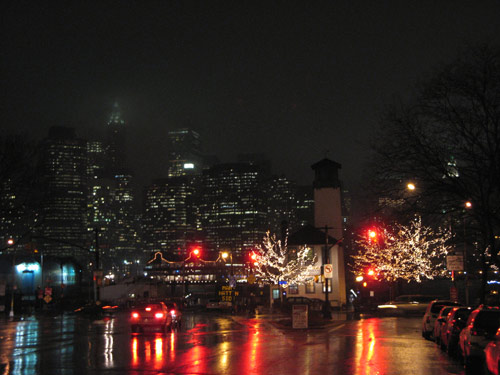
Just after knocking off of work for the week, I met up with SYB and JC, and the three of us hopped the 2 into Brooklyn. Slowed slightly by injury, we made our way through foggy, rain-slicked sidewalks to the Fulton Ferry Landing area between the Manhattan and Brooklyn Bridges for dinner.

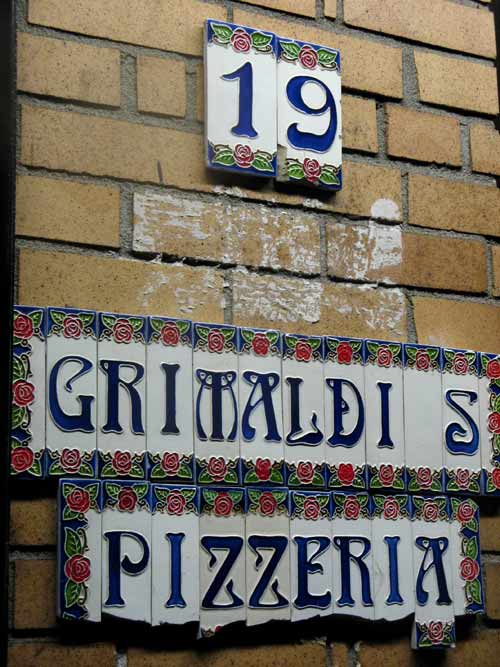
Grimaldi’s Pizzeria on Old Fulton Street is consistently rated by Zagat’s among the top pizzas in the city. The pizzeria was founded in 1990 by Patsy Grimaldi, a nephew of Patsy Lancieri (the man behind the original Patsy’s in East Harlem) — but has the look and feel of a place far older. On fine days, the line stretches down the block for the coal-oven pizzas — no reservations, no delivery; tonight, the early dinner hour and inclement weather kept most of the crowds away.

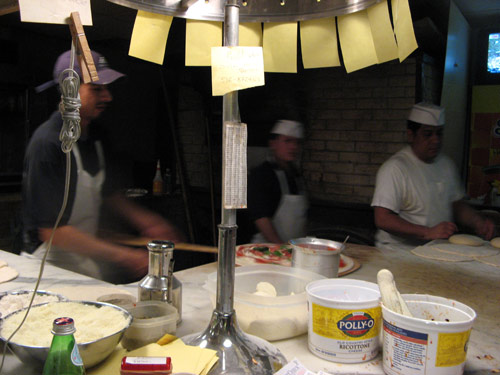
Inside, the scene was all red-checkered tablecloths and Sinatra memorabilia; Johnny Cash rumbled on the jukebox. We each picked a topping and within mere minutes, the pie arrived at the table, steaming hot and perfectly charred. Fresh, homemade mozzarella, crushed basil-infused Italian tomatoes, onions, roasted peppers, black olives… and that crust! Crispy, smoky and chewy all at once — it set the pizza on a different plane. We sat blissfully chewing as the rain-dampened crowds trickled in around us, considering whether we’ve ever had better. I don’t think so.

Grimaldis Sign

Grimaldis Pizza Makers

In better weather, Grimaldi’s pizza is the perfect way to cap off a walk over the Brooklyn Bridge. And, according to one of the framed articles on the wall, a marriage proposal.

Which brings me to the main reason for our trip: MW and MA’s engagement party. The rains had tapered off by then, and bellies full, we strolled into DUMBO along cobblestone streets, past the galleries and funky boutiques. The affair was being hosted by a friend of the couple’s in one of the swanky warehouse conversions overlooking the waterfront, in a building known for both its striking lobby sculpture and its rodent problem. (Eek.)

The apartment itself was stunning, offering a swell space in which to mingle among the other guests, including one whose path I must have crossed many, many times, yet never met until this night. One of those serendipitous New York moments. It called to mind the opening lines of ABC’s Six Degrees : “In New York City, they say you walk by the person you are going to marry three times before you even meet them.” Aside from the use of the amorphous “they” — which irks me — the idea is intriguing, if unprovable. Perhaps the reason I’m attending engagement parties (and not hosting them) is because I don’t walk the streets enough.

Or perhaps it’s because I quote indefinitely hiatused J.J. Abrams shows.

Old Fulton Street

(New) Wonton Garden

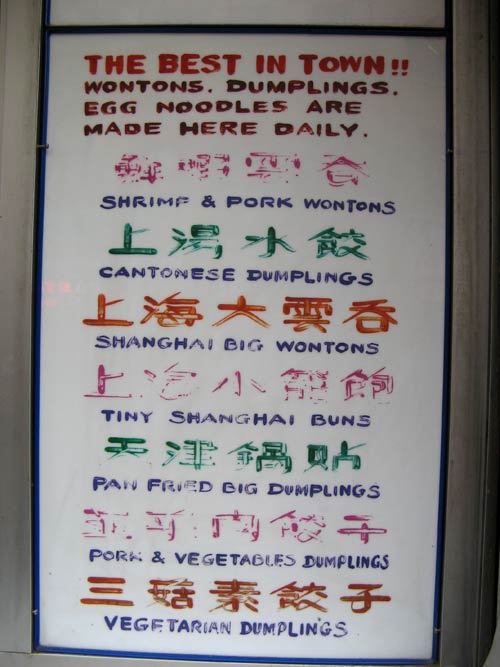
My new Thursday afternoon ritual: lunch in Chinatown. New Wonton Garden has been a fixture on Mott Street for over a quarter of a century. (I’ve heard rumors of some graduate students from New Jersey driving into the city just for those noodles in the 1980s.) A sign outside the restaurant touts their daily made wontons (natch) and dumplings as the best in town.

Wonton Garden Sign

I don’t recall if “New” was always part of the restaurant’s name; for as long as I can remember, it’s always been just “Wonton Garden” to me. In any case, there’s nothing particularly new about this utilitarian noodle shop: the bright fluorescent lighting, the perpetually steam-clouded windows, the close-set formica tables, all speak to a lack of concern for decor that you’ll find at just about any restaurant in Chinatown. The food is fresh, fast, cheap, and consistently good — what else do you need?

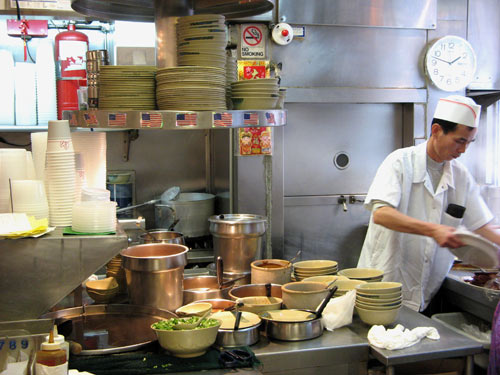
Most of the kitchen is in the front window — a stoveless area laden with tubs of hot broth, wire cages of noodles, and assorted soup fixins. It seems to be carved out of the dining area, which is comprised of an irreguarly-shaped room about the size of a Manhattan one bedroom apartment. There’s usually just one man working among the bowls piled high, waiting to be filled with noodles, wontons, dumplings and fishballs. Presumably there’s a full kitchen hidden away downstairs.

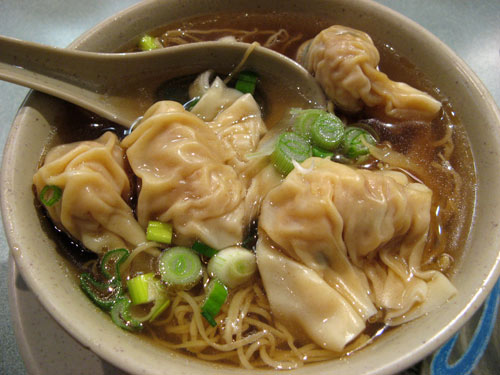
Wonton Garden Dumplings

Wonton Garden Kitchen

A recent article in the The Phoenix queried several Boston-area chefs about their “yardstick dish,” the single dish they use to guage a restaurant’s quality. The dish — or component of a dish– is usually rather simple to prepare, e.g., roast chicken, caesar salad, spaghetti with fresh clam sauce, which suggests a chef’s mastery of the basics. At Japanese restaurants: sushi rice. At Italian trattorias: the risotti. And at Chinese noodles shops, that dish could be the wonton noodle soup.

The wontons here at New Wonton Garden are delicate, flavorful, tender-skinned lumps of fresh shrimp, shiitake mushroom and pork. The thin, toothsome noodles arrive steaming hot, after being dunked in their broth just ten feet away. Simple. Perfect. Best in town? Quite possibly.