vip in the city, page 49

We love Liev

February 18 post:

Thanks to EB’s connections, we scored tickets to actor-playwright Eric Bogosian’s Talk Radio at The Longacre, which opens officially on Broadway March 11. (And thanks to DB, I now know a little more about Actors’ Equity rules and what it means to be in previews.)

The play stars Tony winner Liev Schreiber as controversial late night radio host, Barry Champlain. Talk Radio debuted at The Public Theater in 1987, with the playwright in the starring role. In 1988, it was made into a critically well-received film, directed by Oliver Stone. Bogosian loosely based his play on the 1984 murder of radio host Alan Berg.

Schreiber is the foremost American Shakespearean actor of his generation, as evidenced by his decade-long partnership with the Public, for which he took on the roles of Macbeth, Hamlet, Iago and Henry V among others. On stage, he is a large, imposing presence — fiery, dynamic and completely riveting. The play belongs to Schreiber; he is on stage for almost the entire time, enraging the show sponsors, his callers, his call screeners, his station manager and his producer/sometime lover (played by Bogosian’s fellow Law & Order alum, Stephanie March, a.k.a. Mrs. Bobby Flay.)

With its disturbing (and disturbed) callers and tough themes, the play itself is far easier to respect than to love. Schreiber, as always, is spectacularly and grotesquely raw in his embodying portrayal of Champlain; even in his dark, silent moments — quaking with frustration, compulsively smoking his endless chain of cigarettes or snorting lines of coke, just off the main spotlight — Schreiber commanded this audience’s rapt attention. His character seemed to represent the id in us all, which left to run rampant, feasts on our desire for invincibility, only in the case of Champlain, to crumble tragically as he glimpses into the isolation and fragility of the world he has created. It’s a performance that was at turns raging, cruel and vulnerable. (One hopes that Schrieber is somewhat less scary and intense in person.)

If the context of the call-in radio show feels dated, it is perhaps a by-product of how times have changed since the play’s introduction two decades ago. It’s a problem that also arguably plagued Bogosian’s 2006 revival of subUurbia about grunge-era disaffected teens.

Is it ironic that the initial radio ads for Talk Radio were banned from radio?

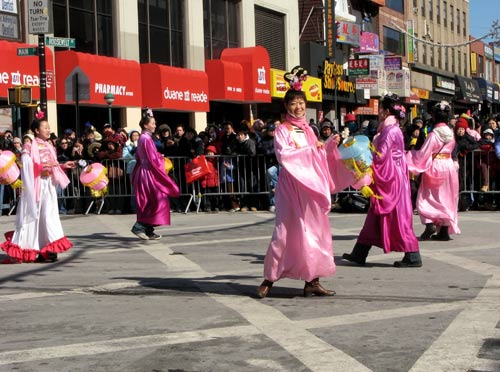
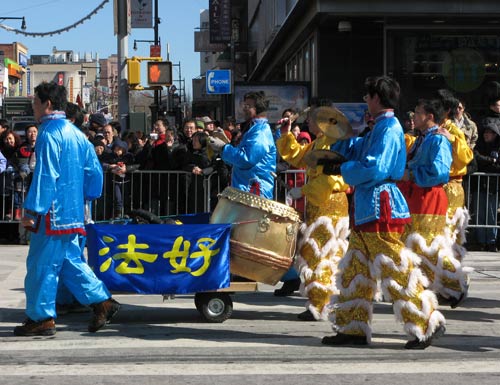
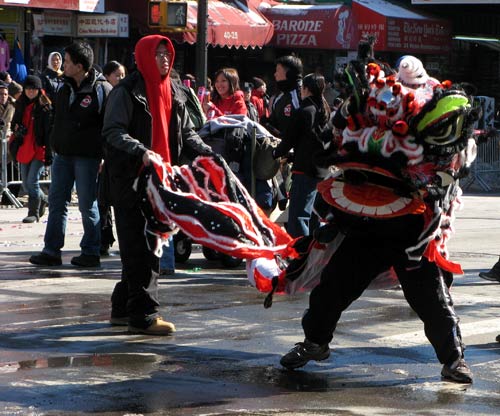
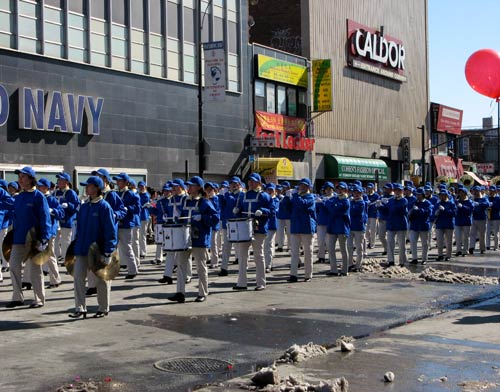
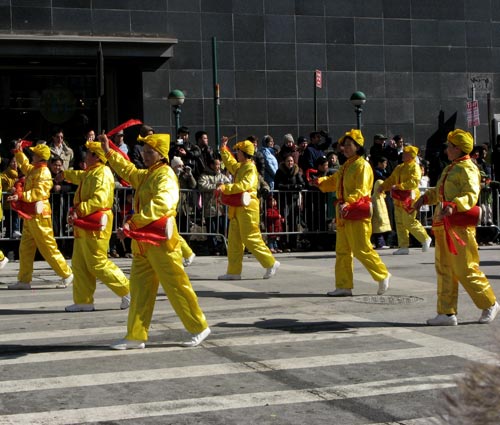
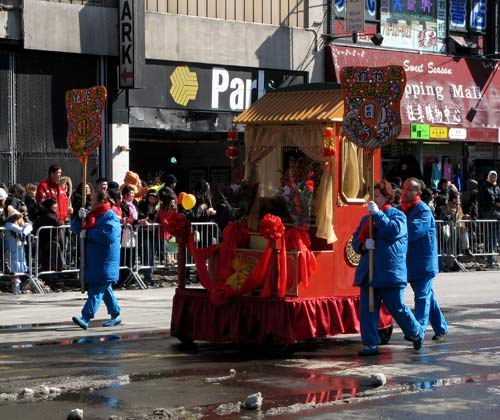
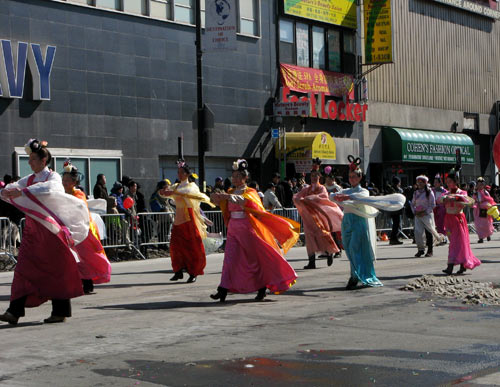
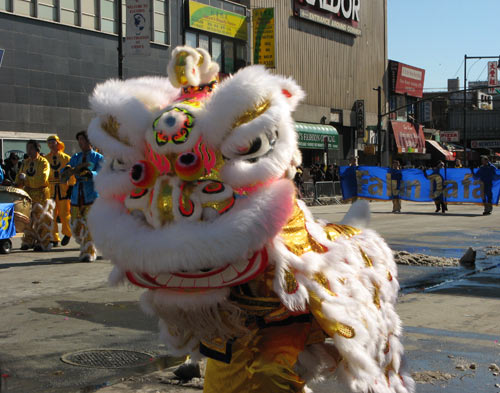
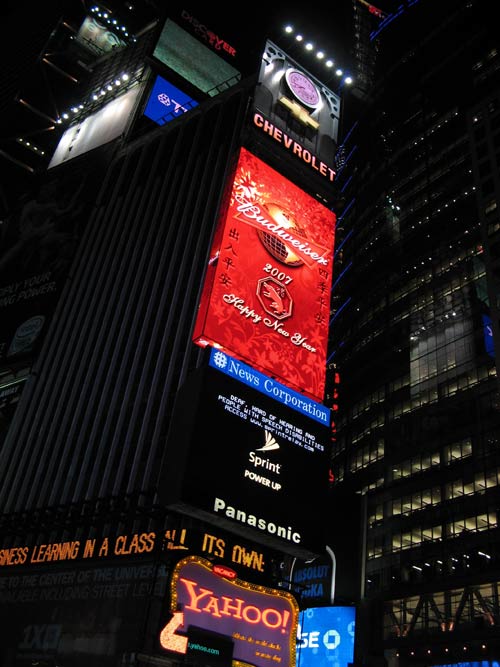
No midnight countdown to the Year of the Pig, but Times Square still commemorates the occasion in its own way.
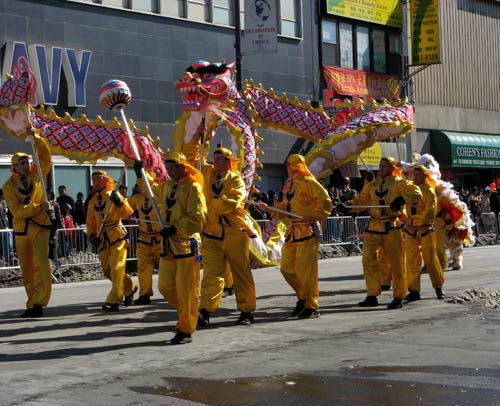
Happy Chinese New Year

A pair of parties

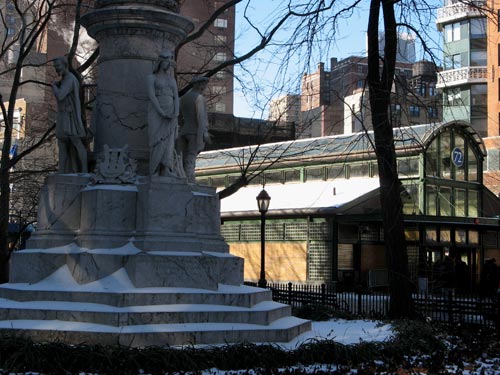
After weeks of drama, the day finally arrived for TL and LN’s farewell reception. The luncheon ended on a sweet note with a custom cake from Fairway Market, which was the best choice, given our extremely limited budget, and need to accommodate various food allergies (chocolate) and dietary requirements (kosher). Ah, good ol’ Fairway. By pre-paying the order earlier in the week, I managed to avoid most of the morning crowds already forming at the registers. But getting that immense white cardboard bakery box to the station along snow dusted streets, and then downtown on the subway during rush hour, was another matter entirely. Comical, actually… but only in retrospect.

72nd Street Station

Best of Luck Cake

Next time, perhaps we’ll try the custom cakes at Billy’s Bakery in Chelsea or Umanoff & Parsons in TriBeCa. And spring for the delivery service.

After work, party # 2:

After several big birthday blowouts, SYB decided to keep the festivities low-key this year with drinks and dinner among his nearest and dearest, which also included JL (x2), AH, RV, AB and of course, HYB. I wore my “Team Servilia” tee for the occasion because, you know, “Atia is a Tramp.”

I had recently won a happy hour at Stone Creek — $10pp open bar! – so the stars seemed aligned to make Curry Hill the starting point for the evening’s plans.

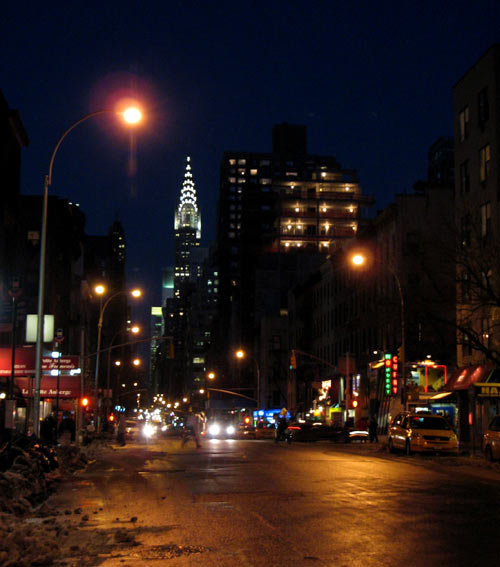
Curry Hill

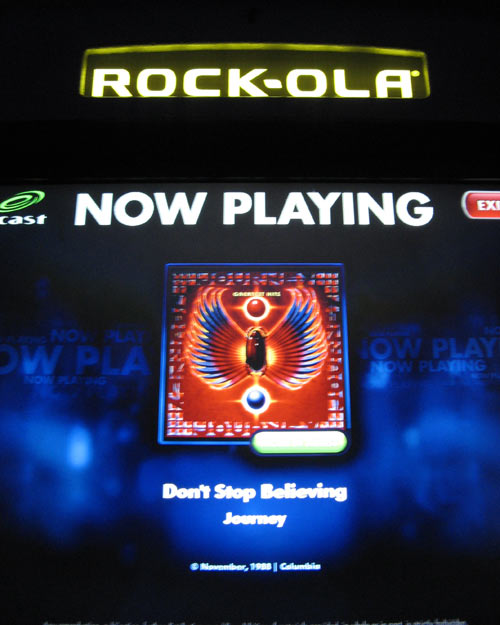
After some remarkably efficient imbibing, we made our way over to Bamiyan, chosen based on the success of previous outings and for its proximity to Stone Creek. We could not, however, walk out those doors without dropping a pair of quarters into the jukebox, branded awesomely enough, Rock-ola. Don’t stop believing!

Don’t Stop Believing

Over tasty and mostly vegan Afghani food, the table talk turned to lookists. We determined that SYB may be one, but that actress Mischa Barton almost surely isn’t. (I’ll spare you all the photographic — read: pornographic — evidence. You’re welcome.)

Happy birthday, SYB!

Wonton soup for the soul

Another Thursday lunch in Chinatown. Earlier this month, New York magazine named New Chao Chow on Mott Street as one of the best places to go for “slurping down some wontons” as part of a larger feature on all things Chinatown. Chaozhou (or “Chiu Chow” as it is known in Cantonese) is a city in eastern Guangdong province, 150 miles northeast of Hong Kong. Chaozhou refers to the dialect of Chinese and to the cultural group. Over the centuries, Chaozhou emigrated to Thailand, Vietnam, Singapore, Malaysia and Cambodia, forming their own distinct communities in each country. While the decades immediately following the 1950s were ones of generally restricted or controlled migration from mainland China, there was a notable exodus by those fleeing the communist rule into Hong Kong. Refugees from Chaozhou, in particular, converged and settled into their own enclaves among the Cantonese in the British colony.

The dialect may be different, but “chiu chow” cuisine is rather similar to Cantonese, and is notable for its delicacy, fresh ingredients and piquant flavors, particularly in its seafood and vegetarian dishes. New Chao Chao specializes in the cuisine of this region. Another chiu chow restaurant I like is Chao Zhou in Flushing — across the street from the Queens Borough Public Library, and immediately identifiable by the immense red bowl on its roof.

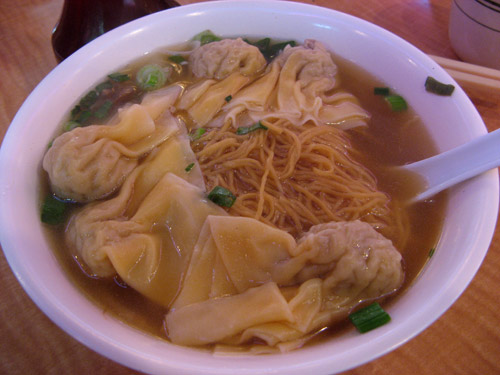
In his New York Times piece on the city’s best chicken soups, Ed Levine named New Chao Chow’s “the greatest wonton soup that I’ve had in New York,” citing its “amazing golden broth” which “doesn’t need either its fabulous wontons or its fresh cilantro and scallion garnishes to enter the Chicken Soup Hall of Fame on the first ballot.” On his site, he declares the soup one of the best eating bargains around the country; I paid $4 for a large bowl of the house wonton noodles soup.

Robert Sietsema of the Village Voice dubbed New Chao Chow the place for “Choicest Chiu Chow” in his 2004 roundup.

The wontons, to my taste, were just fine — not much better or worse than most one would encounter at any of the long-standing noodle shops in Chinatown. (But that’s pretty good indeed.) I agree with those who noted that the broth is what distinguishes this bowl above some of the others — light and immensely flavorful, and tasty enough to stand on its own.

New Chao Chow wontons

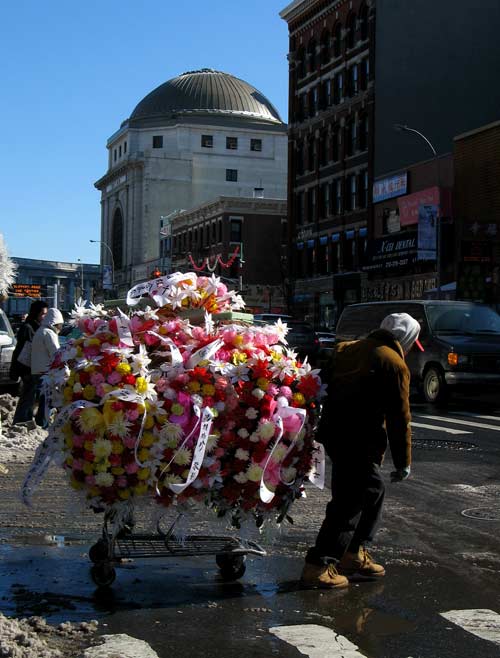
Special delivery — perhaps for the Lunar New Year Flower Market in Columbus Park (February 16-17)? Maybe next year.

Chinatown flowers

Love Lost readings

From February 8 through February 14, Altoids opened a pop-up Curious & Original Chocolate Shoppe on Bleecker Street to celebrate the launch of its new Altoids Dark Chocolate Dipped Mints.

On Valentine’s Day, the company partnered with the nonprofit writing lab and free tutoring center 826 NYC (local chapter of the Dave Eggers-founded organization, 826 Valencia) to host a special night of “Love Lost Readings,” expressly for those seeking a literary respite from the Hallmark-manufactured madness.

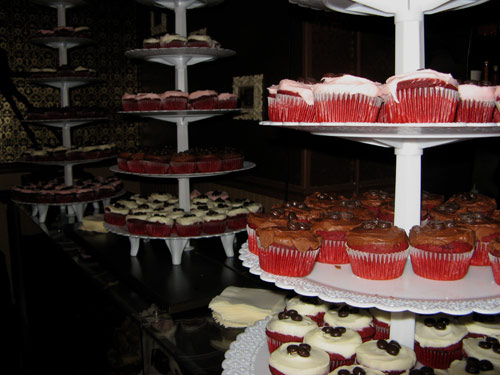
Attendees sampled the dark chocolate mints (pretty good!), tiers of red velvet cupcakes, copious glasses of wine and artistically presented cups of espresso drinks by baristas from independent coffeehouse Ninth Street Espresso.

Red Velvet Cupcakes

Andy Selsberg, contributor to The Believer, The Village Voice and GQ, described the most dysfunctional relationship ever. Starlee Kine, contributor to NPR’s wonderful This American Life, read her New York Times break-up piece from 2006. Leo Allen, stand-up comedian and prolific reader, added some levity to the love-weary festivities, and for the finale, author Jonathan Ames read terribly funny and terribly sad excerpts from his new book, I Love You More Than You Know.

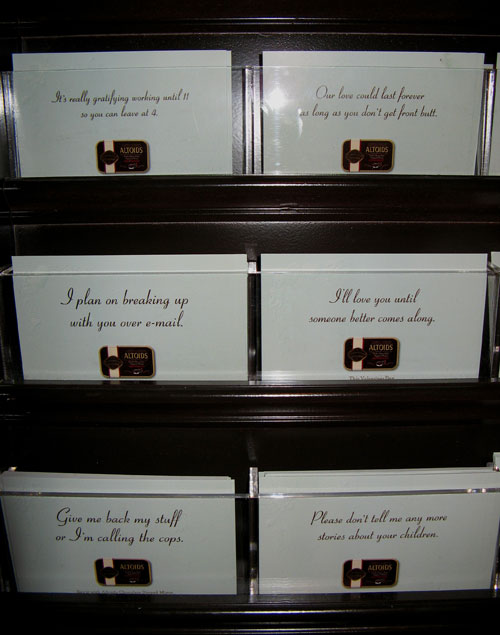
For the event, Altoids printed up a selection of glossy postcards with tongue-in-cheek takes on traditional Valentine’s Day messages, suitable for a recent or imminent break-up: “I’ll love you until someone better comes along,” “We’d be made for each other if I were a jerk,” “It’s you. Not me,” “Another day closer ’til death does us part,” and my personal favorite, “I plan on breaking up with you over e-mail.

Love Lost Cards

You can laugh or you can cry.

Eugene Onegin

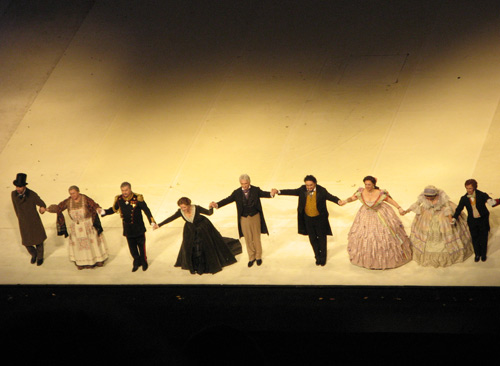
Tonight, the final opera of our Met season series, and the production with which I was least familiar: Eugene Onegin. In fact, we exchanged what had been tickets to La Bohème from last November, drawn to this particular show by the female lead casting of beloved soprano Renée Fleming as Tatyana.

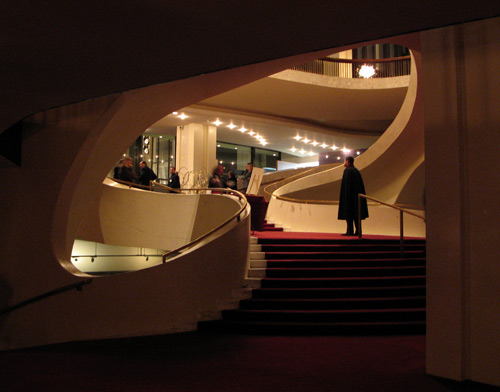
Pre-Opera

Until then, having never read Vladimir Nabokov’s celebrated four-volume English translation, I had only the most general plot outlines of the 1833 epic poem by Aleksandr Pushkin – whom many consider to be Russia’s greatest poet and the founder of modern Russian literature. I’d never even seen the film adaptation starring Ralph Fiennes as Onegin and Liv Tyler as his girlish admirer (though it seems I’m not really missing out there.)

Surely Fleming’s star draw was also one of the reasons the Met selected the Saturday February 24 matinee of this production for its live high-definition broadcast in some 150 screening theaters from Los Angeles to London.

Eugene Onegin presents an overview of traditional early 19th century Russian society, which Piotr Ilyich Tchaikovsky’s score adapts to the shifting scenes: from the countryside of rural gentry to the glittering ballrooms of St. Petersburg imperial aristocracy. Although Tchaikovsky’s most enduring and popular performance works are his ballets (Sleeping Beauty, The Nutcracker and Swan Lake), Eugene Onegin is his best known operatic work and has secured a place in the standard repertory.

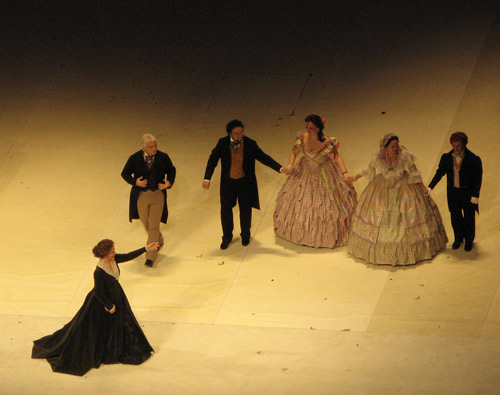
The sweeping dramatic arc of this opera — youthful longing, crushing rejection, deep regret — and Tchaikovsky’s swooning score seemed a natural match for the big screen. Less so Michael Levine’s exquisitely minimalist set. Barren, almost austere, floor and walls, swirling golden leaves, sparely but purposefully furnished period style rooms, wonderful, glowing lights… the overall effect was simply gorgeous when taken in from even our seats at the very rear of the opera house. I wondered, though, how the impact would translate to film and in close-up.

The performances, no doubt, would more than compensate for any production shortfall there. Ah, Renée!

Eugene Onegin Cast

Eugene Onegin Cast

The opera was sung in Russian (naturally) and I was very excited to have been able to pick out the phrase, “Ya lyublyu vas,” – “I love you” — from Lenski’s Act I aria. I’ll get back to my studies yet.

“Heaven grants us habit in place of happiness.”

I'd like to thank the Academy...

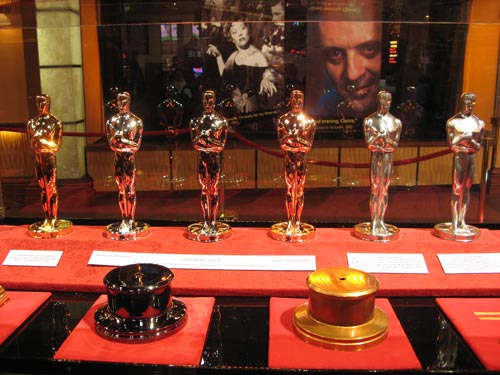
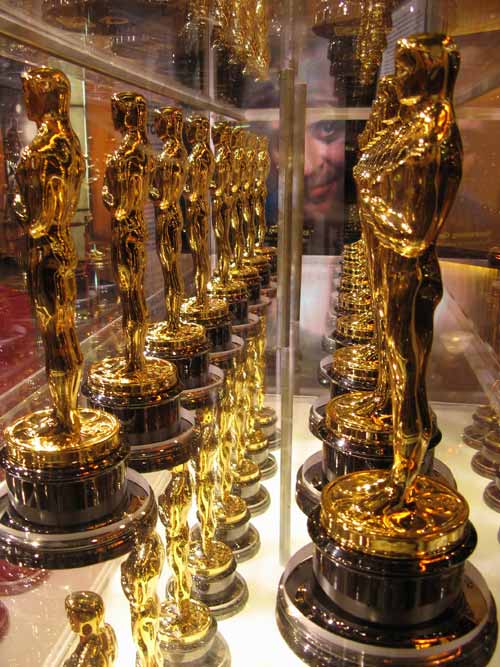
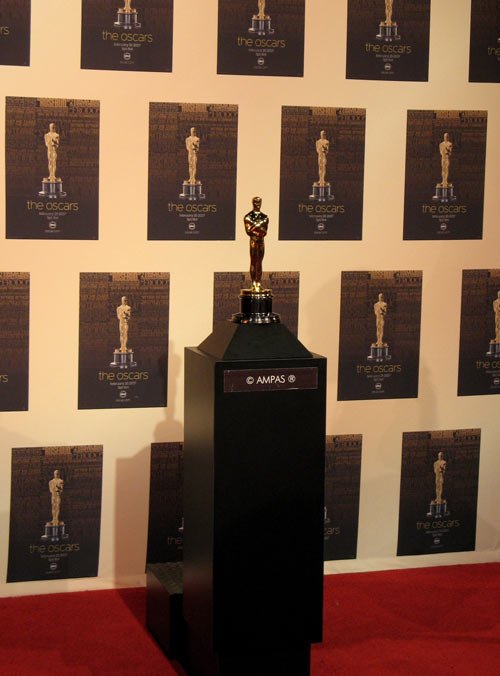
From February 12 through Oscar Saturday, February 24, the Academy of Motion Picture Arts and Sciences displayed for public viewing 50 newly minted Oscar statuettes in New York at Times Square Studios, home of ABC’s Good Morning America.

Oscar Evolution

Oscars Case

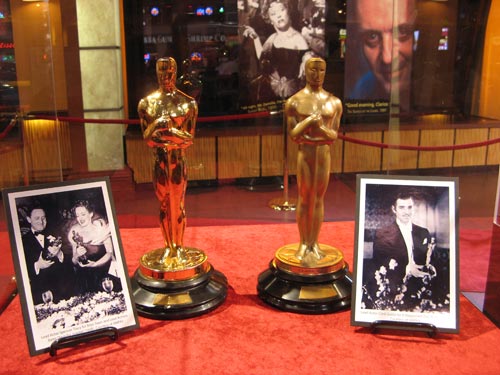
Included in the “Meet the Oscars” exhibit were two statuettes previously owned by Hollywood legends Bette Davis and Clark Gable. Academy Award winners are required to sign a waiver, preventing them from ever selling their award. To dispose of an unwanted statuette, owners must sell it back to the Academy for $1. Oscars awarded before 1950 — including the two on display here — are exempt from the rule. In 2001, Steven Spielberg paid $578,000 for the Oscar Davis won for Jezebel  in 1938, with the express purpose of returning it to the Academy. Five years earlier, Spielberg bought Gable’s 1934 Oscar (for It Happened One Night) for $607,500, returning that statuette to the Academy as well. (Each of these was a relative bargain compared to the $1.54M Michael Jackson paid at auction for David O. Selznick’s producing Oscar for Best Film Gone With The Wind  (1939).

Davis and Gable Oscars

Oscar stands 13.5 inches tall and weighs a surprisingly hefty 8.5 pounds. The best part: the Academy made one golden statuette available for members of the public to pick up and hold (and perhaps fantasize a little bit.) How could I resist?

Oscar

On Oscar Sunday, I was thrilled to see New York filmmaker Martin Scorsese win his long overdue Academy Award after three decades and seven previous nominations — five for directing (Raging Bull, The Last Temptation of Christ, Goodfellas, Gangs of New York  and The Aviator) and two for screenplays (for co-writing Goodfellas  and The Age of Innocence.)

In his acceptance speech, Scorsese remarked of his drought:

I just want to say too that so many people over the years have been wishing this for me. Strangers. You know, I went walking in the street, people say something to me. I go in a doctor’s office, I go in a whatever. Elevators, people saying, “You should win one, you should win one.” I go for an X-Ray, “you should win one.”

So typical of New Yorkers!

Hail, hail Freedonia (and French toast)

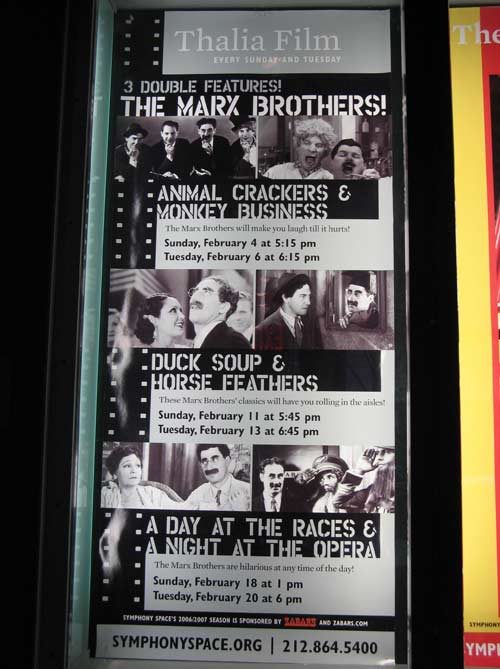
For the past several weeks, SYB had been tantalizingly tight-lipped about a surprise awaiting me this afternoon. When at last the day arrived, I was treated to a homemade Sunday brunch of challah french toast and crispy bacon — not part of the surprise — which I happily devoured with the B brothers while playing television catch-up.

46 Bliss Street

I inadvertantly spoiled everything by figuring out our destination just as we were setting out — probably because I already had the Marx Brothers on the brain. SYB seemed so crestfallen that I was tempted to continue claiming ignorance, but I sensed that my acting skills wouldn’t quite hold up during the long subway ride into Manhattan.

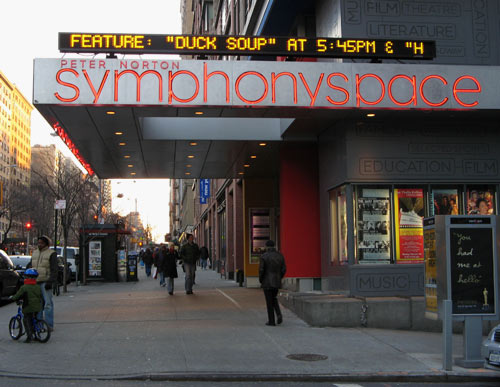
Still, the outing was no less diminished by my pre-knowledge: I’ve loved Duck Soup since childhood; J, J and I rewatched the film so many times — guffawing hysterically at the same corny jokes each time — that each of us could probably even now, decades later, recite most of the dialogue and songs verbatim. As Roger Ebert has noted, “to describe the plot would be an exercise in futility“; indeed, there is political satire, strategery, espionage, treason, nationalistic jingoism, musical numbers, romantic rivalry, international warfare… and not all of it quite ties together in a cohesive narrative. No matter: in this theater full of Upper West Side families, the near constant screaming laughter of young children stood testament to the film’s broad, continuing appeal.

Rewatching Duck Soup as an adult, I recognized once more how some of the jokes are not really all that appropriate for younger audiences. Some of the saucier/misogynistic bits surely escaped our grade school notice in the rapid-fire stream of one-liners and zany comedic bits. And sequences like the famous and famously mimickedMirror scene” require no measurable level of sophistication to appreciate. No wonder that the film was named one of the funniest American films of all time by the The American Film Institute (AFI) in 2000.

Symphony Space Duck Soup

Marx Bros Features

Sitting outside the theater, finishing off my contraband beverage before the double feature, we randomly crossed paths with AC, whom I hadn’t seen since our high school reunion last June; the time before was the reunion five years prior to that. Funny how through those six years of shared classes, I never realized that he and I also shared a common love for the Marx Brothers.

Squares, Stars, Stripes

Long Island City on Saturday morning:

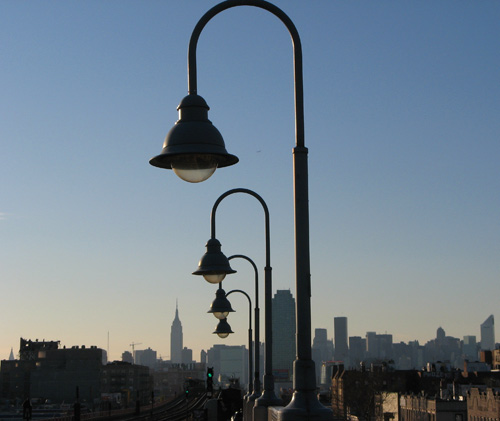
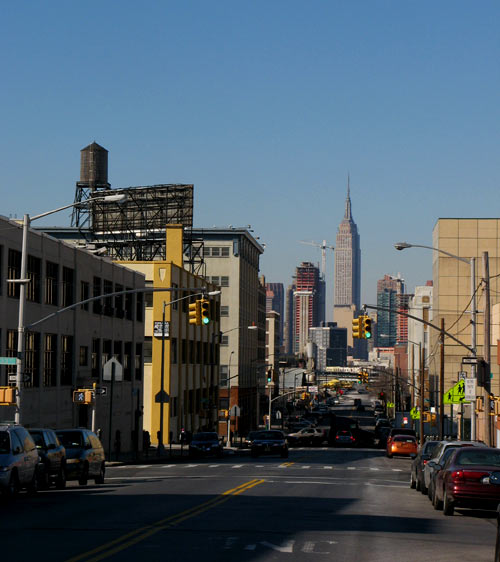
LIC View

Like many young girls, my introduction to the ballet was a class trip to see a George Balanchine production of The Nutcracker. From those sugar-plum beginnings grew a season subscription as a young adult. But as with so many things, after a couple of years, the escalating cost and scheduling logistics became too much to manage. The Philharmonic, the Opera, assorted theatrical productions… it’s the best and worst thing about New York City: so much to do, so little time.

But tonight, I was back after a few years hiatus. The name of the program — new to the NYCB repertory — was Essential Balanchine: Square Dance, performed to a selection of Antonio Vivaldi and Arcangelo Corelli songs; Liebeslieder Walzer with songs by Johannes Brahms; and Stars and Stripes to the music of John Philip Sousa.

Such lovely performances. We were awed by the elegance of the Square Dance tableaux (Balanchine’s nod to American folk dance tradition) and by the beautiful, gilded ballroom set of the Liebeslieder — the four dancing couples sharing a stage with a quartet of singers and a pianist. The rousing Stars and Stripes finale was a crowd pleaser with its vibrant colors, flashy costumes, and dizzying bursts of virtuosity. With such parade patriotism on display — a baton-twirling majorette! a marching band! a kickline! — it’s not hard to see why this particular work was chosen to welcome home the former hostages upon their return from Iran in 1981.

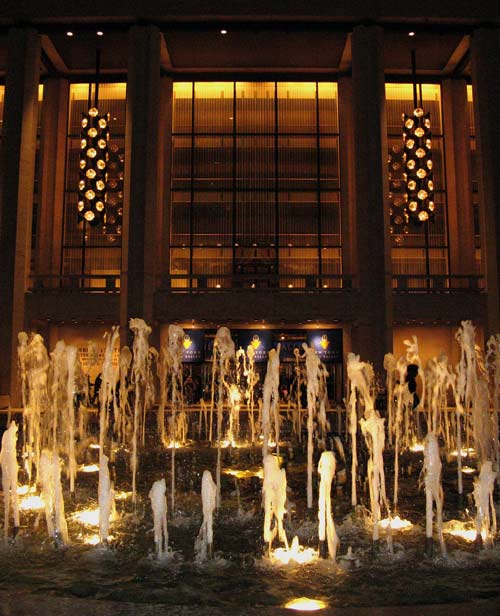
NYC Ballet Fountain