vip in the city, page 14

A Giant parade

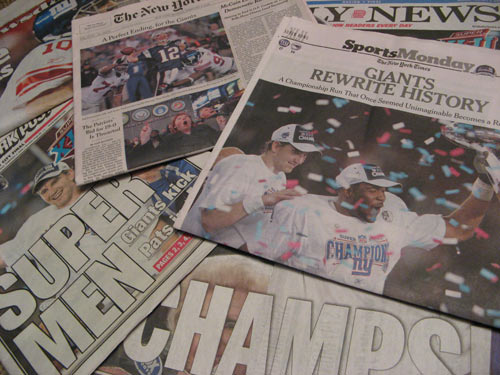
The entire city was still on a high from the New York Giants’ stunning win over the imperfect New England Patriots on Sunday night — a game seen by 97.5 million viewers, the most in Super Bowl history.

And now, on to the celebration! (People of Boston, in the meantime, cried.) On my commute into the office this morning, the subways were crammed with rowdy, banner-wielding, face-painted, blue-jersey clad fans — more than a few of whom looked suspiciously young — all heading into the Financial District for the Giants victory parade through the Canyon of Heroes.

An estimated 3 million football fans attended the ticker tape parade which began at 11AM at Battery Place and culminated with a 1PM City Hall Plaza ceremony, where winning Mayor Michael Bloomberg presented keys to the city to the team’s players, coaches and owners. Streets around the downtown parade route were closed beginning at 7AM to accommodate early-arriving spectators, some of whom began staking out spots along Broadway the night before.

The forecast was for showers on Tuesday morning, but after a few light sprinkles, our Giant heroes were deluged mostly with 50 tons of confetti and shredded paper that rained down on the donated floats. The bells at Trinity Church rang for 45 minutes — mostly drowned out by the cheering crowds — and Trinity’s rector Reverend Dr. James H. Cooper, clad in a Giants cap, offered his blessing over the procession.
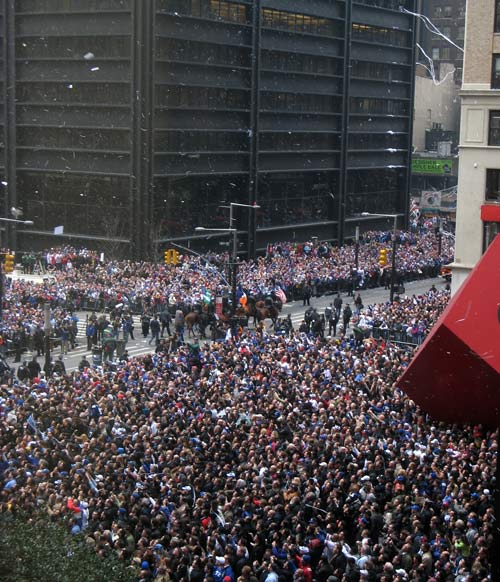
Giants parade

The Giants’ parade was the city’s first ticker tape celebration since the Yankees won the 2000 World Series, and the first ever for a Super Bowl championship. Most significantly, this morning’s parade was the first to take place in the Financial District since September 11.


Giants parade

Giants parade

Super Bowl XLII MVP Eli Manning and the Vince Lombardi trophy:

Giants parade

Of course, although the event is called a “ticker tape” parade, financial institutions no longer use ticker tape to record stock prices, as the ticker tape machines became obsolete in the 1960s. The streams of papers are more likely these days to be of the bathroom tissue variety, unfurled from oversized institutional rolls swiped from the restrooms of office buildings lining Broadway.

On the topic of defunct technology, it seems that Polaroid has quietly halted production of its signature instant cameras and film. Does that mean that years from now, kids will have no understanding of what it means to “shake it like a Polaroid picture“? Or will the phrase continue to retain relevance a laYou spin me right round, baby, right round like a record, baby, right round, round, round“?
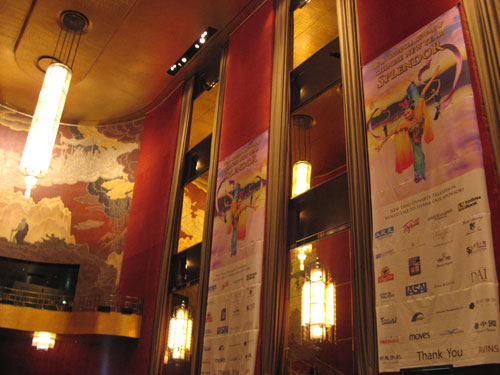
Splendor agenda

For weeks, I’d been running into the brightly costumed promoters out on the streets — by the office, near my home — and seeing the mobile LED billboard tooling around the city to advertise New Tang Dynasty Television’s Chinese New Year Splendor, which played a 15-show run over 11 days at Radio City Music Hall. Now in its fifth year, the show was performed by members of the New York-based Divine Performing Arts company to showcase 5,000 years of Chinese music, dance and culture.

I had seen the show in 2006 and found it fine, if not all that compelling, entertainment; nonetheless, when I was offered the opportunity to check out the show tonight, there seemed little reason to turn down a ticket. The venue was about a third empty tonight, probably due in part to the outrageously steep ticket prices, which soared to Young Frankenstein-esque levels of $280(!) apiece. For the price of admission, audiences could expect the usual assortment of traditional musicians and dancers, lavish costumes and dramatizations of Chinese legends. The various scenes were supported by a full orchestra comprised of both Eastern and Western instruments, played out against a backdrop of the Music Hall’s enormous LCD screen on which scrolled floating buddhas, glowing temples and pastoral landscapes.

Chinese New Year Splendor

Fan dancers, swirling scarves and ribbons, tumbling acrobatic dancers, singers accompanied by a Steinway… all pretty standard. But then, about half a dozen acts in, a startling collision of politics and culture — “The Risen Lotus Flower” depicted the persecution of Falun Gong in China: three women, peacefully meditating, coming under vicious attack by Communists, portrayed as black-clad thugs with red hammer and sickle emblazoned on their jacket backs. (No points for subtlety there.) They beat and kill one of the women, whose spirit rises to its just reward in heaven. What the…?

The change in tone was jarring, and I swiveled around in my seat to check out the reaction of other audience members. Most didn’t seem particularly surprised or disturbed, though I did note a few people walk out. The following act to this bizarre display: an erhu soloist.

After intermission, nestled among the Korean-style and Mongolian dance sets, another segment with anti-Chinese government undercurrents: “The Power of Awareness.” The Communists were back, this time attacking a mother and daughter holding up banners with the Falun Gong message of “Faithfulness, Compassion and Forebearance.”

I would have captured some of these images, but the organizers seemed particularly strict on banning photography of the show: a billboard on stage declared “PHOTOGRAPHY STRICTLY PROHIBITED” — a message reinforced in English and Mandarin announcements before each half, and by several men walking the aisles bearing “NO CAMERAS” signs. Check out videos and photos on the show site, though none feature the segments I just described.

So was I the only one caught completely unaware of the show’s agenda? A couple days later, an article appeared in The New York Times, drawing attention to Chinese New Year Splendor co-sponsors’ alignment with the Falun Gong movement — a relationship not at all clear in any of the show’s extensive advertising. Gothamist covered the controversy as well, sparking a rather heated debate in the comments section.

Chinese authorities have labeled Falun Gong a cult, outlawing its practice and even issuing a statement against NTDTV’s “so-called Gala.” Regardless of one’s views toward the Falun Gong practitioners, what is clear is that the Chinese do have a history of human rights abuses toward them, as noted with concern in reports by Amnesty International and the Human Rights Watch.

And all I was expecting to see tonight were pretty dances.

In the papers

Immediately after the Giants’ amazing Super Bowl victory last night, I was out on Columbus Avenue, taking in the spontaneous celebrations erupting in my neighborhood. At the Food Emporium to pick up drinks, it was an entirely different scene: empty aisles, and hardly an employee to be found on the floor or at the registers. As I made my way to the checkout lane, one of the cashiers hastily hustled over from the customer service station, where it seemed the entire supermarket staff was huddled around a mini-television set, jubilantly riveted to the post-game proceedings. I smiled, and with a gesture toward his co-workers, quipped, “So how about those Giants?”

He smiled back and replied in halting English, “Very good. It is a good day. A very good day.”

Yes, it is.

Giants coverage

Love (and the Giants) Conquer All

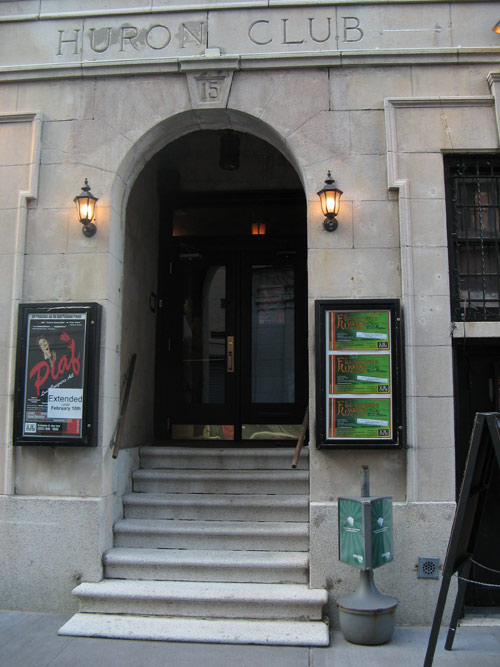
At the SoHo Playhouse this afternoon for Piaf: Love Conquers All, LVR Productions‘ one-woman show on the life of Édith Piaf, which began its Off-Broadway run on December 8. The show had been set to play downtown through late January, but due to popular demand, its run was extended by three weeks through February 10. Check out a commercial for show here.

SoHo Playhouse

Naomi Emmerson stars in the title role (as well as also being responsible for the set and costume design and stage direction) with Carmela Sinco accompanying on the piano. Emmerson grew up one of three daughters of a Quebecois Anglophone family — the only one to speak French fluently. She first performed Piaf: Love Conquers All at The Limelight Supper Club in Toronto in 1993, re-creating the role for the 2005 Toronto Fringe Festival. The show had its American debut at last summer’s FringeNYC festival, where it won an Overall Excellence Award for Outstanding Musical. Thirteen of Piaf’s songs were interspersed among the biographical anecdotes whose plot points were familiar to me from La Vie En Rose — the Piaf biopic, which earned French actress Marion Cotillard her Oscar nomination and Golden Globe win (not that anyone noticed.)

As a revue of Piaf’s songs, the show worked well; we were admonished at the outset to resist the urge to join in singing the more familiar tunes, a temptation avoided by most in the audience. Most. I was less moved by the show as a story framed around the singer’s loves and heartbreaks. Act I (“Marcel”), set in 1949 with flashbacks, closes with the plane crash death of middleweight championship boxer Marcel Cerdan, the man generally perceived to be the love of Piaf’s life. The second, shorter half fast-forwards to 1961 and features a visibly diminished Piaf – wracked by rheumatism and addiction. Her post-Cerdan lovers for the most part don’t even warrant names — the pair of cyclists, “the artist,” “the actor” — and though this act is titled “Theo,” after Piaf’s second husband Théo Sarapo, a Greek hairdresser-turned-singer and actor two decades her junior, the man seems less a great love than the singer’s last ditch hope for love at last. As in the film, the show closes on Piaf’s defiant declaration: “Non, Je ne Regrette Rien.”

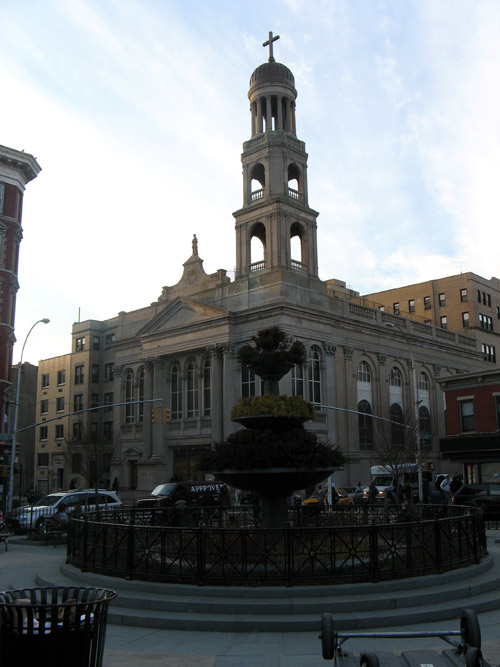
It was such a beautiful day that I decided to walk uptown. At Father Demo Square:

Father Demo Square

Sixth Avenue

As dusk approached, the sidewalks began emptying of people as everyone gathered around the communal televisions for Super Bowl XLII. By now, we all know how that turned out, no? And after our underdog Giants quarterback hit receiver Plaxico Burress for the winning touchdown with 35 seconds left in the game, following that incredible, fortune-changing Hail Manning… well, for an otherwise “miserable city,” there was an outpouring of joy in the streets.

Saturday in Saugerties

The dreaded stomach virus that has been running rampant throughout the city continued to wreak havoc on my social calendar when both gatherings scheduled for this weekend were canceled due to friends’ illnesses. (Get well soon!)

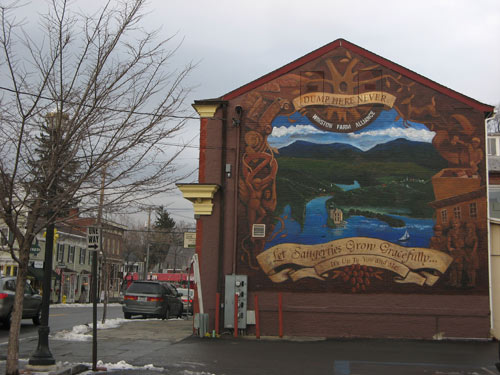
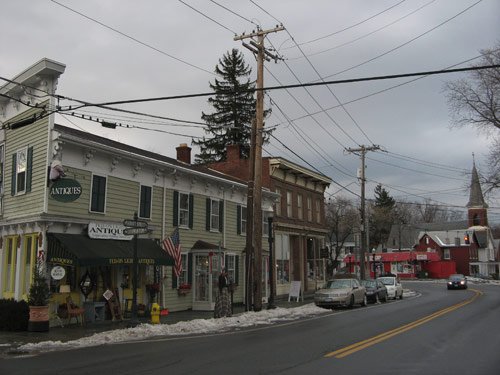
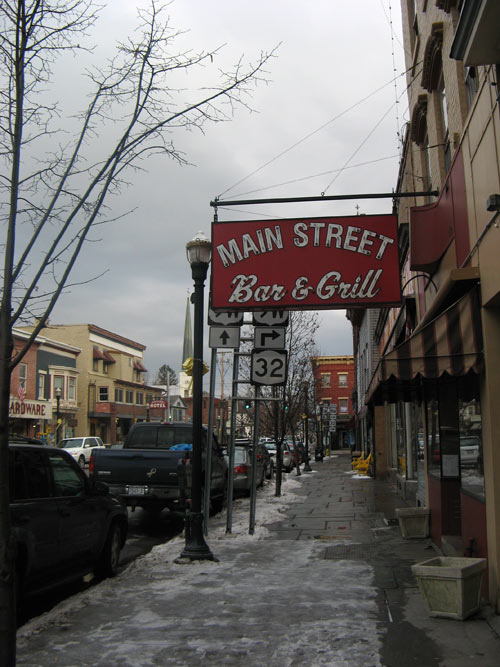
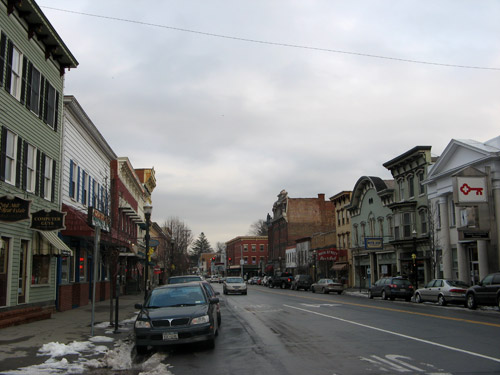
So instead, a one-day getaway to Saugerties, probably best known as the site of the 1994 Woodstock Festival revival. This quaint, historic town is located in Ulster County, in the heart of the Hudson River Valley. We were just 100 miles out of the city, but here, the streets were patched with winter snow. (Remember snow?)

Saugerties

Saugerties

Saugerties

Saugerties

In 1677, New York’s Governor Edmund Andros agreed to purchase the land which now comprises the town from the Esopus Indian tribe for the price of a blanket, a piece of cloth, a shirt, a loaf of bread, and some coarse fiber. The deal recalls a similar transaction half a century earlier, between the Director-General of the Dutch colony of New Netherland, Peter Minuit, and the Lenape tribe, in which the island of Manhattan was exchanged for 60 guilders — those 24 famous dollars — worth of beads and trinkets.

Flushing foray

So engaged over dinner at Flushing’s Spicy & Tasty that I failed to snap even a single photo the entire evening. (The one below was taken at Main and Roosevelt the following morning.) If I had, though, there would be shots of the refrigerated case near the entrance, where it was all we could do to reign ourselves in from loading up on the appetizers alone. After perusing the array of options — rabbit tendons were tempting, but Arctic surf clams don’t seem like a natural choice for a restaurant whose cuisine is based in landlocked Sichuan province — we opted finally for the “Sliced Conch in Red Chili Sauce,” the “Cucumber in Sesame Oil Sauce” and the “Sesame Cold Noodle.”

Fortified with cooling bottles of Tsingtao, we moved on from there to the “Spicy Double Cooked Pork” – a classic regional dish in which marbled slices of pork belly, i.e., uncured bacon – yes?, are boiled then flash-fried in hot, chili-spiked oil, and served over a mound of leeks. Wikipedia traces the origins of the dish to the Qing Dynasty, when a group of Sichuan villagers repurposed their leftover pork in a desperate attempt to create a feast for the visiting Emperor. He enjoyed it so much that “Twice Cooked Pork” became a signature dish of the region.

We knew we had a hit when a quick perusal of the dining room showed the same dish on almost every other table.

And then, because we could not resist, another classic: the “Smoked Tea Duck,” literally in Chinese, “camphor tea duck.” This dish is prepared by smoking a marinated and dried duck over camphor tea leaves and twigs — a process which imparts a dark color to the crisp skin and a strongly, unique flavor to the meat. Another winner, though, by meal’s end, we could hardly manage more than a couple pieces each.

And yet, somehow, there’s always room for dessert at Sweet n’ Tart. And on the ride back into Manhattan, some carefully considered discussions over where to find the best fast food in country. (Hmm, Wendy’s — really?)

Oh, I do love food — both the high and the low.

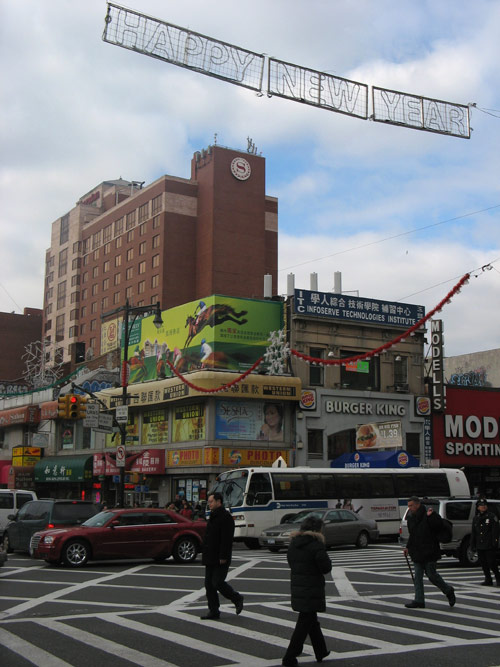
Main Street New Year

Dixieland downtown

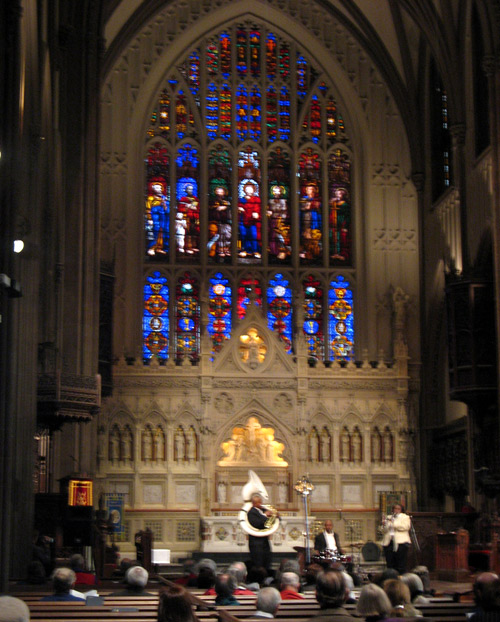
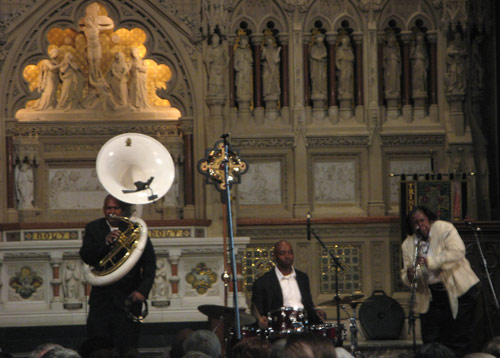
Inside Trinity Church for one of their “Concerts at One,” part of the church’s Concerts-to-Go outreach program, now in its 40th season. This afternoon’s concert featured Doreen’s New Orleans Jazz, a Dixieland jazz trio made up of Doreen Ketchens on clarinet, her husband Lawrence Henry Ketchens II on tuba, and drummer Walter Harris.

Doreen’s Jazz

Doreen has been dubbed by the press as “The Queen of Jazz,” “The Female Louis Armstrong,” “Queen Clarinet,” and “Miss Satchmo.” Their toe-tapping renditions of “Sweet Georgia Brown” (best recognized as the Harlem Globetrotters’ theme) and “Basin Street Blues” illustrate why.

Doreen’s Jazz

Prior to Hurricane Katrina, the Ketchens used to perform in New Orleans near Jackson Square; they evacuated the city with their young daughter before the hurricane hit, losing virtually everything except for their musical instruments and a few possessions.

In between performances for American presidents (according to the group’s website, they’ve played before four of them), and their work spreading the culture and traditional music of New Orleans throughout the world, they still make it back for impromptu concerts on the streets of the French Quarter.

In 2006, the Ketchens participated in Jazz at Lincoln Center’s first ever South African cultural exchange program with the Field Band Foundation, an organization sponsored by The U.S. Department of State’s Bureau of Educational and Cultural Affairs to produce performances and events to increase awareness of the importance of HIV prevention.

The Slug Bearers of Kayrol Island

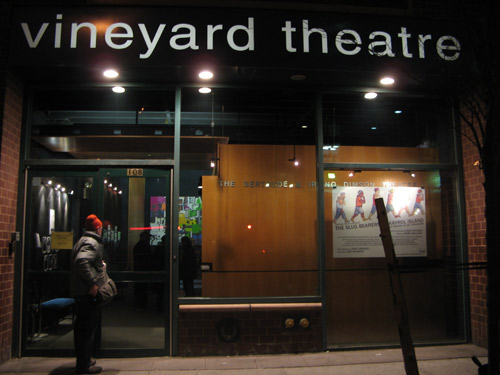
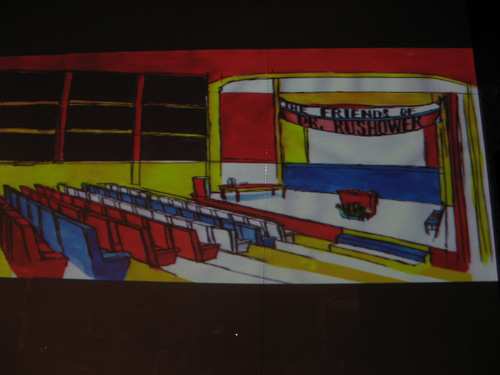
The ever-versatile and accomplished Ben Katchor is the 1995 recipient of a Guggenheim Fellowship, a 2000 MacArthur Fellow, an Obie Award winner (for his “comic-book opera,” The Carbon Copy Building), and creator of books, graphic novels, cartoon strips, magazine illustrations, and radio shows. Katchor wrote the libretto and created the animated drawings for The Slug Bearers of Kayrol Island (or The Friends of Dr. Rushower), the show I was at The Vineyard Theatre to see tonight. (The same company developed the critically acclaimed Avenue Q and [title of show].) Check out the commercial for their latest show here.

Katchor described it as an “absurdist romance… about the romance of poetry and humanitarianism.” For his darkly funny, slyly political musical, he collaborated with Mark Mulcahy, former frontman for indie rockers Miracle Legion and Adventures of Pete & Pete house band Polaris.  The Kitchen, New York’s non-profit experimental performance space, commissioned The Slug Bearers of Kayrol Island and secured the majority of the show’s funding; it was presented at the Massachusetts Museum of Contemporary Art in 2003 and at The Kitchen in 2004 before making its way to Union Square.

Vineyard Theatre

The action is set in Manhattan and on a tropical factory-island in the fictional “Roomy Archipelago,” where workers toil to transport small lead weights (destined for placement in unseen appliances to give the impression of “heft and worth”) from factory to ship. After the laborers plight is exposed on the news, well-intentioned philanthropist Dr. Rushower (Peter Friedman) takes it up as his annual cause to organize an expedition from New York City to Kayrol Island; he sends his idealistic daughter GinGin (Jody Flader) and her suitor Immanuel Lubang (Bobby Steggert) to provide solace to the exploited workers by introducing them to the beauty of “consumer fiction” — poetry found in the text of obscure appliance instructional pamphlets. Complications ensue when the locals don’t — or can’t — appreciate the offering, and GinGin falls in love with local slug bearer Samson (Matt Pearson) — who, as it happens, is not all that unhappy with his lot — drawn to the liberation of a life where labor is divorced from purpose. Katchor’s colorful, shifting landscapes are projected onto large, folding screens on stage: a swanky penthouse, a poetry slam at a Macedonian coffee house, a city street, a biplane soaring over the ocean, a tropical paradise marred by smokestacks and cinderblock buildings… The overall effect is whimsical and delightful, and Mulcahy’s catchy pop score is sung through by the actors and played with terrific energy by an actual four-piece rock band.

Slug Bearers

The Slug Bearers of Kayrol Island
is playing at The Vineyard Theatre through March 2, 2008.

Remember me to Herald Square

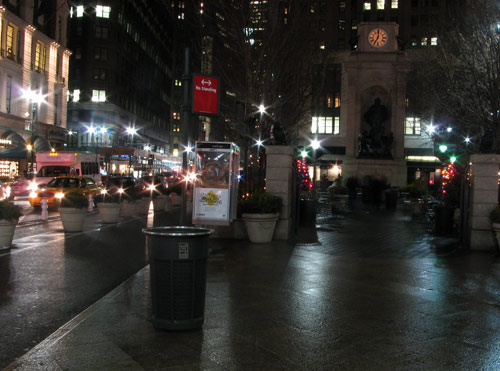
Passing through a drizzle-slicked Herald Square while running errands this evening…

This small, trapezoidal park was named for The New York Herald newspaper, which had its offices and plant one block north. Those headquarters were built by McKim, Mead & White in 1894; eventually, the building was demolished, and The Herald was sold to the owners of the New York Tribune. Not all Herald memorabilia was transferred to the new owners, however: the clock and bronze statuary – the 10-foot figure of Minerva and 7-foot bellringers Gog and Magog (a.k.a. “Stuff and Guff,” who knew?) — which had adorned the roof of the Herald building, were gifted to New York University. The school lent them in perpetuity to the city for the clock monument at Herald Square, designed by Aymar Embury II in 1940, where they have remained ever since, ringing in the hours on the James Gordon Bennett Monument’s bell.

Herald Square

The park underwent a $1 million restoration several years ago and reopened in 2000. Last September, a newly pristine Stuff and Guff emerged, burnished and restored under the auspices of the Municipal Art Society, the Parks Department, the Art Commission of the City of New York and the 34th Street Partnership.

Two Thousand Years

The B brothers had procured tickets to the five hour opera marathon that is Richard Wagner’s Die Walküre at The Met — immortalized in the classic 1957 Bugs Bunny cartoon “What’s Opera, Doc?,” a.k.a., “Kill the Wabbit,” #1 of the “50 Greatest Cartoons: As Selected by 1,000 Animation Professionals” in 1994. As neither of the men thought he had the endurance to make it through the entire Lorin Maazel-helmed evening, the three of us tentatively planned on swapping out of the seats and dividing the show’s acts among ourselves — two segments apiece, which no doubt would have confused the heck out of our fellow patrons in the front balcony. Ultimately, though, the opera relay plan did not come to fruition. (I was told afterwards that based on how much they did see, it was a pretty amazing show.)

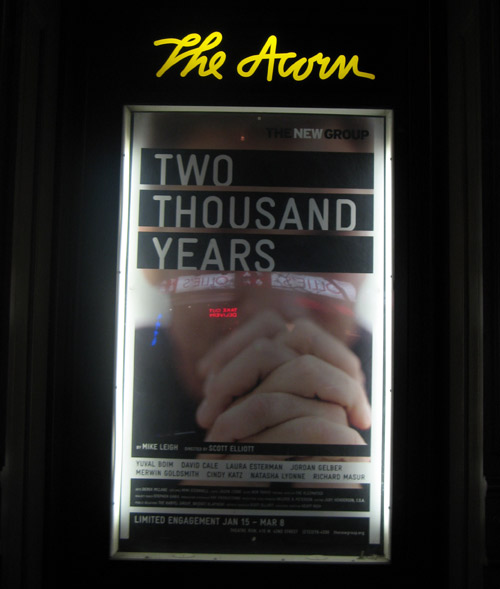
Instead, I was at The Acorn in Theatre Row for The New Group’s American premiere of Mike Leigh’s Two Thousand Years, featuring onetime troubled actress Natasha Lyonne, which began previews on January 15.

Two Thousand Years

Leigh has written more than 20 plays since 1965; the four which have been staged previously by the New Group — Ecstasy, Goose Pimples, Smelling a Rat, and Abigail’s Party — all date from his late 70s and 80s residence at London’s Hampstead Theatre. For the most part, Americans — I included — are more familiar with Leigh’s film work, such as Naked (1993), Secrets and Lies (1996), Topsy-Turvy (1999) and Vera Drake (2004).

Commissioned by the National Theatre back in 2001, Two Thousand Years is the playwright’s first play in over a decade. As such, there was quite a bit of excitement in theatre circles when its imminent arrival was announced in 2003; before the play even had a title, and with no information available about its content, it managed to sell out the entire 16,000 tickets of its London run.

This is the first of Leigh’s works — film or theatre– to deal exclusively with his Jewish background. The story concerns a well-to-do, intellectual Jewish family in the Northern London suburb of Cricklewood, and the domestic trauma that ensues when their brooding, unemployed, university-educated son becomes religiously observant. The rest of the family is decidedly secular: although several members have spent time on Israeli kibbutzes, and all of them casually toss Yiddish words into conversation, they eat bacon and do not attend synagogue; their “Jewishness” seems mostly reflected by their close reading of The Guardian‘s coverage on the Gaza disengagement, bewailing the loss of their Zionist ideals, and loudly shouting during family gatherings. (That last is a stereotype that’s been reinforced endlessly on American sitcoms such as Will & Grace and Frasier. I know: I’ve watched the late night syndicated episodes more times than I care to admit.) When the son starts sporting a kippah (yarmulke) and skulking out into the patio for morning prayers, his parents are at a loss over how to react. (“It’s like having a Muslim in the house… or a martian,” balks the father; the mother, in the meantime, frets over what her son will be able to eat.) In addition, there are the usual family conflicts: sibling rivalries, an estranged aunt (who makes a sudden, unexpected appearance in the second half) and an argumentative grandfather.

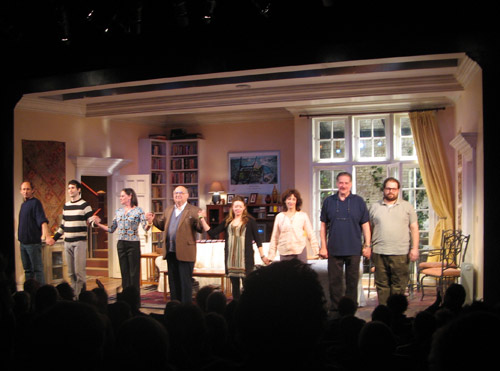
Two Thousand Years cast

An intriguing premise and excellent acting throughout, with scene fade-ins and outs punctuated by original music by the New York-based Klezmatics. Based on the frequent outbreaks of laughter, the audience seemed to enjoy it quite a bit, while the play’s analysis of the strains of religion and family life were both thought provoking and moving.