vip in the city, page 13

Second snow

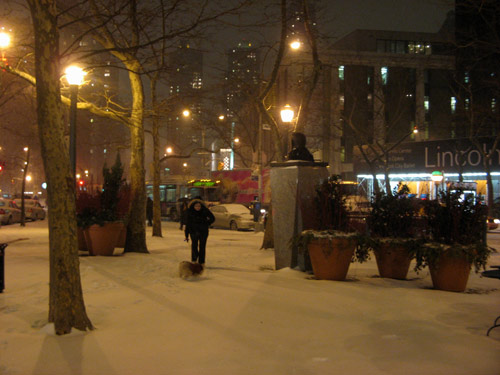
The swirl of snow that descended upon us a couple of days ago blew in fast, but left hardly a trace in the streets. On the way home from the office this evening, I took a photo of our first significant snowfall of the year— the first in the city since December 16.

A few hours later, all of this would be washed away by the wintry mix that followed.

First snow

Later that night, we gathered over take-out Tebaya at SC’s home. Oh, how we love those Japanese chicken wings! But alas: just potemochi for me… and crackers spread generously with triple crème brie and Cambozola™ (the delightful blend of French Camembert and Italian Gorgonzola), which our hostess was considerate enough to pick up out of deference to Lenten diet.

40 days until Easter…

The Duchess of Langeais

My Town Hall Feature Film Seminar Series began in earnest this week. For the next three months, I’ll be in Times Square every other Monday night — a frequency which I used to describe as “bi-weekly.” Until rather recently, I thought that “bi-weekly” was synonymous with “fortnightly” — which it is — but Merriam-Webster lists a primary definition of “occurring twice a week.” So yes, the two definitions vary by a factor of four, and technically, “bi-weekly” could mean the same as “bi-monthly.” Gee, you think this ever causes any confusion?

Tonight’s film was Jacques Rivette‘s The Duchess of Langeais (Ne Touchez pas la Hache) — an adaptation of Honoré de Balzac’s novella, La Duchesse de Langeais. (The English title of the French film keeps the author’s original title, while the French “Don’t Touch the Axe” is culled from an ominous anecdote in the film.) The much-admired Antoinette de Langeais (chanteuse/actrice Jeanne Balibar), a married aristocrat with an oft-absent husband, is bored by her lavish, but empty Restoration-era Parisian lifestyle. She meets a Napoleonic war hero, the dashing General Armand de Montriveau (Guillaume Depardieu — yes, son of Gérard) — and the two begin an intense, but unconsummated flirtation, during which the duchess tantalizingly retains the upper hand to the endless frustration of de Montriveau – an imposing man clearly used to getting his way. Eventually, however, both control and power shift to de Montriveau and the story evolves into a tale of obsessive passion between two ill-starred, stubbornly unyielding — and thus frustrated – partners plunged into the alienating, often degrading, depths of love.

Cheshire and Siegel

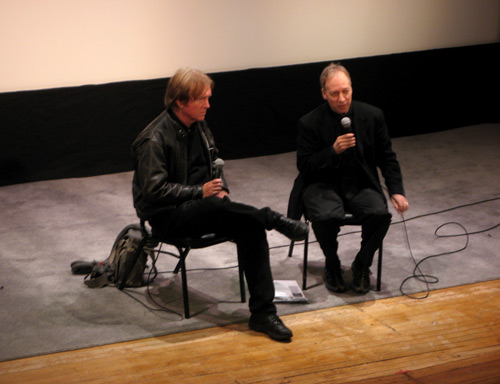
Afterwards, we sat through one of our more erudite post-film discussions, featuring guest Godfrey Cheshire (left), the director and New York-based film critic. I learned more in this single night about Rivette and the Nouvelle Vague (the French cinema movement, that is, not the musical collective) than in all my years of watching movies. Then again, the man behind such films as Céline and Julie Go Boating, Va Savoir and La Belle Noiseuse is generally considered the most experimental, and therefore the least screened, of his renowned colleagues Jean-Luc Godard, Éric Rohmer, and François Truffaut. It may have something to do with Rivette’s deliberately challenging films and penchant for length; one of the director’s earlier masterpieces, Out 1, is another Balzac adaptation that infamously stretches well over twelve hours long — 743 minutes, to be precise. That’s almost 9 Cloverfields! Sacrebleu!

Love at the Crossroads

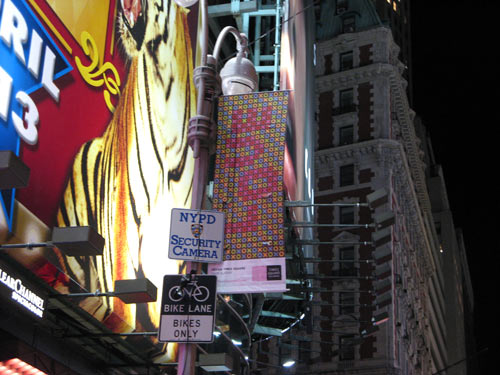
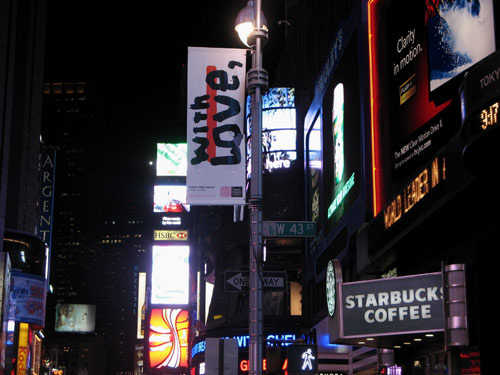
Just in time for Valentines Day, the Times Square Alliance unveiled “LOVE in Times Square” — a public art project featuring 15 banner designs by 12 top graphic artists, each inspired by the word “LOVE.”   The colorful flags have been mounted on lampposts all around Times Square.

David Slatoff:

Love banner

James Victore:

Love banner

Goodesign and Worldstudio:

Love banner

Be on the lookout for LOVE from 42nd to 48th Streets, between Sixth and Eighth Avenues.

089 pizza on Arthur Avenue

Last month, HH came across an article declaring Zero Otto Nove in the Bronx the “Best New U.S. Pizzeria.” Intriguing. He had missed out (or “lucked out,” depending on your perspective) on our last quest for the city’s best pizza — a 2+ hour “adventure” that brought us to Midwood, Brooklyn. So this afternoon, we set out for the Belmont section of the Bronx — “New York’s other, better, Little Italy” and an area well known for its quality fish, meats, cheeses, pastas and groceries.

The Bronx location and bus ride’s distance from the subway line keep this neighborhood somewhat insulated from the touristy masses that have all but obliterated the better known Little Italy in downtown Manhattan. Some cursory research will call up a long list of Belmont recommendations along and around main thoroughfare Arthur Avenue: The enclosed Arthur Avenue Retail Market, (which like the Essex Street Market, was created under Mayor Fiorello La Guardia in 1940 to reduce pushcart street-crowding); dueling fish purveyors Randazzo’s and Cosenza’s; Egidio’s or De Lillo’s for Italian pastries; the Calabria Pork Store; fourth generation-owned Biancardi Meats; Italian delicatessen Mike’s Deli; Casa Della Mozzarella, which is known for some of the best fresh-made mozzarella in New York…
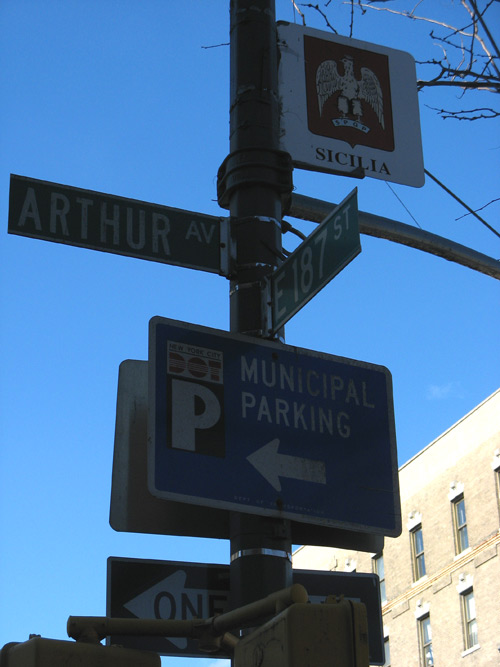
Arthur Avenue

The cloudless blue sky belied the swirl of snow that would be unleashed upon us not three hours later.

On Sunday afternoon, many of the shops were shuttered, or winding down business for the day. We made it to Borgatti’s Ravioli & Egg Noodles on 187th Street just before 1PM closing. This family-owned neighborhood fixture is renowned citywide for its fresh pasta; last year the shop scored “an astounding 29” — and the top spot — on Zagat’s list of pasta purveyors. There were some intriguing options: multi-colored, multi-shaped, fresh and dried… We each picked up a box of 100 fresh ravioli for $11.50 — ricotta-stuffed for me, meat and spinach-filled for the boys.

And then to sample this Neapolitan-style pizza we had read so much about. Zero Otto Nove is named for the area code in Salerno, Italy from which owner-chef, Robert Paciullo hails. (Paciullo is also owner-chef of area favorite restaurant Roberto’s, which was number two on Robert Sietsema’s 2004 list of “100 Best Italian Restaurants.”) The space is designed with a front bar and a long, narrow, arched passageway leading to a skylit, muraled, double height dining room, centered around a brick, wood-burning pizza oven.
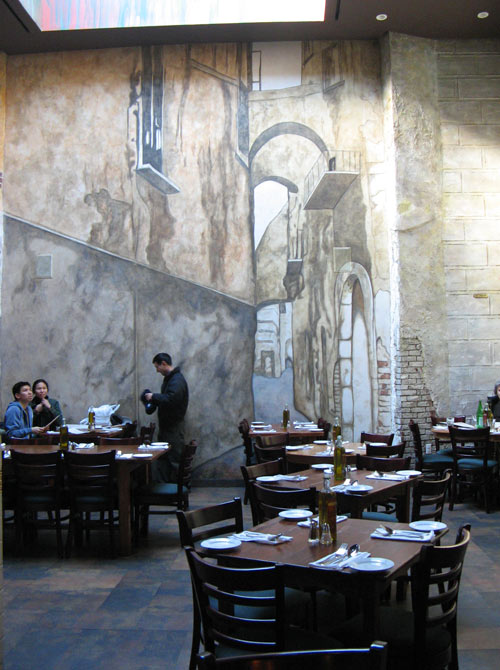
Zero Otto Nove

Hard to imagine that this was once a McDonald’s. (I asked our hostess.)

The Antipasto Salernitano Caldo: Stuffed peppers, eggplant & zucchini scapece & cauliflower:
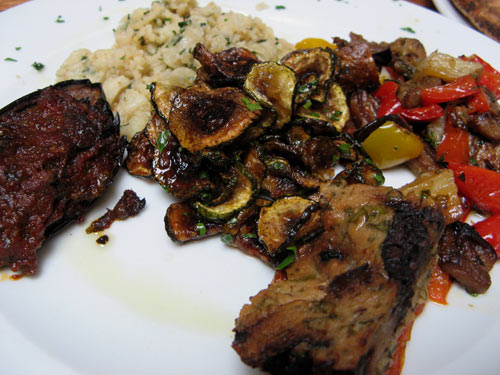
Antipasti

The Margherita pizza: San Marzano tomatoes, buffalo mozzarella & basil:
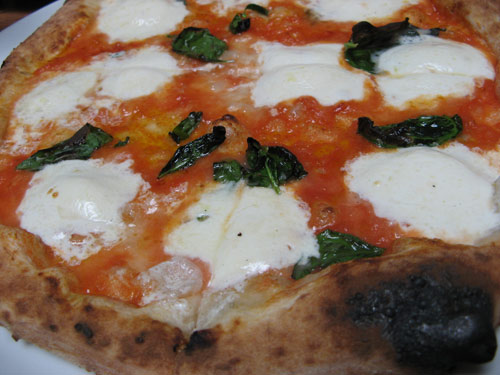
Margherita pizza

The Patate e Porcini pizza: Fresh mozzarella, sliced potatoes & porcini mushrooms:
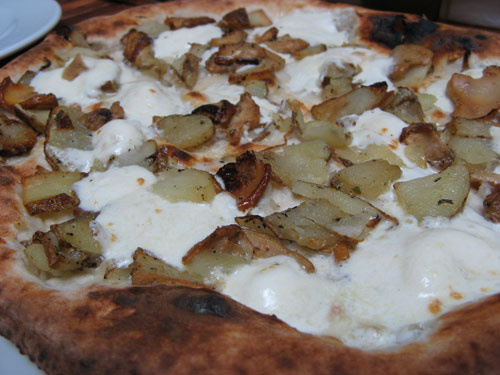
Patate e Porcini pizza

Each of the pies was advertised as a personal pizza, but could (and did) feed two, though HH later admitted that could have polished off an entire pie without assistance. Knowing a bit about DK’s pizza-eating abilities, I suspect the same of him.

So our verdict: high quality toppings (I liked the earthiness of the porcini), crust a shade on the soft side, tomato sauce a bit bland…. good pizza, but no, not the best in New York. On the other hand, we didn’t wait two hours for it either — even factoring in round-trip travel time to the Bronx — which probably ranked the overall experience above you-know-where a.k.a., that $4 slice place in Brooklyn. (What’s next: $1.20 plain bagels?)
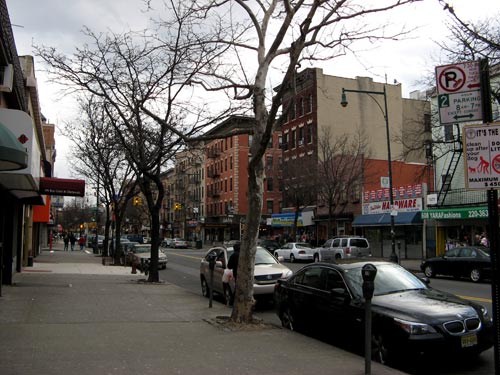
Arthur Avenue

On our hostess’s recommendation, we stopped by afterwards at Palombo Pastry Shop Café. Though the cafe itself is a relatively new addition to the neighborhood (open since 2006), as we sat among the locals at a small table with our cappuccinos and small plates of Italian pastries, the overall feel was of the kind of Old World neighborhood spot rapidly disappearing from this increasingly gentrified, sanitized version of the city. I’m reminded of a trenchant observation by Adam Gopnik in a 2007 New Yorker commentary: “New York is safer and richer but less like itself, an old lover who has gone for a face-lift and come out looking like no one in particular. The wrinkles are gone, but so is the face.”

How best to preserve all those wonderful, character-filled wrinkles that make New York, New York?
Family feasting

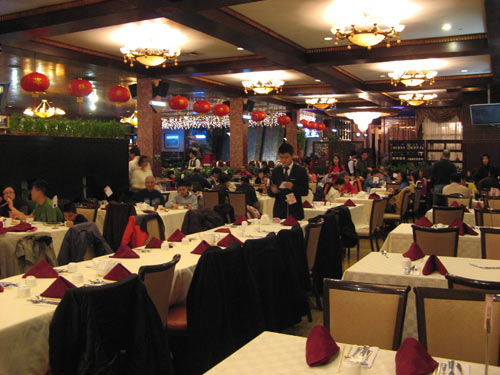
More Chinese New Year feasting. A few suggestions had been bandied about for tonight’s dinner — Flushing’s Ocean Jewels, or perhaps Imperial Palace — but with Dad setting the agenda, it came as no surprise when we ended up at East Manor in Elmhurst. (Oh, he loves his buffet!) Well, at least I knew then that there would be plenty of pescetarian options.

Our last dinner here was Mom’s 60th birthday banquet when I was nearly done in by the concept of the “intercalary month.”

East Manor

We arrived early to beat the Chinese New Year’s weekend dinner rush — a strategy which worked in our favor: an hour later, and it was an entirely different scene at the restaurant.

East Manor

Below, seafood for the huoguo, literally: “fire pot” — a popular cold weather dish sometimes referred to as “Chinese fondue,” though the similarity to traditional Swiss fondue is only tangential. Instead of melted cheese and wine, the pot is filled with simmering, savory broth; instead of chunks of bread for dipping, there is an array of raw meats, seafood, vegetables, tofu… pretty much an endless variety of items to be cooked in the hot soup, fished out with wire ladles, and dipped into sauces afterwards. At the end of the meal, the delicious soup base makes for a wonderful finish — usually accompanied, inevitably, by the errant piece of rubbery shrimp, which you’ve neglected to fish out before it’s been boiled beyond recognition.

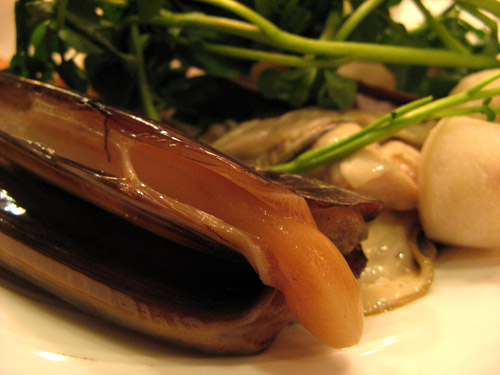
I’ve always known this mollusk as a “razor clam,” but it’s more properly called the Atlantic jackknife clam:

Razor Clams

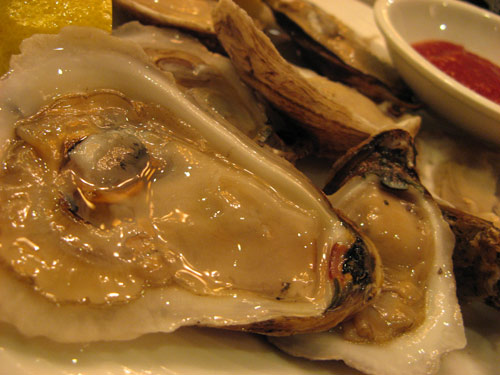
Oysters to bring in more good things for the new year. (These I ate raw, with a squeeze of lemon juice — is there any better way? )

Raw Oysters

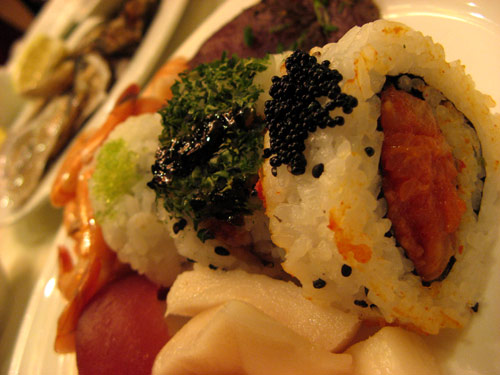
…and despite all the hoopla over new data on the high mercury levels in tuna sushi, I could not resist:

Sushi

Flickr preview: The Harlem Globetrotters at Izod Center (February 16, 2008).

Coming soon: Citi Field

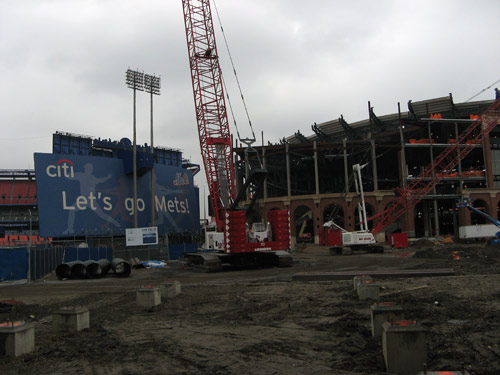
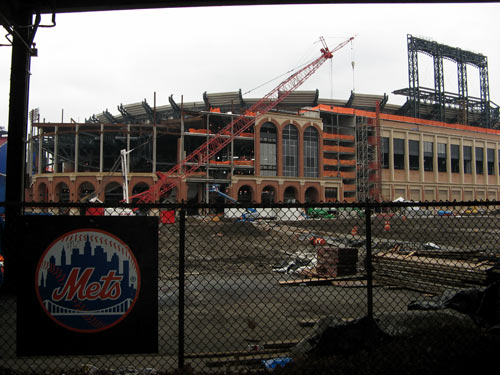
Citi Field, the future home of the New York Mets, is scheduled to open its doors by Opening Day 2009 to coincide with the opening of the New York Yankees’ new stadium in the Bronx.

Citi Field

In March 2006, the Mets received approval for $632.1 million in bonds for construction of the new ballpark. (Corporate sponsor Citigroup will be paying $20 million a year over the next 20 years for the naming rights to the park.) HOK Sports‘ plans were unveiled a month later, and on November 13, 2006, the Mets officially broke ground for their first new ballpark since 1964.

The concrete arches and brick, limestone, granite and cast stone façade were inspired by Ebbets Field, home of the bygone Brooklyn Dodgers.

I’ve been able to track the progress of the construction going on adjacent to Shea on my weekly rides out to Queens on the 7 train. This Saturday, avoiding the Chinese New Year parade madness in progress at Main Street, I got a closer look at the project from Willets Point. As of mid-February, about 85% of the stadium’s structural frame is complete.

Citi Field

Mets pitchers and catchers report for duty on Valentines Day!

Under Milk Wood

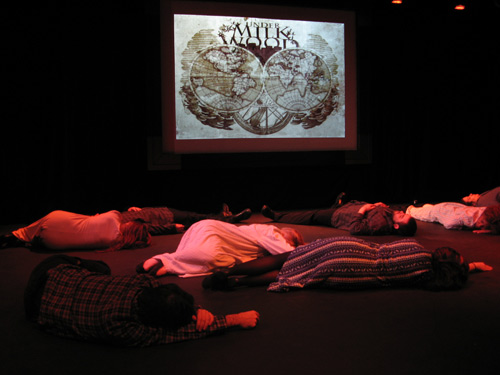
This winter has seen a couple of productions of the works of Welsh poet Dylan “Do not go gentle into that good night” Thomas. His Child’s Christmas in Wales was produced at the Irish Repertory Theatre in December, and this month, the Intimation Theatre Company staged Thomas’ only play, Under Milk Wood, as its inaugural production.

Originally written as a radio play, Under Milk Wood — subtitled “a play for voices” — was first broadcast (posthumously) in January 1954 by the BBC with a distinguished all-Welsh cast, including Richard Burton. Later, it was put on as a stage play and then adapted into a 1972 film, with Burton reprising his role, supported by Hollywood luminaries Elizabeth Taylor and Peter O’Toole. The plot follows an entire day in the life of the inhabitants of the imaginary seaside town of Llareggub, Wales — that’s “Bugger all,” backwards — so classy!

To begin at the beginning:
It is spring, moonless night in the small town, starless and bible-black, the cobblestreets silent and the hunched, courters’-and-rabbits’ wood limping invisible down to the sloeblack, slow, black, crowblack, fishingboat-bobbing sea.

Under Milk Wood

For the first twenty minutes, the entire cast wandered the stage with closed eyes, and we were brought through each character’s dreams– 40+ in all — guided by a pair of omniscient narrators (“voices”). I cast a sidelong glance at SC, and fleetingly wondered if I would ever be allowed to pick another play again.

But once the day began in earnest, and we were able to get into the groove of Thomas’ poetry, things picked up considerably. (Good thing, as there was no intermission.) The action followed the townspeople through their daily business, shifting among sets of characters as they sang, worked, frolicked, gossiped, lusted, reminisced and plotted murder — with some surprisingly bawdy language.

Thomas had worked on this, his final work, for years and in October 1953 he delivered a full draft of Under Milk Wood to the BBC as he left for his fourth and ultimately, final, American tour. He gave his first public reading of the script in Cambridge, Massachusetts, and soon after, sound-recorded a performance at the 92nd Street Y. Within the month, after a famous drinking binge at New York’s White Horse Tavern — the “18 whiskies” of legend — Thomas fell into a coma and died at St. Vincent’s Hospital, just a couple of weeks after his 39th birthday.

In the poet’s wake, we have this play, which stands as a testament to the lyrical dignity in the everyday. Read the beginning of Under Milk Wood here.

In other theater news:  On the strength of last week’s favorable reviews, Mike Leigh’s Two Thousand Years has been extended at The Acorn through March 22, 2008.

Year of the Rat

Gung Hay Fat Choy! Happy Lunar New Year, family and friends!

Today marked the beginning of Year 4705 by the Chinese calendar — the start of a 15-day celebration that culminates with the Lantern Festival on the night of the first full moon.

The year of the Rat is the first in the sequence of twelve Chinese zodiac animals, familiar to many via those brightly printed paper placemats in Chinese restaurants of yore: rat, ox, tiger, rabbit, dragon, snake, horse, ram, monkey, rooster, dog, and pig. (Once so popular, I can’t recall the last time I saw one.)

The related children’s story goes that the Jade Emperor wanted to designate a dozen animals for the calendar, and announced a race through a river to determine their order. The cat and the rat, being the worst swimmers, devised a plan to cross the river on the back of the naive and agreeable ox. On the day of the race, though, the competitive rat pushed the cat off into the river, and rode the ox’s horn to victory himself, jumping off at the opposite bank to reach the finish line first. (“You dirty rat!”) As a result of the rat’s betrayal, the cat came in dead last — 13th — and did not get a year named in his honor. Swearing vengeance, the cat has chased the rat for all eternity… and has hated water ever since.

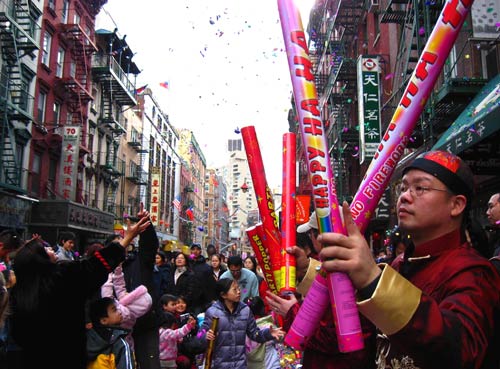
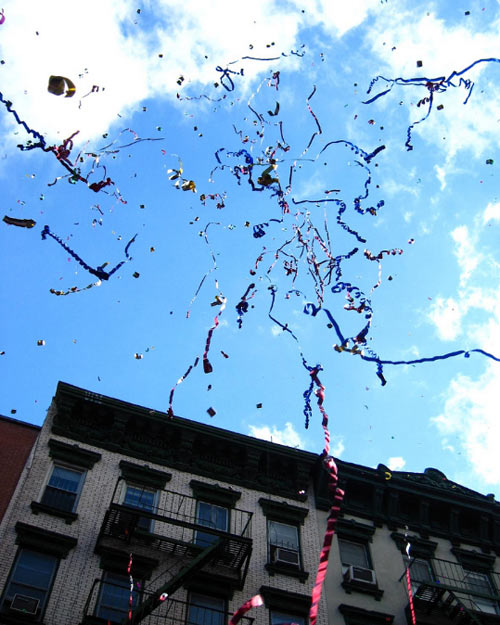
We had plans to check out the new year’s festivities going on in Chinatown this afternoon. I could hear the building din on my approach from the subway on Canal. Here, the madness on Mott. Drums! Lions! Second time in a week I was showered in confetti.

Chinese New Year

Chinese New Year

Seemed like a fun idea at the time, but in practice… not so much, after a while. “The crazy secret about New York is that many locals can’t stand crowds.” Word. We hastily decamped to the relative calm of Baxter Street a few blocks away, where we opted instead for a lunch of Vietnamese food that thankfully, did not include rats.

Well, not that we know of, anyway.

Creamy indulgence

Today was Ash Wednesday – the first day of Lent. After last night’s extravagant feast, I was ready to embrace a more ascetic lifestyle, so for the next forty days, I will be giving up meat – red and white… and the other white.

Having gone the “meatless Fridays” route the past few years, it didn’t seem too great an additional burden to extend the restriction throughout the entire week. I do appreciate the carnivore’s lifestyle, though, so rest assured that the required element of sacrifice is still there. But let’s be realistic: I’ll still be eating seafood and animal products (dairy, eggs, honey). Apparently this dietary combination makes me a pescetarian rather than a vegetarian, since of course, true vegetarians do not eat fish.

Incidentally, is there a word for the vegetarians who eat bacon? If not, there should be, because I’ve met my share of those in my day. Hey, I sympathize: if ever I were to attempt to extend my Lenten dietary restrictions year-round, that would be my downfall as well. Bacon’s tasty, yo!

The New York Times just ran a piece on the challenges incompatible diets can pose for romantic relationships. In it, author Kate Murphy included a hilarious quote from Anthony Bourdain’s compulsively readable 2000 memoir and industry exposé Kitchen Confidential: Adventures in the Culinary Underbelly: “vegetarians, and their Hezbollah-like splinter faction, the vegans … are the enemy of everything good and decent in the human spirit.”

Well, I wouldn’t go quite that far. But I certainly don’t have to understand it.

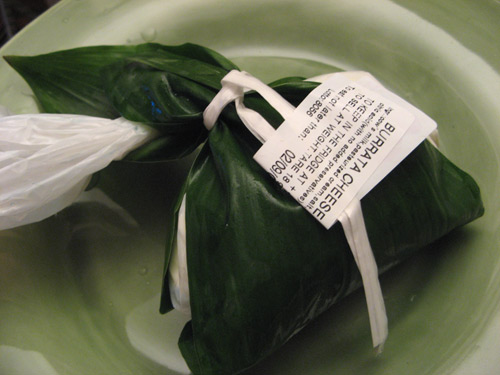
So I may be off meat for a month and a half, but I can still indulge in delicious cheese. And wouldn’t you know: Fairway Market had just gotten in a fresh shipment of burrata, the highly perishable curd and cream delicacy from Campania, introduced to me by MLF a couple of weeks ago.

I picked up one of the leaf-wrapped pouches, and hurried home with my bounty….

Burrata

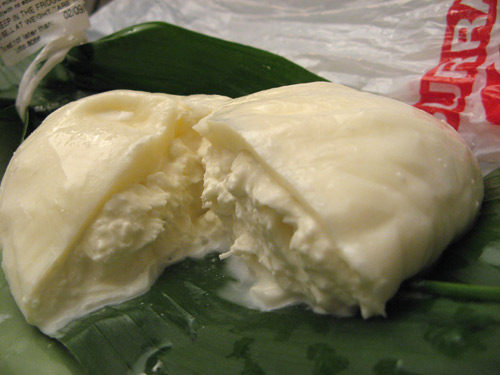
…and cut right in, unleashing the oozing creaminess within.

Burrata

Now that’s sinful.

Super Duper Fat Tuesday

Is it still only Tuesday? So far this week, there’s already been song and dance, thrilling victory and joyous celebration… and tonight, coinciding with Super Duper Tuesday and the traditional excess associated with Mardi Gras, our long-planned, pre-Chinese New Year feast at Chinatown’s Amazing 66.

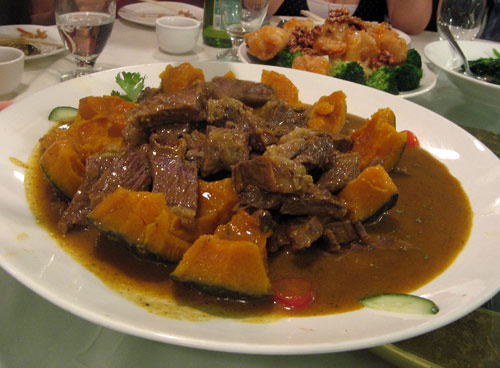
A dozen friends, new and old, gathered in the restaurant’s lower level. Early in, it was established that we would place ourselves (willingly, happily) in SL’s capable ordering hands, and just eat whatever food was placed before us this evening. So began the parade of deliciousness — off and on the menu. A platter of batter-fried seafood, sauteed pea shoots, pan-fried noodles with seafood, braised E-Fu noodles with black mushroom (for longevity), and this, the first of two restaurant specialties that required advance ordering: Short Rib Beef in a Pumpkin. Yes: that’s short rib beef! In a pumpkin! Was ever there more a delightful combination of words spoken? The dish was brought out to the table in one glorious piece, with chunks of steaming, lightly curry-spiced meat exploding tantalizingly out the top of the hollowed out squash. Our glossy-tressed waiter, brandishing a large chef’s knife, made quick work of the soft, pumpkin flesh before our eyes.

Short Rib Beef in a Pumpkin

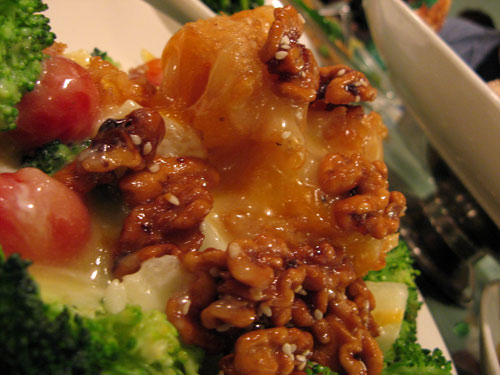
Salad Walnut Prawns — a classic dish made up of the seemingly strange combination of deep-fried jumbo prawns, slathered in a sweet mayonnaise, and laid over a bed of dressed mixed fruits, broccoli and candied walnuts. Tasty, though.

Walnut Shrimp

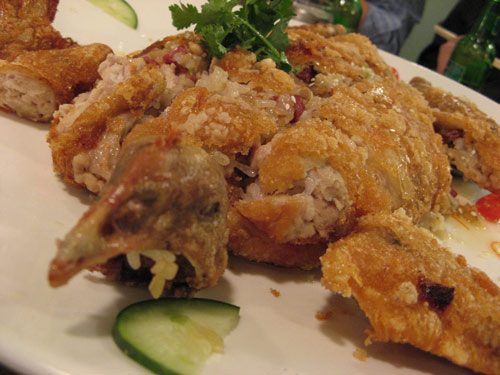
And the second show-stopper of the evening: the House Special Crispy Chicken Stuffed with Sticky Rice. Essentially, a whole chicken, deboned and de-…fleshed(?), crammed with a combination of sausage-studded sticky rice, and then deep-fried and meticulously reassembled into the general shape a chicken, albeit a rather flat one. Head included, of course — to symbolize wholeness and togetherness.

House Special Crispy Chicken

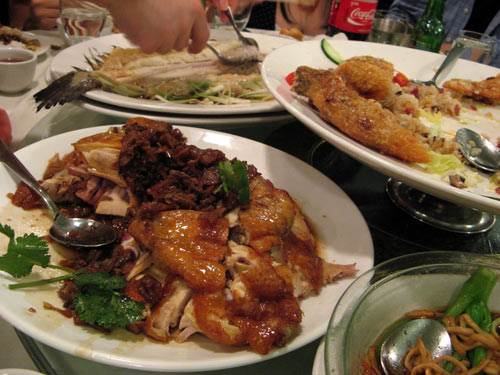
There were more dishes, selected for their symbolic auspiciousness: another chicken, roasted, and topped with preserved vegetables. A whole steamed flounder; the Chinese word for “fish” is a homonym for “abundance”. And an oyster casserole, to bring in “good things” for the coming year.

Amazing 66 spread

We ate our fill — or perhaps just beyond — and finished with a round of orange wedges (for wealth) and bowls of red bean tong shui (sweet dessert soup). How a few of us still managed after all that to squeeze in a post-dinner trip to the Chinatown Ice Cream Factory can best be attributed to a new year’s miracle.

Though when it comes to such temptations, I align myself with New York‘s Insatiable Critic Gael Greene, who declares quite rightly: “I shall never trust anyone who doesn’t love ice cream.

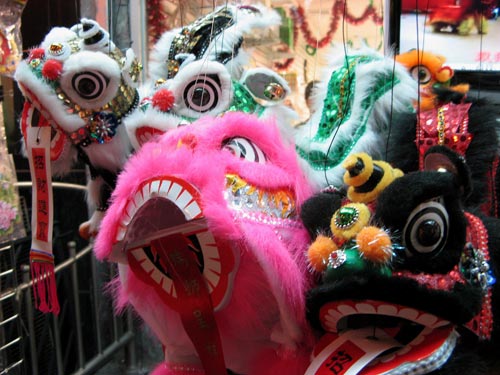
Chinese New Year dragons