vip in the city, page 15

Grandaisy Bakery

Grandaisy Bakery was known as Sullivan Street Bakery until sometime in 2006 when the original partners parted ways. Despite the separation, the two bakeries seemed to maintain almost identical models: Jim Lahey took the brand (and the wholesale business) to the location on far West 47th Street; Monica Von Thun Calderón stayed on in SoHo, keeping head baker Cristobal Julio Guarchaj and head pastry chef Peggy Jacobs. In the process, Calderón rechristened the Sullivan Street place “Grandaisy Bakery” after her grandmother. Food writer Ed Levine explains the history better; he’s partial to their olive roll — one of his “favorite rolls in New York.”

Excitement spread when word of a second Upper West Side location opening first circulated in September, and then again earlier this week, as the bakery’s Italian-imported pizza ovens fired up for the first time.
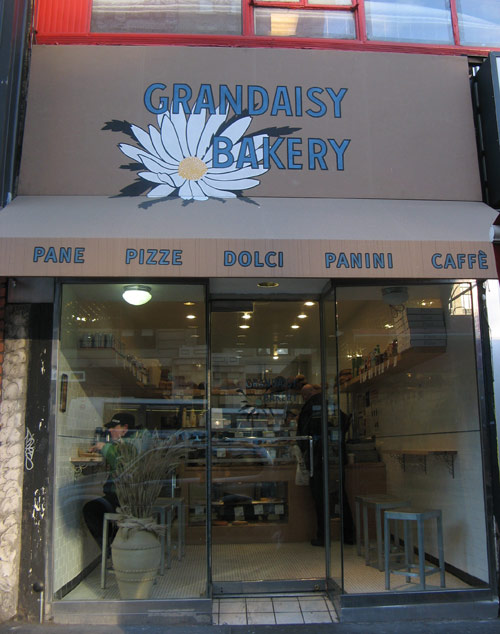
Grandaisy Bakery

This afternoon, Grandaisy had four varieties of pizza – identical to the ones available at Sullivan Street Bakery: their pomodoro (tomato sauce, olive oil and sea salt), cavolfiore (cauliflower, Gruyère cheese, bread crumbs, olive oil and black pepper), patate (potato, onion, olive oil, rosemary and black pepper) and funghi (cremini mushrooms, onions, olive oil, sea salt and thyme). Not offered today: the zucchini and the pizza bianca, hand-formed slices of flatbread, dressed simply with extra virgin olive oil, coarse sea salt and rosemary.

It’s not typical New York City pizza: with the exception of the bianca (which is plain), these are small rectangles of thin, crispy flatbread, covered in high quality toppings, and served at room temperature… or given the exposure of the trays to today’s chilly outside air, just a little cooler. Nonetheless, New York magazine named their pomodoro among the “Best Square Pizza” in 2006; the Voice has lauded their potato pizza. The unconventional pizza also was named the third best in New York by Time Out – the best in Manhattan, but lagging behind Brooklyn’s Di Fara Pizza and Staten Island’s Denino’s Pizzeria & Tavern.
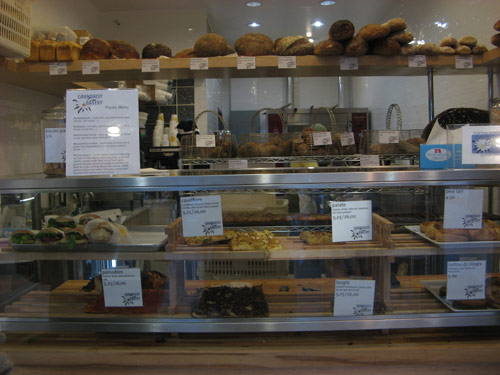
Grandaisy Bakery

My funghi slice was good. Slightly soft in the center, with a dense, layer of earthy, salty mushrooms — but at $3.25 a slice, a small extravagance.
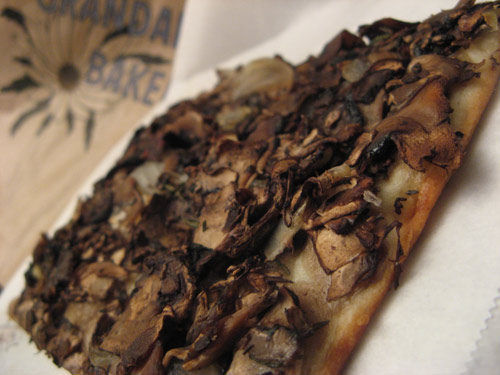
Funghi Pizza

Related: this week, Serious Eats posted an informative rundown of the regional variations of pizza in the United States.
Beekman birthday

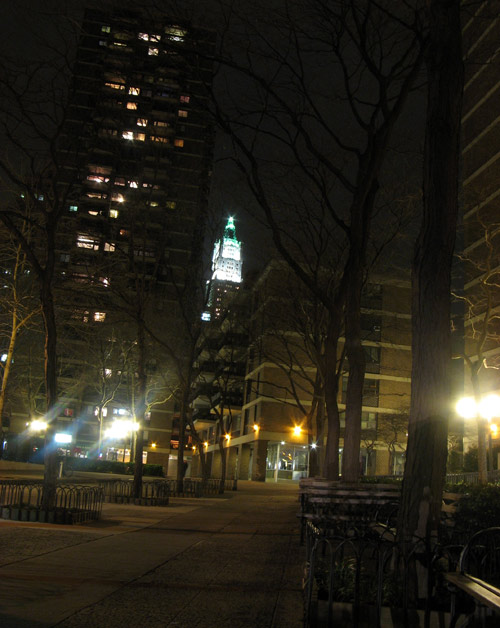
On Beekman Street in the Financial District… not to be confused with Beekman Place, in Midtown — the latter of which is named for the site of the summer home of the prominent Beekman family, whose main estate was on the Street downtown.

It was CC’s birthday today; he and EH were hosting a gathering at their shared apartment to celebrate. (I feel like I’ve been attending a lot of these lately.) I spent most of the evening catching up with newly-minted real estate agent AC. It was difficult, at first, breaching the divide between the teachers and the non, but EH’s cognac and cream-soaked plaintains proved an effective social lubricant.

40 Wall Street

Afterwards, a core group of us set out to continue the evening’s revelries, making our way through the construction that was to be the grand — but now less grand — Fulton Street transit hub. Final destination: Momofuku Ssäm Bar, which may be my favorite late night dining spot in the city.

If only I were the least bit hungry. No matter, there was plenty of house sake and communal seating, a combination which made it all the easier for us to befriend the group of five at our table who had gathered at the restaurant for their own birthday celebration. Through them, we learned about “ghost riding the whip,” or “ghostin'” — an activity which involves a driver leaping out onto the road from behind the wheel of a moving vehicle (the “whip”), and dancing along beside it. (Um, yeah.)  Apparently the trend originates out of The Bay Area’s hyphy movement. Kids today!

Madangsui BBQ

SC, CS and I met in Koreatown ostensibly to celebrate a belated birthday and recent professional successes, but as often happens when the girls and I get together, the evening’s conversation quickly turned to our personal lives. (Hey, men do it too… don’t they?)

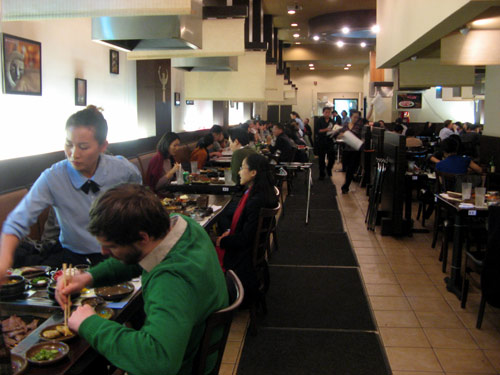
We were on West 35th Street to check out the new(ish) Manhattan outpost of Madangsui — a popular Fort Lee, New Jersey Korean barbecue restaurant. At just before 8 on a Friday night, the entrance was packed with mostly Korean diners; we ended up waiting about half an hour to be seated, during which our appetites were whetted by the tantalizingly smoky scent of barbecuing meats — a scent which I carried in my hair and clothes for hours afterwards.

Madangsui

When at last the hostess called our names, springing us from waiting list purgatory, we were led to a table with a sunken grill. We placed our order promptly, kicking off a parade of panchan, the quantity and variety of which I’ve never quite experienced before. In addition to the usual kimchi variations, there was a potato salad (someday I’ll find out how this anachronistic item came to become a standard offering in Korean restaurants), mini pa jun, and a small plate of blue crab, which was served raw, like a ceviche, bathed in gochujang (spicy, fermented pepper paste). By the time our jap chae and raw meats arrived with their accompanying lettuce leaves, every available inch of table top was filled.

Crab panchan

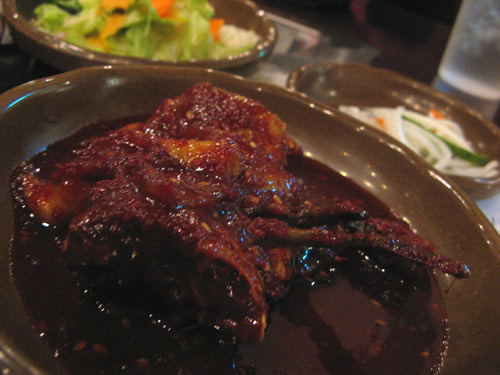
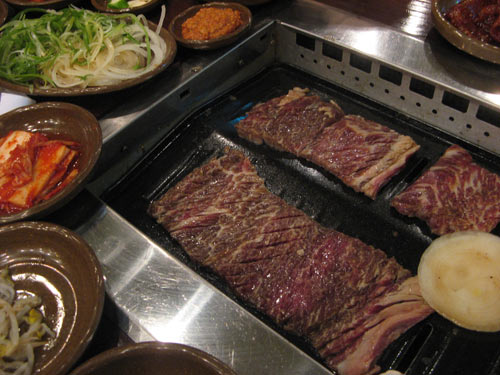
The Saeng Galbi (“fresh butterflied all natural short rib”) – pictured below – was tender and delicious. Likewise the Sam Gyup Sal (sliced fresh pork belly strips) – ¼ inch thick slabs of meat that had the appearance of bacon.

Kalbi BBQ

Through it all, our servers were attentive, manning the grill and bringing us yet more panchan as space allowed, including bowls of chigae (bean paste casserole) and gyeran jjim (the steamed egg dish I tasted for the first time at Kunjip).

It was all more than the three of us could finish. We left the restaurant laden with ample leftovers and new missions.

A very good place to start

After that first visit to Amazing 66 on Mott, I could hardly wait a week before coming back to sample more of their $4.95 lunch menu.

But where to begin? With item #1: Pork Chop with Chili & Spiced Salt.

Salt and pepper pork

The dish was expertly prepared: half a dozen lightly battered pieces of pork on the bone, topped with crunchy fried bits of minced garlic, and slices of scallions and jalapeños. I ended up finishing only about half of this platter. As I was pondering whether to have the leftovers wrapped, the harried waiter swiftly spirited our plates away, rendering my decision moot. No matter, these fried dishes tend not to hold up so well over time anyway.

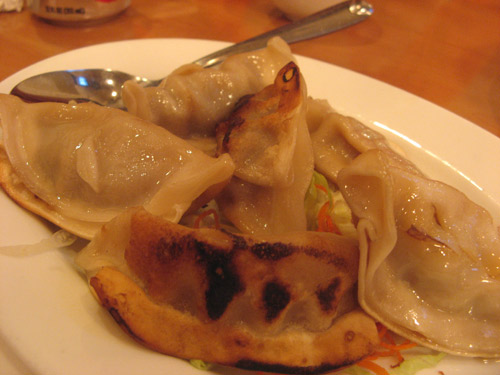
And, because my friend had a craving: a plate of fried dumplings. I didn’t even see these on the menu, but ask, and ye shall receive.

Fried dumplings

Go ahead... Jump

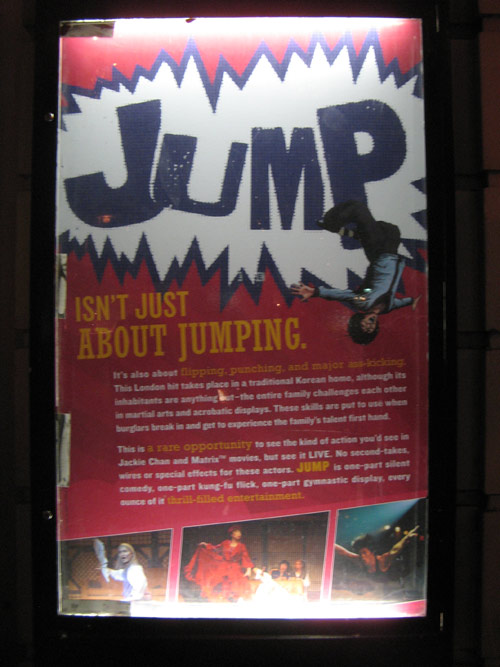
Jump was created by Korea’s Yegam Theatre Company, and spent several years in development before it premiered at the Woolim Cheongdam Theater of Seoul in 2003. Since then, the show has had successful engagements throughout Asia and Europe, earning a Comedy Award at the Edinburgh Fringe Festival in 2006. The 90-minute spectacle began an open-ended run at the Union Square Theater on September 25, opening officially on October 7 before a packed house that included the Jolie-Pitt crew.

Jump

Another entry on the long off-Broadway list of “barely verbal foreign imports” (see: Stomp, Blue Man Group, Fuerzabruta), the show is part slapstick comedy, part martial arts demonstration, and part gymnastics display, with shades of The Matrix thrown in.

The men and women of the cast rotate their roles regularly, and were culled from experts in kickboxing, gymnastics, modern dance, and theater. The story, such as it is, revolves around a family of five martial arts specialists (grandfather, father, mother, drunken uncle, daughter) and their skirmishes. During the first act, an unassuming, nerdy young man visits the household and promptly falls in love with the daughter. (We later discover that he is transformed into a wildly gyrating, mesh-shirted Lothario once his coke-bottle glasses are removed.) With seeming randomness, a series of segments are strung together in which the various cast members challenge each other to impressively athletic martial arts and acrobatic displays, under the supervision of the imperious grandfather. All these well-honed skills are put to good use when a pair of hapless burglars break into the family home in the second act.

They fight, they woo, and occasionally members of the audience are brought up on stage to participate in the shenanigans… It makes no sense, really — “more a stage version of Kung Fu Hustle than actual theater” — but it was far more fun than I expected going in.

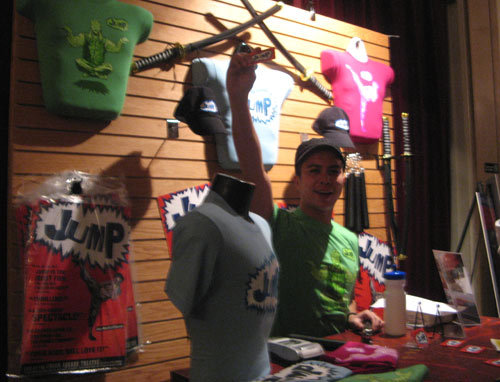
Jump vendor

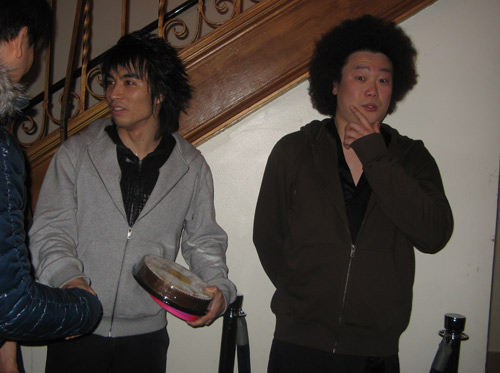
Tonight’s burglars — Yun-Gab Hong and Seung-Youl Lee — at the post-show meet and greet. Love the ‘fro!

Jump cast

Afterwards, we ended up at nearby Republic for what may have been the fastest dinner on record. Barely were the orders out of our mouths when the food hit the table, in seeming defiance of all physical law.

Burrata at La Bottega

After popping in at Pasita for an apéritif with SK, I left him to his dinner while I set off to meet MLF at La Bottega inside the possibly haunted Maritime Hotel. I strolled in through that familiar lobby, where my friend was waiting at the bar with a glass of red wine and a smile.

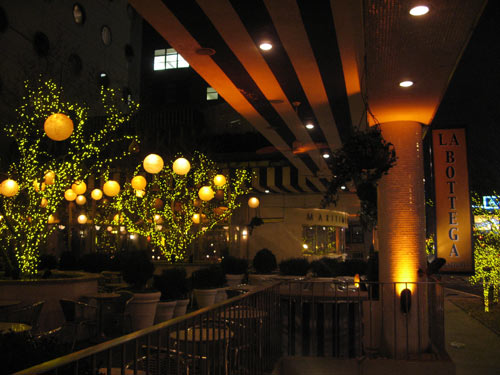
The hotel restaurant has a casually rustic Italian feel, reminiscent of ‘inoteca or a slew of other downtown Keith McNally clones: long bar, prominent wood pizza oven, white tile, wooden tables, wine bottle-lined walls… The Times less charitably described the decor as a “mix of Italian trattoria and 1950’s high school.” La Bottega’s biggest draw, though, is its beautifully lit, tree-lined patio; on warmer evenings the deck overflows with the bold and the beautiful — or is that the beautiful and the damned? — and offers a prime vantage point for MePa people watching.

La Bottega

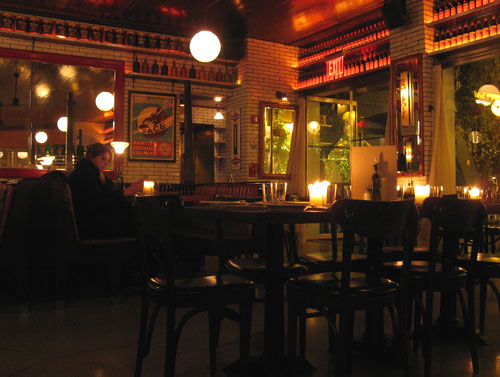
We were spared the crowds this chilly winter night, but the green twinkling lights just outside the picture windows cast their own warm glow over us.

La Bottega

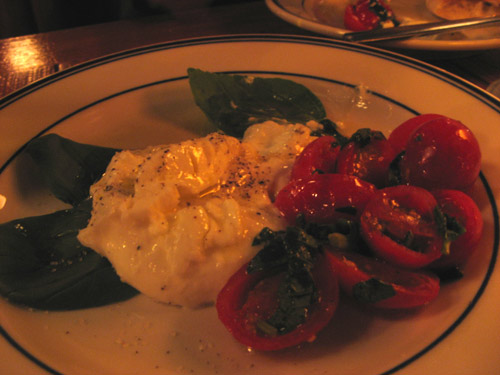
Tonight MLF, who knows how I love cheese, introduced me to the joys of burrata, a specialty fresh mozzarella originating from the Puglia region of southern Italy. The decadent cheese derives its name from burro, the Italian word for “butter.” To produce it, cheese makers stretch a still-warm, thin layer of fresh mozzarella curd around a pillowy soft blend of heavy cream and tender, unspun mozzarella curds, or stracciatelle (“little rags”). Traditionally, the delicate pouch is sealed off with a topknot, brined and then wrapped in asphodel (similar to leek) leaves. The relatively recent trendiness of burrata in the United States poses a challenge for suppliers of the extremely perishable cheese: burrata imported from Italy is usually two days old by the time it reaches New York, one day old if it’s flown in from California, where artisanal producers like Gioia Cheese Co. hand-form up to 1500 pounds of burrata balls a day.

At La Bottega, it’s served up in a lusciously rich Insalata Caprese: the soft pouch surrounded by halved grape tomatoes and torn basil, and drizzled with extra virgin olive oil and freshly cracked black pepper. Once pierced, the burrata gives up its sweetly creamy, oozing center — perfect for scooping up with pieces of crusty bread. Wow. 

Dim lighting doesn’t do the dish justice, but here it is:

Burrata

The San Francisco Chronicle, in a 2006 article about burrata, wrote that the cheese’s “gushing inner richness has sent shivers of desire up and down the West Coast.” Here on the East Coast, pound-size servings are available for sale at purveyors like Fairway, Zabar’s, Agata & Valentina and Williamsburg’s Bedford Cheese Shop — check out their rather evocative description — a few of which also carry versions of burrata filled with porcini mushrooms or black truffles.

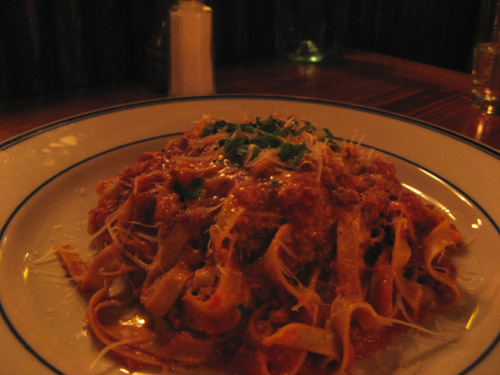
Tagliatelle al Ragú Bolognese — fresh pasta ribbons with beef, pork & veal ragú:

Ragu Bolognese

As we made our way through a leisurely meal, our seats vibrated to pounding beats coming from the Hiro Ballroom below, where the Hip Rock Reggae show with guest DJs Biz Markie and Roxy Cottontail was in full swing.

More pencils, more books

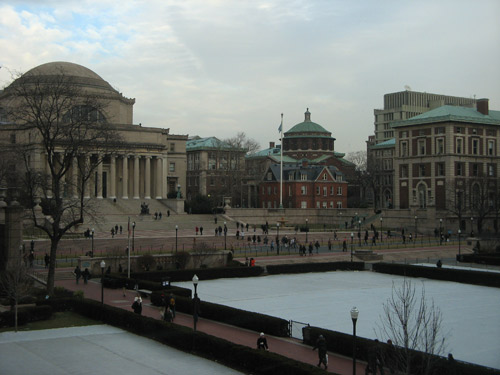
My visit uptown coincided with the first day of Spring semester classes at Columbia. Remember how exciting that used to be?

Columbia University

I was last on campus in late October for the talk with New Yorker music critic Alex Ross. Since then, his cultural history of music since 1900, The Rest Is Noise: Listening to the Twentieth Century, has landed on several “Best of 2007” lists including those of The New York Times, New York magazine and Slate. Earlier this month, the book was selected as a finalist for the 2008 National Book Critics Circle Award for Criticism.

Gothamist posted an interview with Ross today, in which he names Radiohead guitarist Jonny Greenwood‘s score to Paul Thomas Anderson’s There Will Be Blood as his current soundtrack to the city. Disappointingly, the 33-minute piece (which has received raves all around) was disqualified from Oscar contention as it recycled parts of Greenwood’s 2005 BBC-commissioned suite “Popcorn Superhet Receiver.”

Ah, we still love you, Jonny.

"I saw it. It's alive. It's huge."

Yes, I bought into the hype. Last summer’s viral marketing campaign surrounding fanboyfavorite J.J. Abrams‘s new project, the nameless trailer, the cryptic film website www.1-18-08.com (Cloverfield‘s release date), the flurry of possibly affiliated websites… it all proved irresistible to my inner — and outer — geek.

The conceit: a videotape retrieved from the area “formerly known as Central Park” after an apocalyptic incident code-named “Cloverfield.” Described as Godzilla meets The Blair Witch Project (sprinkled with 9/11 anxieties), the entire film is shot with a handheld camera, so those sensitive to motion sickness should consider themselves forewarned. (With a running time of 84 minutes, the shaky camera work is intense, yet mercifully brief.) The movie begins at a downtown loft party, populated by a certain type of insufferable New Yorker, on a night when Manhattan comes under attack by an enormous, briefly-glimpsed monster. What is the morbid fascination movie-goers have with watching New York City get destroyed?

Cloverfield has a lo-fi look, but impressive special effects, which allegedly cost a little over $30 million. To put it in perspective, that’s just $10 million more than Will Smith’s salary for I Am Legend, the other NYC-based apocalyptic film in theaters now.

Here, the single camera POV works well in conveying the chaos and mass confusion. The disorientation and visceral panic of being down in the streets in the midst of the destruction kept the tension high throughout. As typical for this type of film, my emotional investment in the characters was minimal — let’s face it, they’re not a particularly sympathetic group — but the alternating glimpses of original tape footage, showing one of the telegenic couples during recent, happier times does work effectively in jarring juxtaposition. (It is in those sweetly intimate snippets that we see hints of director Matt Reeves‘s previous work with Abrams on the WB’s “Felicity.”)

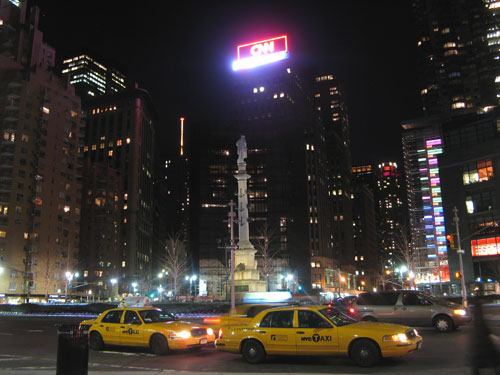
Columbus Circle

The Times‘s Manohla Dargis appreciated Cloverfield quite a bit less (“Rarely have I rooted for a monster with such enthusiasm“), but other critics responded more positively. More importantly, from the studio’s perspective, so did audiences, who flocked to theaters opening weekend to the tune of $41+ million in ticket sales, surpassing the January record of $35.9 million set by the Star Wars special edition re-release in 1997.

By the way: a gigantic reptilian beast laying waste to Manhattan, dropping vicious crab/spider creatures along the way — sure… could happen. Cell phones working during the siege — hmm, seems unlikely, but… well, okay. But reaching Bloomingdale’s from Spring Street on foot via subway tunnel in a few, albeit action-packed, real-time minutes? The audience at our afternoon screening audibly scoffed. C’mon… it’s clear that writer Drew Goddard, director Reeves and producer Abrams all hail from L.A. because as any New Yorker could tell you: that just makes no sense whatsoever.

Crimes, chills, thrills

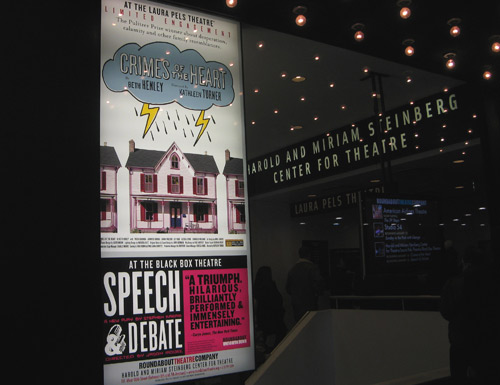
Actress Kathleen Turner has been generating a lot of buzz recently for her upcoming autobiography Send Yourself Roses (currently excerpted in the UK’s Daily Mail), in which she dishes on former co-stars including William Hurt, Michael Dougles, Nicolas Cage and Burt Reynolds. J and I saw Turner — a whole lot of her — when she performed “Mrs. Robinson” in the 2002 Broadway staging of The Graduate. Meh. This time, though, Turner is behind the scenes in her New York directorial debut: an Off-Broadway revival of Crimes of the Heart at the Laura Pels Theatre. (It was her commanding, husky voice that warned everyone to turn off their cell phones before the curtain rose. Her mildly threatening tone incited some nervous laughter, but not one ringer went off during the performance.)

Crimes of the Heart

Playwright Beth Henley won the 1981 Pulitzer Prize for Drama after Crimes of the Heart was produced off-Broadway at the Manhattan Theatre Club for a limited, sold-out, engagement of 32 performance, making it the first play ever to win before opening on Broadway. (It transfered in November 1981, and went on to also win the New York Drama Critics’ Circle award for best new American play.) Henley also wrote the screenplay for the well-loved 1986 film version starring Diane Keaton, Jessica Lange and Sissy Spacek, which garnered three Academy Award nominations, including one for Henley’s adaptation.

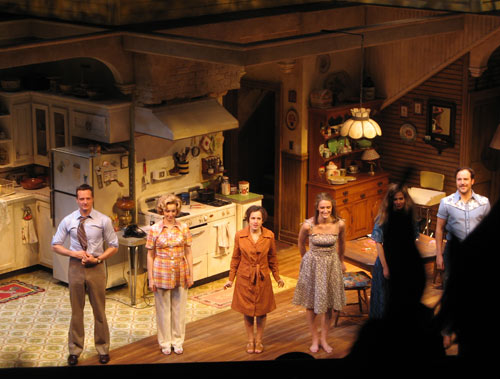
I’d never seen the play or the movie: a Southern family melodrama revolving around three sisters as they convene at the family estate in Hazlehurst, Mississippi. In addition to having grown up in the shadow of their mother’s suicide, each faces her own personal tragedy: the eldest, Lenny (Jennifer Dundas), is marking her 30th birthday and facing the prospect of life as an infertile spinster; Meg (Sarah Paulson), once known as the town tramp, has a sputtering career as a singer/actress in Hollywood; the youngest, “Babe” (Lily Rabe), is in jail for shooting her abusive, state senator husband. Abandonment, broken dreams, domestic violence, adultery, interracial relations, attempted murder… all of which takes place before the curtain even rises. And yet, despite the decidedly dark and emotionally heavy subject matter, and its characters who are at turns kooky and sympathetic, the play’s general tone is warm and humorous, and it stands as a testament to the strength of family.

The performances were solid throughout: most of the cast originated their roles in the recent Williamstown Theatre Festival production. Previews began on Friday, and based on this performance, there may be a few pacing adjustments to make before the official opening on February 7. Rabe, who was injured in rehearsals, did not perform the first weekend; in her place, understudy Jessica Cummings went on as the youngest McGrath sister, and turned in an impressive performance in her New York theatrical debut.

Crimes of the Heart

Check out more photos of the Crimes of the Heart cast and set here.

In other New York theater news: after glowing reviews in the The Times, The Sun, and The Wall Street Journal, the Classic Stage Company’s production of New Jerusalem has been extended through February 10. Talented actor Jeremy Strong (who played Spinoza) is set to star in the upcoming film, Humboldt County.

The temperatures were dropping steadily, and I hurried home through the bitter chill after the performance. Later that night, while reading in the cozy confines of my living room, I heard what sounded like my entire building erupt into spontaneous cheers.

w00t! The Giants are going to the Super Bowl!

A taste of Morocco

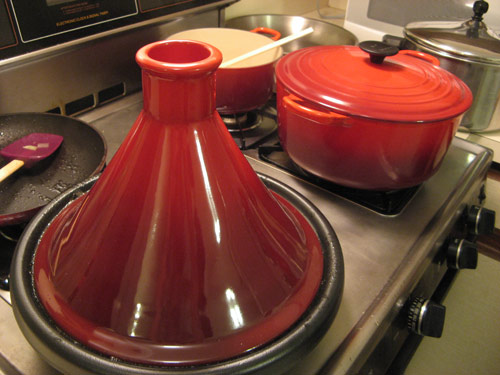
This weekend’s North African pot luck may have been the most challenging yet, requiring research for new recipes and the deployment of special equipment. An excellent opportunity to break out the clay tagine I received for Christmas from SC a while back. SYB, for his part, selected the dinner theme to show off his fancy new Le Creuset version. (Incidentally, Amazon sells a silicone tagine for $20. I adore my Silpats, but I am skeptical of the suitability of silicone for this particular purpose.)

Tagine

So this is what I learned in my preparations for Saturday night: a “tagine” refers to both a shallow, rimmed earthenware cooking dish with a tight-fitting conical lid, and to the food cooked within. The distinctive shape of the tagine creates a closed convection system, circulating moisture and heat. Steam condenses at the top of the lid – the farthest point from the heat source – and drips back into the dish, which allows the tagine’s contents to be braised over a long period of time without requiring additional liquid. I’ve seen tagines used in the oven, but they are intended for use on the stove top, or traditionally over a charcoal brazier.

The main characteristic of a Moroccan meat tagine is a full-bodied, highly seasoned sauce — not spicy hot, though, which is more characteristic of Tunisian cuisine. I located a recipe for Chicken Tagine with Apricots and Almonds and set to work in my kitchen, but due the size of my dish, I ended up making two batches: one in the tagine, the other in my trusty dutch oven. Curiously, they didn’t turn out looking or tasting noticeably different.

My results bore out Cooks Illustrated’s May 2006 look at tagines in an “Equipment Corner” article titled “Do you really need a tagine?” The editors concluded “no” — that for the most part, a quality dutch oven will do the same job at least as well.

In my Moroccan recipe hunt, I came across a New York Times piece in which Zarela Martínez (executive chef and owner of midtown Mexican restaurant Zarela) mentioned a chicken, preserved lemons and green olives tagine, accompanied by eggplant grilled with a pomegranate-molasses vinaigrette — a flavor combination which sounded intriguing and delicious. “Somehow eating that combination of the preserved lemon and the olive, which is salty, and the slightly sweet eggplant on the side with the pomegranate molasses, is just heaven. Whenever I’m trying to seduce someone, let’s say, that’s exactly the meal that I’ll make.

Hmm, interesting. So just in case: here’s that tagine recipe, adapted from Paula Wolfert‘s 1973 classic cookbook, Couscous and Other Good Foods from Morocco.

And because it’s still a dream of mine: 36 hours in Marrakesh. One day.