vip in the city, page 72

All This Intimacy

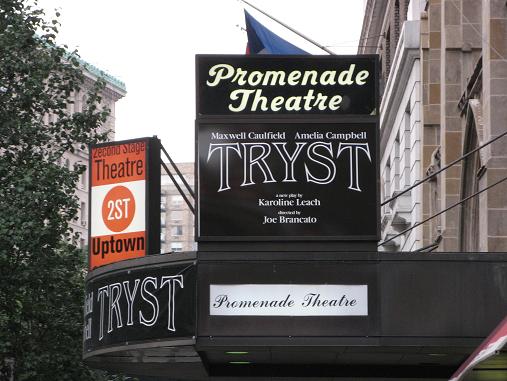
Promenade Theatre

Saw Rajiv Joseph’s All This Intimacy , world premiering at The McGinn/Cazale Theatre, as part of Second Stage Theatre’s New Plays Uptown series.

The building at Broadway and 76th Street has a long and storied history. In 1929, the Manhattan Congregational Church commissioned the mixed use building to be erected over the site of their old church in order to generate revenue. Above the church’s three story sanctuary, the 626-room Manhattan Towers Hotel opened in Spring 1930. Not the best timing: within two years of opening, the hotel had gone out of business, and Manhattan Congregational Church soon ran into serious financial trouble, due to the loss of rental income and financial mismanagement. Through the next several decades, the fate of the building was in flux: it fell into receivership, was appropriated by The Church of Jesus Christ of Latter-day Saints, went up for auction (no takers) and was eventually reposessed by the city and used as U.S. Naval Barracks. Following the trend of several large Upper West Side buildings, it served for many years as an SRO, and after an extensive renovation, was eventually converted into coop apartments. The Promenade Theatre now occupies most the space that was originally the church sanctuary.
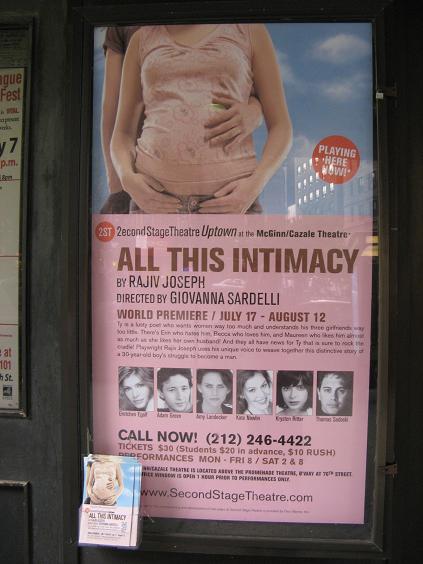
All This Intimacy Poster

The play’s story centered around a 30-year old poet, who through moral weakness and a series of poor judgments (plus some bad luck), ends up simultaneously impregnating three women: his girlfriend, his married neighbor, and his college freshman student. The first half of the play was more comical, focusing on the whirlwind courtships and possibilities of new relationships; the second was decidedly darker as the toxic consequences of the protagonist’s indiscretions came into play. Well done, all around. Afterwards, there was a post-theatre discussion with the artistic team, including the playwright and the director, Giovanna Sardelli.

The audience was heavy with NYU Writing Program students – Joseph is a Tisch MFA graduate – and their contributions alternated between trenchant observation and random criticism. Responding to the playwright’s query about the message the audience might come away with after seeing the play, one young woman posited: “Men… SUCK.”

Well, yes. Sometimes.

A reception followed with Beard Papa creampuffs (love ) and a tasty port from “America’s Oldest Wineshop,” Acker Merrall & Condit.
NY-HS Happy Hour @ Old Town Bar

The heat index in NYC hit 104 degrees this afternoon. Yikes. We’re not alone in our suffering: The New York Times reported 21 states with at least one location exceeding 100 degrees.

Wretched morning commute. The soaring temperatures have been wreaking havoc on the century-old NYC subway system. Yesterday, the nearly 100 degree heat caused a portion of the electrified third rail on the A line to buckle, stranding commuters for almost two hours in Rockaway. This morning, disaster struck the IRT. After slipping into the subway, just ahead of the closing doors on the downtown 1 train, my train proceeded to inch along the track for about 50 feet before jerking — hard — to a dead stop. A feeling of dread spread through the car, as the lights flickered, while the air conditioning sputtered, then whirred into ominous silence.

Seemingly within seconds, the train car was heavy with the sweaty steam rising off dozens of increasingly agitated commuter bodies. Car end-doors propped open, cabin windows popped and newspapers were fashioned into makeshift fans in a desperate attempt to generate some air circulation as we sat (or stood) in wait. Finally, an announcement: “Power outage on the West Side — please be patient.”

We were patient. We had no choice, really. I half expected a spontaneous riot, or some flare-up of commuter-rage, but the extreme heat seemed to have cowed the crowd into quietly suffering resignation.

Twenty stifling, interminable minutes later, the train reversed back into the Lincoln Center station, and we were released into the blazing sun. It was another twenty minutes of watching bus after impossibly-packed bus crawl past on Broadway after which I decided to change tactics and cross town for the East Side trains.

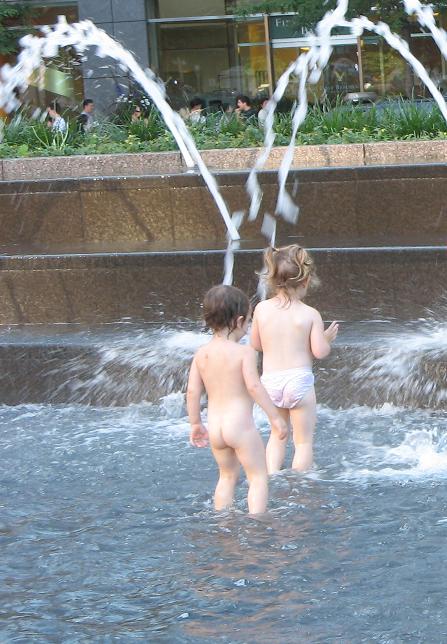
If not for work, I could have taken a cue from the toddlers frolicking in the Columbus Circle fountain. Though at some point, public nudity becomes considerably less cute.

Columbus Circle Fountain

Met SYB at the McBurney Y for our weekly CSA vegetable pick-up. After we’d divvied up our shares of Red Sails lettuce, dill, summer squash, perpetual spinach, new red potatoes, scallions, fennel, escarole, cucumbers, and Bright Lights swiss chard, he walked me to the Old Town Bar, where the Young Friends of the New York-Historical Society were hosting a happy hour.

The OTB was established in 1892 and is one of the Old New York watering holes, of which the most famous is probably McSorley’s Old Ale House. The high-backed booths (some original, with Prohibition-era storage space underneath in case of government raid), soaring tin ceilings, bevel-edged plate mirrors and marble topped mahogany bar all add to the charm. It sits west on 18th Street from another old timey bar: Pete’s Tavern, where in 1904, O. Henry penned his classic “The Gift of the Magi” at his favorite booth by the front doors.

Appropriately enough for the Historical Society, we were given a fact sheet on our venue (from which I cribbed some of the information above.) SYB stayed on for one lemonade — somewhat inferior to the deluxe versions from Sunday — while I remained to mingle with the other Young Friends. Met KW for the first time, and several others, including D, a documentary filmmaker who was recording the event for inclusion in a piece on the Society. Shortly after 8:00PM, DLW arrived from his office uptown; he and I stuck around for another hour or so, catching up on our summers.

Raced back home for a quick and much needed rinse before meeting CS at “our place.” As I was preparing to head out the door, I could hear the rumble of thunder and the sudden sound of rain — lots of rain — pounding against my windows. A quick call to CS, and after brief consultation, we decided to go forward with our plans, regardless of the storm. We did, after all, have important matters to discuss. Luckily, I had only to cross the rivulet, formerly known as Columbus Avenue, to reach my destination; CS sloshed in minutes later, from five blocks away. What a trooper!

Drenching aside, it was a lovely way to unwind after a long, hot day. On top of which, CS and I got to introduce ourselves to bartender Paul, whom we will no doubt be visiting again very soon.

Copa del Rey 2006

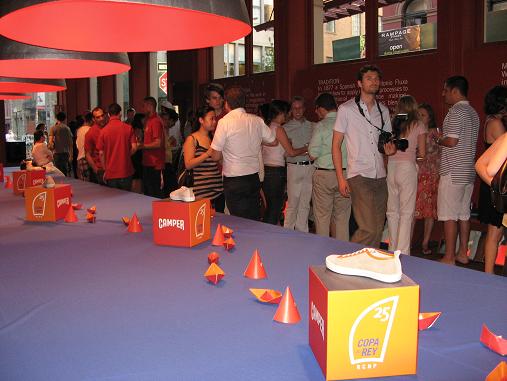
Attended the Copa del Rey 2006 party, at co-sponsor Camper’s shop in SoHo to commemorate the 25th annual sailing regatta, taking place in Palma de Mallorca, July 29 through August 6, 2006. In honor of the occasion, Camper (Spain’s most popular shoe company and design sensation) debuted the IMAR Limited Edition — a nautical shoe to be released in a limited run of 500 pairs worldwide.

Camper Party
Platters of sea-themed hors d’oeuvres (crab cakes, tuna tartare, lobster puffs, etc.) were passed among the funky shoe displays. The signature cocktail of the evening was dubbed the “Camper Special”: vodka, orange juice and grenadine over ice. Actually, the drink’s proper name is a Bird of Paradise. The more familiar Tequila Sunrise substitutes tequila for the vodka.

Grenadine, from the French word grenade for pomegranate, is a deep ruby red syrup that was once made with a base of sugar (sometimes honey) and pomegranates. It’s popularly used in mixology to add sweetness, while importing a pretty hue to drinks (as in pink lemonade.) The Wall Street Journal last month ran an interesting article on how today’s commercial grenadines, however, are very often artificially flavored, with many brands containing almost no fruit juice at all. The most popular brand in the United States (and the brand used at this party) is Rose’s, which is made from high fructose corn syrup – not sugar – and whose color is derived from red dye #40 (with some blue dye #1) – not pomegranates – plus the catchall “natural and artificial flavors.” The article went on to compare the scent of Rose’s to cough syrup.

For true sirop de grenadine, the article recommended as an alternative Rième Boissons (made with beet sugar), Williams-Sonoma brand and Stirrings grenadines, or the Sonoma Syrup Company’s Pomegranate Simple Syrup. All are available (with some searching) in New York City’s better liquor stores and gourmet food shops.

Or there’s always the option of making your own, which, based on the recipes I’ve seen, would be a simple matter of juicing pomegranates and reducing with a simple syrup of sugar and water. Easier still (and less messy), one could use the now widely available POM-branded pomegranate juice, as the Williams-Sonoma version does.

Try it, you’ll like it.

Sunday Jazz @ MoMA Summergarden

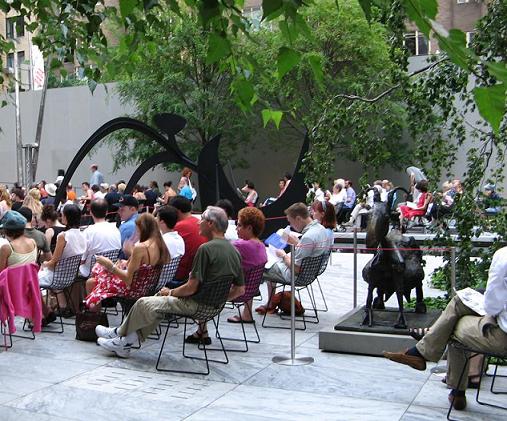
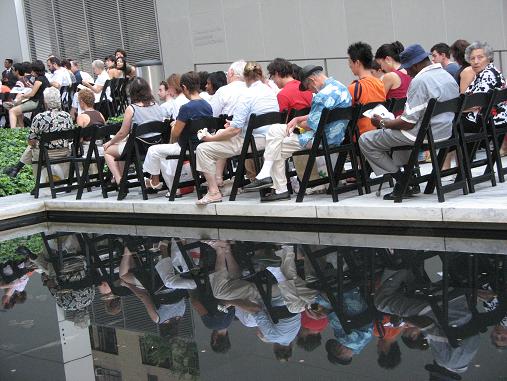
Arrived at The Museum of Modern Art Summergarden just before doors opened at 7:00PM for the 8:00PM concert. By then, there were a couple hundred people ahead in line; luckily, that night the Abby Aldrich Rockefeller Sculpture Garden was set up to accommodate over 800 people. We ended up with seats between one of the reflecting pools and Donald Judd’s Untitled (1968). Despite the oppressive heat of the waning day, by concert time, the garden was standing room only.

On the program was a jazz performance by Steve Coleman and Five Elements. The alto saxophone, trumpet, trombone, bass, drums and vocal ensemble played an impressive 90-minute suite as night shadows descended upon the space. I would have enjoyed the concert much more had we not been beset by infuriating rudeness on all sides: in front, one man decided to use the Judd sculpture (a series of large, open, painted green rectangles) as his personal shoe rack, until ordered by one of the guards to kindly remove his socks(!) and sneakers from the artwork, thank you; to our right, a pair of eurotrashy women co-opted the section’s one walkway for their personal lounge area, laying fully supine on the marble tile next to the water, while everyone else was forced to navigate precariously around them to pass; and in the row directly behind, a French couple prattled loudly and obliviously through most of the performance with complete lack of regard for those around them who were there to listen to the music. Mon Dieu!

EH was friends with the singer and introduced us to her after the show. After parting ways with the others outside MoMA, we got to introduce AC (aspiring dentist, whom I met that night) to the joys of late night burgers at Burger Joint, one of my favorite no-longer-secret places in New York – now almost entirely ruined, thanks to write-ups like the one in GQ Magazine, naming theirs among one of “The 20 Hamburgers You Must Eat Before You Die.”

MoMA Concert

MoMA Concert

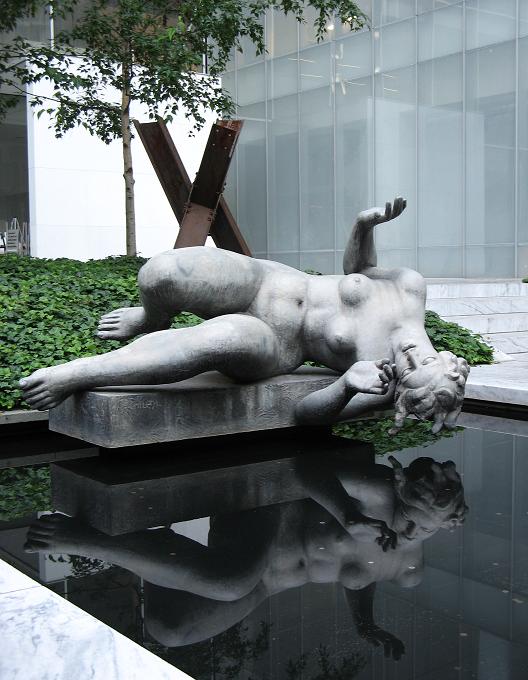
Aristide Maillol’s The River :

Recumbant Nude

Bastille Day 2006 Redux

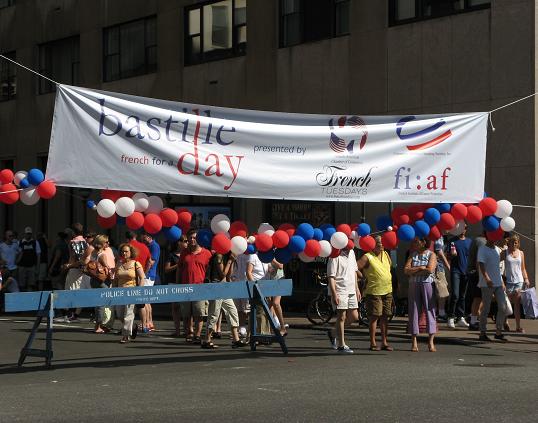
Although Friday July 14 was Bastille Day, the French Institute Alliance Française (FI: AF) held its annual fête on Sunday afternoon, July 16, this year.

The French Institute and the Alliance Française de New York (Nouveau York?) originally operated as two separate organizations, but merged in 1971 to form the largest Alliance Française in the United States; their Haskell Library is the most comprehensive private collection of French volumes in the nation.

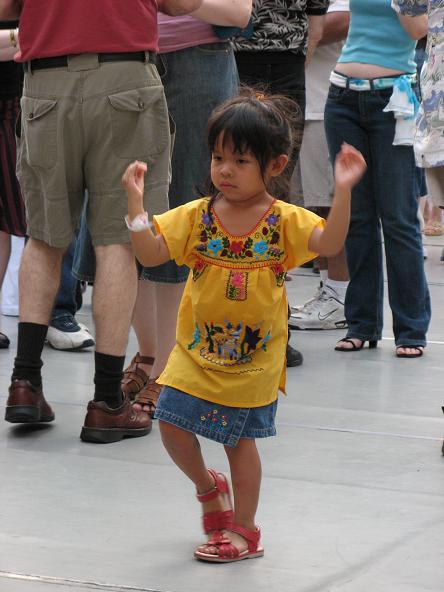
Bastille Day

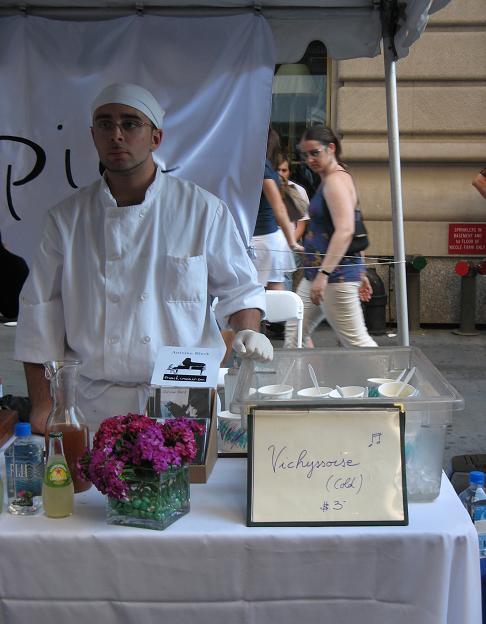
No waiter races this year, but there was plenty of good, French fun to be had. We arrived in time for the “Fun with French” comedy/musical performance of stripe-shirted Jacques and Marie. The stands lining East 60th Street offered crepes, creme brulée, eclairs and vichyssoise – somewhat classier that the standard street fair fare of sausage and peppers and deep fried funnel cakes.

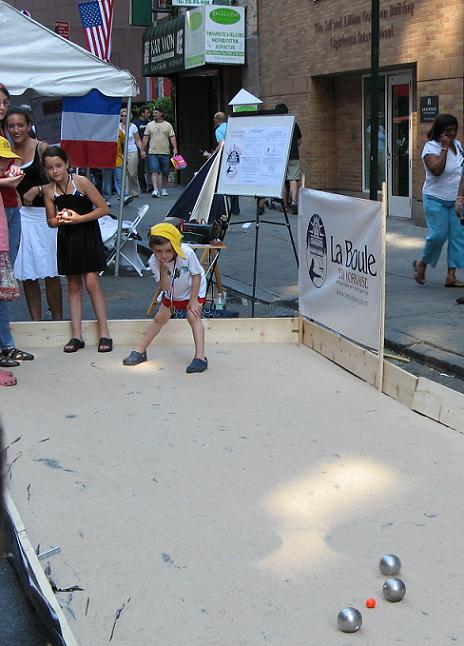
Children gathered at the (ineffectually sloped) sand pit for rounds of pétanque — the French version of bocce.

Petanque

While the American origins of vichyssoise have been debated by culinary historians, its creation is generally attributed to French chef Louis Diat, who created the soup for the opening of the Ritz-Carlton rooftop restaurant in New York City. In his 1961 “Gourmet’s Basic French Cookbook,” Diat recounted that as a child in France, his maman would serve him warm leek and potato soup for breakfast, which she would sometimes cool with milk. So while Diat was certainly not the first to combine leeks, potatoes and cream in a soup, he added the innovation of serving it chilled, and dubbing it with its current name, after his birth town, Vichy.

Interestingly, the quintessential French dish coq au vin was, according to popular myth, invented by an Italian. Sort of. The legend goes that when Caesar conquered the Gauls, the inhabitants of the area – now modern day France – presented him with an old rooster as a sarcastic tribute. Instead of being galled at their impudence, Caesar ordered his chef to stew the tough bird in wine and served it to the Gauls for dinner. In urban dictionary parlance, this would be known as “flipping the script.” Or the bird. Nowadays, of course, the dish is almost always prepared using a poule/chicken instead of an old coq/cock.

Vichyssoise

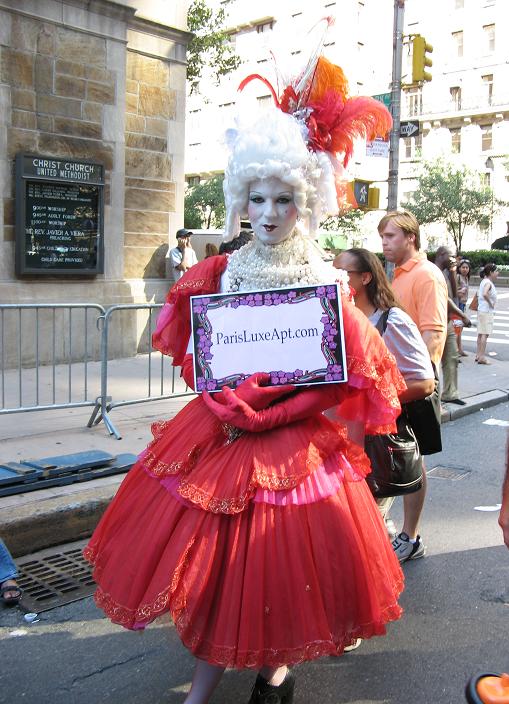
And yes, I’m playing directly into this website’s advertising campaign, but if you’re in the market for a luxury Parisian rental, or like me, you just enjoy poring over photos of stylish/fancy apartments, you can check it out.

ParisLuxeApt

I indulged in some overpriced but refreshing lemonade (rather: citron pressé) at the fair, unwittingly opting to pay the 50% premium for quality. Hours later, in the much needed oasis of air-conditioned cool at the TimeWarner Center, I paid for more quality lemonade from Bouchon Bakery.

La chair est triste, hélas! et j’ai lu tous les livres. (Alas, the flesh is weary, and I have read all the books.)
– Stéphane Mallarmé (1842-1898)

One tequila, two tequila, three tequila, floor

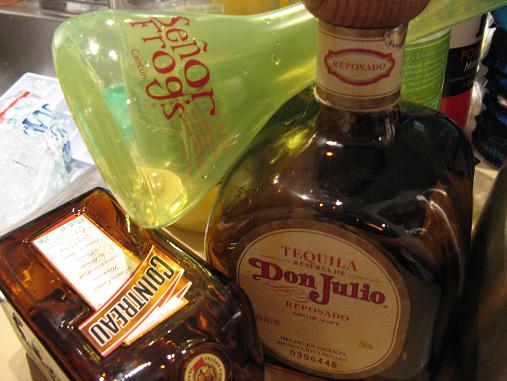
Among the souvenirs M returned with from Mexico were two bottles of premium Don Julio Reposado tequila — aka “the good stuff” — which she decided to debut at a garden party on Friday night.

By the time I arrived, M, AC, MM and BK were in the courtyard; MP and RB arrived later, after Motorcycle Safety School. Summer rolls and kabobs were set aside a sweating pitcher of frozen margaritas on the patio table. On Bastille Day. How multi-cultural!

BK had brought in a box of (Popsicle-brand) popsicles, which I probably hadn’t had in two decades. Brilliant. But after all these years, I still can’t stomach the grape-flavored ones; they remind me too much of Dimetapp.

Detritus

The Happy Hooker

Started my “Crochet: An Exploration of the Basics” class at The Cooper Union this evening.

The class was held in the Engineering Building at 51 Astor Place. As could be expected, the group was made up entirely of women: ten in total, ranging in ages from their late 20s to their late 60s. During the obligatory introductions, I learned that eight of the ten women had prior knitting or crochet experience. Five minutes in, and already things did not bode well.

A little background: My mother is an expert knitter and crocheter. Growing up, we had a steady supply of beautiful, handmade sweaters, throws, bedspreads and pillow shams that seemed to bloom, as if by magic, off her rapidly clicking needles and hooks. Regrettably, these abilities do not appear to be heritable. Over the years, I had made a few feeble attempts to get knitting lessons from my mother, but each time, one or the other of us lost patience. So I never learned.

I signed up for the class with high hopes which quickly began to erode as it became obvious that I was going to be the student most in need of “extra attention.” As the instructor — a cheerful, and infinitely patient woman named Lisa — explained to the rest of class the mechanics of a starting chain stitch, nine heads bobbed silently in seeming immediate comprehension. Whuh? I stared at my new yarn and tried to figure out how to hold the crochet hook. Despite my best efforts, I dropped it — three times over the course of the class, each time sending a loud PING! reverberating off the walls of the otherwise hushed classroom. Why oh why did I have to buy a metal hook? As the others in the class moved on to placing their first row of crochet stitches, I struggled with not tangling my fingers in the loops of the alarmingly knotted yarn.

“Don’t worry: the first row is the hardest,” Lisa soothed.

Row? I stared helplessly at the jumble of wool in my hands that seemed decidedly more wad-like than row-like.

Lisa made her rounds, clucking encouragement and approval to my classmates. When my turn came, she stood behind my chair and fell into a contemplative silence.

“Oh… my. Well, let’s see what you’ve got here.” She delicately plucked the hook and yarn from me and held it up for closer inspection, turning it slowly to examine the entire lumpy mess from all angles, while the beginnings of a furrow formed over her brow. “Hmm. Well… this isn’t so bad,” she added. Unconvincingly.

“What do you do when you get to the end of a row?” someone called from across the room.

“Chain one up, turn and reverse the stitches,” she called back. To me, she murmured, “I’ll be right back,” with a reassuring (sympathetic?) pat on the shoulder. From the center of our crocheting circle, she held up her sample swatch and demonstrated the technique for all to see.

Within minutes, the cries of “Ah!”, “Look at that!”, “Cool!”, “Hey, I think I’m getting this!” filled the room. Even my fellow newbie seemed to be cruising along. Under my breath, I began to swear.

Lisa returned to my side. “Ahem. Okay, now. Don’t worry, we’ll get this,” she assured me, all business. “Let’s start over.” She handed me a pair of scissors.

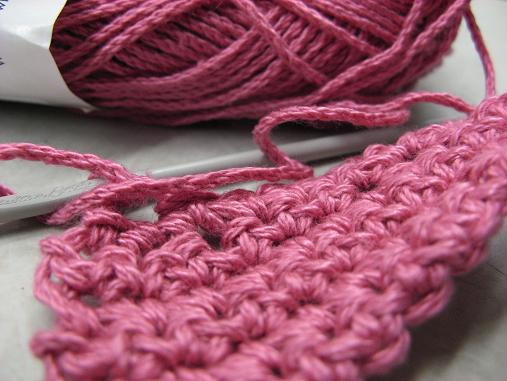
While the rest of the class moved on to the double and then triple crochet stitches, I cut line and began anew. And two hours and forty-five minutes into the three hour class, I did get it. Sort of. My neck was stiff and my fingers ached, but I had something resembling crochet as I knew it:

Crochet

Towards the end of class, Lisa talked us through a simple — hah! — pattern for granny squares to attempt at home. Looks like I’ve got some catching up to do before next Thursday night.

Public Art (but no Music)

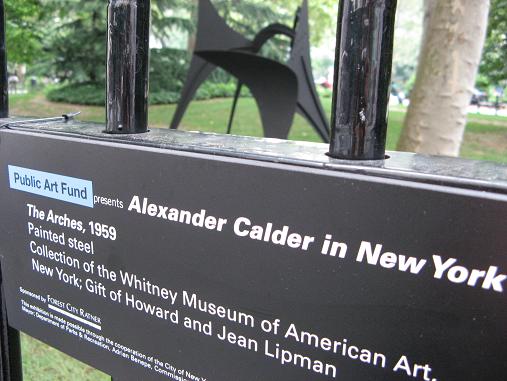
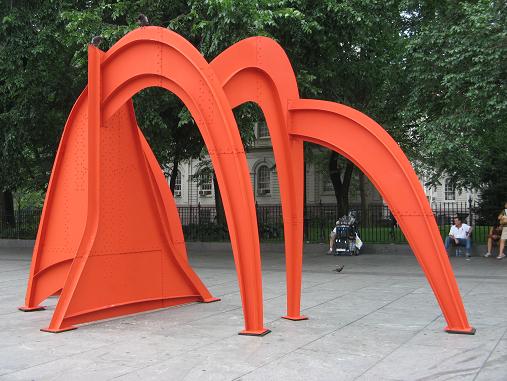
Walked to TriBeCa during lunch to purchase crochet supplies for my first class. On the way I passed through the ”Alexander Calder in New York” exhibit in City Hall Park — five large scale “stabiles” (as Calder called his freestanding, nonmoving sculptures), created between 1957 and 1976 and on loan from the Calder Foundation and the Whitney Museum of American Art through March 2007.

Calder Arches

Jerusalem Stabile

The exhibit includes one of Calder’s signature mobiles — not displayed outdoors, but suspended inside the City Hall rotunda. Made a mental note to check that out sometime soon.

Always enjoy seeing public art in random places. Barrelling through the financial district, head down, in your own world, or talking into a cell phone, and then suddenly — bam! — an unignorable, massive, bright red Calder at your feet.

The first of the two Philharmonic in the Parks concerts in Central Park was canceled due to thundershowers that rolled in, blackening the sky late in the afternoon. By concert time, the skies had actually cleared somewhat, but the grounds would have been wet and muddy and not at all pleasant for lawn lounging. Weather permitting, the orchestra performs Beethoven’s Fifth next Tuesday, in keeping with the tradition for mass appeal.

Which recalls to mind the popular “Beethoven’s Wig” series created by Richard Perlmutter. Simple concept: taking classical melodies and writing — or rewriting — lyrics. So The Fifth Symphony would be sung:

Beethoven’s WIG… is very BIG
Beethoven’s wig is long and curly and it’s white
Beethoven takes his wig off when he sleeps at night
Because it’s big
It’s very big
Beethoven’s WIG… is… BIG!

And so on. I remember engaging similar efforts in preparation for those “Name that tune” exams in high school music class, to less witty and commercially-recognized effect. Almost surprising that these discs didn’t hit the market until 2002, considering the glut of Mozart Effect-fueled “classical music for babies/children” collections in the mid to late 1990s.

Witty stuff, though I think that if I were trying to instill an appreciation for classical music in my children, I’d still be more likely just to play them the originals.

Met BH for drinks in the neighborhood. Now that he’s a father of twins and living in New Jersey, his opportunities for socializing are relegated to late night drives into the city after putting the babies to sleep. Over rounds of rapidly melting — and later, rain spattered — frozen margaritas, he waxed nostalgic about his single days as a Manhattanite, and brought up the subject of Internet dating services. I explained that while I could see how it might be a good way to meet a lot of people, I didn’t think that online dating was really my thing, especially after that little dalliance I had with the Nigerian diplomat ended on such a disappointing note. I’m still waiting for my millions.

Bodies

The steaminess set in around 3:00AM, after I shut down the bedroom air conditioning and drifted off to a fitful sleep. Too soon, I was jolted by the rude blaring of my alarm clock. I crawled out of bed reluctantly and spent the better part of the morning in a hazy, pensive state.

Met SN for lunch this afternoon at a Japanese place on William Street. Actually, the spot was only nominally Japanese, as they also prepared Korean chap jae (which I ordered) and Chinese mapo tofu (which he ordered) alongside their sushi and teriyaki items. Despite the popularity of such eateries, I still find the hodgepodge of Asian cuisine offerings a little disconcerting.

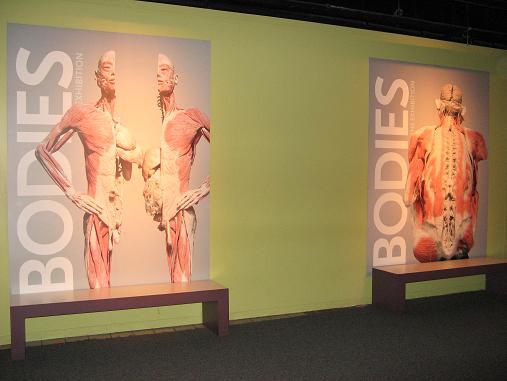
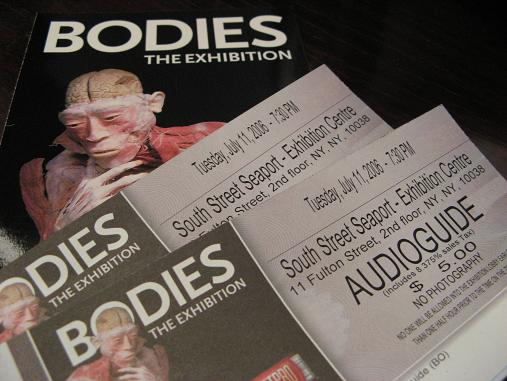
After work, CS came downtown to meet me for BODIES…The Exhibition at South Street Seaport.

According to the site:

A human specimen is first preserved according to standard mortuary science. The specimen is then dissected to show whatever it is that someone wants to display. Once dissected, the specimen is immersed in acetone, which eliminates all body water. The specimen is then placed in a large bath of silicone, or polymer, and sealed in a vacuum chamber. Under vacuum, acetone leaves the body in the form of gas and the polymer replaces it, entering each cell and body tissue. A catalyst is then applied to the specimen, hardening it and completing the process.

End results are remarkably vivid and endlessly fascinating. Several of the cadavers were posed to illustrate the interconnections between muscle and bone in action. Referring to one body arranged to mimic a man taking a jumpshot, I remarked to CS that it would have been funny if the basketball in his hand were also dissected to show the peeled back layers of orange and black rubber. She giggled at the idea, earning us a few disapproving glances from the other attendees, who no doubt assumed we were deriving more prurient amusements.

Immaculate and amazing dissections, including one of the entire central nervous system. One gallery exhibited the immensely complex network of arteries, veins and capillaries comprising the circulatory system. The vessels were injected with a coloring polymer that hardens, and the remaining tissue was chemically removed in a process known as “corrosion casting.” What remained behind were the delicate branches, devoid of internal structure and displayed in dramatically spotlit glass cases: organs, limbs and one entire human body. The effect was eerily beautiful.

Bodies

Bodies Tix