vip in the city, page 64

WIRED NextFest

WIRED Magazine’s NextFest (or perhaps more aptly: “NerdFest” – yep, beat you to it, wise guys) took place at the Jacob K. Javits Convention Center September 29 through October 1. The event was billed as “WIRED’s vision of a new world’s fair” — a four-day festival of innovative products and technologies. Featured were over 130 interactive exhibits from leading scientists and researchers around the world, showcasing “the future of exploration, entertainment, transportation, health, communication, design, security, and green living.”

WIRED had arranged for shuttle buses from Union Square, Grand Central and Penn Station to transport fest attendees reluctant to make the somewhat gritty trek from the nearest subway station to the Far West Side of Manhattan. We caught one of the early buses, arriving at the I.M. Pei–designed glass-walled convention center shortly after the festival opened its doors on the final day.
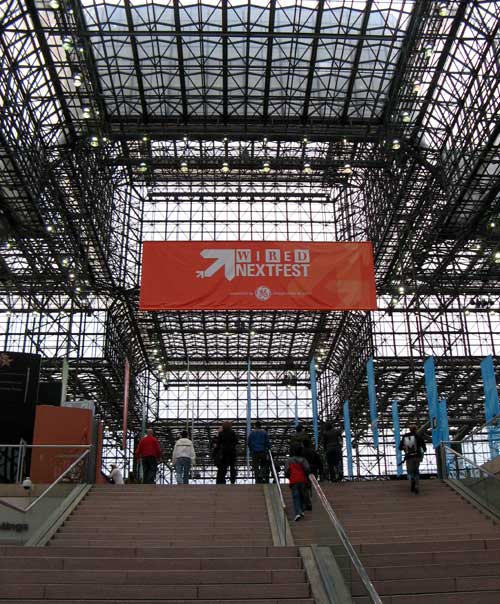
Jacob Javits

As was to be expected, the crowd was predominantly young and male. Less expected were the passels of grade school kids, whose parents had brought them by to wander among the many, many cool exhibits. With all the flashing lights, spinning and moving parts, blips and beeps, it was complete sensory overload in the atrium. And as if that weren’t enough stimulation, the Coca-Cola BlaK reps were there, handing out bottles of their brew, ensuring that everyone remained appropriately hyper-caffeinated. It’s Coke… with coffee! (The “carbonated fusion beverage,” introduced to the U.S. in April, contains roughly double the caffeine and half the calories of regular Coke, and tastes better than it perhaps sounds on paper… er, screen.) Hard to say who was most excited: we were all like kids in a giant candy store that morning.

A small sampling…

Circles Mirror” (Tisch School of the Arts, New York University) — a 25 square-foot “mirror” constructed of 900 overlapping disks of laminated paper, arranged in a 30 x 30 pixel matrix. The disks mechanically rotate to “reflect” the changing shadows and light picked up by a video footage. Each circle is powered by its own motor and bears 1 of 12 laser-printed patterns, ranging from light to dark.
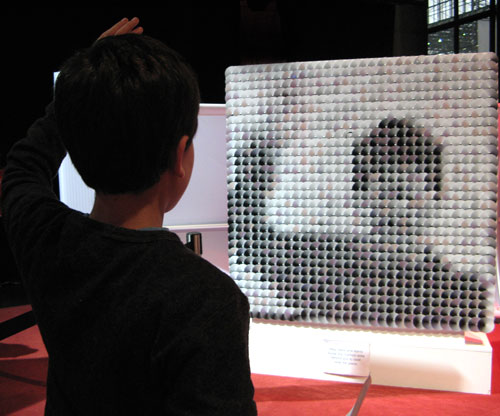
Circles Mirror

“Atari Rabbit Theater” (Violet) — an installation of 100 rabbits in a dimly lit room: talking, singing, wiggling their ears and throwing disco lights to perform an original opera.
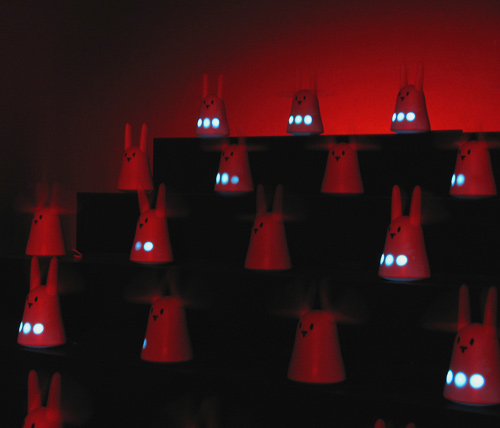
Atari Bunnies

On “Robot Row”: the Albert Einstein Robot Face (Hanson Robotics) and HUBO robot body (Korea Advanced Institute of Science and Technology) — debuting the first ever walking robot with an expressive frubber face. Handlers put the robot through the motions of Tai Chi and modern dance.
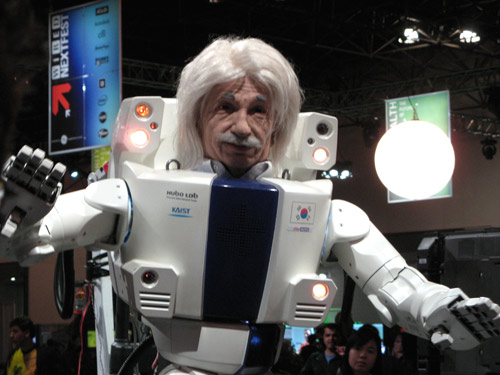
Alex HUBO

“Juke Bots” (Robot Lab, Germany) — Twin five-foot robotic arms, constructed out of KUKA industrial robots, that select and spin vinyl records on slightly modified Technics 1200 turntables. (Cool to watch, but I don’t think flesh and blood DJs need watch their backs.) The bots are programmed to perform scratch compositions and, on occasion, choreographed synchronized “dances.”
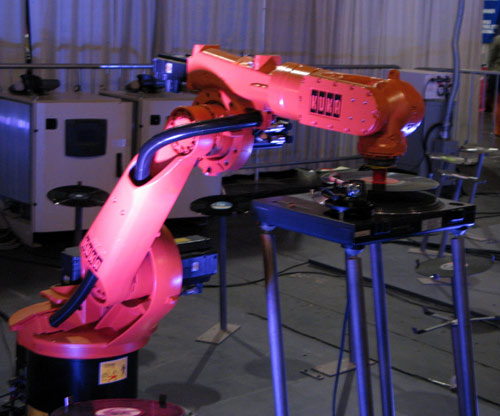
Juke Bot

In the “The Portal” entrance, there was a “Laser Harp” exhibit by Blue Ink Studio — a large scale piece that users could “play” by using movement to manipulate virtual laser strings.

Also musical, the “Laptop Orchestra” (LIMITEAZERO): Users conduct sound and abstract video on 15 laptops by touching the corresponding stems grouped together at the podium. Lightly tapping the stem tops activate and deactivate the computers. Custom algorithms on each machine produce different sounds and shapes.
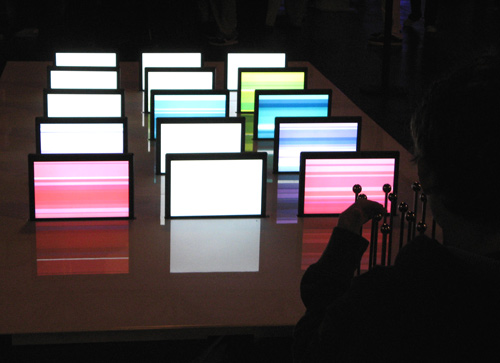
Laptop Orchestra

There was the eerily lifelike “Actroid Der” (Kokoro) — an android resembling a young, slim, black stretch vinyl-clad (natch) Japanese woman, capable of mimicking human facial expression, gestures and speech, and “understanding” common English and Japanese phrases.

And here, the “Partner Ballroom Dance Robot” (Tohoku University, Japan) — a battery-powered fembot equipped with force and torque sensors, capable of anticipating and matching a dance partner’s steps.
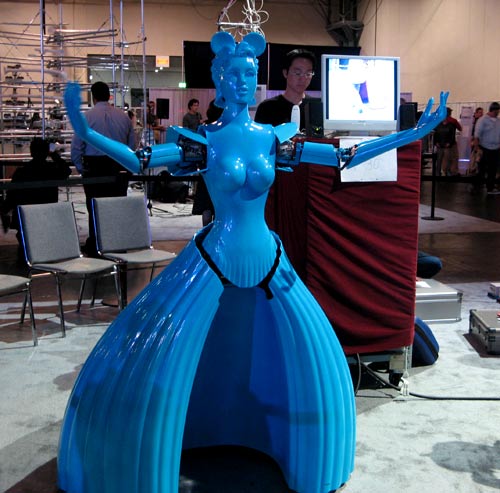
Ballroom Dance Robot

“Fogscreen” (Fogscreen Inc.) — impressively detailed images are projected onto an ultrafine vapor “screen,” which is dry to the touch.
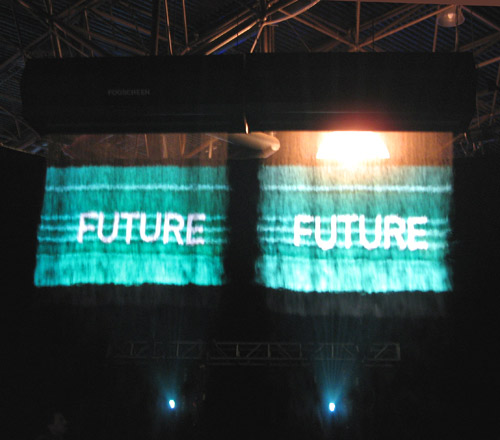
Fog Screens

Kick Ass Kung-Fu“! (Animaatiokone Industries) — one of the more popular exhibits. Gamers lined up for a test round of this large-scale video game, capable of inserting the user’s full body — plus any weapons he or she brought into the arena — directly into the fighting action.
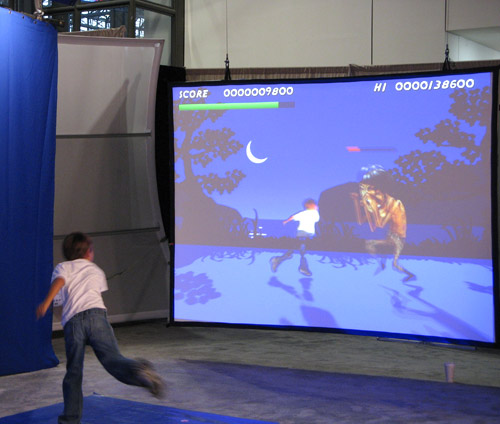
Kick Ass Kung Fu

Other games on display: the more cerebral “Brainball,” (from Sweden’s Interactive Institute) in which two players, wearing brainwave-detecting headbands, face-off against each other. The headbands monitor alpha and theta brain waves, to direct movement of a ball across a special table. Cool technology, oddly applied: the design of the game counterintuitively promotes “Winning by relaxing!”: the ball moves towards less activity, not more.

3D Display Cubes” (James Clar) — a custom built three-dimensional light installation made up of cubes of 1,000 individually controlled LED’s, soldered onto a freestanding matrix. Sparklingly beautiful, no?
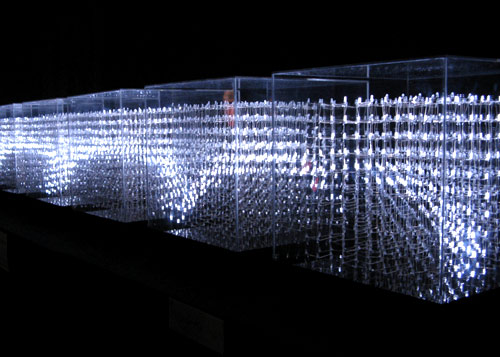
3D Display Cubes

Exhibitor Con Edison donated more than 400,000 kilowatt hours of electricity, generated entirely by wind-driven machines.
Rare Saturday

This is absurd: since when does the holiday season kick off before October 1? Can the crystal UNICEF Snowflake at 57th Street and Fifth Avenue be far behind?

Snowflake

On this last day of September, SYB and I decided on a lark to try to cash in our “Free jar of peanut butter with sandwich purchase” coupons that we picked up from Peanut Butter & Co. at Time Out New York’s “Back to School Blowout” in Union Square a couple of weeks ago. The only difficulty would be in deciding which cutely-named peanut butter variety to pick: the standard creamy (“Smooth Operator”) or crunchy (“Crunch Time”)… or the quirkier blends: “White Chocolate Wonderful,” “Cinnamon Raisin Swirl,” “Dark Chocolate Dreams” or “The Heat Is On” (natural peanut butter blended with fiery spices.)

I was somewhat intrigued by that last one, figuring it wouldn’t be much different, from say, Chinese takeout Sesame Noodles (minus the noodles). And I like those, on occasion — ever since first being introduced to them in the 8th grade at DLW’s Upper West Side apartment. On the other hand, the combination was potentially really, really vile.

I decided to try out the blend in a sandwich before committing to an entire jar. The PB & Co. menu offers “The Heat Is On Sandwich” (“Spicy peanut butter and chilled grilled chicken, with a little bit of pineapple jam. Like a Thai satay — only better.”) Hmm, interesting… though I actually had my heart set on “The Elvis” (“A grilled peanut butter sandwich, stuffed with bananas and honey. Try it with bacon for that extra indulgence. Long live the King!” Yow.)

So after work, I hopped into a towncar and headed down to the Village. Unfortunately, I wasn’t paying attention, and the driver — newly arrived in New York City — hadn’t yet built up the wealth of driving experience to know that one should never, ever, attempt to cross town on Bleecker Street on a Saturday night. Oh, he knows now. It took about ten minutes to get downtown, and another twenty-five of stops and starts to reach Sullivan Street.

SYB actually beat me there by subway from Sunnyside. I was sitting in traffic a few blocks away when he called my cell phone with the sad news: Peanut Butter & Co. had run out of bread for the evening. (?!) No bread meant no sandwiches. No sandwiches meant no free jars of peanut butter. Alas. Technically, the shop was still open, so we could still be seated for salads or milkshakes, but that just seemed to defeat the purpose of the outing.

Damn. That’s the last time I plan my night around a peanut butter sandwich.

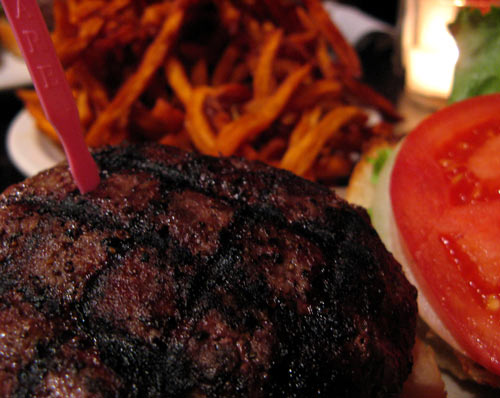
We ended up at Rare Bar & Grill, the Bleecker Street offshoot of the burger joint located in the lobby of the Shelburne Murray Hill Hotel. Pretty good — and they actually prepared the burger medium-rare as I requested — but still not my favorite hotel lobby burger joint.

While we were picking at our side order of somewhat soggy sweet potato shoestring fries with too sweet maple dipping sauce, a seriously skeletal Kate Bosworth ambled past our sidewalk-side table, looking as if she hadn’t enjoyed a fry or a sandwich in quite some time.

Rare Burger

Jersey City housewarming

Well, M(LF) finally did it: after months of threatening to do so, she finally left the place in Chelsea behind for Jersey City (a.k.a. the Dirty Jerz). Tonight would be the housewarming party.

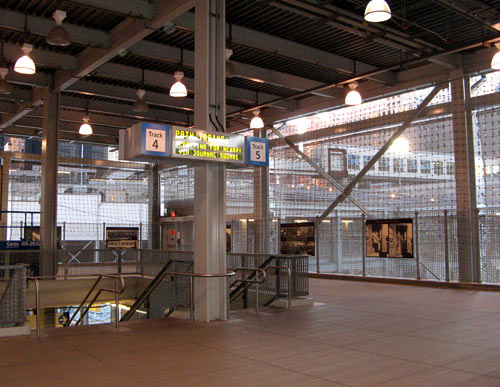
Despite its proximity to downtown Manhattan -– a mere six-minute ride from the World Trade Center PATH station (Yes, I timed it) — I’d only ever been through, not to, Jersey City. On the way down to the train platform, we passed a familiar face, riding the escalator in the opposite direction. It was DK, on his way home from work.

“Where are you going?,” he called.

As the escalators pulled us deeper into the station, widening the gap between him and us, we called back, “JER-zeeee!”

WTC PATH

The city has a (2000 U.S. Census) population of 240,055, comparable to post-Katrina New Orleans (i.e., about half of the pre-Katrina population numbers.)

In the late 19th century, Jersey City served as an inviting destination for immigrants coming through Ellis Island, offering easy access to Manhattan and plentiful jobs in its thriving manufacturing center. But decades of government mismanagement and a history of political scandal and corruption produced a classic example of urban blight by the late 20th century, leaving abandoned waterfront rail yards and shells of warehouses in its wake. In the past decade, though, Jersey City has undergone a major renaissance and the yards have been replaced with public parks and massive residential and commercial development. Trump Plaza: Jersey City is in the works at Washington and Bay Streets, and will include New Jersey’s two tallest residential towers (50 and 55 stories tall.)

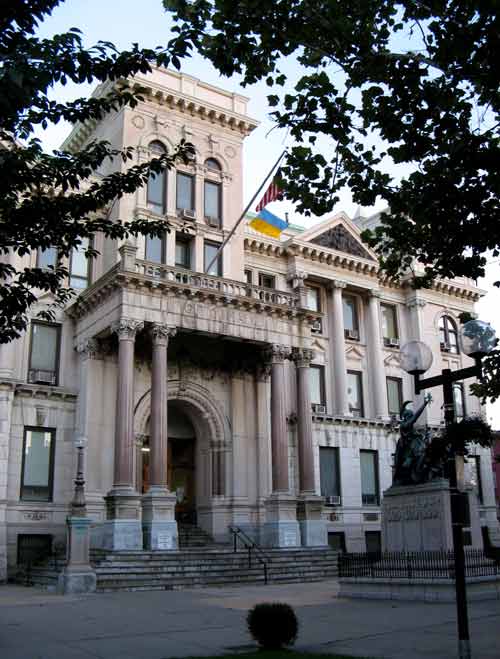
City Hall of the City of Jersey City (1896) — designed by Lewis Broome, who also did the plans for the Trenton State House:

JC City Hall

M’s apartment, is located in the Van Vorst Park historical district. The park itself is 1.8 acres of landscaped public space, named for Cornelius Van Vorst, onetime mayor of Jersey City. It is surrounded on four sides by historic brick and brownstone rowhouses, and separated from the waterfront by a legacy of older infrastructure. The park features pathed walkways, garden areas, a playground, an ornate iron fountain and manicured lawns. The space underwent a $2 million renovation in 1999, and is maintained in large part through the efforts of the Friends of the Van Vorst Park Association.

M’s apartment was enviable: easily triple the space of the Chelsea pad, with a granite-countered kitchen and the almost unimaginable luxury of two bathrooms (one en suite). One week in, and she already had in place some serious, grown-up furniture pieces, including a substantial four-poster bed “as nice as the ones in the Sheraton!”

Bamiyan dinner

At our first group dinner, we were thwarted in our attempts to order the pumpkin dish at Pam’s. Talk turned to other pumpkin offerings around the city, and once JS described the pumpkin turnovers at Bamiyan, our next dining destination was set. Same crew as the last time, minus CC (who was in Barcelona for a conference), plus JG and HN.

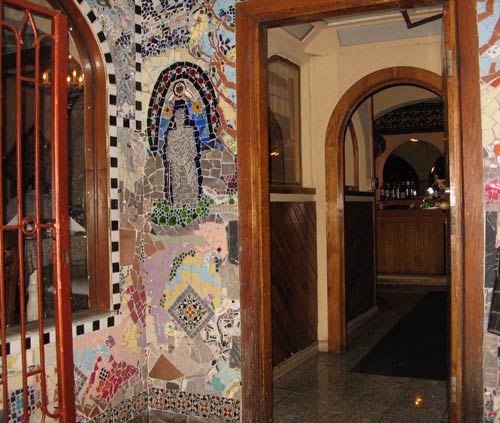
Through the mosaiqued entryway, and we were ready for another culinary adventure. The restaurant itself is located in the heart of Curry Hill (a play on “Murray Hill“) — an area which is still sometimes referred to as “Little India.” Though nowadays that moniker will sometimes be applied to East Sixth Street, between First and Second Avenues (a.k.a. Curry Row ) or to the area in Jackson Heights, Queens, around Roosevelt Avenue and 74th Street. Point being that if you’re making plans to meet friends for dinner in “Little India,” it’s best to be specific.

Bamiyan

Prior to this night, I’d not actually eaten much in the way of Afghani cuisine other than the Hells Kitchen kebabs, so this was something of a revelation. The cuisine melds together Middle Eastern, Persian and Indian influences. The last, particularly, at least in terms of the appearance and presentation of the dishes. The spicing of Afghani food is milder, though, and the flavors seem lighter, relying on just three or four complementary tastes to bring the dishes together.

As to be expected, there was an impressive array of shish kabob offerings (minced beef, lamb, chicken, filet mignon, cornish game hen, salmon…), but we were lured in by the pumpkin, and the Kadu  did not disappoint. The crispy turnovers were stuffed with creamy, sweetened, spiced orange flesh and served with a garlicky yogurt dip, sprinkled with fresh mint. Delicious, and possibly my favorite of the evening. We appointed JS in charge of selecting appetizers: the Bouranee Kadu (sauteéd fresh butternut squash), the Baunjaun Bouranee (eggplant slices layered with mint yogurt) and assorted dumplings (Mantoo and Sambusa ). There were grilled meat entrees, served with fragrant basmati rice (Chalows ), intermingling flavors of lemon, cucumber, saffron and coriander. Also the Asheh Keshida -– homemade “Afghan pasta” with tangy yogurt, butter and garlic sauce. And accompanying my meal, a pot of Shir-Chay: traditional Afghan tea brewed with milk, sugar, cardamom and rose petals. Could I replicate this brew at home with black tea, cardamom pods and rosewater? I’d like to try.

After dinner, CS, HN and I continued the evening with wine and beers at McCormack’s Pub across the street. The rugby game being broadcast inside reminded HN of home. The bar’s soundtrack of Morrissey/The Smiths, Joy Division/New Order and The Cure reminded me of high school.

The three of us shared a cab back to the Upper West Side, after which CS and I somehow ended up back on stools at our local haunt, sharing stories and sipping Diet Cokes late into the night.

Judy & Bea

Tonight’s class went somewhat better than the first. And I was saved by the bell when class ended before the professor could call me up in front of the class to recite my Russian compositions.

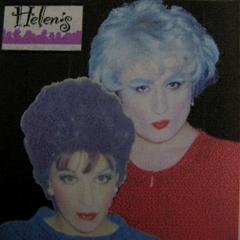
After class, SN invited me along to meet up with his co-workers for the taping of a cabaret show in which his boss JS would be performing at Helen’s in Chelsea.

As it turned out, JS would be performing “Bea,” as in “Bea Arthur,” in the Judy & Bea: Two Dorothy’s reunited cabaret show. “Judy,” as in “Judy Garland,” was portrayed by his real-life partner, PM. The two were billed as a duo of “gender illusionists,” i.e, drag queens. JS was reprising his role from 2003’s cease-and-desist-letter-shortened run of “The Golden Girls: LIVE!“; PM first impersonated Garland in his autobiographical play “Judy and Me.”

Emceeing this evening for the live taping was Joe Franklin. When I mentioned this to DM later in the week, she balked, “He’s still alive?!” And indeed: Franklin has been listed in the Guinness Book of Records as television’s ”Most durable talk show host,” appearing on his eponymous talk show for five decades, and interviewing, by some accounts, over 300,000 guests (which may or may not include Krusty the Clown on the “Bart’s Dog Gets an F” episode of The Simpsons.)

Also in attendance: Leon Hall, whom I remember from E!’s Fashion Emergency, and Jim Colucci, author of The Q Guide to The Golden Girls. Random! Though perhaps, not so.

The show was great fun, and the transformations quite remarkable. PM very ably performed many of the Garland standbys, including “Zing! Went The Strings Of My Heart,” “The Trolley Song,” “You Made Me Love You,” “Chicago” and “Swanee” (which had the blatantly adulterous couple at our table chiming in.) And of course: “Over the Rainbow.”

JS, who holds a doctorate in Computer-mediated Learning and is the grand-nephew and godson of the actor/television writer Richard Waring, did a scarily spot-on Dorothy Zbornak — down to the gravelly speak-singing and sarcastic deadpan zingers. Naturally he closed out his segment with The Golden Girls theme song, “Thank You for Being a Friend.”

I’ve often wondered about the origin of the phrase “Friend of Dorothy” to describe gay men. I had assumed that it was a reference to gay icon Judy Garland’s “Dorothy Gale” character from The Wizard of Oz, but others point the origin to Dorothy Parker, American critic, poet and writer, and a founding member of the Algonquin Round Table. Parker was — and continues to be — very popular in gay circles, and appreciated for her caustic and incisive — dare we say: bitchy ? — style.

From the program (no photos permitted during the performance): PM (Dorothy) and JS (Bea) — before and after:

Before     After

Men seldom make passes
At girls who wear glasses.

— Dorothy Parker (1893-1967), “News Item

La Gioconda - Act I

I did not make it into the office today.

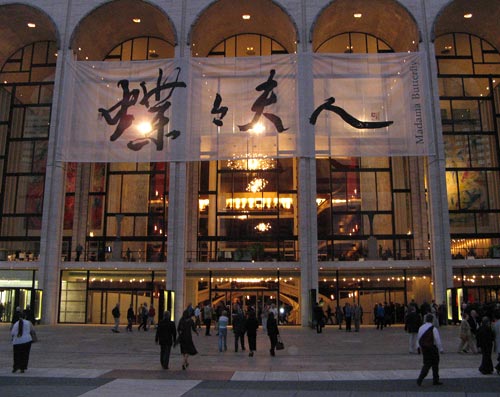
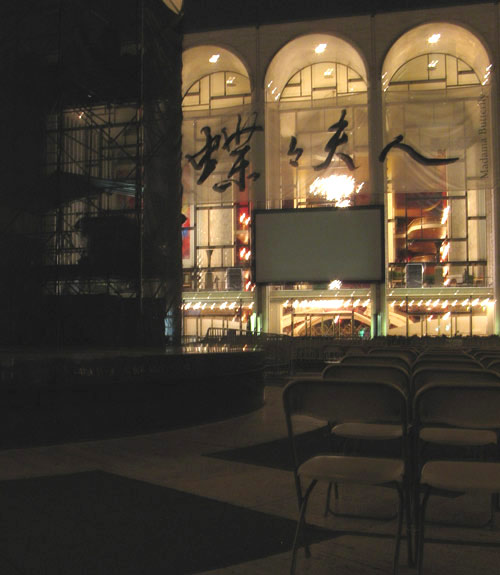
I did, however, make it to the opera for the first performance in my season’s series. The Metropolitan Opera’s 2006-2007 season kicked off the night before with a red-carpet gala performance of Madama Butterfly broadcast on giant video screens in both Lincoln Center Plaza and on the Panasonic jumbo screen at 1 Times Square. Broadway between 42nd and 45th Streets was closed to traffic to make space for 650 cushioned seats — no tickets necessary; alternatively, for $50,000, patrons could have purchased an eight-seat opera box and attended the post-performance dinner.

This night (sans Mikhail Baryshnikov, Sean Connery, Goldie Hawn, Anjelica Huston, David Bowie, Meg Ryan, Al Roker, Susan Sarandon, Tim Robbins, James Gandolfini and Jude Law): Amilcare Ponchielli’s La Gioconda.

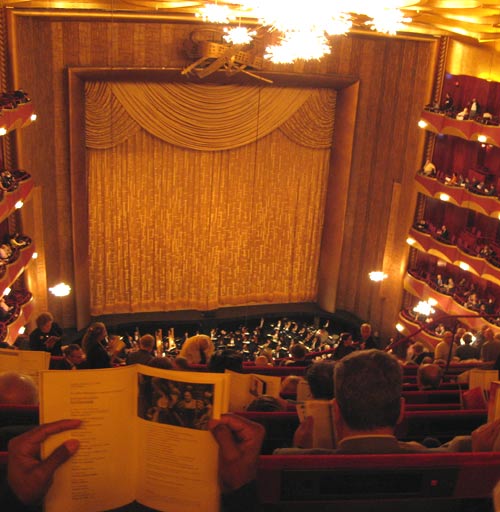
Met Opera

Madama Butterfly

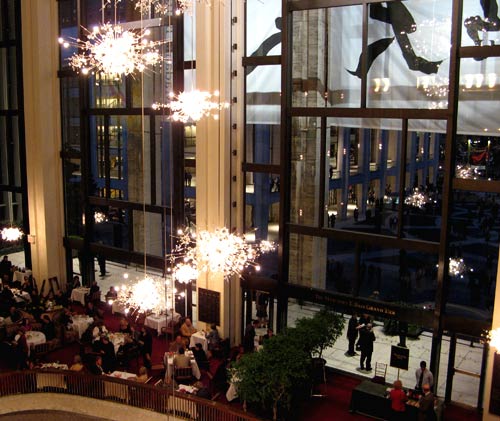
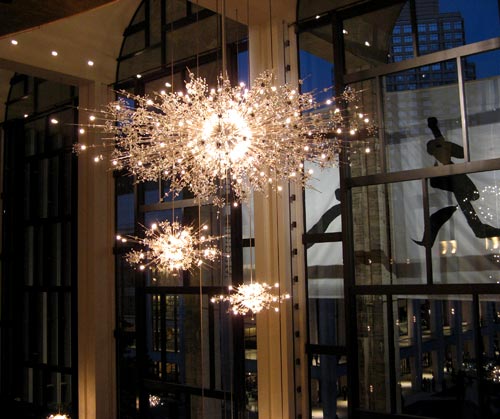
Met Chandelier

La Gioconda translates to The Ballad Singer, though the English title is almost never used. It is a lengthy work (with an estimated performance length of four hours) with four acts by Ponchielli, and a libretto by Arrigo Boito, after Victor Hugo’s play, Angelo, Tyrant of Padua. Each act of the opera has a separate title: Act I, “The Lion’s Mouth“; Act II, “The Rosary“; Act III, “The House of Gold,”; Act IV, “The Orfano Canal.”

Even those not familiar with La Gioconda  recognize its “Dance of the Hours,” which is inextricably associated in the cultural consciousness with the trippily lumbering, twirling hippos of Disney’s Fantasia (and Allan Sherman’s “Hello Muddah, Hello Fadduh”).

From the Met’s website description of La Gioconda:

Historical spectacle and extreme contrast of musical moods highlight the plights of five love-crazed characters in Ponchielli’s grandest of grand operas. Violeta Urmana, Olga Borodina, and Marcello Giordani head the vocal forces while renowned choreographer Christopher Wheeldon creates the dances (including the irrepressible “Dance of the Hours,” made famous in Walt Disney’s Fantasia). The opera also features the all-time best final line in opera (“and by the way, I killed your mother!”).

Pre-Gioconda

This night, I didn’t make it to that finale either.

Once burned, twice Thai

I could not resist another dinner at Sripraphai — my second. This time, SYB invited along our favorite Kiwi couple JD and MB. (The nickname for New Zealanders, by the way, comes from the national bird, not the fruit.)

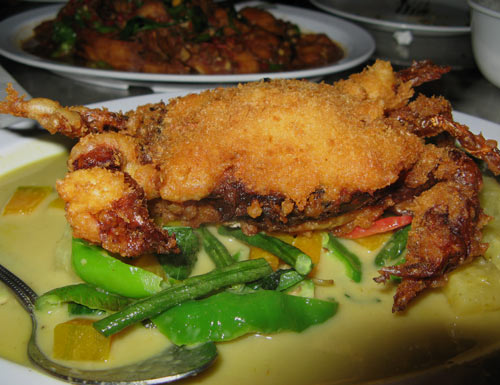
We commandeered a fourtop out in the garden again, enjoying one of the first cool nights of autumn. On the menu tonight: the Crispy Chinese Watercress Salad and Drunken Noodles with Beef from last week. For variety, I added the Curried Softshell Crab with Pumpkin special of the evening. (I think I will always opt for pumpkin when it is offered.) JD chose the Tilapia Filets with Chili and Basil Leaves entree. And MB rounded out our dinner menu with the Jungle Curry with Shrimp and Mixed Vegetables.

It was my first real meal of the day.  So very delicious and — despite the fiery heat — oddly comforting. Again, “medium” spiciness was just spicy enough… and in fact, the Drunken Noodles kept our tongues tingling throughout the meal.

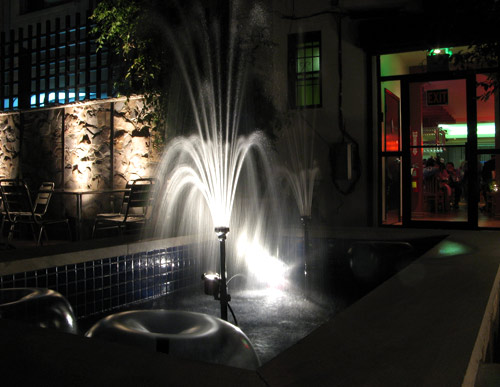
Fountain

Softshell Crab

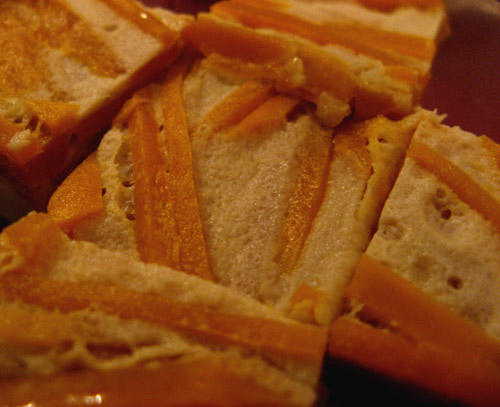
More creamy pumpkin custards (which I got to sample this time) and sweet coconut rice bundles wrapped in banana leaves at Chez B, over which I attempted to lose myself in the escapist pleasures of the Grey’s Anatomy season premiere (in HD.)

Pumpkin Custards

When I woke this morning, I did not know that this afternoon’s events would send me spiraling into a state of despair… re-examining all that has happened, doubting everything I thought I knew to be true. But life goes on.

Ah, love, let us be true
To one another! for the world, which seems
To lie before us like a land of dreams,
So various, so beautiful, so new,
Hath really neither joy, nor love, nor light,
Nor certitude, nor peace, nor help for pain…

— Matthew Arnold (1822-1888), “Dover Beach

The Good Life

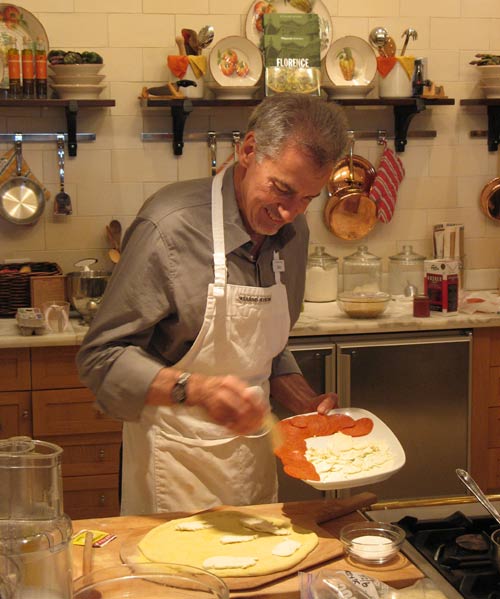
Sunday morning at Williams-Sonoma for Pizza 101 technique class. John was back, demonstrating how to make pizzas from scratch at home, with the caveat that home versions would never be identical to commercial versions, due to the same heat intensity being unattainable by standard residential ovens. Using a pizza stone helps, as the stone’s pores absorb exuding moisture from the dough (for ideally crispy crusts) while distributing heat evenly throughout the pie, minimizing hot spots and increasing the efficiency of the oven. As he started a surprisingly simple pizza dough in the food processor (yeast, sugar, warm water plus flour, salt and extra virgin olive oil), John covered some of the storied history of pizza in America, starting with Gennaro Lombardi’s Spring Street grocery store (later: pizzeria), and his defectors/offshoots: Anthony (Totonno) Pero (of Totonno’s in Coney Island), John Sasso (of Greenwich Village’s John’s Pizzeria), Pasquale “Patsy” Lancieri (of Patsy’s Pizzeria) and Lancieri’s nephew, Patsy Grimaldi (of Brooklyn’s Grimaldi’s Pizzeria). No word on Ray’s.

John demonstrated a classic Pizza Margherita (invented around 1889 and named for the then visiting Queen of Italy, Margherita di Savoia) with diced tomatoes, fresh mozzarella di bufala and chiffonaded basil leaves — representing the red, white and green of the Italian flag. Fifteen minutes out of the oven, and we still had time to make another pie with hot peppers and pepperoni, the most popular topping in the United States.

W-S John

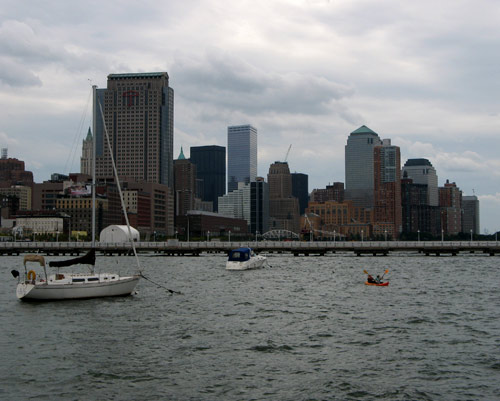
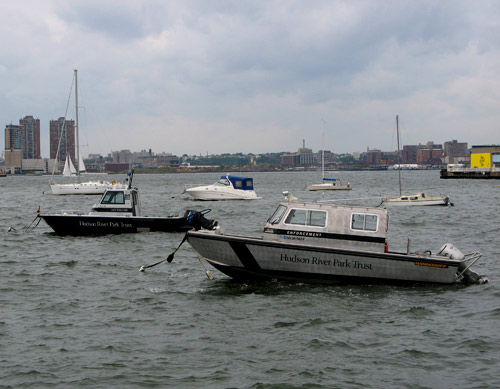
The Van Alen Institute’s “The Good Life: New Public Spaces For Recreation” exhibit was showing at Hudson River Park’s Pier 40. The Downtown Boathouse location here opened for public kayaking on August 19, 2006.

TriBeCa

HRPT Boats

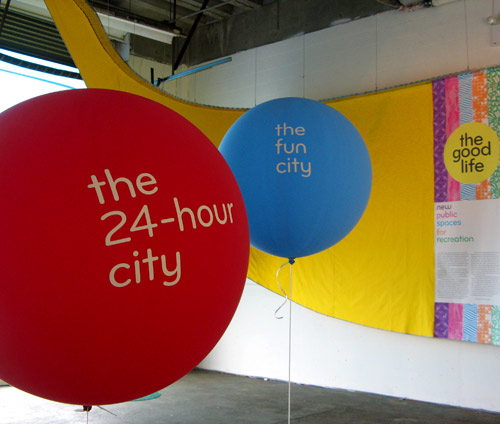
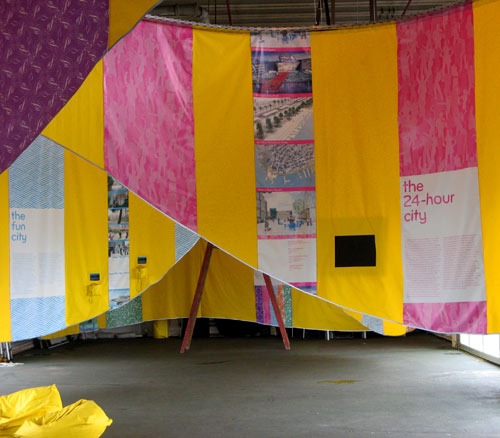
Featured were 70 projects from New York City to London to Rio de Janeiro to Soweto, South Africa — urban projects and existing communal spaces, each selected for its power to redefine public space in the 21st century. Amale Andraos and Dan Wood of WORK Architecture Company transformed the 4500 square foot raw garage space on the southwest corner of the pier into a large-scale exhibit space broken up into smaller spaces by a winding canvas screen, held in place with sandbags. This exhibition was organized around five themes: The 24-Hour City, The Connected City, The Cultured City, The Fun City and The Healthy City. Each “gallery” was set up with video screens and listening stations, explaining the architects’ vision.

The Good Life” explored both new and currently in development projects on former industrial sites, waterfronts, and reclaimed land, including New York’s Highline and Lincoln Center’s Promenade and West 65th Street Projects.

The Good Life

The Good Life

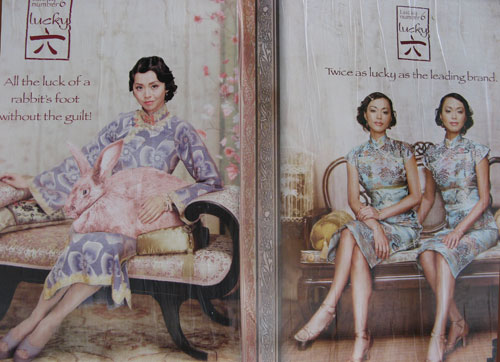
On Hudson Street, I passed a wall of posters for Lucky Number 6 – which is apparently a perfume being sold at Macy’s:

“Your elegant scent will attract many. For good fortune & happiness, mist on this flower-full blend of harmonious lotus, tiger lily, cashmere woods and jasmine.”

Lucky Number 6

Not sure what to make of the “Shanghai Ladies” aesthetic or the weirdly mystical, fortune cookie-esqe ad copy: “For good fortune & happiness, mist on this flower-full blend” — what the heck?

“Shanghai ladies,” by the way, is not to be confused with “Shanghai women.”

Happy Birthday Dad

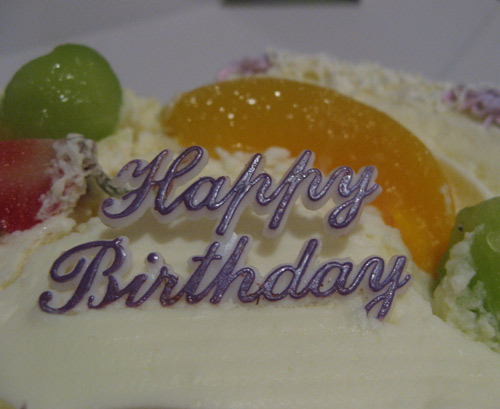
Dinner in Long Island with the family. Peking duck and softshell crab — two of my favorites. Afterwards, we shared cake at J & C’s new — and newly renovated — apartment. Happy birthday, Dad! (One day late.)

The Met for the masses

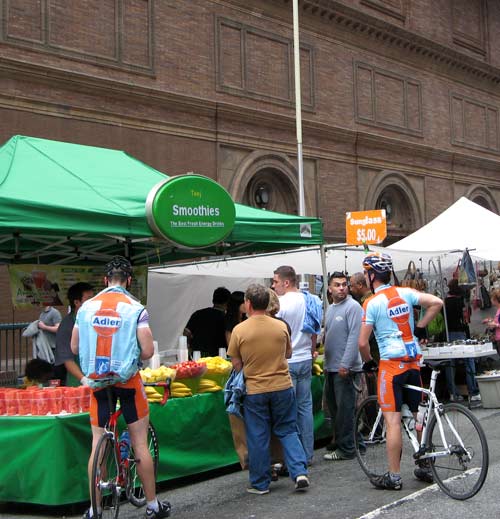
Wasn’t there just a street fair along Seventh Avenue? Yes, I believe there was.

Seventh Ave Fair

On the way home after work, I passed Josie Robertson Plaza, still set up to accommodate the droves of people who turned out for free tickets to the Metropolitan Opera’s Open House, which took place yesterday.

Tickets for the Open House were distributed first-come first-served at the Met Box Office beginning at 10:00AM on Wednesday morning. For the first time in its 123 year history, the Met invited the public to a final dress rehearsal, offering a preview of the highly anticipated new production of Puccini’s Madama Butterfly. Included on the program was a box lunch and a panel discussion with cast members and the show’s director, Academy Award-winning filmmaker Anthony Minghella. Attendees were offered the opportunity to head backstage for a behind the scenes look at the Met, to examine production sketches and set models, and to take individual walks across the famed stage. So cool!

Josie Robertson Plaza

It still amazes me the lengths to which New Yorkers will go to gain access to events like these. With a program lineup like that, though, it was no wonder that the crowds descended. I would have loved to be right there with them, but sadly, despite living just a few short blocks away, I couldn’t justify taking the time off. Just as well: news reports were that the first arrivals lined up for tickets the night before, camping out on the stone plaza ground for a free shot at those $375 seats. All 3,000 tickets were gone by noon.

The Met’s Open House, which garnered quite a bit of media coverage, was intended to generate interest in the new season and spur ticket sales, which suffered a dramatic drop-off during the 2001-2002 season and steadily declined to last year’s new low of 77% capacity. As part of the plan to broaden opera’s appeal to younger audiences, new General Manager Peter Gelb also reduced ticket prices for the least expensive seats –- thanks to which I have season tickets this year — and orchestrated six high-definition video simulcasts to be shown in over 100 specially-equipped movie theaters in the United States, Canada and Europe, and 500 long-dormant historic opera recordings to be broadcast on Sirius Radio.

Coming soon to a movie theater near you… six matinees will be presented live this season: beginning on December 30, Mozart’s The Magic Flute, directed by Julie Taymor and conducted by James Levine; Bellini’s I Puritani on Jan. 6; the world premiere of Tan Dun’s The First Emperor, with Placido Domingo in the title role, on Jan. 13; Tchaikovsky’s Eugene Onegin, with Renee Fleming, on Feb. 24; a new staging of Rossini’s The Barber of Seville on March 24; and a new production of Puccini’s Il Trittico, conducted by Levine, on April 28.

Doctors without boundaries

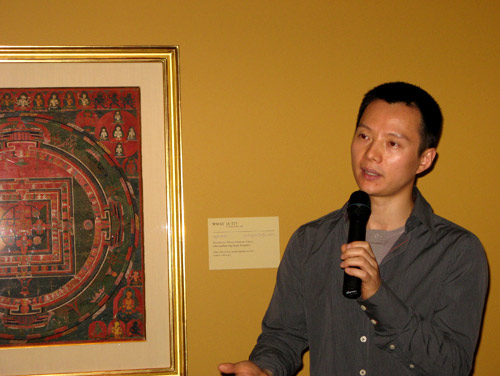
I was back at the Rubin Museum of Art on Friday night for the Artists on Art presentation by Shen Wei, the choreographer behind New York-based contemporary dance company Shen Wei Dance Arts. Wei and one of the RMA guides gave a brief talk about mandalas — the graphic representations of the universe in Hindu or Buddhist culture. The museum had several of the intricate circle-within-a-square images on display. Chinese-born Wei explained how he drew upon the variety of the mandalas he came across on a recent trip to Tibet as inspiration for the dance forms he used in Re-, (Part I), his performance work based on the spirituality of Tibetan culture which is being performed at the Joyce Theater September 26 through October 1, 2006. Also in attendance that evening was Ani Choying Drolma, the Tibetan nun who sings the music in the show.

Shen Wei

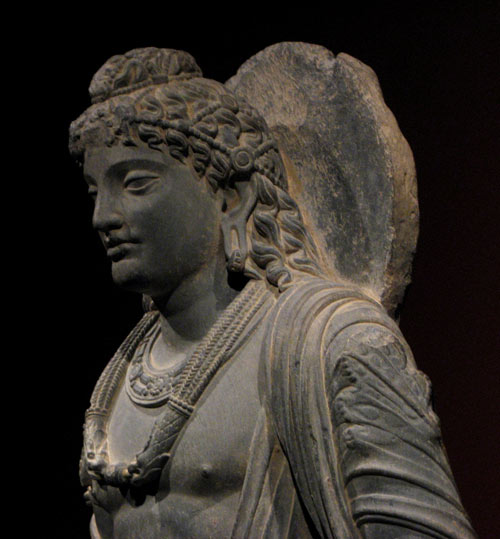
I wandered through the galleries, spending more time at the whimsical Flying Mystics exhibition, with its focus on depictions of flight in Buddhist paintings and sculptures. The top (sixth) floor had just opened a new, interesting-looking exhibition last week: I See No Stranger: Early Sikh Art and Devotion for which the museum had printed and bound stacks of impressively detailed gallery guides. A tour would have required a lot more time to explore than I had that evening, though. The exhibit runs through January 29, 2007, so I have time to come back.

RMA Statue

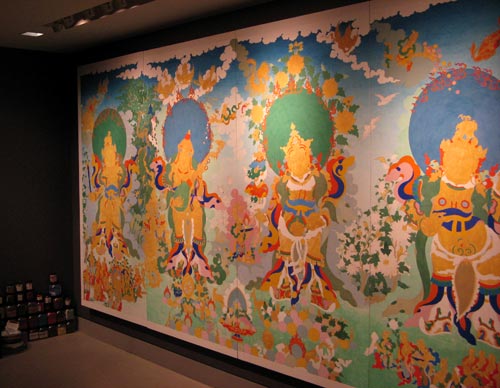
On my way out I stopped to check in on RMA Artist in Residence Pema Rinzin and the progress of his painted mural, The Guardian Kings, since the last time I was at the museum.

RMA Mural

RMA Spiral

Afterwards, it was a leisurely stroll from the museum for a light dinner at “posh pita parlour” Chickpea — just a couple of storefronts down from my namesake dumpling purveyor, the Union Square outpost of Dumpling House on Eldridge. I was just washing down my very first shawafel (shawarma + falafel = pretty good!) with lemonade when SYB and HYB arrived from their first party of the evening. It was still a bit too early for the three of us to head over to CP’s birthday bash at Kabin, so we wandered the aisles of Trader Joe’s for a while, picking up some dark chocolate-covered espresso beans along the way.

Later in the East Village, I ran into JL, with whom I had spent some time last year during the series of J’s wedding events. Her cousin is CP’s fiancé — small world. Also notably, I experienced what may have been the most horrifying pick-up banter ever. Hard to say which was most galling: the unabashed arrogance, the jaw-dropping inappropriateness, or the crass directives involving cupcake frosting. Wow… seriously? After that, I was ready to go home. The B brothers insisted on accompanying me out, for which I felt a little bit guilty about cutting short their stay. But at least SYB got his mojo back with a dancer from the other party.