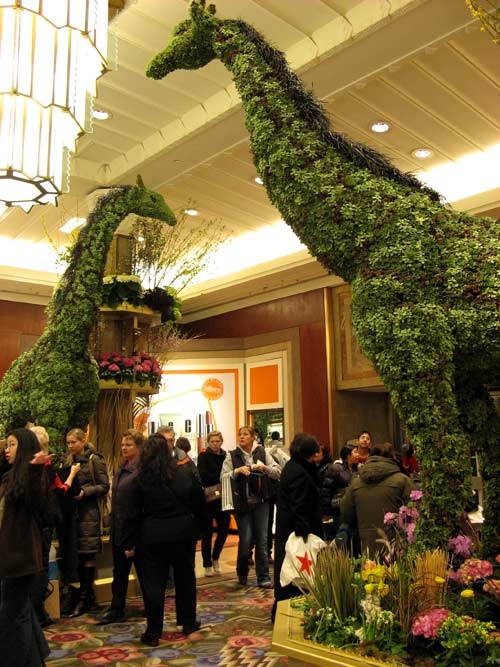
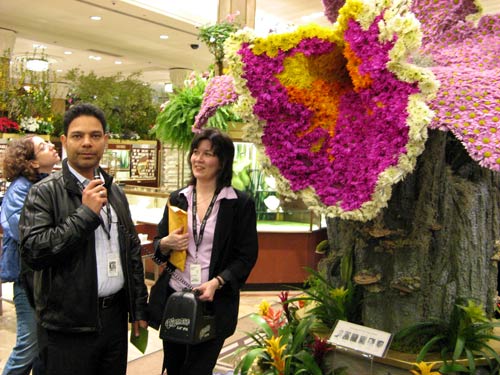
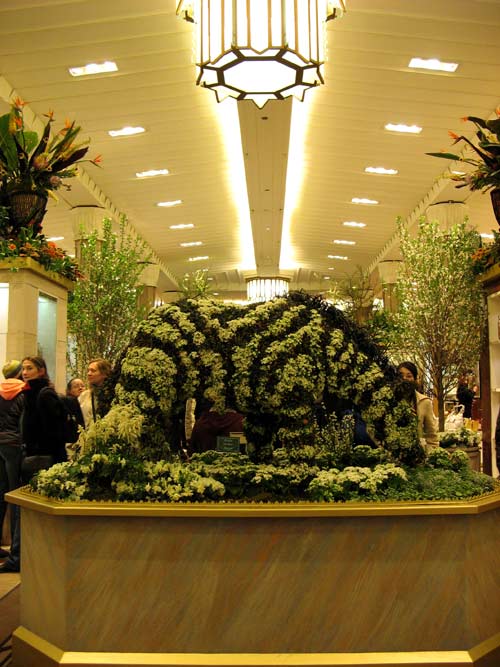
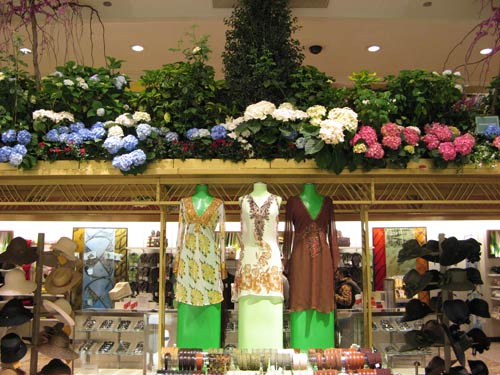
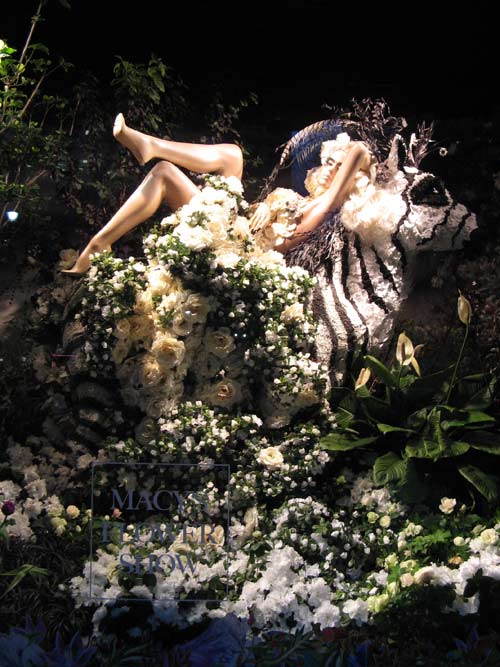
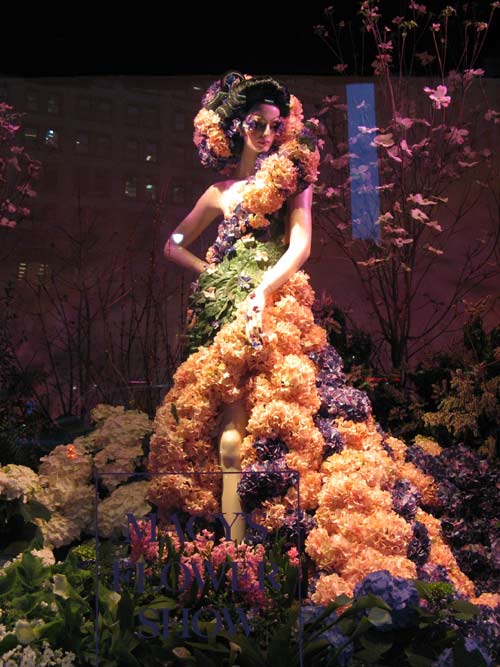
At the Macy’s Flower Show:
A native New Yorker's adventures from 2006–2010 in the city and around the world — including a little history and a lot of food.
At the Macy’s Flower Show:
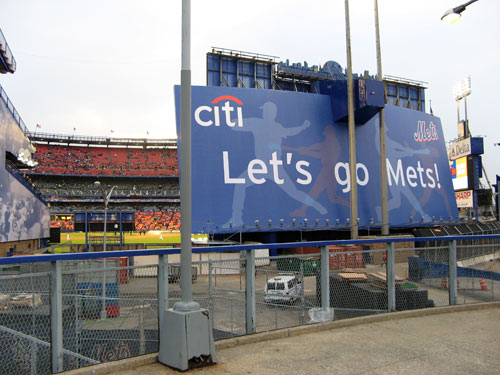
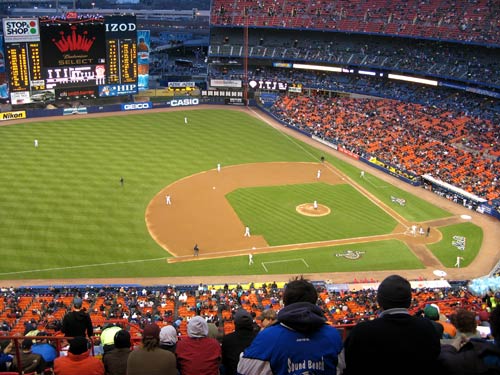
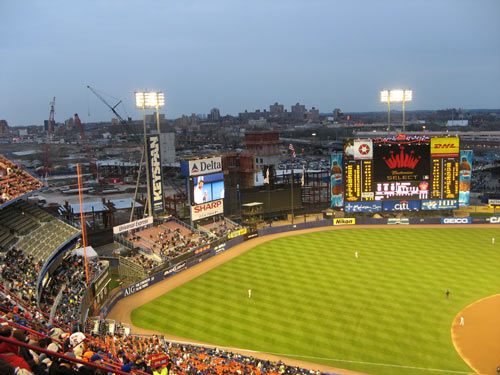
Chilly night for a baseball game. We sat shivering in our upper tier seats, and watched the Mets lose, 5-2.
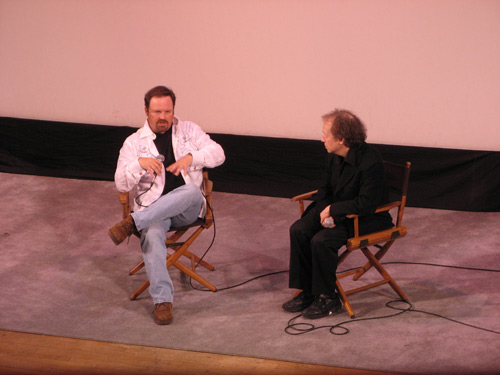
After a screening of Lonely Hearts, the little seen film based on the real-life notorious duo of Martha Beck and Raymond Fernandez, 1940s serial killers who came to be known in the press as “The Lonely Hearts Killers.”
Director-screenwriter Todd Robinson, who was interviewed by Scott Siegel after our screening, is the grandson of Long Island detective Elmer C. Robinson, credited with apprehending Beck and Fernandez — both of whom were eventually executed for their crimes. Elmer is portrayed in the film by John Travolta. In another bit of Hollywood glamorizing, Beck – whose weight the press estimated to be anywhere from 200 to over 300 pounds – was played by Salma Hayek.
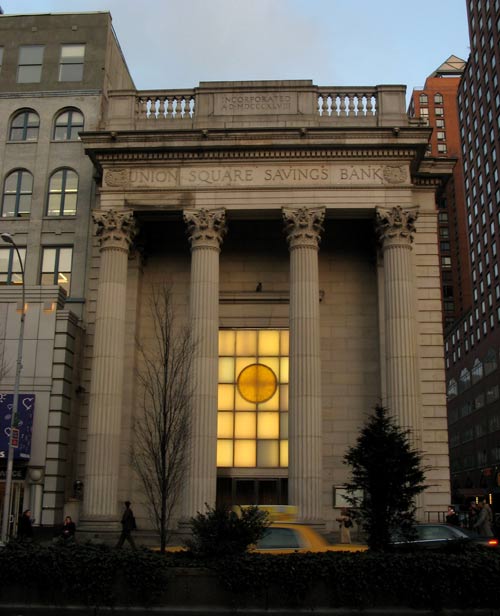
At the old Union Square Savings Bank, now the Daryl Roth Theatre, for Vineland: a musical about wine, not Thomas Pynchon’s 1989 follow-up to Gravity’s Rainbow.
If you haven’t heard of it, don’t be surprised. While most musicals are commercial productions, this was the first production I’d ever attended that may have been an actual commercial. Ostensibly, this was a “preview touring production” of a new musical based on the life and times of the Chilean vintner and senator Don Melchor de Concha y Toro, founder of the Concho y Toro winery.
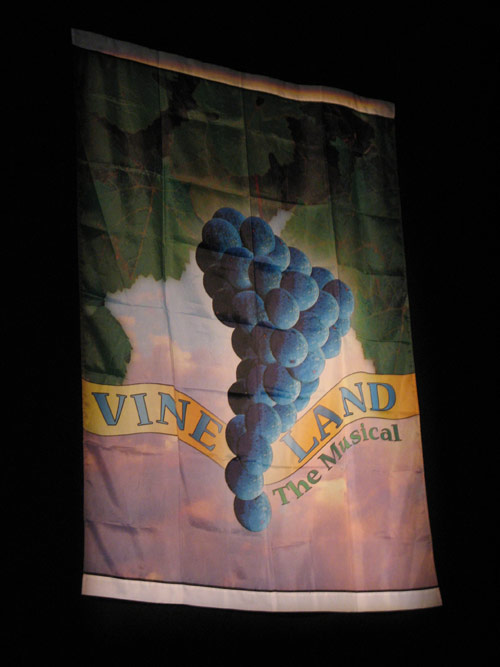
A pre-performance reception featured generous tastings of the vineyard’s Casillero del Diablo (Cellar of the Devil ) label: a Sauvignon Blanc, a Merlot and a Carménère, alongside award-winning Andes Panquehue cheeses from Chile.
The show was billed as “a dramatic musical celebration about wine and the people who make it, staged around the modern roots of South American winemaking.” Okay, sure. There were a few allusions to Chilean political turmoil and social crisis, but most of that was lost among the treacly love songs, the hammy shenanigans of the estate’s (very, very) French cellarmaster and landscape designer, and the physical prowess of one ballet-dancing devil. The energetic performers gamely sung through even the lamest set pieces, and we in attendance could not help but be charmed a little. Did I mention that they plied us with wine — lots and lots of wine?
Luckily for director Marc Robin, just as impatience began setting in (coinciding with the wearing off of our pre-show buzz), the ushers trotted out trays loaded with glasses of sparkling Rosa Regale for the audience, as the entire cast took the stage to sing the toasting song finale, “Salud Amigos.” (Verdi need not watch his back.)
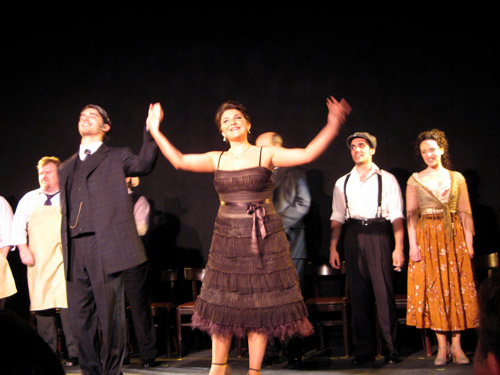
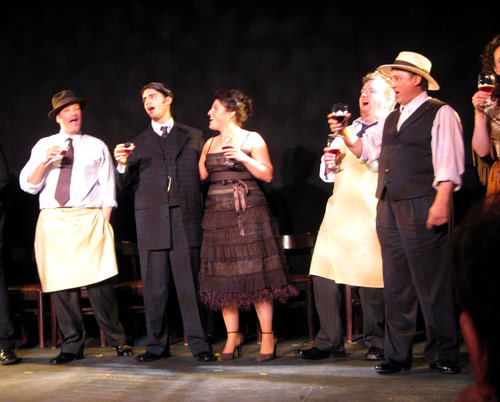
Maybe luck didn’t have all that much to do with the timing of the drinks after all.
Attended one of the “Brown Bag Lunch Lectures” at the Museum of Modern Art this afternoon.
It was my first look inside The Lewis B. and Dorothy Cullman Education and Research Building, which opened in late-November 2006. The eight-story, 63,000-square-foot building marks the final element of Yoshio Taniguchi’s redesign project, increasing MoMA’s educational and research space fivefold. The expanded Library and Archives occupy the top floors; the glass-encased lobby and sixth floor open-air terrace offer views into the museum’s Sculpture Garden.
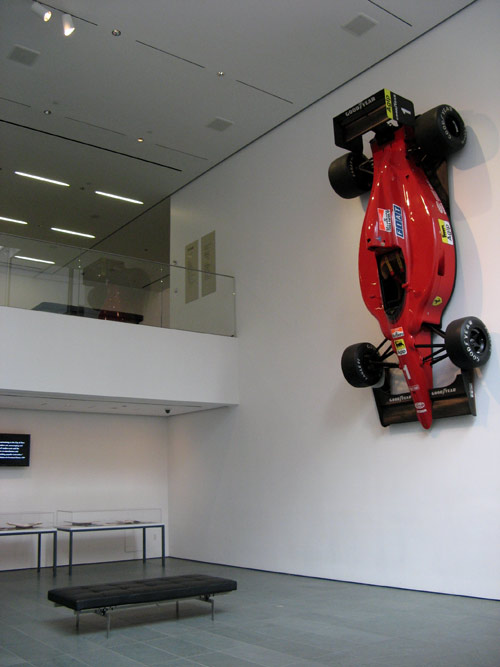
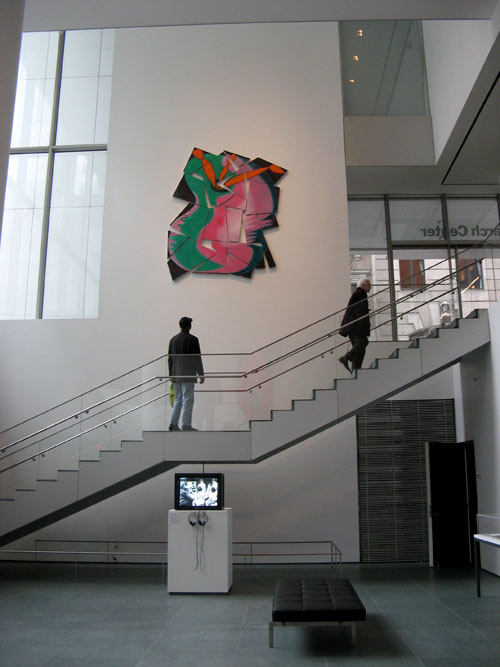
The subject this afternoon was painter Armando Reverón’s then-current retrospective, the first North American exhibit to focus on the Venezuelan early modernist. (Listen to the MoMA podcast here.)
The exhibit, comprised of some 100 landscape and figural paintings and objects, focused on 30 years of Reverón’s life, during which he worked and resided in the Venezuelan fishing village/resort of Macuto, on the Caribbean coast. He and his wife (and sometime model), Juanita Ríos, entertained many visitors at their home; during his life, Reverón actively cultivated an “eccentric artist” persona — reinforced in a couple of films — and grew to become something of a local attraction, where he produced pieces for the tourists that would make their way to the Northern coast.
Reverón dubbed his residence and workshop El Castillete, or “Tiny Castle,” which seems a bit grand based on the slidehow photos we were shown of the crudely constructed, palm-frond walled huts. The compound remained an attraction after the artist’s death in 1954 (in a psychiatric clinic where he was under treatment for schizophrenia); Ríos continued to live there until her death decades later. Ultimately, the castle was destroyed by the mudslides of Venezuela’s Macuto region that claimed the lives of 5,000-20,000 and the homes of 100,000 more in 1999.
Also discussed: the life-size dolls (muñecas) that Reverón used as models for his dream-like figural paintings. Sewn from stuffed burlap sacks and garishly wigged and made up, the dolls (each of whom had a name) were regular fixtures in the Reverón-Ríos home, where they were were outfitted and posed to greet visitors or provide silent companionship and artistic inspiration.
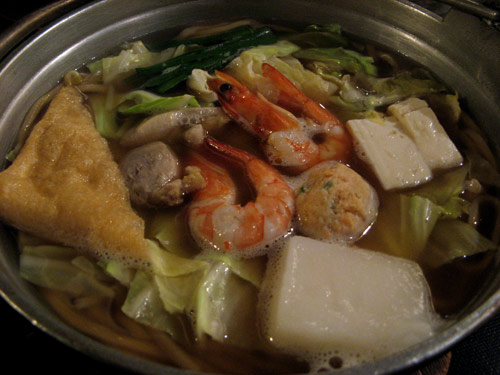
Lunch at Menchanko-Tei — not the best ramen in a city full of great ramen joints, but one of the best above 14th Street, and a great bargain in expense-account rich Midtown. There are about a dozen different noodle soup varieties on the menu from which to choose; I went for the house-named Menchanko, which arrived in a very hot cast-iron bowl, topped with chicken, whole shrimp, a salmon ball, tofu, vegetables and a single gummy rice cake.
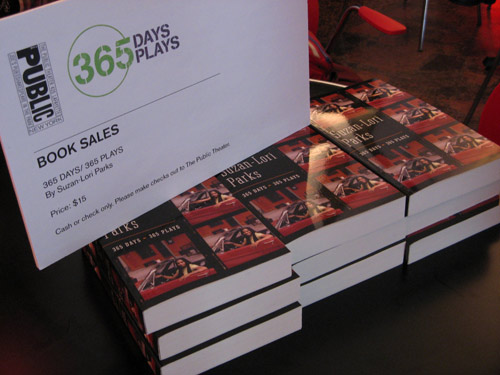
Another visit to The Public Theater for the April installment of the 365 Days/365 Plays festival.
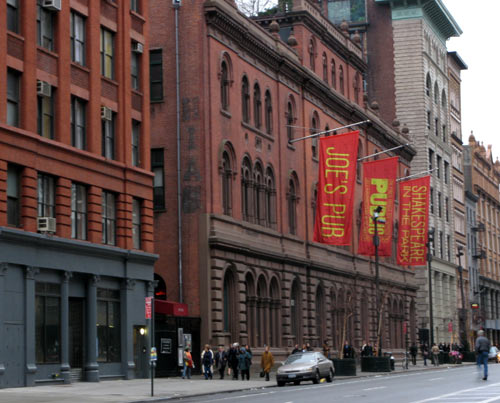
This time out, the four participating companies (Lightbox, New York Neo-Futurists, New Georges and the Epic Theatre Centre) were staging the Suzan-Lori Parks plays from March 2003, weeks 17-20. It was SYB and CS’s first time to 365 Days/365 Plays, and I wasn’t quite sure how to describe to them what I’d seen in February. Parks composing a play a day for an entire year: the feat alone is noteworthy, and the press has covered the project as if it were some kind of literary stunt. But would the gimmick factor be too high (and the entertainment value too low) to warrant the two hour investment?
Based on my last visit, I didn’t think so, but I was unsure how the other two would respond to the unorthodox theater production. (We’d had success here in the past, and though I didn’t think that either would actually hold me accountable for the show’s quality, I couldn’t help but feel some twinges of responsibility.) After being ushered in — to the Newman Theater this time — we sat through a short introduction describing the year-long project. The first set of young actors took the stage and launched into their assigned series of seven short plays. One after another, the four companies gave Parks’s words their own unique treatments, a synergy of creative effort, and a testament to the diversity of the theatrical interpretations.
Several of the plays were allegorical (complete with mythical beasts), some were domestic scenes, some snippets of a conversation or a song, one familiar tableau, and one just a laundry list of tasks, read against the ticking of a stopclock.
The sheer breadth of style is what one would expect from a playwright who when called upon by NPR to name her favorite scenes, selected the opening of The Sound of Music, along with an ordinary conversation between a cabbie and a 12-year old prosititute in Taxi Driver.
Later, at the Astor Place Starbucks, we staved off the grey chill with chai and Rice Krispies treats (or as they’re labeled under the glass: “crispy marshmallow squares.”)
351. Be held.
352. Behold.
353. Be quiet.
354. Be yourself.
355. Be good.
356. Be nice.
357. Be.
358. Pass these tasks out to the audience.
359. Pass these tasks to others among you.
360. Take these tasks with you.
361. Do these tasks.
362. Free someone.
363. Offer an audible response to the performance you’ve just seen.
364. Bow.
365. Go home.
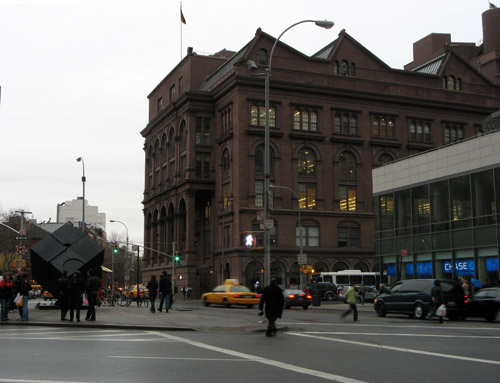
After powering through the final week of 7 train detours, I stopped by the Strand Bookstore for a quick hello with the Deadline Club boys who were browsing through the shop’s much touted “18 miles of books.” The bookstore, one of the city’s few remaining independent booksellers, opened in 1927, and although my memory doesn’t extend quite that far back, I do recall when the store lay claim to 8, and not 18, miles of books. The number refers presumably not to floor space but to all the new, used, rare and out-of-print books laid end-to-end.
Since opening the 4,000 square foot shop on New York’s once-fertile Book Row five decades ago, the owners have expanded their stock to encompass five floors (of the eleven-story building they now own), and an annex on Fulton Street in the financial district.
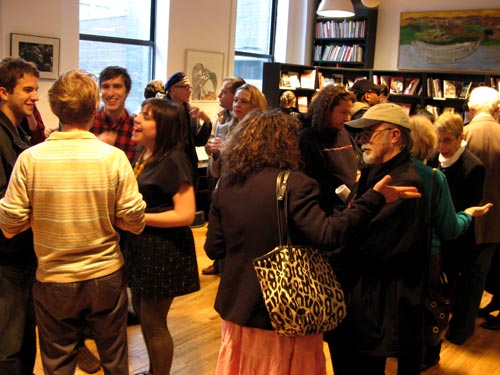
Downtown, The Poets House in SoHo was hosting the opening reception of their impressive showcase exhibit featuring all of the poetry published in the United States over the last year. (On view through April 30, 2007.) Several of the writers were in attendance that evening to mingle in the packed house among like-minded literary types (and fellow YoCos.)
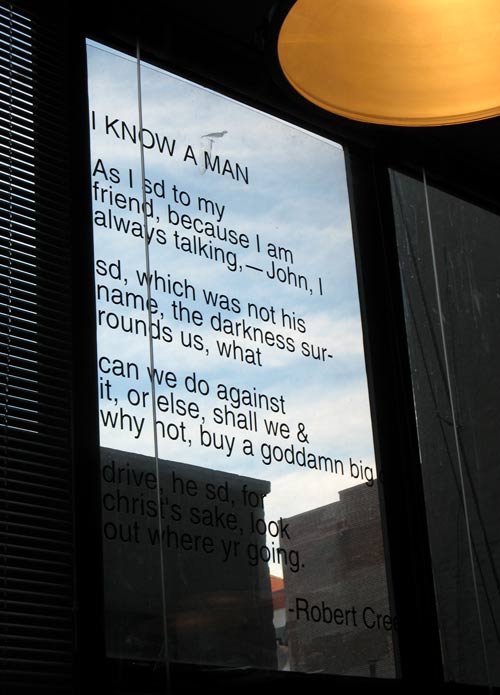
All of which seems to rebut the assertion made in an infamous opinion piece that appeared in Newsweek in May 2003: “Poetry Is Dead, Does Anybody Really Care?” According to the author, Bruce Wexler, “[p]oetry is designed for an era when people valued the written word and had the time and inclination to possess it in its highest form.” The passion of the responses that appeared after that essay was published would indicate otherwise… as would the countless MFA programs and weekly poetry slams that proliferate through the towns across America like Starbucks. (And I mean that in a good way.) Is poetry “the only art form where the number of people creating it is far greater than the number of people appreciating it,” as Wexler asserts? Poetry may be far from dead, but is it relevant in the Internet age of fast-paced media?
I hope so. The Academy of American Poets declared April National Poetry Month in 1996 to encourage more people to acknowledge and appreciate poetry — one of the world’s richest literary traditions.
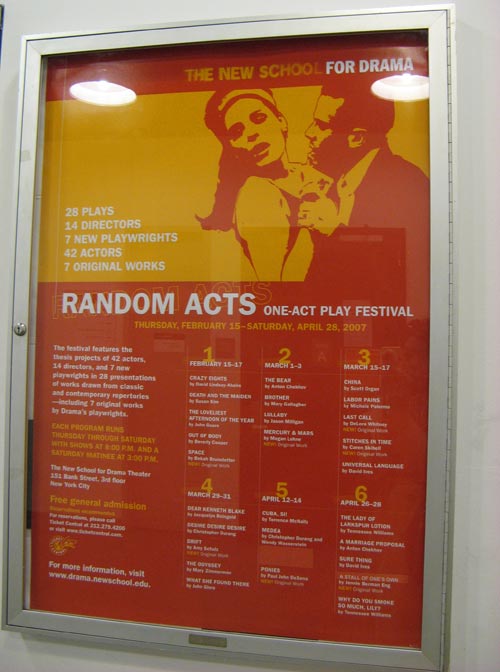
To end my night: a series of one-act plays at the New School. Bite-sized pieces of drama, none longer than the average sitcom, including one by Obie-award winning, Tony-nominated and 2006 Pulitzer finalist Christopher Durang: an absurdist take-off of A Streetcar Named Desire, with some Cat on a Hot Tin Roof and The Iceman Cometh thrown into the mix.
We ventured deep into the heart of NYU territory for the “New York Version of The Philly Cheesesteak Sandwich” at BB Sandwich Bar on West 3rd Street. Chef Gary Thompson’s shop opened in 2002 with a menu listing just one item – a stark departure from his then just-closed upscale French bistro, Sonia Rose. Since then, the sandwich bar space has been divided to accommodate Tonnie’s Minis Cupcake and Coffee Bar.
Meat sandwiches and baked goods – always a winning combination. See: Burgers and Cupcakes, shortlisted in this year’s Time Out New York Eat Out guide for “Best new gimmick.”
These sandwiches are not what you’d call authentic Philly Cheesesteaks — for your “whiz wit” you still have to drive to South Philly — but Thompson’s version with his finely-honed onion recipe (19 ingredients, marinated over four hours!), fancy chili-pepper relish and poppy-seed kaiser rolls (sacrilege!) is very tasty. Framed rave reviews line the walls; in its debut year, New York magazine named this the city’s best sandwich.
And how could we leave without sampling the cupcakes?

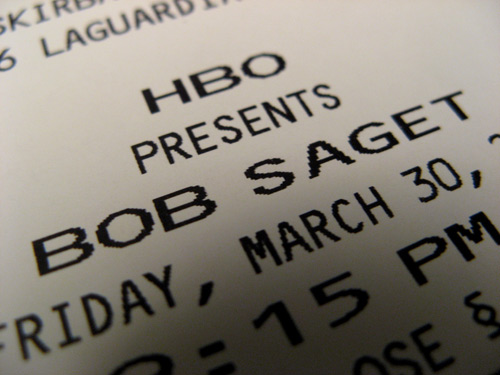
Afterwards, we were off to see Bob Saget at NYU’s Skirball Center for Performing Arts, Saget was in town performing a pair of 90-minute shows that will be edited together for his upcoming HBO stand-up special. Before a packed house — many of whom grew up with Full House and America’s Funniest Home Vidoes on constant television rotation – Saget quickly skewered his wholesome television image. After The Aristocrats, is there anyone left who can still think of Danny Tanner the same way?
There was the usual amount of self-parody, and liberal doses of the over-the-top raunch with which Saget has come to be associated in the last few years (How I Met Your Mother and 1 vs. 100 notwithstanding)… all the more hilarious and wince-inducing coming out the mouth of someone who is still best known for playing a freakishly neat (yet not gay) widowed father of three girls. For that matter John Stamos and Dave Coulier‘s images don’t come off untarnished in Saget’s act either. As for that stuff he said about Andrea Barber, a.k.a. Kimmy Gibbler… well, that’s just not right.
Saget seems to revel in the adult turn his career has taken since the 1990s: from the guest appearances on Entourage to the uncredited (audio possibly NSFW) cameo in 1998’s Half-Baked, (which was liberally referenced in his act, and offers a compelling viewpoint on what qualifies as an addiction) to Jamie Kennedy’s rap tribute “Rollin’ With Saget.” (Check out the unedited version here.)
Saget closed out his show with a few tunes, folksily strummed on a guitar (see above: “Danny Tanner Was Not Gay” to the tune of the Backstreet Boys “I Want It That Way”) and a somewhat less romantic retooling of Eric Clapton’s “Wonderful Tonight.”
Thunder, thunder, thunder, thundercats!
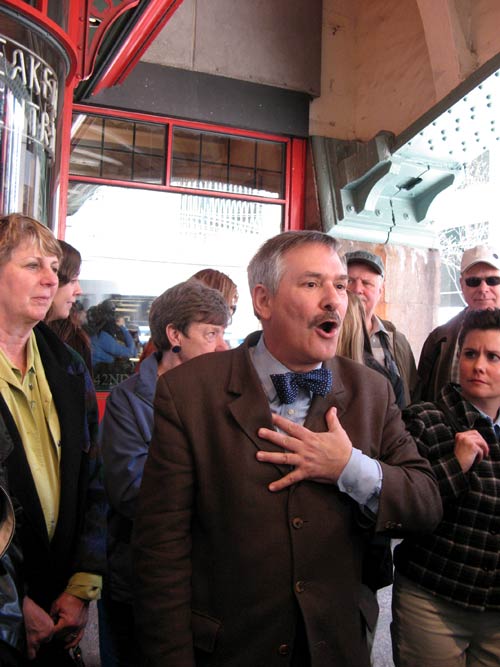
Justin Ferate, an urban storyteller, historian and a former director of continuing education at The Cooper Union, hosts weekly tours of Midtown Manhattan, with a focus on its crowning jewel: Grand Central Terminal. Ferate is one of the city’s most popular and dynamic tour guides; he was selected by the NYC Department of Consumer Affairs to create the licensing examination for prospective city tour guides. The test comprises 150 questions on everything from knowledge of landmarks, history, and public points of interest, to lore, literature, ethnic foods, religious sites and city transportation routes.
This afternoon I joined a group of a couple dozen, mostly tourists, across the street from Grand Central at the Whitney Museum of American Art at Altria. In the airy sculpture court, Ferate held forth entertainingly about Old New York: on Edith Wharton, the Vanderbilts, and the spirited rivalry between the Waldorfs and the Astors. We made our way onto sunny Park Avenue where the stories continued under the gaze of the Hercules, Minerva and Mercury, surrounding the thirteen foot Tiffany glass clock.
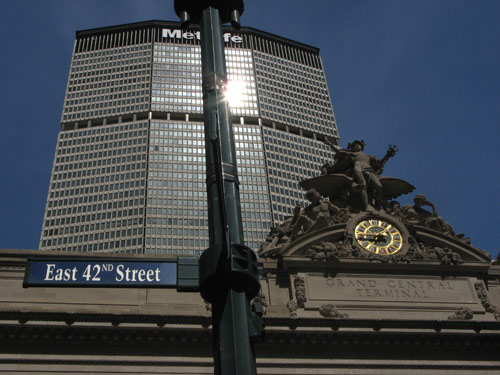
First off: as the onetime principal origin and terminus for transcontinental railroads, the name of the building is Grand Central Terminal. Grand Central Station is the name of the nearby post office and the East Side IRT stop.
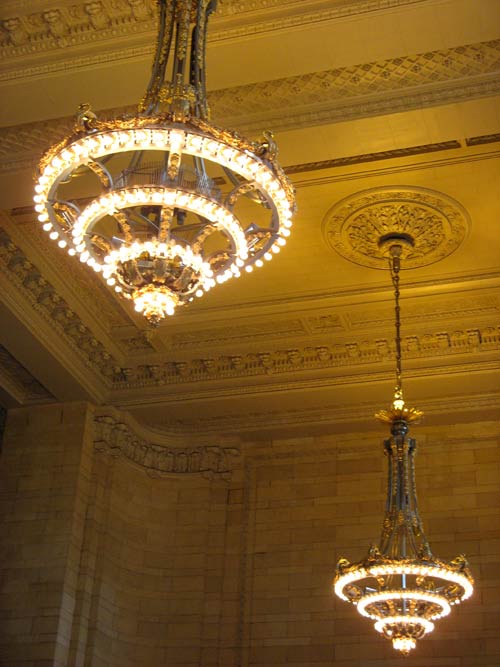
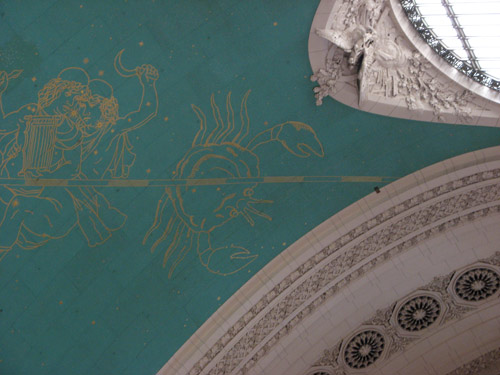
Over the next two and a half hours, Ferate guided and interacted with the group through the building, highlighting several aspects of the Beaux Arts architecture and the 12-year, $160 million LaSalle Partners and Williams Jackson Ewing restoration of the terminal. Besides expanding the retail space and creating the gourmet food market, the renovation included the cleaning of the Main Concourse’s ceiling mural. In 1998, Grand Central unveiled the original sky ceiling, painted in 1912 by French artist Paul César Helleu.
For decades, the gilded constellations were obscured by what had been thought to be smoke soot generated by the trains sitting in the terminal. Spectroscopic analysis, however, revealed that the coating was actually tar and nicotine residue, generated by the cigars and cigarettes of the half-million commuters passing through the concourse daily — much like the Tiffany-style glass dome at the Carlton Hotel.
Renovators left a single rectangular patch of the ceiling untouched — half on the blue, half on the white — to remind visitors of the grime that once coated the entire ceiling, and of the immense work involved in restoring the mural to its current condition.
Ferate’s energy and enthusiasm were infectious. He brought the group through the food court, where he waxed on about the New York classic black and white cookie (claiming that the best in the city is to be had at century-old Glaser’s Bakery on the Upper East Side), and in front of Junior’s glass cases, what makes a true New York cheesecake. (No graham cracker crust. And fruit glaze is for tourists.) We finished our tour at the Guastavino tiles of the whispering gallery.
Check out Ferate’s site for information on more of his entertaining tours around the city. Not just for tourists: in this month alone, you can explore neighborhoods from “Literary Brooklyn Heights” to “Historic! Romantic! Seductive! Staten Island!”
Stop number three on the Chinatown hand-pulled noodle shop tour: Eastern Noodles. This family-run noodle shop relocated to Forsyth from just around the corner on noodle (and dumpling)-rich Eldridge Street. Though still Chinatown-utilitarian, the decor of this newest outpost is just slightly brighter and perhaps a little cleaner than the others.
The Times Peter Meehan wrote up this little place in 2005, in a piece from which I lifted the title of this blog entry. Like him, we put in our order for bowls of beef with hand-pulled noodles and sat back to watch the show. A man — the owner, Lanzhou-trained Jianbin Gao — measured out a wad of dough and went to work, stretching and pulling the dough into increasingly thinner strands. The noodles twirled and flipped through the air in his expert hands, intermittently slapping against the floured counter. According to the Times, Gao and his wife opened the original noodle shop in 2001 to follow one they had operated for a decade in Fujian before moving to the United States.
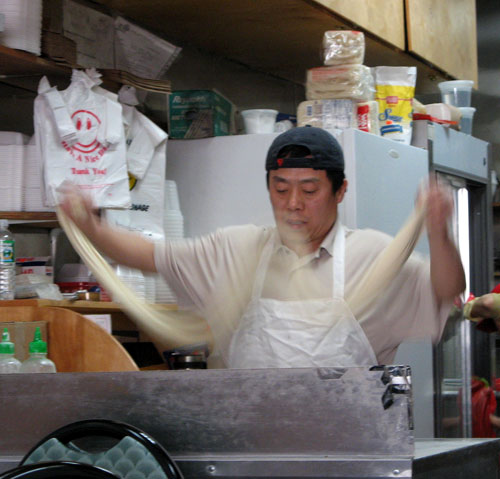
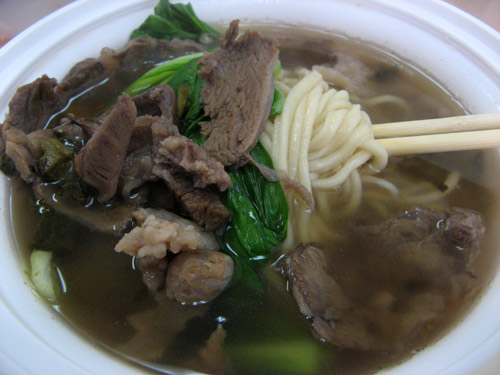
Gao made short work of the dough, after which his wife took over, dunking the noodles into a vat of broth deeper inside the kitchen, and topping our bowls with a pile of beef and greens. (White, take-out plastic dishware seems to be standard issue among these shops.) The texture of the noodles was delightful — firm and just chewy enough, as they would remain to the last strand. The soup broth was fine, too, but to my tastebuds, fell just short of the richness of Sheng Wang’s, for which we compensated with a generous — perhaps too generous — spoonful of chili oil from the table.