vip in the city, page 3

From the sales of Montezuma...

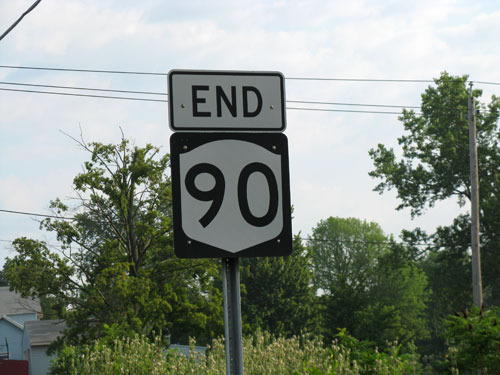
S and I had reserved high hopes for Montezuma, New York, deducing that the northern terminus of the Route 90 Sale — farthest from the city, and with the least picked-over stock — would yield the greatest treasures. The reality turned out differently: Montezuma, population 1400, had little to offer in the way of sales… or anything else for that matter. We breezed through the sleepy town in under 15 minutes.

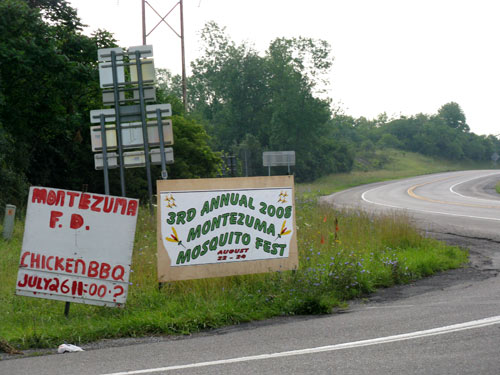
The local scene may be much more happening next month during the Third Annual “Montezuma Mosquito Fest”…

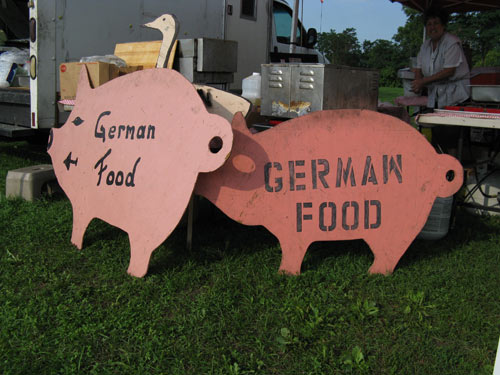
Even locating a spot for breakfast turned out to be somewhat of a challenge. We passed on the “German Food” truck in Springport, and settled instead on the Be Happy Cafe in Union Springs, where 2 eggs, bacon and unlimited French toast (touted on the menu as “made with real Italian bread!”) set us back just $4.95 per person.

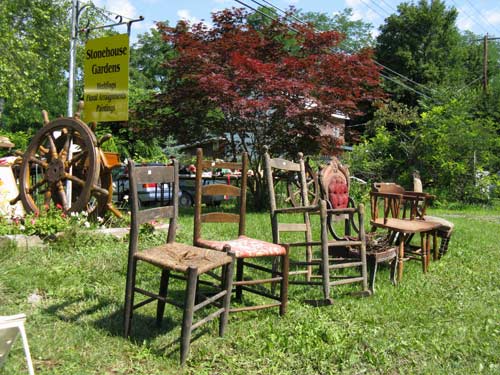
Even our return pass through lakeside Aurora proved a little disappointing, though we did find a cool collection of authentic ship steering wheels, bleached and weathered from years of salty spray, handles worn smooth by countless captains’ hands. No doubt a bargain at $125 apiece, but the prospect of lugging one of those iron-cored hubs onto the Metro North proved too daunting, even for our intrepid crew.

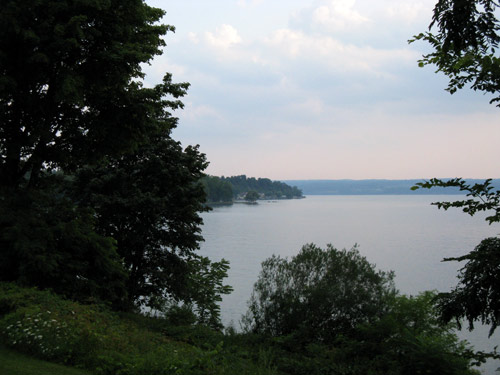
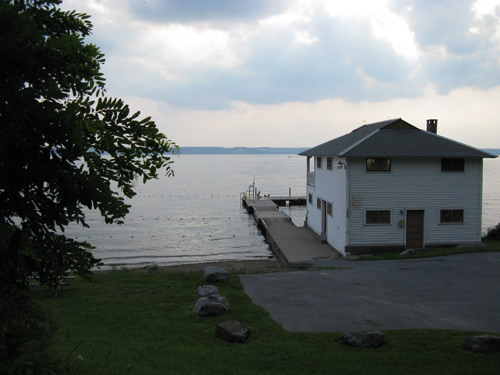
Cayuga Lake

Revived by our late lunch/early dinner (not to be confused with the fried-fest we shared at McMurphy’s Pub much later that night), we hit the road once more in search of treasures. The afternoon hailstorm, though, seemed to have dampened not just the farmland, but the momentum of the weekend’s sale. We passed many closed up tents and tarp-covered tables en route to our hotel. So ended Route 90 shopping for the day.

In Aurora, the expanse of farmland made way for a picturesque village of stately homes fronting Cayuga Lake. Much of this historic town was restored between 2001 and 2006 by American Girl founder (and Wells College alum) Pleasant T. Rowland — efforts which nonetheless were not embraced by all Aurora locals. Familiar laments all.

Eventually we made our way off the route to Auburn, a small city notable for three sites: the Harriet Tubman home, Seward House (the family home of William H. Seward, former Governor of New York and Secretary of State under Lincoln, responsible for “Seward’s Folly“) and The Auburn State Correctional Facility. By 6PM, the first two places were already closed; the third, we discovered somewhat by accident while coasting through our hotel’s packed parking lot, situated directly next door. (The hotel’s proximity to a maximum security prison was not all that off-putting, as it turned out: tonight we encountered a wedding reception and a high school reunion in progress.)

Auburn CF was the site of the first execution via electric chair in 1890; Leon Czolgosz, the anarchist who shot William McKinley during the 1901 Pan-American Exposition in Buffalo was put to death there. It’s apparently a point of perverse pride among the locals; Swaby’s, the pub on South Street where we ended up briefly that night, has on display an actual electric chair used in the prison. (Ew.)

Our exploration of Auburn nightlife began and ended there: when the rains let up, we abandoned our watered-down beers next to their busted pool table, having stayed just long enough for me to get in one play ofJust Like Heaven” on the jukebox.

Gathering for supper

By late afternoon, we found ourselves with rumbling stomachs and very few options along Route 90. Our brief detour onto Route 38 improved matters, but only slightly. After passing on a defunct dairy and a Hoffman Hots truck, we came upon Barb’s Diner in Genoa, which seemed promising — going by Calvin Trillin‘s theory that eating establishments named for people have a better-than-average chance of being good — but closed.

Even so, there was zero chance we would be eating at nearby Giuseppe’s Pizzeria. Sorry, Giuseppe.

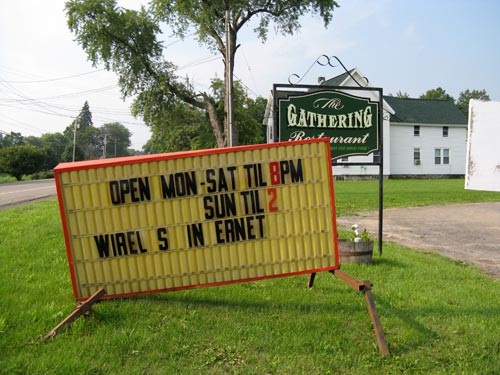
All of which brought us eventually to The Gathering in Moravia, which we all agreed was a name less suited for a restaurant than for an M. Night Shyamalan film. We were slightly reassured by the handful of cars in the parking lot — a veritable crowd in this sparsely populated region — but slightly perplexed by the presence of a drive-thru. But we pulled in anyway, deciding to take our chances. (Plus, did I mention we were starving?)

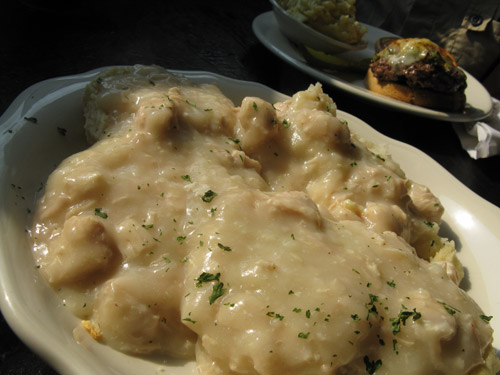
And we’re so glad we did! The Gathering turned out to be a charming diner with a stooled formica-top counter, friendly service and a chalkboard on which were handwritten the homemade pie offerings — always a good sign. And on the menu: Chicken n’ Biscuits — made daily from scratch:

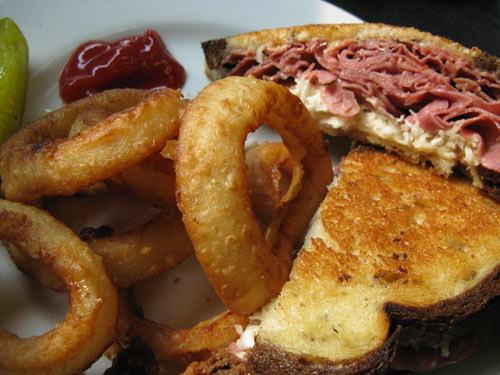
A “Rachel” sandwich, i.e., a Reuben with coleslaw substituted for the usual sauerkraut.

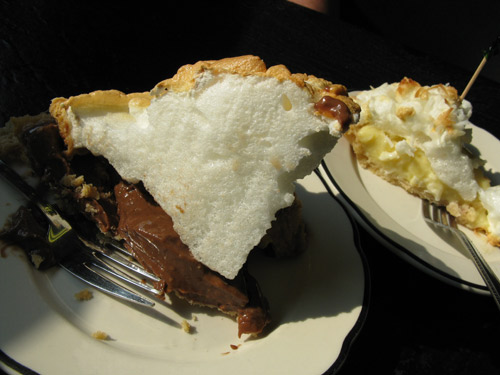
And of course, our visit would not be complete without sampling those pies: chocolate meringue (very first slice) and coconut cream (very last slice):

Garage sales galore

After a hearty homemade breakfast in Croton-on-Hudson, we piled into the Honda Pilot and set our GPS course for the 50-mile Route 90 Scenic Byway sale in Central New York. This annual July event began in 1989 as a means to draw visitors to the rural east side of Cayuga Lake, which is far less traveled than the vineyard-lined western edge.

S & I first learned about this event in our home state during last year’s road trip through the South for the World’s Longest Yardsale. An antiques dealer near the heart of the 127 Corridor Sale tipped us off to the similar event near New York’s Finger Lakes that he had participated in just before setting up shop in Jamestown, Tennessee. Hmm: shorter, more manageable, closer to home… I think it was pretty much decided last August that we’d be making the trip upstate this year.

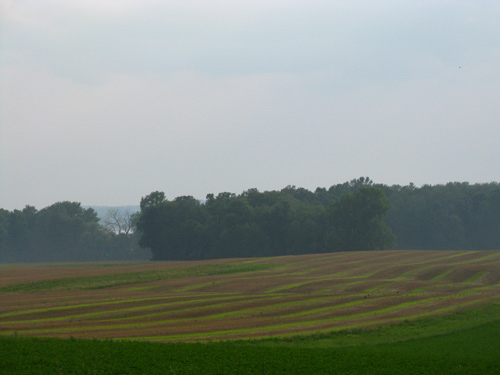
The Route 90 sale wends through the historic farmland of Cortland and Cayuga counties, from Montezuma in the north to Homer in the south. Along the way, there are bucolic fields of corn and what we later determined to be soy, a few picturesque small towns, and several less-picturesque trailer parks scattered along the shores of Cayuga Lake.

Just a few hours north of New York City, it’s an entirely different world.
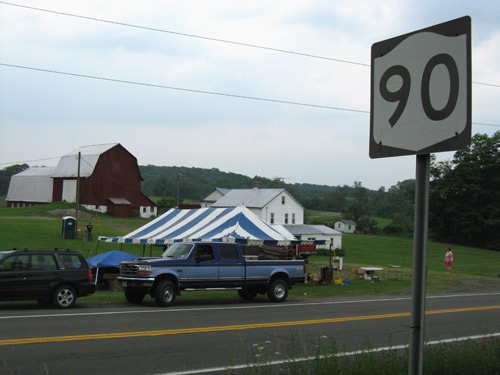
We started our shopping at the southern end of the route, stopping in at a few family-run barn/garage sales en route to the fields of dealers we felt sure to come across throughout the weekend.
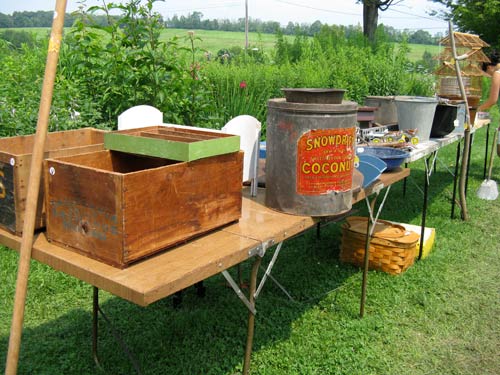
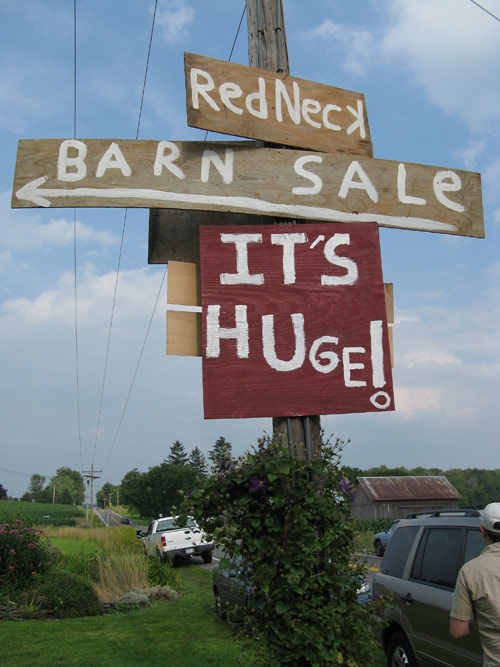
Except such fields of treasures never materialized. Not today, anyway. The sale, such as it was, was comprised of a string of garage sales of widely varying quality. On several occasions we rolled the car slowly past the roadside tables — drive-thru style — before opting not to even bother exiting the vehicle.

If I were to have made one purchase today, it would have been this vintage Smith-Corona. I’ve always been fascinated by old typewriters — those loudly clacking, hefty relics, so economical in their keys that the lower-case “L” does double-duty as the numeral “1,” and exclamation marks are made by typing an apostrophe over a period. This one was in reasonably good working condition, too — needing only a new ribbon.

Oh no… is this what’s known as non-buyer’s remorse?
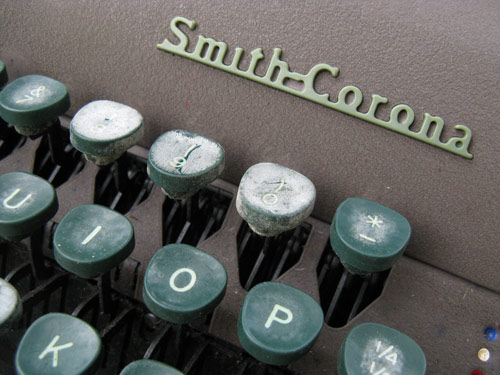
No, no. Perhaps one day I’ll have a shelf lined with these in my library or home office, but for my now, it’s enough of a challenge just to find a place to keep the towering stacks of books in my apartment.

Amish family, walking the route. I snapped this from quite a distance away, with my 6X optical zoom — is that bad?
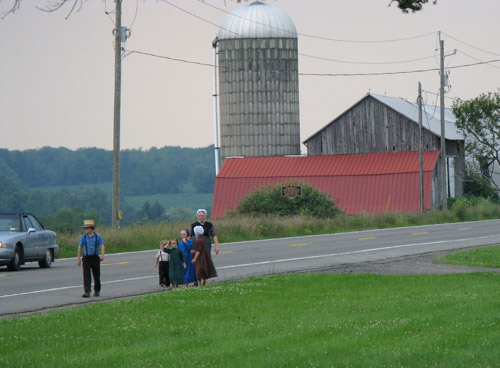
Soon after taking the photo, as my friends and I were browsing a nearby barn sale, a flash thunderstorm rolled in and pellets of hail began to rain down from the darkened skies. I’m reasonably sure that was just a coincidence.

Check out the rest of the Route 90 Sale photos on flickr.
Where in the world is vipnyc?

Friends and readers,

As a few of you may have noticed, I have been on hiatus this past month.

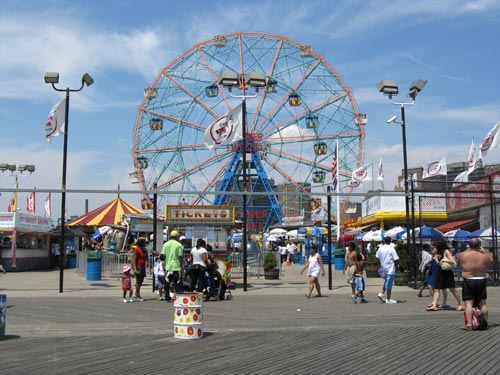
After a musical Memorial Day weekend in the Pacific Northwest, I spent two glorious weeks in Hawaii, followed in rapid succession by a wedding, and jaunts to Orange County, Los Angeles and San Francisco. Locally, there was much work to do launching my community supported agriculture group’s season, a visit to Public Farm One at P.S. 1, a night of Shakespeare in the Park, a slew of birthday celebrations, a pair of sublime sushi dinners, and the Siren Music Festival in Coney Island. More, too, but you know I don’t include everything on this blog…

Oh, you wanted to see pictures, and perhaps a video or two? (Follow the links to the full flickr sets.)

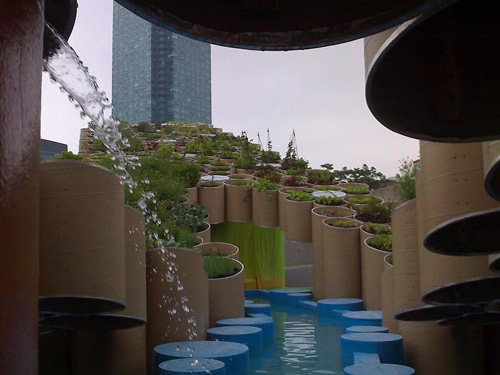
P.F. 1 (Public Farm One) at P.S. 1:

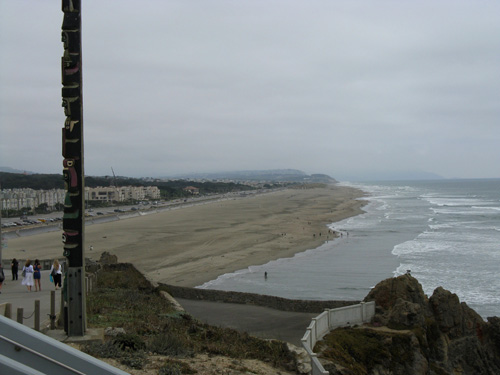
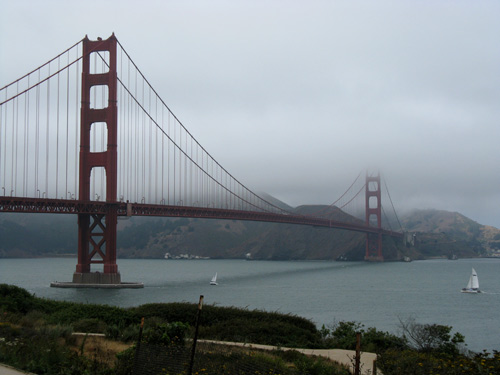
San Francisco shores:

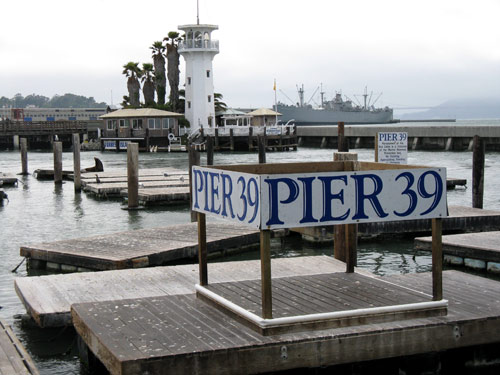
Fisherman’s Wharf, San Francisco:

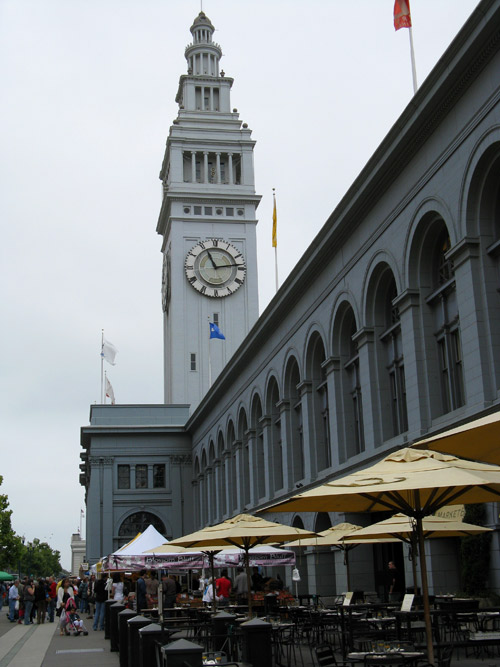
Ferry Plaza Farmers Market, San Francisco:

de Young Museum & Japanese Tea Garden, San Francisco:

Legacy Flickr mediaOpen on Flickr

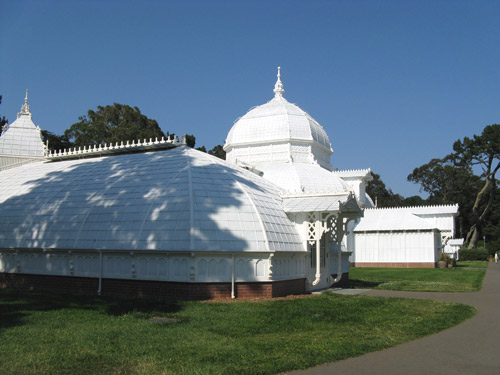
Conservatory of Flowers, San Francisco:

Legacy Flickr mediaOpen on Flickr

Coney Island, New York:

Legacy Flickr mediaOpen on Flickr

…and many more photos from O’ahu: Kualoa Ranch, Diamond Head, The Polynesian Cultural Center, and at Pearl Harbor, the Battleship Missouri and the USS Arizona Memorial.

I will be up in New York’s Finger Lakes region this weekend for the annual 50-mile garage sale along Route 90 — remember last August’s Highway 127 Sale through the rural South? — perhaps with some stops along the Cayuga Wine Trail, after which I hope to be able to buckle back down to the business of blogging as my summer tan lines slowly fade into memory.

Cry sanctuary

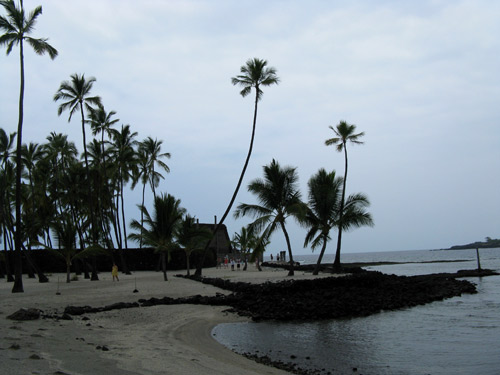
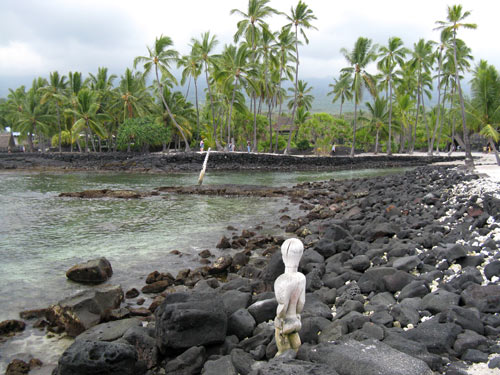
Pu’uhonua o Hōnaunau National Historical Park in South Kona preserves the site where, until 1819 when King Liholiho (Kamehameha II) abolished the ancient system of laws against the gods known as kapu, Hawaiians who broke the law could avoid execution by fleeing to this place of refuge. Under the system of kapu (taboo), offenses punishable by death included treading on the shadow of an ali’i (chief), fishing outside the specified seasons, or eating with a member of the opposite sex.

Such crimes would be forgiven only if the transgressor could reach a sanctuary such as this, either on foot or by swimming through the shark-infested bay. If successful, the kahuna (priest) was required to absolve all wrong-doing. Interesting idea.

As no blood could be shed within the confines of the place of refuge, here, too, defeated warriors could find respite, and women, children, the infirm and the elderly could find a safe haven from the battles raging outside.

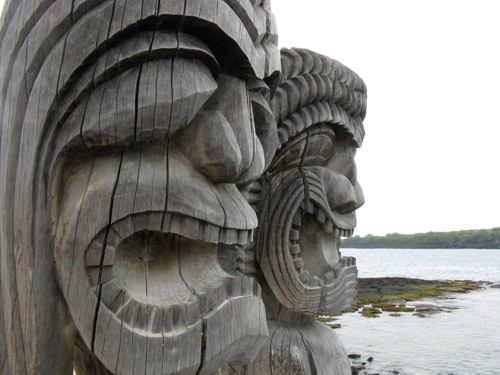
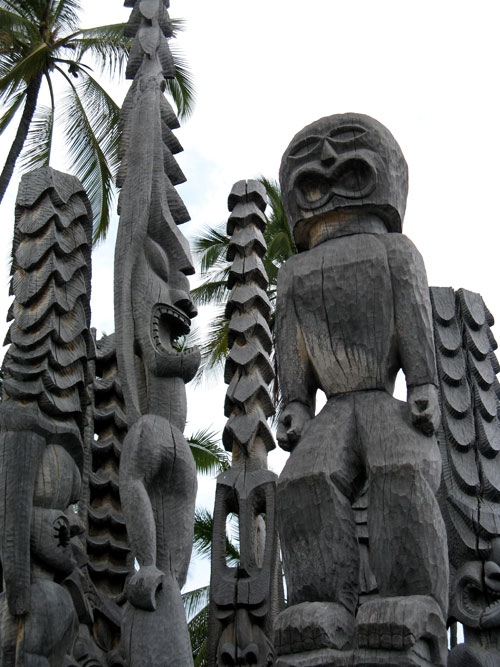
Carved ki’i statues, effigies of gods, tower over the bay. Reproductions, but still eerie.

The temple complex sits on a 20-acre palm-fringed lava bed bordered by the sea on three sides. The grounds include temple ruins, a fishpond and private canoe landing.

What better way to celebrate this milestone of mine than with a clean slate?

Full Pu’uhonua o Hōnaunau National Historical Park photo set on flickr.

Go with the flow

The Big Island is so called because it is the biggest of the archipelago — hundreds in all, eight “main” islands. At 4,030 square miles, about three-quarters the size of Connecticut, it is larger than the other Hawaiian islands combined, and constantly increasing in land mass due to Kīlauea, perhaps the world’s most active volcano, which has continued to pour lava into the ocean since 1983.

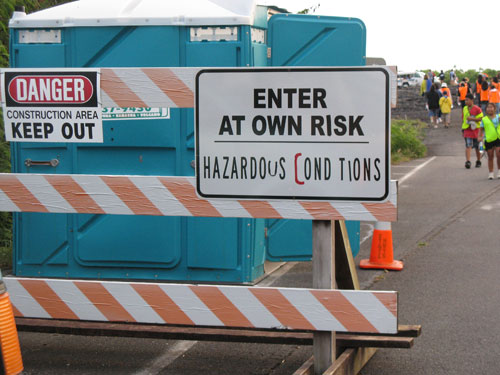
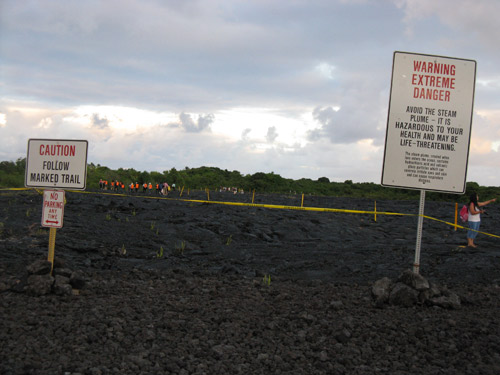
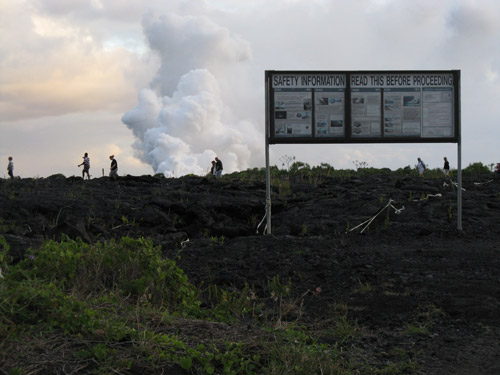
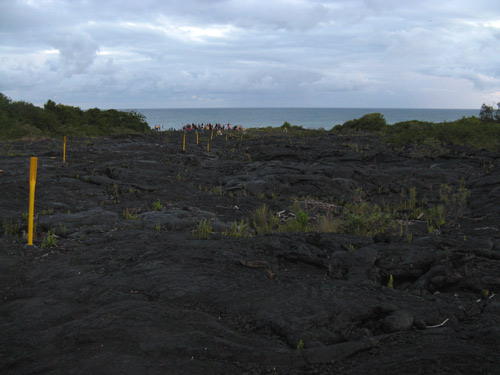
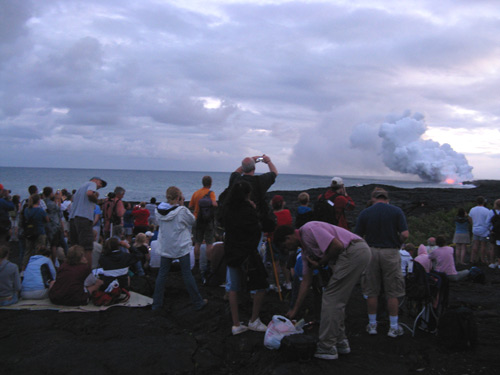
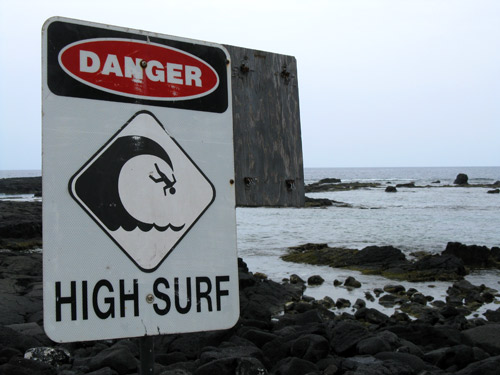
The spectacle of red molten lava hitting the water in blooming clouds of steam draws crowds every night. As the park rangers (and many signs) are quick to warn, trekking out to the view point is something done at your own risk.

Setting foot on this newly formed, perhaps not entirely stable, land is a disconcerting experience: 23 acres of land fell into the ocean last May; over several hours in November 2005, 44 acres of coastline disappeared in segments — the largest collapse since Kīlauea Volcano began its current eruption, and a collapse which included a park station and a segment of the original road out to the lava flow lookout point.

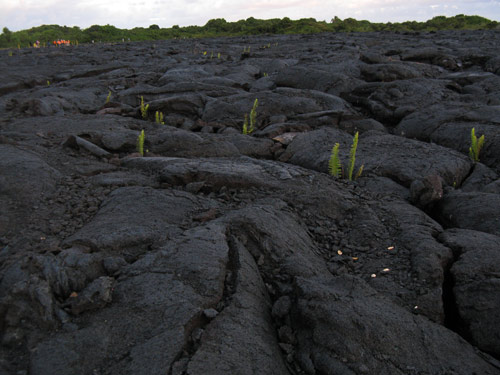
We drove out over a road washed over in parts in hardened lava and hiked half a mile over jagged black rock as we waited for sunset.

Check out the video below — spectacular!

Kīlauea lava flow photos on flickr.
Hawai'i Volcanoes National Park

Hawai’i Volcanoes National Park is a site on UNESCO’s World Heritage List and the most popular attraction on the Big Island, offering a glimpse of landscapes unseen anywhere else. From desolate stretches of volcanic rock and ash to lush green rainforests, from oozing lava to belching clouds of sulfur and hissing steam, it’s a tangible reminder of how actively the Earth continues to evolve.

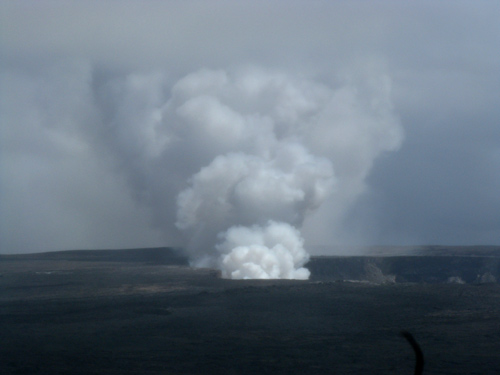
Since a small eruption in March, the Halema`uma`u Crater has been spewing clouds of sulfur dioxide gas into the air resulting in the partial closure of Crater Rim Drive:

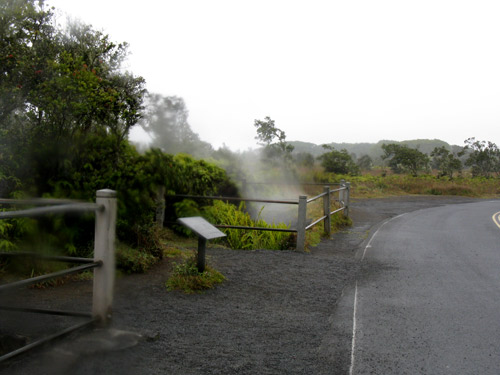
Steam forced to the surface when rainwater seeps into the ground, meeting with hot rock below:

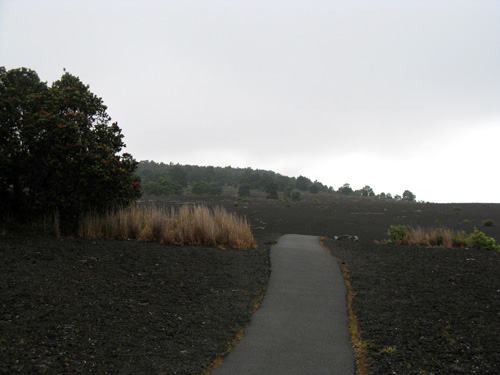
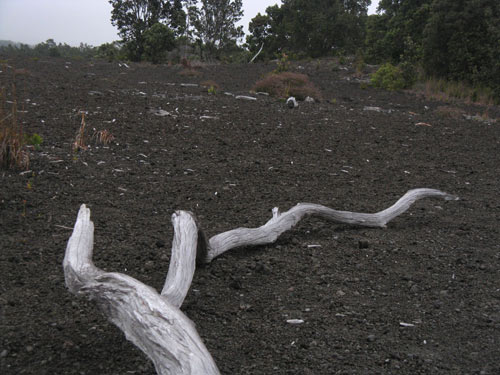
In 1959, an eruption in Kīlauea Iki Crater shot fountains of lava over 1100 feet high, blanketing this area along what is now known as the Devastation Trail. The patches of vegetation are the result of land left to regenerate on its own, as a kind of experiment.

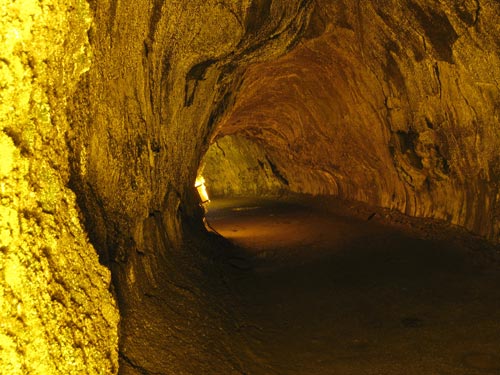
Thurston Lava Tube — an approximately 500 year old cave-like channel formed when slow-moving lava developed a hardened upper crust, forming a roof above the still-flowing lava stream. This segment of the tube is lit (another 1000 feet — open to the public, but blocked off by a chain link gate — is not), with ferns the only vegetation, sprouting up around the edges of the lights.

Check out the rest of the Hawai’i Volcanoes National Park photos on flickr.
Do the Loco Moco

Hawaiian cuisine is a reflection of the various ethnic groups that have immigrated to the islands over the past couple of centuries: strongly Asian-influenced — Japanese, Chinese, Filipino, Korean — and with an emphasis on local ingredients. (See: poi… though I only ever actually saw the well-known Hawaiian dish on the menu at the two lua’aus we attended.)
Given the easy access to fresh seafood and fruits, I was somewhat surprised by how starchy and heavy most of the local dishes were. Though this does explain why a staggering 39 percent of the native Hawaiian population is obese.

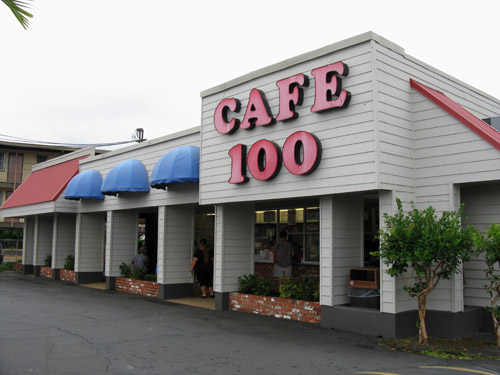
Case in point: Cafe 100, which we visited on our one day in Hilo.

After dropping off the kayaks just after dawn, we raced two and a half hours to the other side of the Big Island for my much anticipated helicopter tour over the active volcanoes. Alas, however, the heavy cloud cover that morning resulted in my ride being canceled at the last minute. Instead, we settled for an early lunch at this Hilo institution.

The Miyashiro family opened Café 100 six decades ago. According to our guidebook, the restaurant, now in its third incarnation, survived destruction by tsunamis in 1946 and 1960. It was named for the original owner’s World War II comrades in the famed 100th Battalion — a Honolulu-based unit comprised predominantly of Japanese Americans.

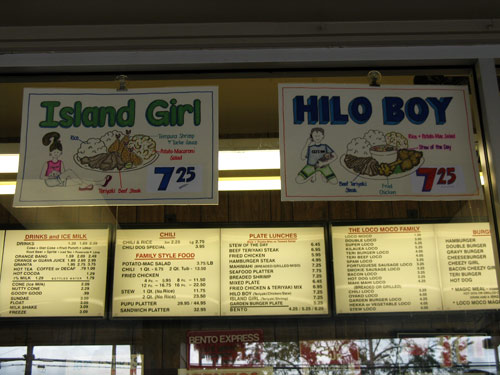
Café 100 is really more of a fast food stop than a café: open air tables and a simple counter where the staff still take down the orders with pen and paper and end every transaction with a cheery “Mahalo.”

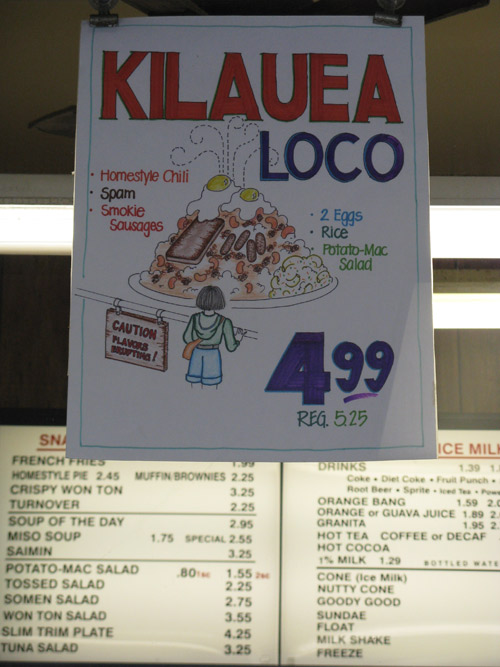
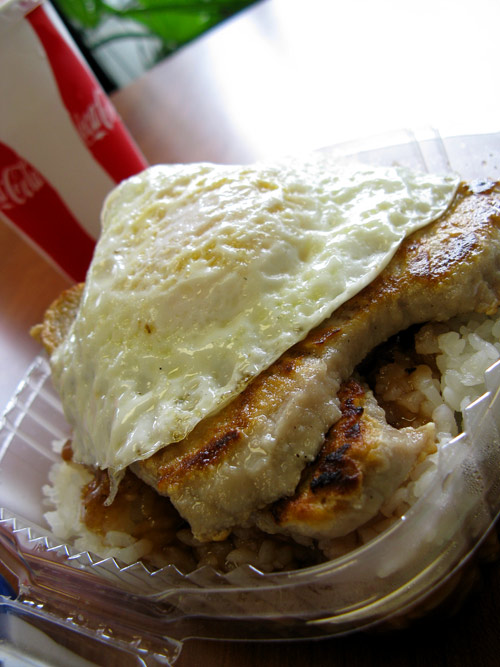
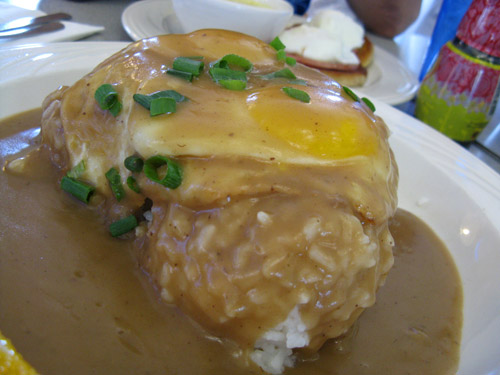
Besides its tasty, cheap eats, the place is most notable for its role in popularizing the Islands specialty “Loco Moco”: a local dish comprised of a mountain of white rice topped with a hamburger patty, brown gravy and an egg or two. Loco Moco was invented in Hilo, though whether by Richard Miyashiro of Café 100 (as I’d read) or by Richard and Nancy Inouye of Lincoln Grill is a matter of some debate.

Other dishes on the menu include the ubiquitous “potato mac salad” — yes, exactly what it sounds like — daily “mixed plate” lunch specials and more standard mainland fare such as cheeseburgers and fried chicken.  Not refined fare, by any means, but all fast, fresh and good.  And did I mention cheap?

Café 100’s Loco Moco is offered in many variations (14, at my count), substituting the beef patty for Spam (of course), “smokie” [sic] Portuguese sausage, hot dog, kalua pig, or fish — here, the mahi mahi. Or was that the ahi?

And below, a photo of our Loco Moco from Kailua-Kona’s Big Island Grill the day before. We hadn’t packed a defibrillator for this trip, so after these two hearty samples, we called a moratorium on the Loco Moco for the remainder of the vacation.

By the bay

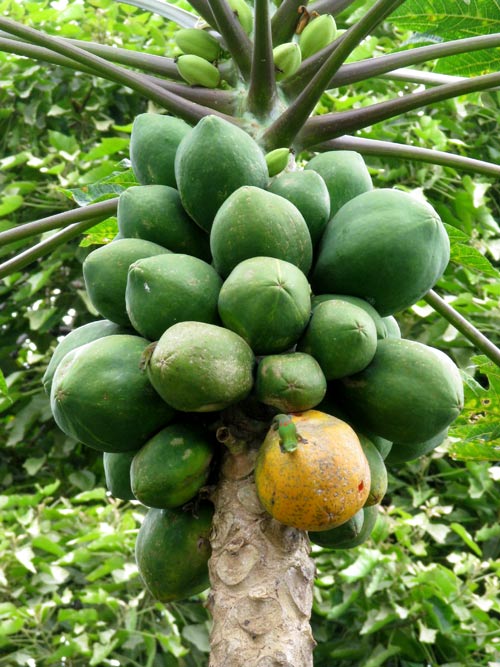
Papaya and gecko:

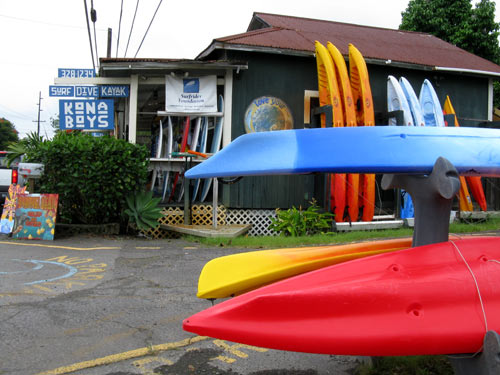
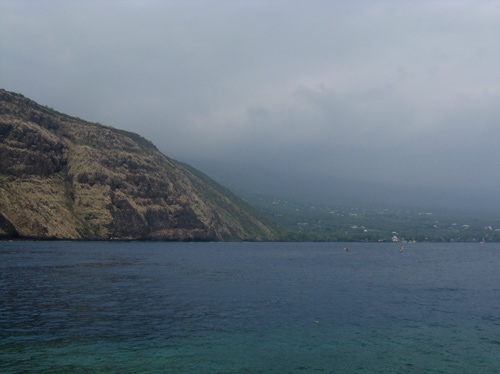
We rented a pair of kayaks from Kona Boys, stacking and strapping them onto the roof of the car for the 6-mile drive to Napo‘opo‘o Beach for our afternoon excursion into Kealakekua Bay. The Marine Life Conservation District is home to one of Hawaii’s most spectacular coral reefs and marks the site of English explorer Captain James Cook‘s first landing in Hawaii in late 1778.

With a little assistance, we set off from a concrete pier into the water surrounded by sheer cliffs. The mile-wide expanse is one of the most protected bays in the Hawaiian islands, with little current and few swells which made for relatively smooth kayaking.

Our guide at the rental shop had told us in advance to expect spinner dolphins in the bay. (Had he not, the first sighting of that swarm of fins circling our kayaks would have been a much more disconcerting experience.) Even so, we did not expect to see quite so many of the friendly creatures — several pods, nearly two dozen dolphins in all — leaping and spinning in the air as if for our entertainment. Amazing and delightful!

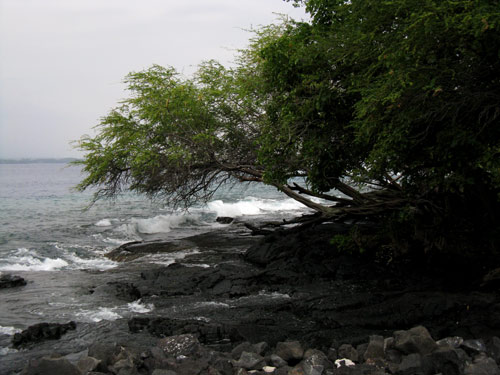
No photos of our near one-hour crossing, unfortunately: my camera was packed away deep in the dry bag, which in the end was a good thing as the rough surf at the ancient canoe landing at Ka‘awaloa made debarking the kayak a much trickier affair than embarking. Let’s just say that I became much better acquainted with these rocks than I would have liked.

At the north end of the bay, the well-developed reef slopes steeply from the shore to a depth of over 100 feet of pristine water, clear as glass, from which we spied jewel-like coral, myriad colorful fish, sea urchin the size of our heads, and even a squid or two. The best snorkeling of the trip.

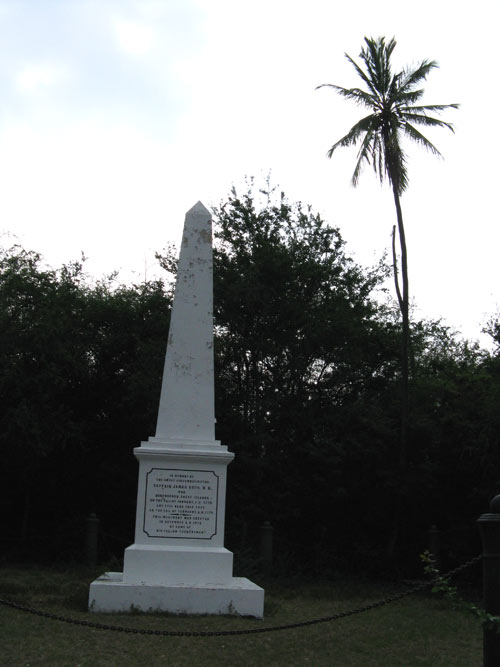
When Captain Cook first arrived on the Sandwich Islands (now Hawaii), he was revered as a god — some natives may have believed him to be a returning form of Lono, the Hawaiian God of peace, agriculture and prosperity — but his subsequent visit in 1779 met with much less favor: a 27-foot white obelisk marks the spot where Cook was killed by Hawaiians on February 14, 1779.

So caught up were we with the marine life that we happily missed the deadline to return the kayaks that evening, opting instead to carry them along to our dinner at the gorgeous Four Seasons Resort Hualalai later that night.