vip in the city, page 25

Columbus Day parade 2007

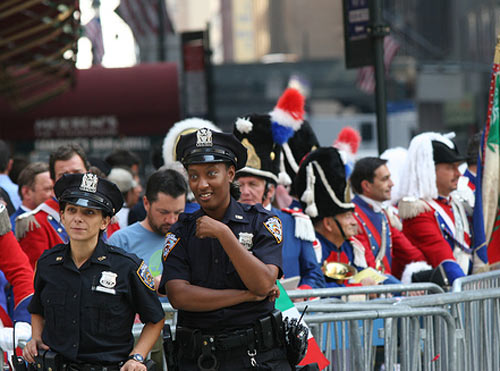
Despite all the controversy, New York City’s Columbus Day Parade continues to commemorate the European discovery of the Americas. Ostensibly, the second Monday in October is dedicated to Christopher Columbus’ arrival in the New World on October 12, 1492; these days, it’s more a celebration of Italian culture and heritage.

It’s one of those perplexing holidays, a federal holiday only since 1981: no mail delivery, but New York City subways and buses operate on weekday schedules. Banks are closed, but stock markets are open. I had the day off from work, but most of my family and friends didn’t. Which essentially meant that I could spend the day wandering around the city by myself.

Well, by myself plus the 35,000 marchers and the million plus spectators who participated in the parade along Fifth Avenue this unseasonably warm October afternoon.

Columbus Day parade

OHNY 2007: Murrays Cheese Caves tour

Murray’s Cheese has been a Greenwich Village fixture since the original owner, Murray Greenberg opened his wholesale butter and egg shop on Cornelia Street in 1940. The current owner, Rob Kaufelt, took over the shop in 1991 from Louis Tudda, onetime clerk at Murray’s, and moved it to its current location on Bleecker Street in 2004. At that time, the cheese purveyors seized upon the opportunity to take their cheese to the next (or rather: lower) level, by building out custom cheese aging caves beneath the shop.

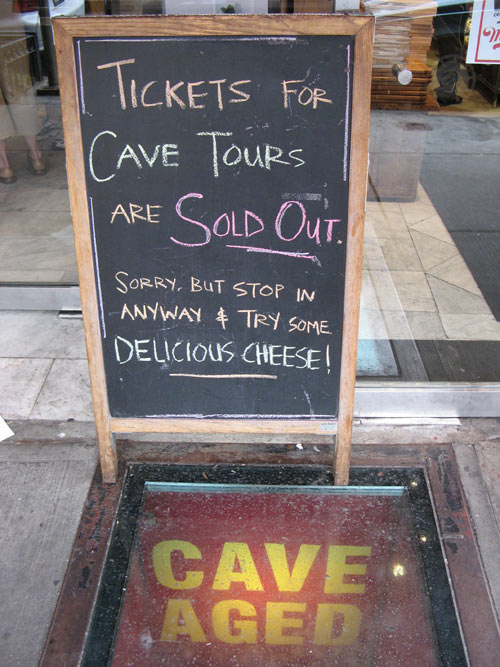
Murray’s opens their caves to the public during their private cheese cave tours: $800 for up to 8 guests, or in conjunction with one of the shop’s $75 “Mystery of the Caves” classes. Last year, Murray’s participated in openhousenewyork Weekend for the first time, offering small group tours of their famed caves by reservation only. In December 2006, Condé Nast Traveler named the cheese cave tours one of their “Fabulous 50” experiences of a lifetime. Combined with the palpable buzz surrounding OHNY this year, I knew that slots for those tours were going to be even tougher to come by, so the night before the reservation lines officially opened, I vigilantly monitored the OHNY website where the official tour information was to post first. Refresh, refresh, refresh… (Yes, I really do love cheese. And um, no, I really don’t have much of a life.) Groups of 10, over two and half hours on Saturday and Sunday afternoons… that left just 100 slots up for grabs, after all. Within minutes of the reservation information going live, I swooped in to book the slots. And success!

To the 400(!) people on the waitlist, and the throngs who showed up at the shop hoping for a last minute cancellation — better luck next year (October 4 & 5, 2008):
Murrays Cheese

So here we were at Murray’s Cheese, having snagged coveted slots for the very first tour of the day. Taylor Cocalis, Murray’s friendly classroom coordinator, signed us in and outfitted CF, SYB and me in snazzy mesh hairnets. After first directing each of us to step through an anti-bacterial mat — with the look and feel of a soggy bit of astroturf — she opened the doors that would lead us down a short hall into the caves.

I hadn’t really known what to expect. “Cheese caves” evoke images of damp and chilly, rocky coves, stalagmites and stalagtites; originally, such caves were more like cellars. Nowadays, affinage — or the craft of maturing and aging cheeses — is its own precise science. Murray’s caves more closely resemble carefully calibrated refrigerated rooms; in all there are four, each maintained at a specific humidity and temperature level tailored to the types of cheeses stored within. The rooms themselves were designed by Hervé Mons, the leading affineur, or “Meilleur Ouvrier,” of France.
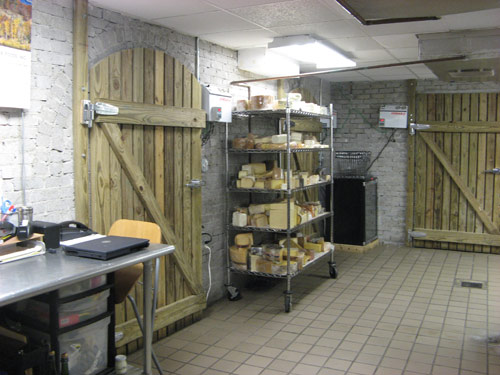
Murrays Cheese

After a brief introduction on proteolysis — the biochemical events that occur in cheese during ripening which are essential for the development of flavor and texture — our guide threw open the first set of doors.

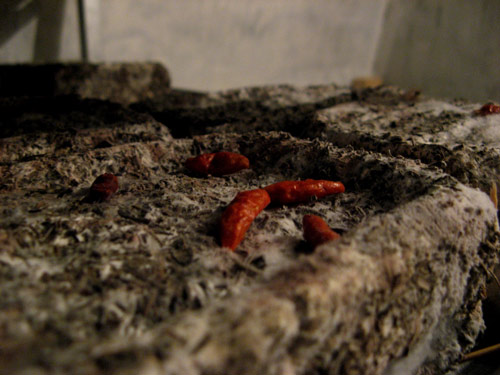
We were almost knocked back by the chilly blast and powerful pungency emitted from those wooden shelves laden with ripening cheese, several spotted and furry, and many tagged for destinations at various restaurants around the city. Taylor urged us inside, and with nose stinging and eyes watering a little, I dove in and began snapping away with the Canon. For you, my friends, so check it out. Taylor, in the meantime, described for us what was involved in caring for the shop’s cheeses: in addition to maintaining an optimal environment for the bacteria and molds to flourish, regular washing and constant flipping and turning distributes the butterfat to improve cheese flavor… while keeping their staff of affinage interns busy.
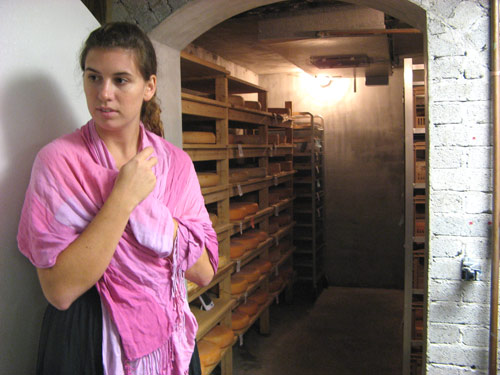
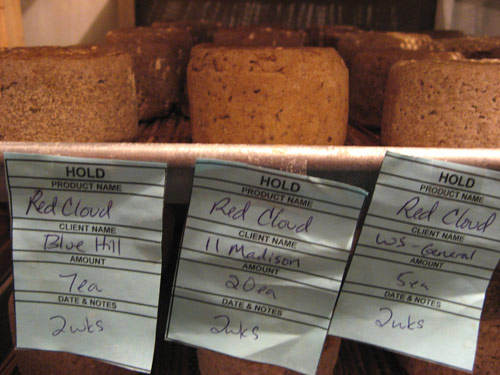
Murrays Cheese cave

Murrays Cheese cave

Murrays Cheese cave

We toured through the rest of the caves — each progressively warmer and less odorific than the last — until we reached that final room, familiarly-scented and stacked with giant hard-aged wheels and hung with waxen-rinded balls.
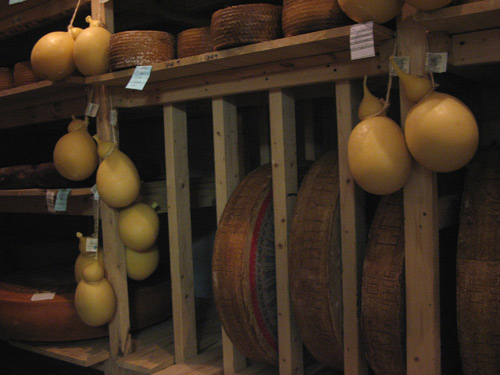
Murrays Cheese cave

Inspired by our tour, we spent quite a bit of time (and a not inconsiderable amount of money) at the shop counter upstairs. Mmm… Drunken Goat

Full of cheesy samples, we had time to visit one final OHNY site. On Park Avenue and 38th Street, en route to Grand Central Terminal, we stopped in at Scandinavia House, which we had skipped last year. Inside the sleek Polshek Partnership-designed building, we toured the upper floor galleries and enjoyed the garden on this perfect Autumn Sunday — a low-key close to a very full weekend of open houses.
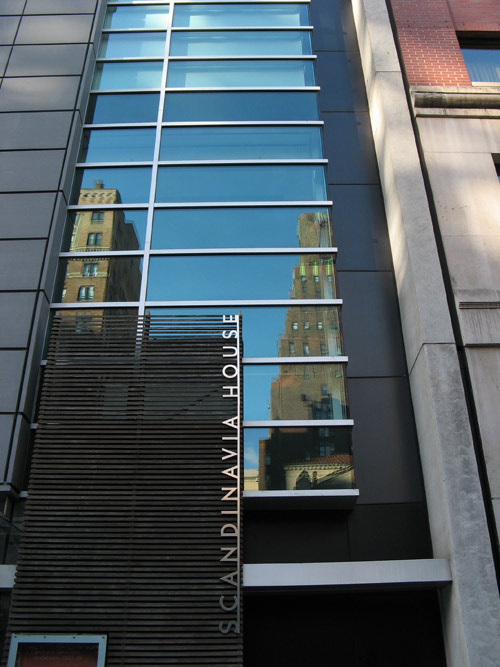
Scandinavia House

“This is no ordinary city, this city of ours.” This is New York City.
OHNY 2007: Roof garden at Rockefeller Center

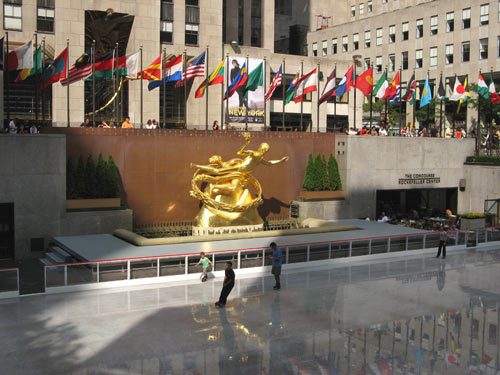
With temperatures hovering in the near-record low 80s, ice skating was just about the furthest thing from most people’s minds, but nonetheless, the Ice Rink at Rockefeller Center opened this first October weekend – right on schedule. This year, as in years past, the Rink is offering its “Engagements on Ice” — or on days like today: “Slush” — marriage proposal package. Broadcast of the couple’s special song and a ceremonial “victory lap” is included in the $200 price tag. Cheesy or charming — what say you? (Hey, it could always be worse…)

Rockefeller Center slush

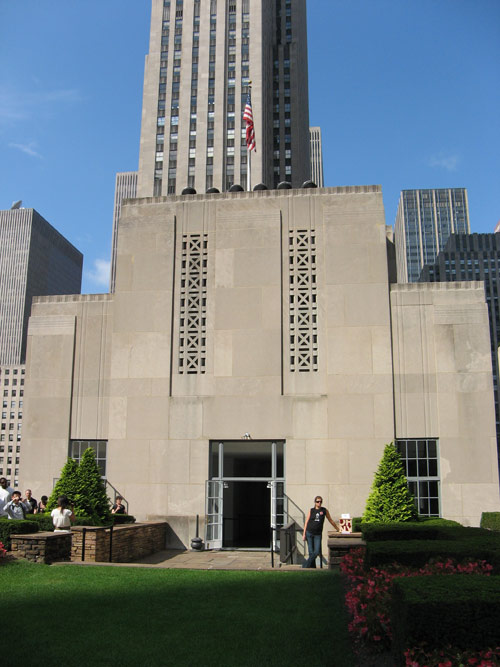
We were here this morning to visit the private roof garden at Rockefeller Center. According to Daniel Okrent‘s Great Fortune: The Epic of Rockefeller Center, the “Gardens in the Sky” were originally open to all but operated at an annual loss of $45,000. Nowadays, the four hours on openhousenewyork Sunday represent one of the public’s rare opportunities to tour this carefully cultivated patch of green, which is otherwise only accessible for film shoots and private events.

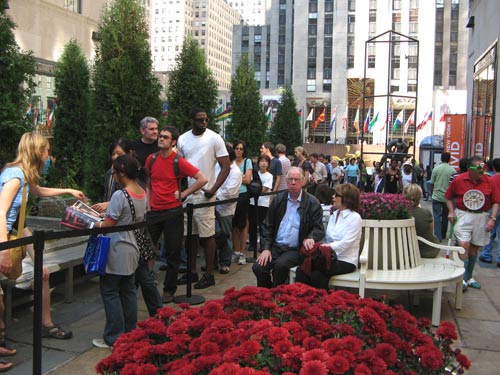
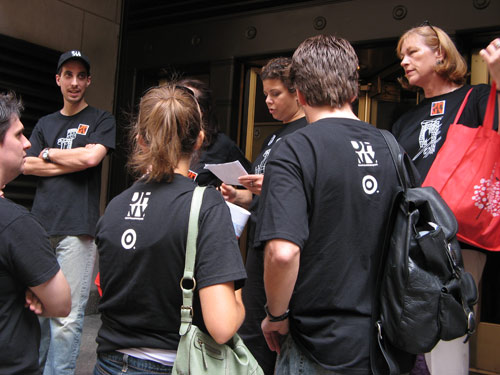
The OHNY volunteers were out in full force this morning, including several (like SYB) who just decided to pitch in to assist with the crowd control. The roof garden is one of the most popular sites of OHNY weekend, and I was determined not to miss it again. With half an hour to go until the noon opening, the line to enter the British Empire Building already wrapped around the plaza and onto Fifth Avenue.

Rockefeller Center line

OHNY volunteers

SYB’s OHNY volunteer pin got us bumped to the front of the line yet again, and as a result, we were among the first to step inside the elevator that would spirit us up to the 7th floor. We piled inside and ten seconds later….

Roof garden view

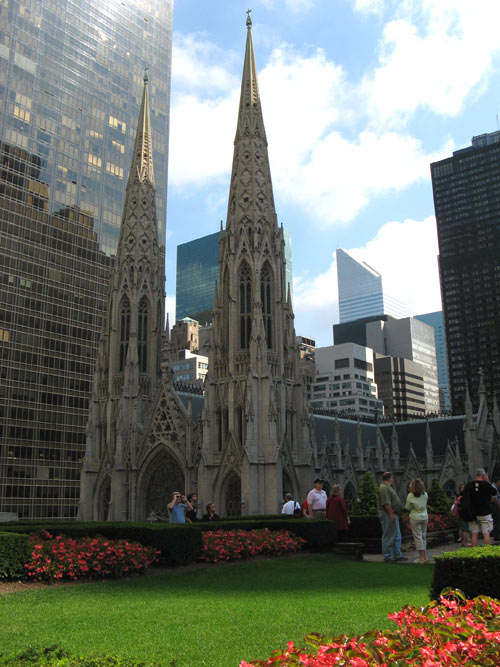
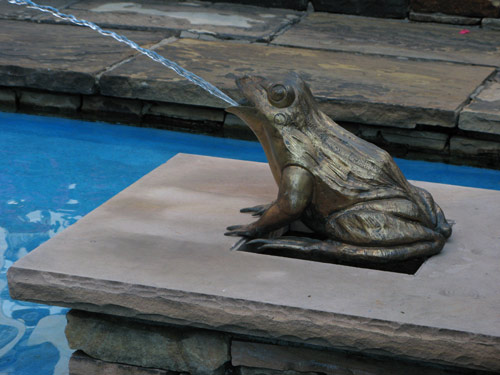
We wandered through the topiary hedges and around the reflecting pool with its frog fountain. Directly across the street, the twin spires of St. Patrick’s Cathedral loomed before us as the Empire State Building rose up behind.

Roof garden view

Rockefeller Center frog

Roof garden view

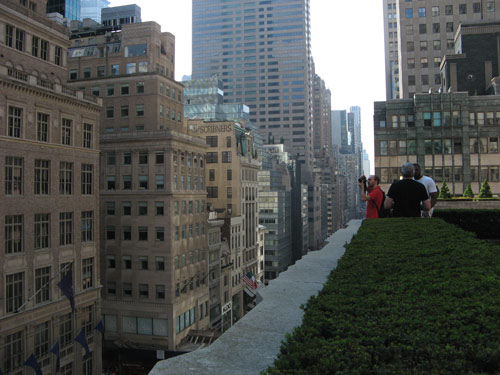
The view over Fifth Avenue, put us just at the end of the Pulaski Day Parade route. The parade, which honors Polish American heritage, was just then beginning on 29th Street, so no revelers had yet made it to midtown; the street below was already barricaded and cleared of vehicular traffic, though, adding to the surreal feel of this secret formal garden in the midst of all these city skyscrapers.

Can’t get enough? Here’s the rest of the set on flickr.

OHNY 2007: Paul Rudolph Foundation

Missed connections + emergency root canal (not mine) = no Arcade Fire et. al. on Randall’s Island tonight. Too bad — I heard it was an awesome show.

Silver lining: the concert ticket snafu freed me up to visit one of the openhousenewyork sites I’d been wanting to check out for the past few years: the Paul Rudolph Foundation/Modulightor Building in midtown. As in years past, the site would be open for one day only, and this was to be the first Saturday in years I was able to attend.

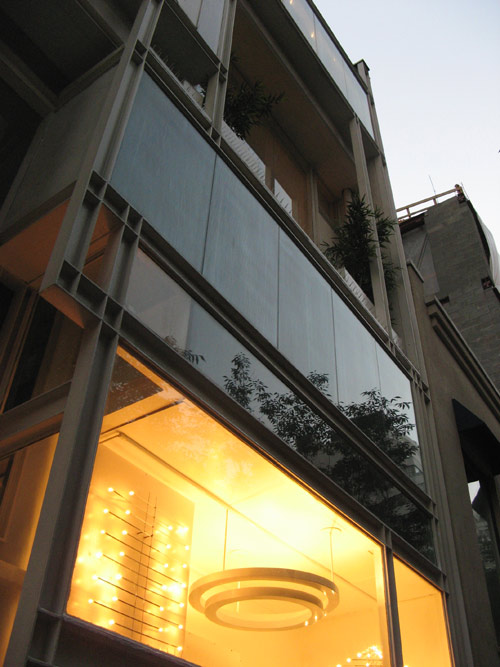
After meeting up with SYB after his volunteering gig, we made our way to 248 East 58th Street to tour the last New York City townhouse built by Late Modernist architect Paul M. Rudolph (1918-1997). By the time we arrived at dusk, the line to enter stretched well down the block, but SYB (and guest) got to jump ahead, owing to his status as an OHNY weekend volunteer.

Paul Rudolph Foundation

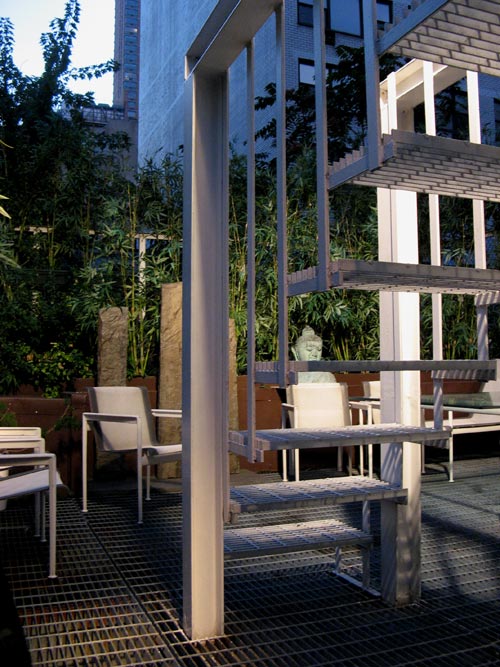
Rudolph lived in a four story, 17-level space at 23 Beekman Place, but in 1989, the architect and his longtime companion, Ernst Wagner bought the then-commercial structure we were visiting tonight with the intention of converting it into rental units. The space took 14 years to fully realize — the last of the glamorous city apartments Rudolph designed — during which the architect fought his long, fatal battle with mesothelioma. He left the townhouse to Wagner, who oversaw the completion of the upper duplex after Rudolph’s death. It is there that Wagner now resides, in a space which doubles as the seat of the Paul Rudolph Foundation, a nonprofit group that seeks to perpetuate Rudolph’s design ideas. Modulightor, the innovative lighting company Rudolph and Wagner founded, occupies the building’s first two floors. (Those showrooms were completed in 1996, a year before Rudolph’s death.)

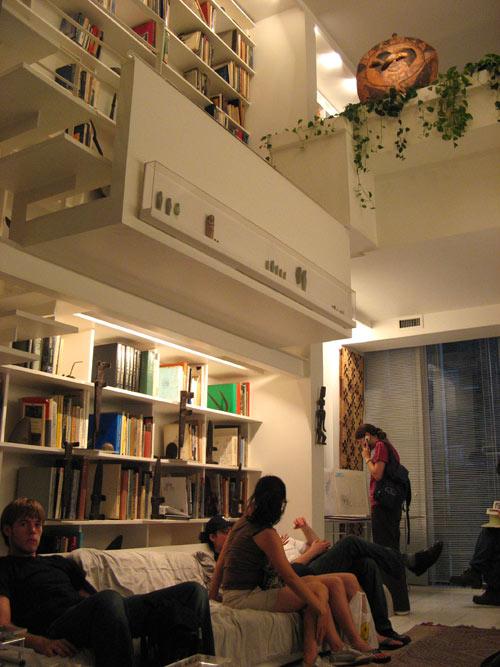
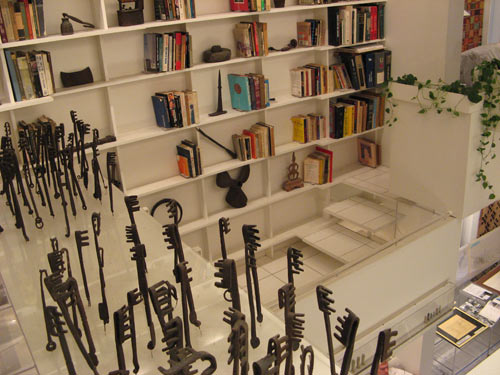
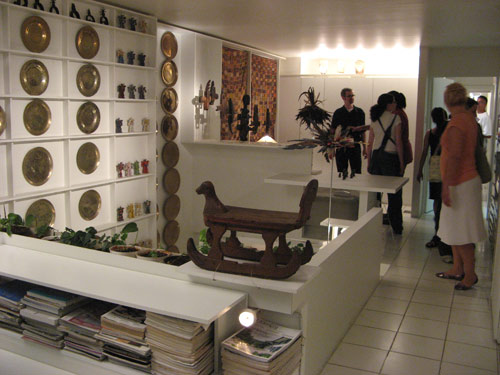
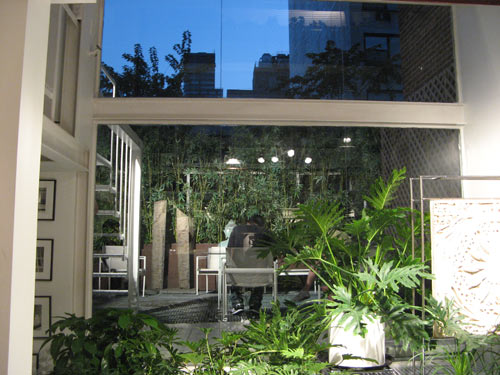
I’ll leave the design commentary to the trained architects (at least one of whom I know reads this blog), and just relate my impressions. As soon as we stepped off the elevator, the sleek exterior revealed a complicated, multi-leveled interior. Dozens of OHNY visitors circulated up, down, around and through the puzzle box of a townhouse. Several just plopped themselves onto the built-in couches to take in the intricately interwoven space around them: all white and glassy, reflective surfaces, with bookcases, floating shelves and open staircases creating layers that combined into a series of unusually shaped compositions that belied the narrow confines of the 20-foot-wide building. The residential duplex was originally designed as two separate two-story apartments, front and rear; Wagner occupies both as a 2,700-square-foot merged unit. For all its complexity, though, I was happy to see that the space still functioned as a home rather than just a showroom; the kitchen had a less-than pristine patina, and we spied a cell phone charging in the bathroom.

Paul Rudolph Foundation

Paul Rudolph Foundation

Paul Rudolph Foundation

The rear garden:

Paul Rudolph Foundation

Paul Rudolph Foundation

One of Rudolph’s most important works is the Art and Architecture (A&A) Building at Yale, where Rudolph was an influential dean of the School of Architecture in the 1960s. The 1963 landmark structure is currently undergoing renovation by New York-based firm Gwathmey Siegel & Associates.

Check out the rest of the Paul Rudolph Foundation photo set on flickr.

OHNY 2007: Voelker Orth Museum

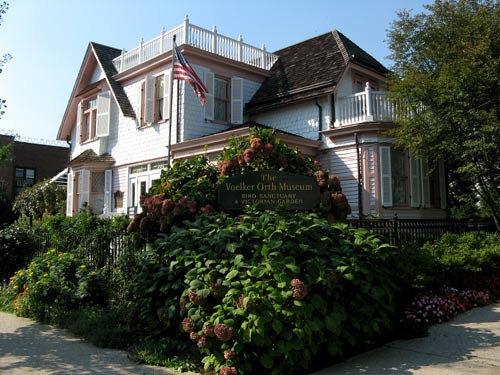
Site #2: The Voelker Orth Museum, Bird Sanctuary and Victorian Garden in Flushing.

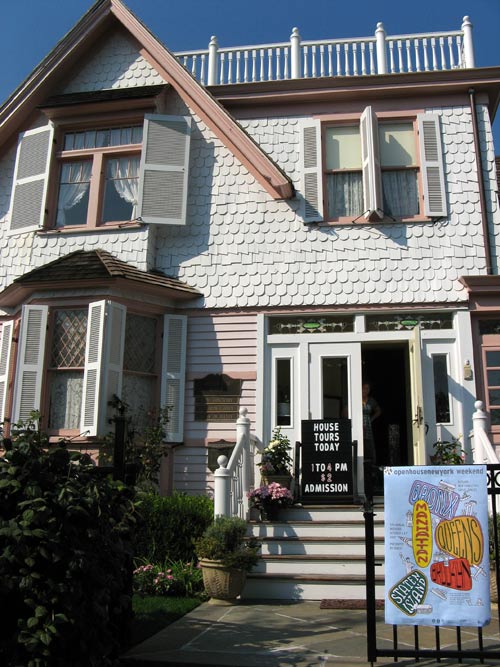
The historic house was built in the 1890s and eventually purchased by Conrad Voelcker, a successful printer who emigrated from Germany in 1881 with just a wooden trunkful of possessions. For the next century, the house remained in the family until his granddaughter Elizabetha Orth’s death in 1995. Orth, a never-married retired schoolteacher with no descendants, left the house and its grounds (and a rather substantial sum of money) to the Queens Historical Society, the Queens Botanical Garden and the Theodore Roosevelt Sanctuary of the National Audubon Society in Oyster Bay, Long Island, stipulating in her will that her legacy was to be used to promote local history, Victorian gardening, and bird sanctuaries. The house – which had been looted and vandalized in the years immediately following Orth’s death – was restored with great attention to original period detail, and opened to the public as a museum in 2003. House tours are now conducted weekend afternoons throughout the year.

Voelker Orth Museum

Voelker Orth Museum

As we waited in the foyer for our OHNY guided tour to begin, I had a chance to talk with the museum’s caretaker, a young man who actually lives inside the house on a part of the upper floor, which has been converted into a separate (modern) studio apartment for that purpose.

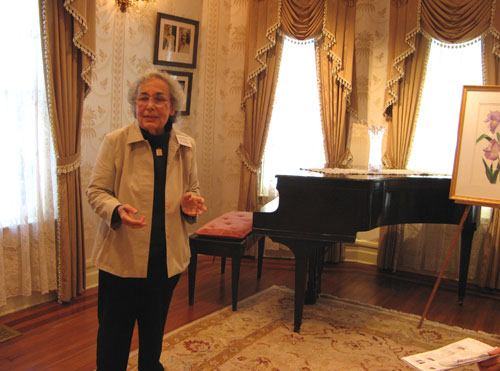
Our guide brought us through the first floor rooms, which included a parlor outfitted with a still working victrola and a baby grand piano (not a Steinway, though), an intimate library, formal dining room and kitchen. Upstairs, we were able to view Orth’s bedroom, decorated as it would have been during her childhood, with her original bed, dresser and dolls.

Voelker Orth Museum guide

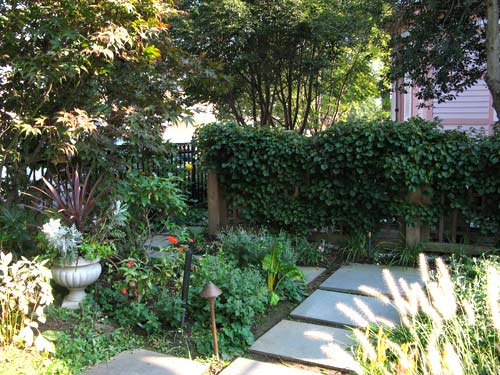
Perhaps the most distinguishing feature of the museum is the prize-winning Victorian garden, which is overseen by the Queens Botanical Garden. The period plants – including those inside the house — are not only landscaped in the Victorian style, but maintained using 19th century propagation methods and gardening techniques, such as hand pruning and natural fertilization.

J and C were able to join in on the tour of the house, which prior to this afternoon, none of us had any idea even existed — just another random glimpse into Queens history.

Voelker Orth Museum garden

Check out the rest of the Voelker Orth Museum photos on flickr.

OHNY 2007: Hindu Temple Society of North America

Mom had been wondering what it is I do on the weekends after I leave Queens, so since I didn’t have to pick up the tickets for tonight’s Arcade Fire show for a few hours, I invited her along to the first of my openhousenewyork weekend tours.

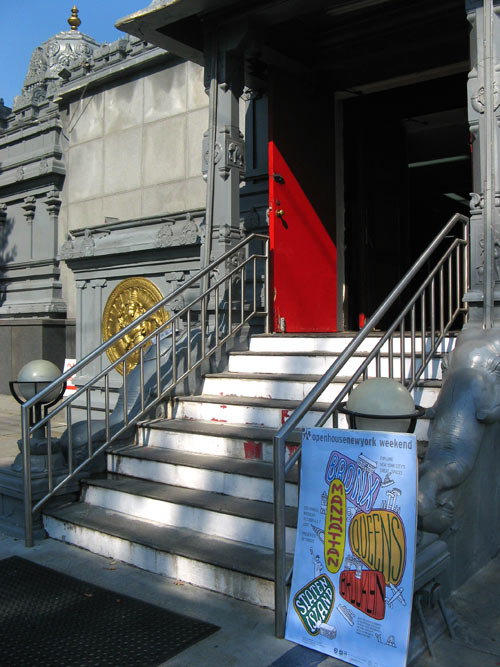
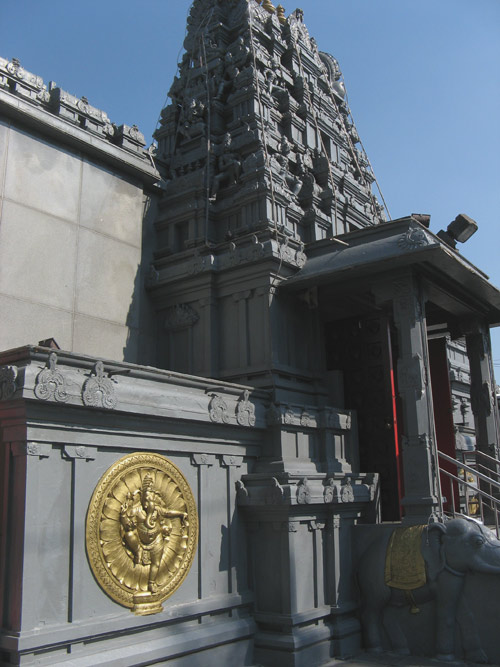
The Hindu Temple Society of North America is nestled among multi-family houses in a predominantly nondescript middle-class residential neighborhood. As we turned the corner onto Flushing’s Bowne Street, we were met suddenly with its looming grey architecture, gilded Ganesha and bright red doors.

The ornate temple is rumored to be the continent’s oldest and with 20,000 devotees, certainly one of its largest. The building was designed and built in India and moved to Queens in the mid-1970s, where it was reconstructed by master craftsmen in full accordance with Hindu principles.

The site is also notable for its community center and basement canteen, which according to The Times’s reviewer Peter Meehan, serves “some of the best dosas in the city.”

I never confirmed that, however. Shoes are not permitted inside the temple, and as I considered wandering through the grounds barefoot, my dreaded fear of the fungorrhea™ got the better of me. It may be entirely irrational (or maybe not) but although I did very much want to see the temple’s famed carved black granite shrine, I just couldn’t bring myself to do it this afternoon. These shots were taken from outside the perimeter.

Hindu Temple Society

Hindu Temple Society

Am I a mycophobe? Or does that term pertain only to mushrooms, and not to fungi generally? Perhaps verminophobe (germs) or automysophobe (being dirty) would be more apt?

I did remove my shoes to tour the Wat Arun in 2004, but maybe because I sensed then that it would be some time before I would find myself in Bangkok again. I know I’ll be back in Flushing, though, soon enough.

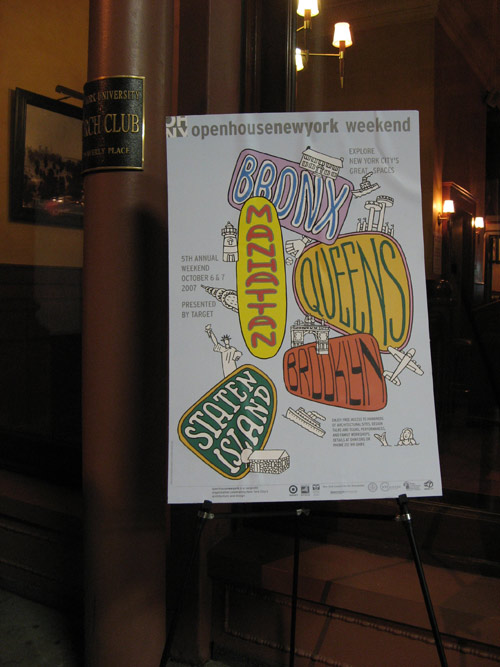
OHNY launch @ The Torch Club

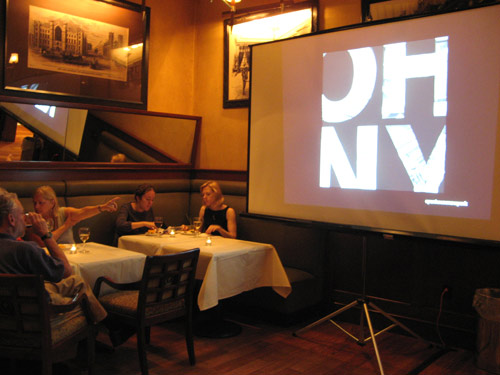
At NYU’s Torch Club on Waverly for the openhousenewyork weekend launch party hosted by OHNY and The Architect’s Newspaper.

OHNY party

OHNY party

The fundraiser was held on the eve of the annual openhousenewyork weekend, which has provided the public with free access to sites of architectural and design interest throughout all five boroughs every October since 2003. OHNY was inspired by the overwhelming popularity of similar events in the United Kingdom and in Canada. Back in its early days, the scale of the event was much smaller; it still felt a bit like a secret waiting to be discovered, peering into these spaces, many of which normally were closed to the public. (One year, we got to wander among the samples and dressmaker models at Narciso Rodriguez‘s design studio — pretty cool!) The secret — such as it was — is definitely out now: with every subsequent year, the number of participants has grown — from an estimated 50,000 site visitors in 2004 to over 100,000 in 2007; many locations began requiring reservations, which were booked up within minutes of offering. OHNY weekend is now the largest architecture and design event in the United States… and one of my favorite events in the city.
The number of sites participating, too, has grown dramatically: this year about 350 sites opened their doors, nearly doubling the number from the year before. (In 2003, the number of participating sites was around 75.) Highlights for 2007 included tours of the little-seen Roof Gardens at Rockefeller Center and a trip through the underground Murray’s Cheese Caves. More on those sites to come…

Tonight, though, we mingled among architects, designers, planners, and fellow OHNY devotees, comparing notes on upcoming weekend tours and commiserating over that most enduring of all New York obsessions: real estate.

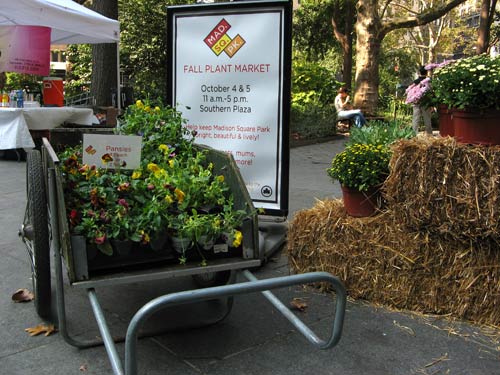
Fall Plant Market

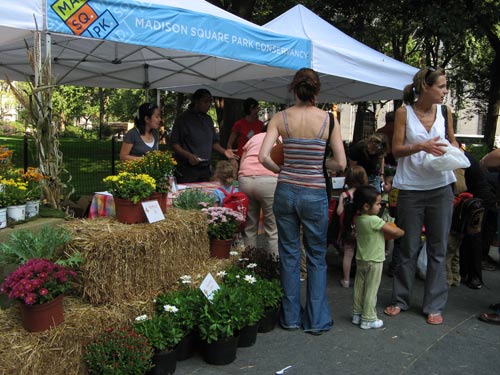
The Madison Square Park Conservancy’s annual Fall Plant Market — one of two that take place during the year — was set up on the southern plaza, near the park’s fountain, this afternoon. After our burgers, we waddled over to take a peek at the seasonal flower and plant offerings. Proceeds benefit the Conservancy.

Fall Plant Market

A group of pre-schoolers, picking out their Halloween pumpkins:

Fall Plant Market

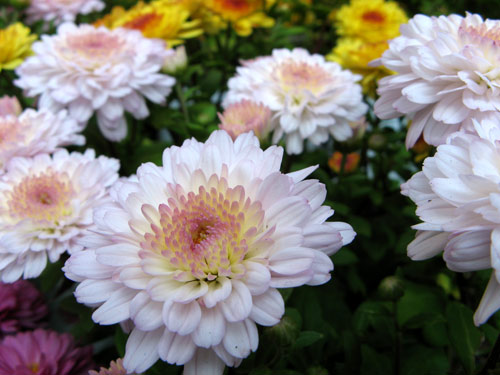
Pretty mums, if not as extravagant as the ones that will be on view at the New York Botanical Garden’s flower show beginning October 20.

Fall Plant Market

I picked up a “Bella Palm” (Chamaedorea elegans) for the office — a popular (and hopefully: hardy) houseplant, originating from the rainforests of Latin America.

Also on view in the park, daily 8AM-8PM, through October 28: “William Wegman: Around the Park“, a new 7 minute video by the artist, starring his signature Weimaraner-headed figures enjoying a fall day alongside their human counterparts, screened on four monitors near the Shake Shack.

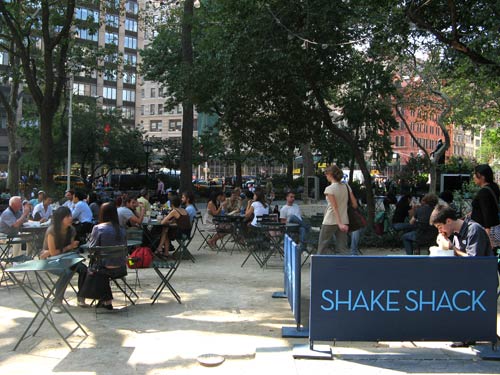
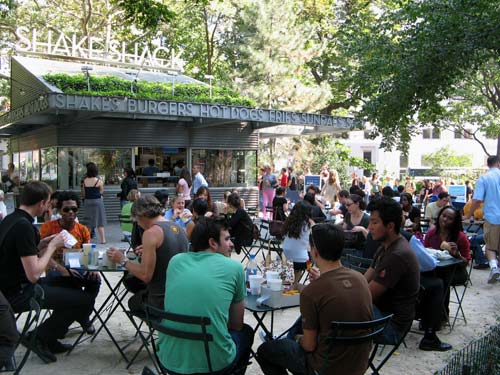
Shake Shack attack

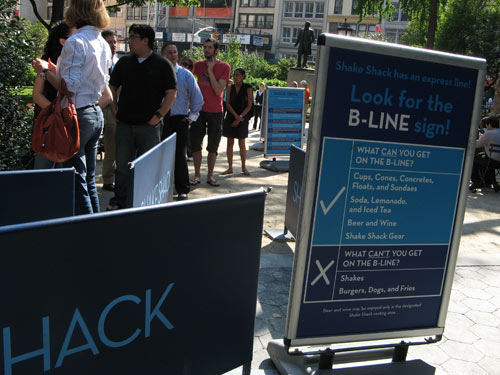
Since its highly hyped debut in July 2004, it seems that Shake Shack has been constantly in the news, making just about every best burger list in NYC (and a few around the country), so I don’t need to add anything more here about how tasty these burgers are, or how long the lines can be.

Shake Shack line

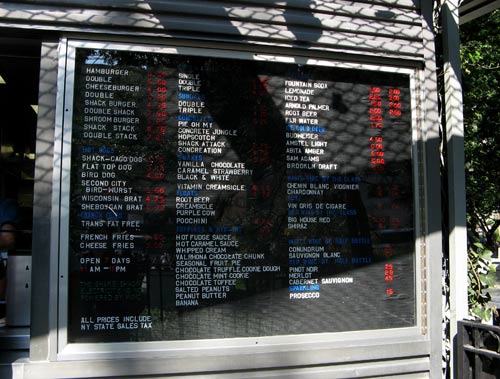
Shake Shack menu

HH had just started a new gig near Madison Square Park, and since I hadn’t ventured it in a couple of seasons, this afternoon seemed as fine a time as any to attempt a visit back to the Shack. At peak times, I’ve known the line to stretch 40-50 deep, but this afternoon, we “only” had to delay our burger gratification — from arrival to eating — by about 40 minutes. It may have been just good luck, or perhaps after three years the Shack has become so crowded, nobody goes there anymore.

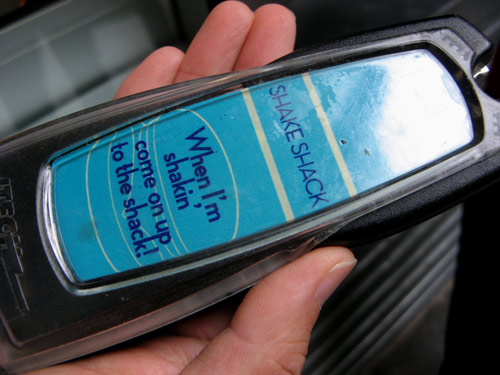
We were a day early for Shacktoberfest, so without the “special Shacktoberfest offerings” to distract, our choice was clear. We put in an order for a round of Shack burgers and fries and repaired to the picnic tables to wait. Last year, due to popular demand, the Shack installed a live ShackCam (rendering the ShackWatchers photo posting service obsolete) so that would-be visitors could monitor the order line and plan their food runs accordingly. This year, they introduced what has been dubbed the ShackWand, which buzzes to let you know when your order is ready for pick-up. Beats the old system of hovering by the window, straining to hear your number called out into the park.

Shake Shack buzzer

Shake Shack

Shake Shack

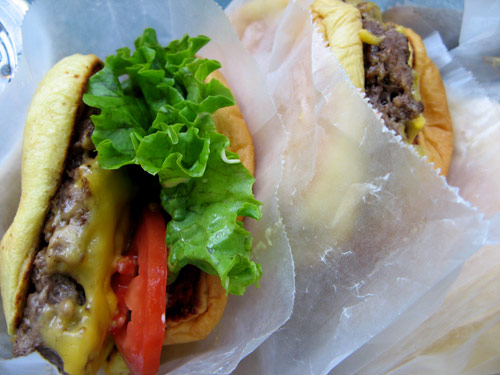
Not everyone is a fan: earlier this year, The Post‘s Steve Cuozzo snarkily deemed Shake Shack’s “the most overrated burger in New York.” Maybe, but as I sat with my friends in the warm Autumn sunshine, burger juice and special Shack sauce dribbling down my chin, I had no complaints.

Shake Shack burgers

The big cheese

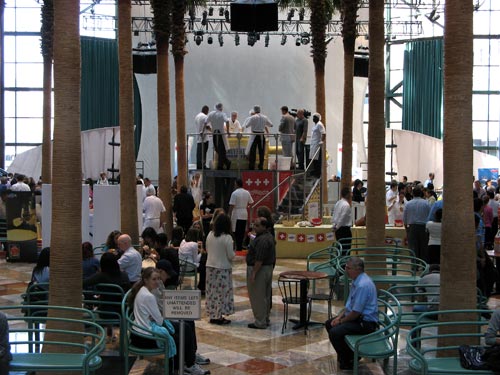
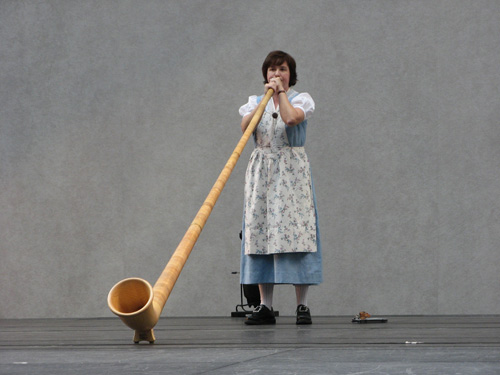
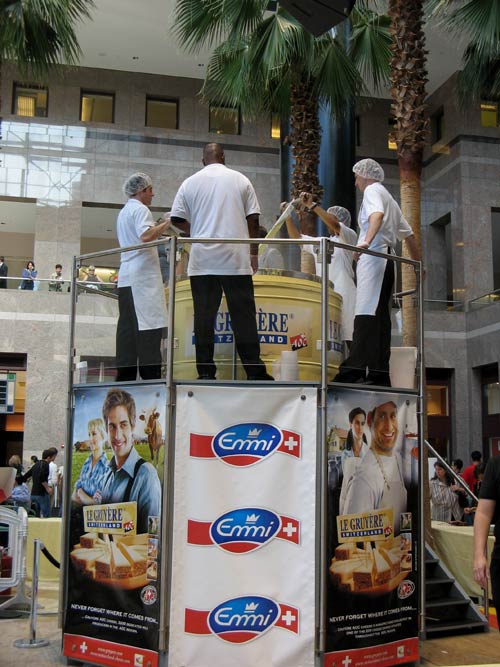
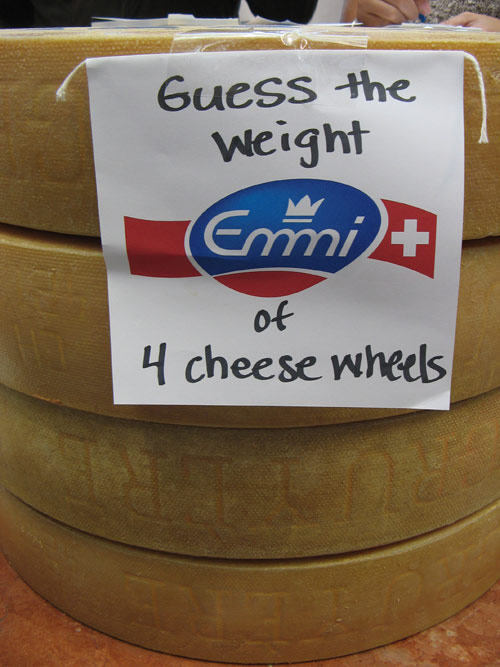
Lucerne-based dairy group Emmi took over the World Financial Center’s Winter Garden this afternoon as part of a Swiss celebration, co-sponsored by Le Gruyère AOC, Swiss Tourism, Swiss International Airlines and Gondrand. Highlights included yodelers and Alpine horn players, but the highlight of the event was the 1,300 kilo cheese fondue — the would-be record holder for the “World’s Largest Fondue… outside of Switzerland.” (Again, there is such a record?)

Why the biggest outside Switzerland, you ask? Well, because the unqualified world record for largest fondue was set in 1998 in Neuchâtel, Switzerland, and out of deference to fondue’s status as the Swiss national dish, this new American-made fondue was made to be just short of the quantity required to overtake that record.

Emmi fondue

Alpine horn blower

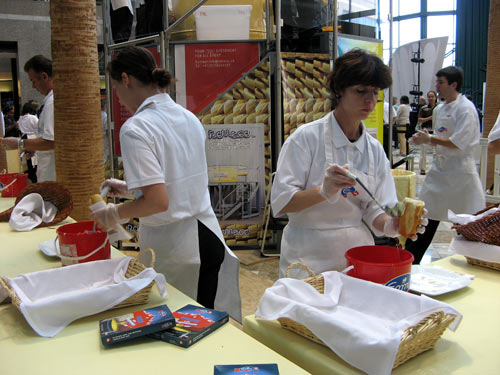
The giant “caquelon”, or traditional style Swiss fondue pot, measured 1.5 meters in diameter; in it was melted 700 kilos of approximately three dozen gruyère cheese varieties specially brought in from Switzerland, plus another 600 kilos of white wine, Kirschwasser and herbs. The mix was presided over by several hairnetted men, wielding giant paddles.

Emmi fondue

Approximately 3,000 people shared in the highly aromatic fondue, which was doled out into smaller plastic buckets, and ladled into freshly baked, hollowed out buns. Mmm, melted cheese on bread — a centuries-old, but winning combination.

Emmi fondue

Emmi cheese wheels

Preview: Check out my photos from CultureFest 2007 on flickr.