vip in the city, page 22

Marathon and meatballs

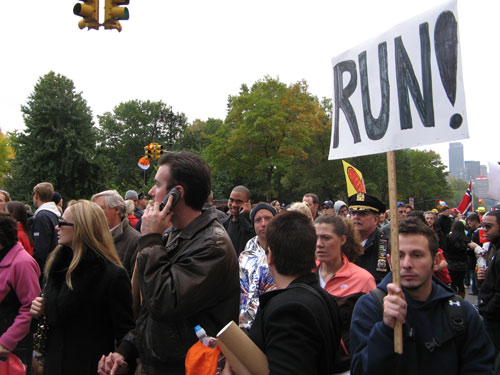
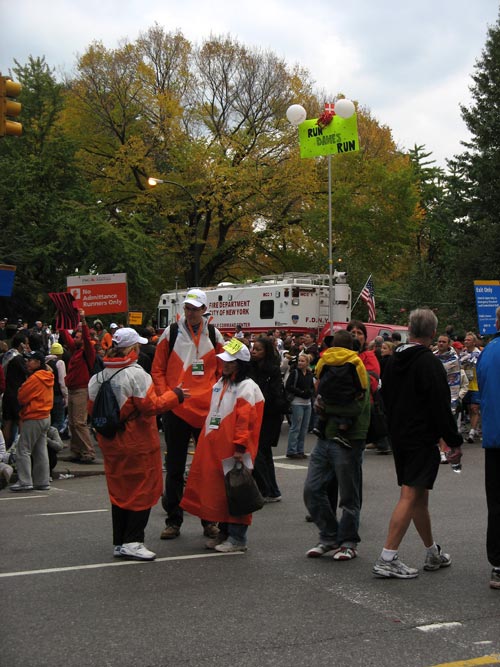
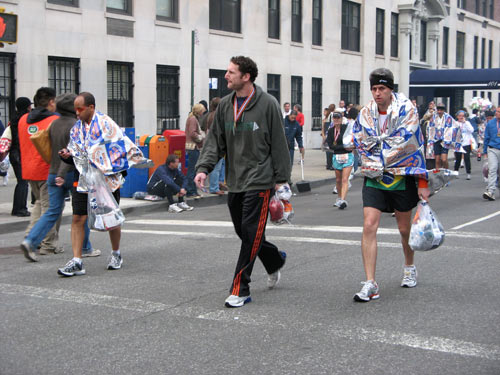
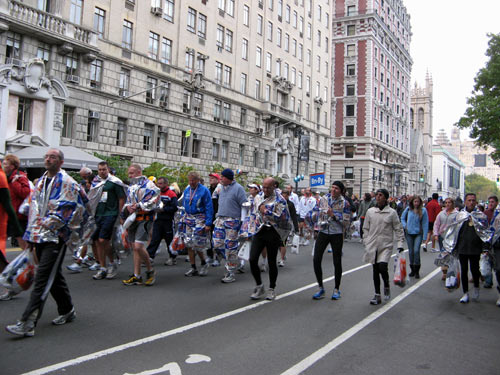
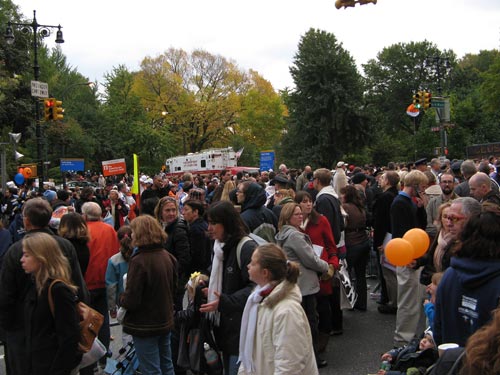
Once again, the [ING] New York City Marathon shut down the streets around my apartment. On this brisk Sunday afternoon, instead of heading into the Park to cheer on the runners, I wandered along the Central Park West reunion areas, where supporters and medaled participants were pooling, post-26.2 mile run.

By foregoing last year’s spot near the finish line, I didn’t catch any glimpses of Katie Holmes, former-Ranger Mike Richter, or Lance Armstrong, who this time out ran a consistent, progressively faster New York City Marathon, finishing in a time of 2:46:43–impressively beating his 2006 time by a margin of nearly 13 minutes.

NYC Marathon

NYC Marathon

NYC Marathon

NYC Marathon

NYC Marathon

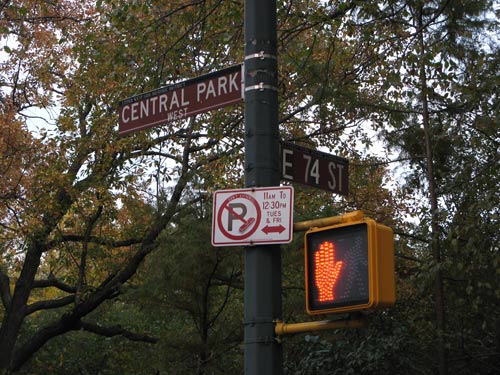
HH and I crossed paths somewhere around West 74th Street, where some prankster had posted a fake street sign, no doubt contributing to the already considerable confusion among the runners and visitors from 100+ countries.

NYC Marathon

Later that night, it was off to the Variety Boys & Girls Club of Queens for the Astoria Performing Arts Center’s production of 2001’s Pulitzer Prize winning play, Proof. After the show, our group dispatched to nearby Sac’s Place on Broadway, based upon TD’s enthusiastic recommendation. The coal-oven pizzas were as tasty as promised—the fine company enhanced the experience, surely—though there continues to be some lively debate as to which is Astoria’s best pie.

Late into the meal, when TD slipped away from the table (after first confirming that none of us was vegetarian—as if!) and returned, almost magically, with a piping hot platter of the house special meatballs… well, I don’t use the word “hero” very often, but just then, she became the greatest hero in American history.

Decompress

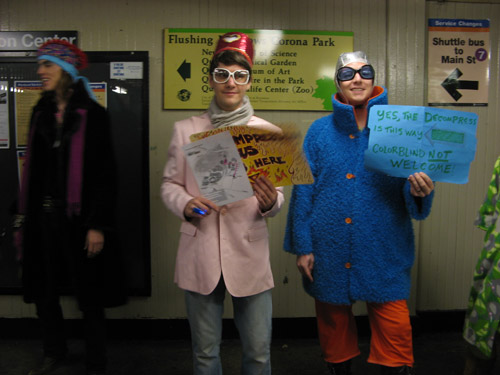
The 7 train wasn’t running all the way out to Main Street, which wreaked quite a bit of havoc on my travel plans all this weekend. As the wave of passengers spilled out in Corona where the fleet of shuttle buses were waiting on the street below, I spied a curiously costumed crew directing people to the Queens Museum of Art. I had to investigate.

Decompress

Decompress

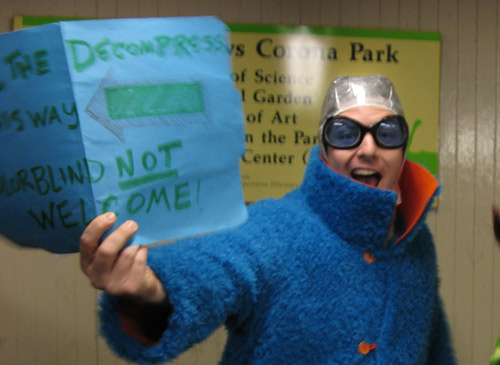
Turns out that they were members of The NYC Decom Team, promoting NYC Decompression 2007 — the city’s official Burning Man offshoot. Like that annual eight-day long art event that draws tens of thousands to a remote lake bed in the Nevada desert, the Decompression Party was intended to draw creative-types to Flushing Meadows Corona Park–a place so chosen (according to the downloadable survival guide) as “like the Black Rock Desert… a location that may deter the casually curious but pique the interest of [the] genuinely committed.”

Count me among the “casually curious” then. I snapped these photos and continued on my way.

Hog heaven

After weeks of intermittent discussions, we finally organized our group trip to Woodside, Queens for a visit to Ihawan, the self-proclaimed “home of the best barbecue in town.”
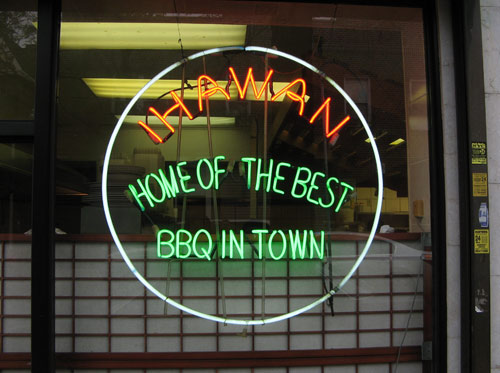
Ihawan

Located just a block east of the 69th Street stop on the 7 train, Ihawan offers a broad range of Filipino dishes, with heavy emphasis on the pig parts, for which the restaurant received the dubious distinction on the Village Voice‘s “Best of NYC” list (2000) of having the “Most Extensive Organ Meat Selection” in the city. One scan of the extensive menu and I do not doubt it.

I’d never before sampled Filipino food, which is far less widely available than other Southeast Asian cuisines–more on this when I get around to blogging the “Found In Translation” panel discussion I attended at NYU on November 13. The dishes are a mix of Chinese, Spanish, Mexican, Malay and American influences, reflecting a blend of cuisines with which the country has interacted throughout the centuries. There is a distinct preference for sour and salty flavors, and several traditional dishes still retain their foreign names, such as the perennial favorite “lechón” (Spanish for suckling pig.)

We had heard that this place is immensely popular with Filipino families, so we decided upon the off-peak time of Saturday at 3:00 PM to ensure that our group of 8 could be accommodated. The strategy worked, but only barely: almost every table in the modest, second floor dining room was filled.

In the week leading up to our visit, JL tempted us via email with hints of good things to come: as Chowhound star “bigjeff,” he waxed rhapsodic over the Avocado Con Hielo (avocado with milk and crushed ice–outrageous!), among other Filipino specialties unfamiliar to the uninitiated. That afternoon, we left the ordering in his and and fellow regular RL’s capable hands. Vegetarians not welcome.

Naturally, we kicked things off with Ihawan’s specialty barbecue: a couple of bamboo sticks of smoky, slightly charred, flat-cut pork, glazed in a sweet sauce. Also a couple orders of their “weekend special” Lumpiang Sariwa–a pair of light flour crepes rolled with assorted vegetables and topped with a crunchy peanut sauce. For contrast, we added an order of the fried version as well: the Lumpiang Shanghai–a dozen crunchy (i.e., deep fried) pieces of finger-sized wrapped rolls filled with minced pork and shrimp.
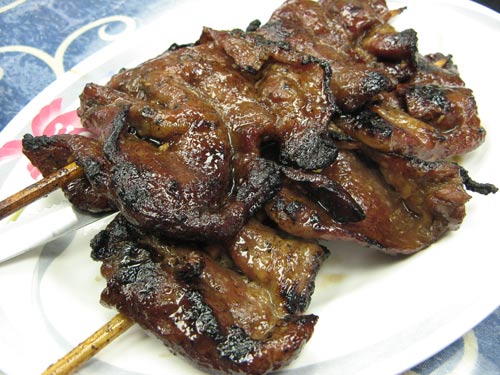
Pork BBQ

From there, it was back on to the meat, and combinations of deep fried–sometimes unidentifiable–organs. Plates of hot, fragrant food began to hit the table at a dizzying pace.

Chicharon Bulaklak–a tasty delicacy described on the menu as “deep fried crispy ruffle fat.” What is ruffle fat, you may ask? I didn’t know it at the time, but it’s the incongruously dainty name for the part of the pig known as the greater omentum: a thin fat-filled membranous sac that hangs down from the stomach, over the top of the small intestine. (Hey, the descriptions can only improve from here.)
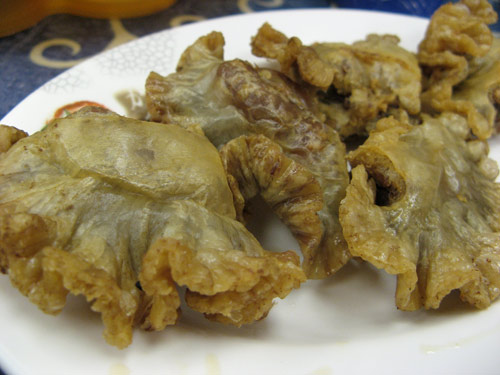
Chicharon Bulaklak

Lechón Kawali–deep fried crispy pork, served with a small bowl of vinegary liver sauce… which perhaps sounds vaguely heinous, but is actually rather good. So good that SC reserved one final, fatty bite next to her plate, for post-dessert. (Hmm, what’s that tingling sensation running down my left arm?)
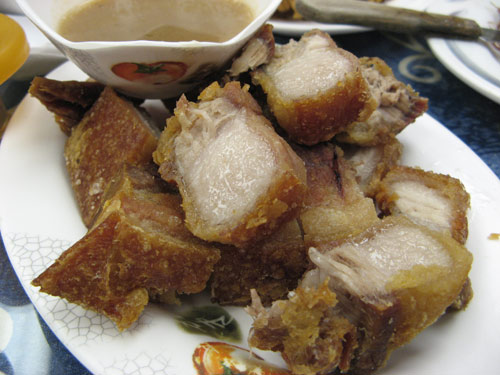
Lechon Kawali

The pièce de résistance: Crispy Pata–deep fried pork knuckles. This incarnation of crunchy, gooey fried goodness–plates of which appeared before almost every group of diners–was accompanied by a chili vinegar to help cut through some of the fat. I find it hard to believe, though, that anything short of an angioplasty would be effective in that regard. But at least the pig feet keep you young-looking.
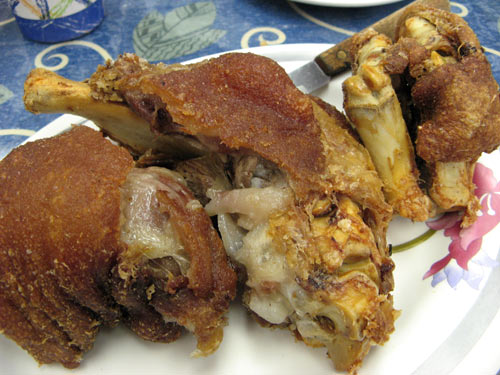
Crispy pata

The rest of the spread: Inihaw Na Langonisa (grilled pork sausage), Pansit Bihon (sauteed rice noodles with shrimp, chicken, chinese sausage and vegetables), Kare-Kare (oxtail, tripe, eggplant and bok choy stew stewed in a thick peanut sauce), fan favorite Dinuguan (pork stewed in pork blood gravy, sometimes known by the Westernized euphemism “chocolate meat“)… There may have been more, but after a while, as the blood chugged laboriously through my veins, I lost track.
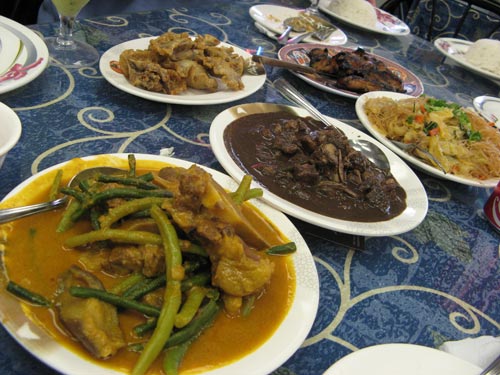
Ihawan spread

And yet, there’s always room for dessert. Here, the Halo-Halo (mixed tropical fruits, red & white beans with crushed ice and milk), topped with a delicate chunk of flan.
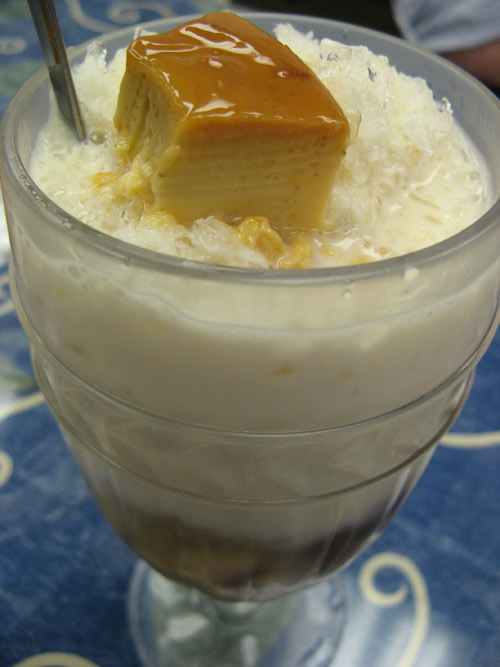
Halo-Halo

I regret that I had but one stomach to devote to this cause.
Music for the Masses

WFMU — “woof-moo” — is the famously eclectic, listener-supported, freeform radio station broadcasting throughout New York City and Metro New Jersey at 91.1FM, 90.1 FM in the Lower Catskills, Hudson Valley, Western New Jersey, and Eastern Pennsylvania. Along with its traditional radio broadcast — four times named the best in the nation by Rolling Stone — WFMU also broadcasts live over the internet.

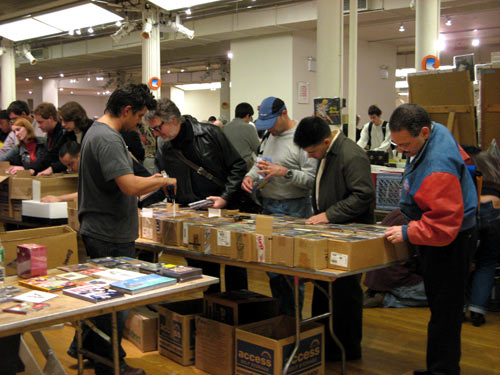
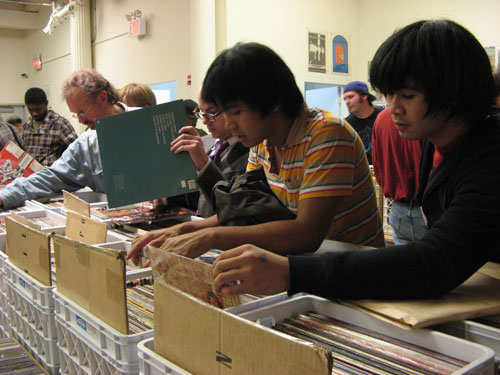
The WFMU Record and CD Fair is the station’s biggest and most-anticipated event. Twice a year, the Metropolitan Pavilion in Chelsea hosts the fundraiser: three days of buying, selling, and trading CDs and vinyl, with all door proceeds going to benefit the independent station. Very different from the last time I was here for a shopping event. It’s quite a scene, actually: as much a party as it is a sale. Over 200 dealers from around the world set up long tables stacked with every genre of music imaginable… and several I’d never even heard of. Gabber? Illbient?

I’d never really thought of music shopping as a gender-specific endeavor, but the clientele this night was strikingly male-dominated. The food offerings reflected that: beer and pizza only. In one corner, Two Boots Pizza had set up a makeshift stand, with some admittedly dreary-looking reheated pizza, which nonetheless sold out before the night was half over. (I held out for basil beef at Pongsri Thai.)

Those “desperate collectors” eager to get first crack at the stock of the weekend-long sale could pay $20 for access during the first three hours; we paid $6 to browse with the rest of the masses after work on Friday.

WFMU sale

WFMU sale

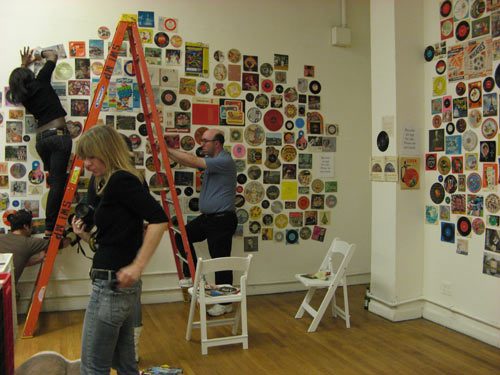
WFMU records

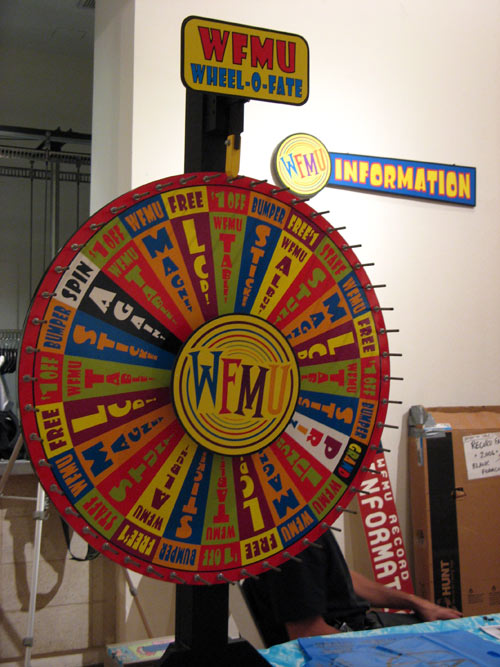
The WFMU Wheel-o-Fate — $1 a spin for a chance at fabulous prizes:

WFMU wheel

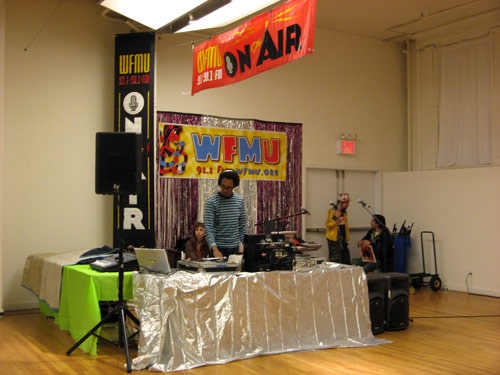
Puerto Rican rapper Tego Calderón‘s DJ set.

WFMU broadcast

We spent the next couple of hours happily sifting through milkcrates and cardboard boxes crammed with music, old and new, familiar and obscure. There was a time when I would wile away hours just like this. Not in years, though. In the age of iTunes are gatherings like these destined for obsolescence?

Outside in

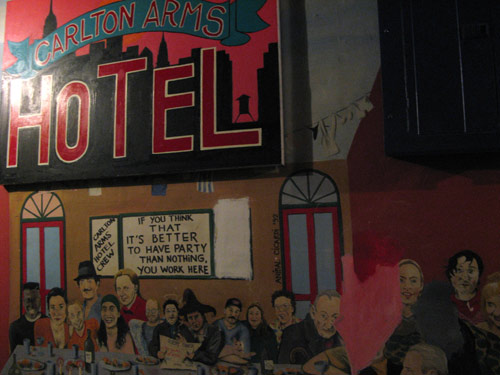
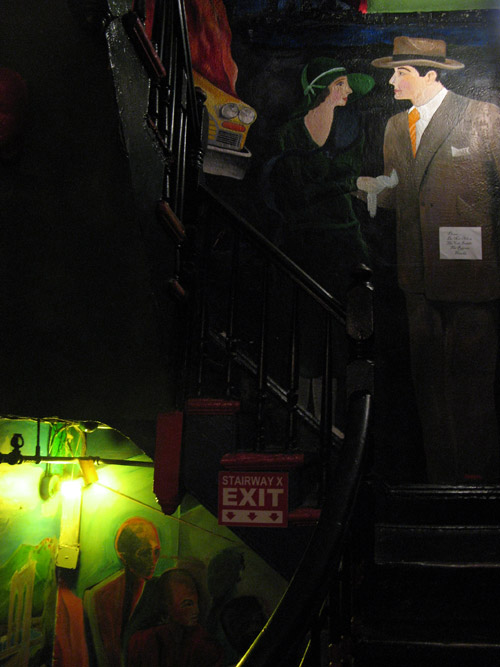
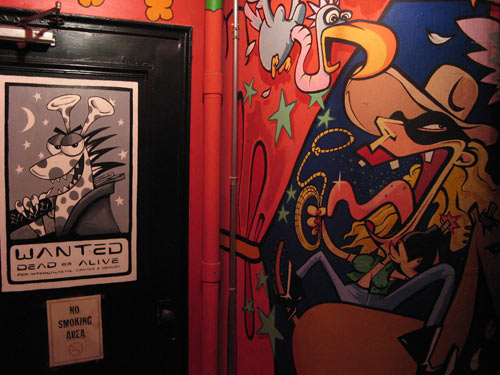
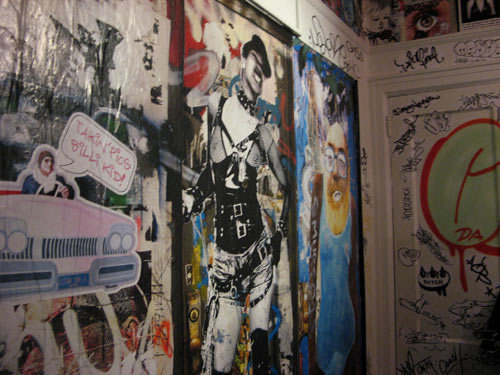
Ye Olde Carlton Arms Hotel on East 25th Street near Third Avenue started as an art project among a group of creative people in the 1980s. The then-new manager Ed Ryan had taken over the former flophouse and hired several of his artist friends to work the front desk; over time, they each began adding their own personal touches to the hotel walls and rooms, and eventually, the idea was born to transform the entire hotel. Dozens of artists from all over the world came to contribute. After Ryan retired in 1998, John Ogren and Ty Inwood took over the Carlton Arms and kept the art project and the budget hotel going. (Room start at $80/night for a single with shared bath.) Today, almost every square inch of the 19th century building interior has been painted or decorated by artists that came from all over the world: all of the 54 rooms, hallways, bathrooms and staircases.

Carlton Arms Hotel

Carlton Arms Hotel

Carlton Arms Hotel

Depending on your perspective, it’s either really fun, or really freaky–as if the old St. Mark’s Place exploded indoors… but without the crack vials and urine stench. Certainly not like any hotel I’ve ever seen or stayed in. And definitely “not for the fainthearted or the humor-free.”

Carlton Arms Hotel

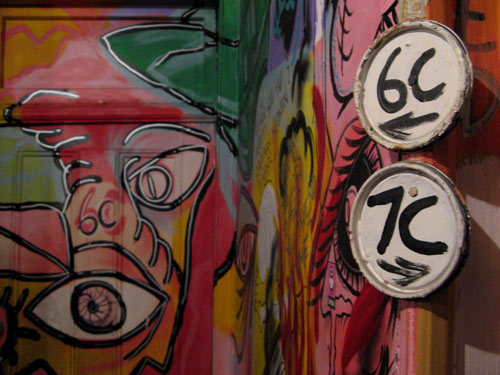
As part of the ongoing commitment to the art, the hotel hired prominent street artist, Billi Kid–along with graffiti artist CERN, photographer Allan Ludwig, published authors-photographers James and Karla Murray, and Carlton Arms veteran Julie Dermansky–to decorate Room 10C completely in graffiti art, dubbing it the “Outside In” room. The results were unveiled at a walk-through reception on November 1.

Carlton Arms Hotel

We passed on the proffered wine; the environs were trippy enough without the introduction of alcohol. Although the highlight of the evening was the special graffiti room on the third floor, attendees were invited to tour all of the hotel’s public spaces and unoccupied rooms, each decorated in their own unique style. Some guests toted around Sharpie pens to mark their visit at the hotel; we caught one guy tagging the fire extinguisher in the hallway, with the management’s apparent blessing. By which I mean that nobody cared enough to stop him.

Check out the rest of the madness on my flickr photo set.

Fuerzabruta

Fuerzabruta, the new original work from the Argentine creators of De La Guarda, has made it to New York City after successful runs in Europe and South America. Originally slated to run until February 18, the show has been extended through June 29, 2008.

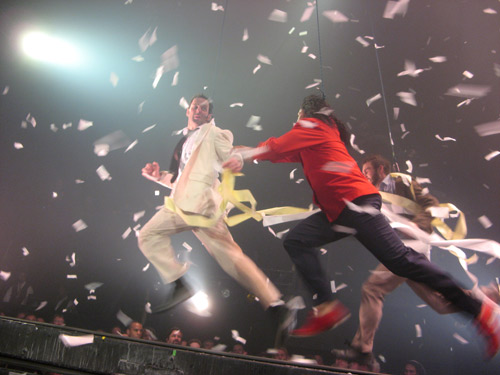
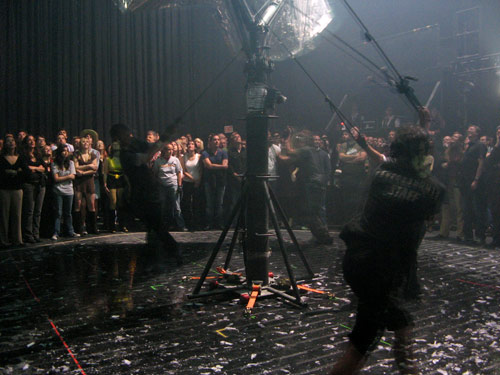
Like its high-flying predecessor, this show has no real narrative; rather, it’s a series of set pieces, backed by thumping loud music, flashing lights, moving sets, and quite of bit of audience participation. Over 65 minutes (no intermission), the audience was led through various dance/acrobatic performances that were unconventional, sometimes sexy, sometimes a little violent. Hence: “brute force.” Assorted crew members herded us around the Daryl Roth Theatre into standing positions from which we could watch the scenes unfold from different perspectives.

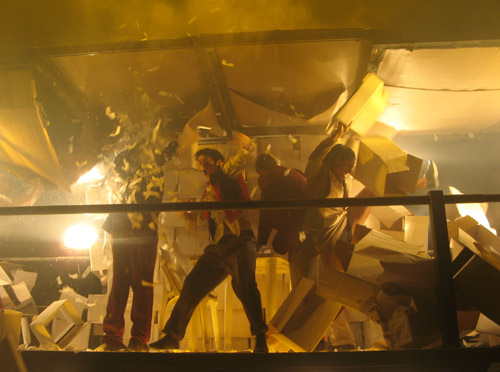
To open the show, a long treadmill was rolled out into the center of the theater, parting the audience. Tethered actors walked and then ran along the rapidly moving belt, dodging moving objects, and smashing through cardboard walls. Paper everywhere!

Fuerzabruta

The somewhat cranky New York Times reviewer likened one segment, for which we were screened in as a pair of women suspended on wires raced over a foil curtain, to “being inside a giant Jiffy Pop.

Fuerzabruta

Another scene featured a man and a woman flying through the air, trying to connect, but separated by a large, rotating silver sail, as the entire contraption was manipulated with cables by a trio on the floor. Groups of actors danced with wild abandon on stage and then among the audience, as sheets of pressed-powdery material crashed over heads, scattering white clouds through the space.

Fuerzabruta

Fuerzabruta

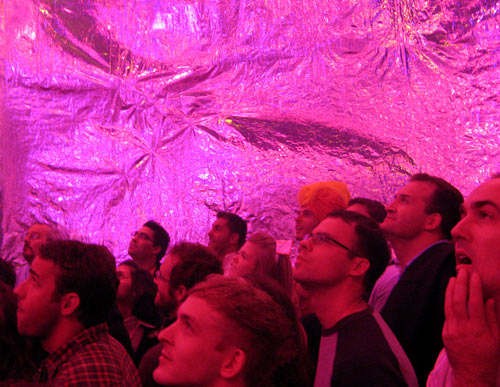
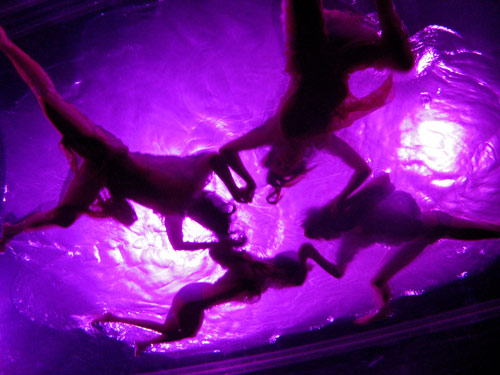
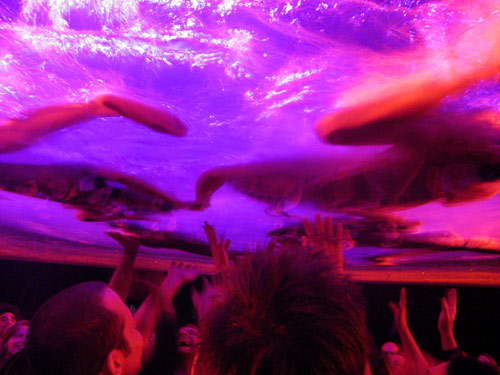
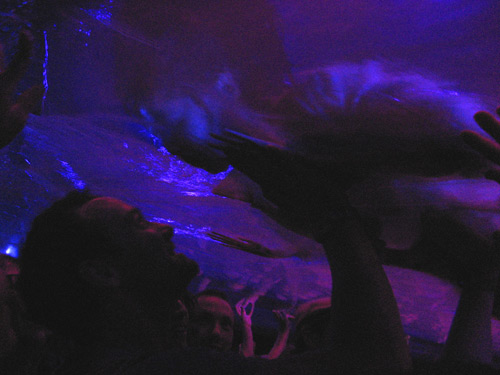
The highlight of the show was the much reported upon segment where the stage floor was set directly above the audience. With heads craned back, our view was through an immense clear-bottomed swimming pool filled with shallow water, raised high and then gradually dropped from the ceiling to within arm’s reach (and kissing distance) of the audience. A bevy of scantily-clad female performers stood, rolled, cavorted, belly-flopped and flirted through the Mylar; I cringed with each thwack, half expecting the thin material to give way, but apparently, it’s stronger than it looks. Their languid movements created mini-waves rippling across the surface overhead. The overall effect was quite remarkable, and it were these scenes which remained most vivid in my mind: the effect of the colored lights reflected through the water, and the sight of wet bodies pressed within millimeter’s reach, yet ultimately untouchable.

Fuerzabruta

Fuerzabruta

Fuerzabruta

You can watch videos on the main Fuerzabruta site; both The New York Times and New York magazine websites have posted gorgeous slideshows of the action. For an amateur eye’s view, check out my flickr set.

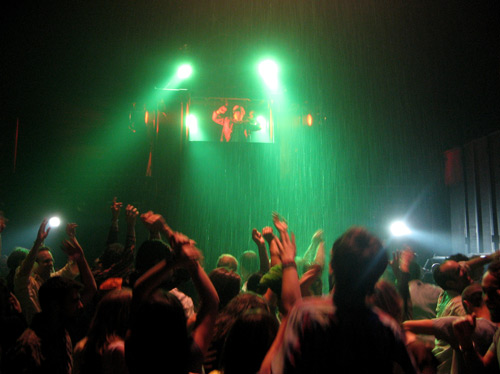
To close out the evening, a DJ in a barrister wig rallied the audience into a dancing frenzy as water poured down from the sprinklers overhead. At Fuerzabruta, you’ll emerge coated in white powder, almost certainly sprayed with water, and possibly covered in debris. But just go with it. Later that night, as I prepared for bed, I noticed the small trail of confetti that I had left on my way to the bathtub and just had to smile.

Fuerzabruta

Trinity trick-or-treating

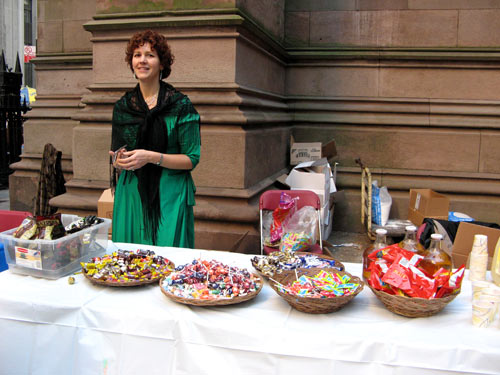
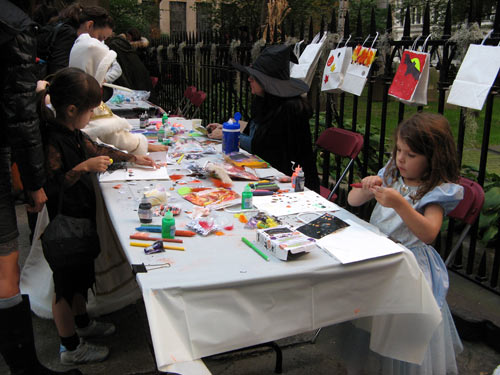
At Trinity Church Wall Street for the Halloween celebration of “Ghouls, Games and Graves.” From 4PM onwards, the North Churchyard — the oldest surviving churchyard in the city, with stones dating to the early 18th century — hosted a series of family-friendly events. Adorably costumed kids (and their guardians) were out in full force this mild late afternoon for treats, games, crafts, and face-painting. The “ghost” of Alexander Hamilton (buried here at Trinity; Aaron Burr is safely entombed across the river in Princeton Cemetery) roamed among the guests telling stories of New York’s past.

Trinity Halloween

Trinity Halloween

Trinity Halloween

Trinity Halloween

Had I stayed on past dark, I could have attended Trinity Church’s screening of the 1922 silent vampire classic Nosferatu — the earliest surviving screen adaptation of Bram Stoker’s Dracula. Adding to the spooky ambiance, in place of dialogue, the film was to be accompanied by Cameron Carpenter on the church’s state-of-the-art electronic organ, which was installed in 2003 to replace the Aeolian-Skinner damaged on September 11, 2001. (The controversial “virtual pipe organ” uses digital samples of actual pipe organ timbres, sent through speakers hidden behind dummy pipes.)

Watch Carpenter perform his own arrangement of John Williams’s Raiders of the Lost Ark  theme on the Trinity organ.

Ricky's Halloween

Halloween is the one night a year when girls can dress like a total slut and no other girls can say anything about it.
— Cady Heron (Lindsay Lohan), Mean Girls

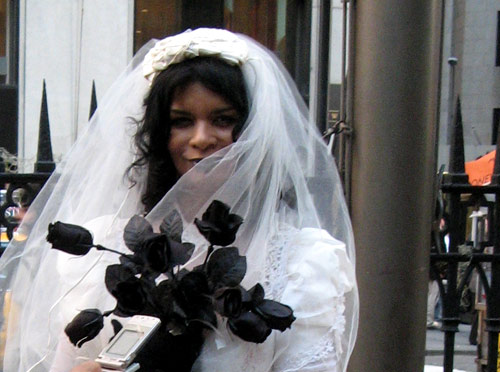
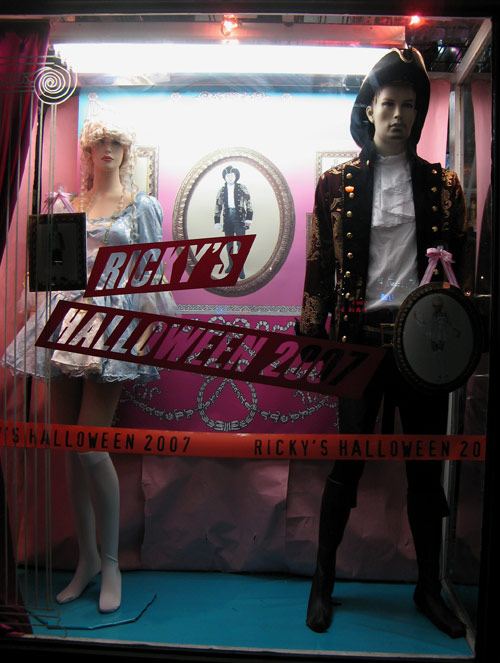
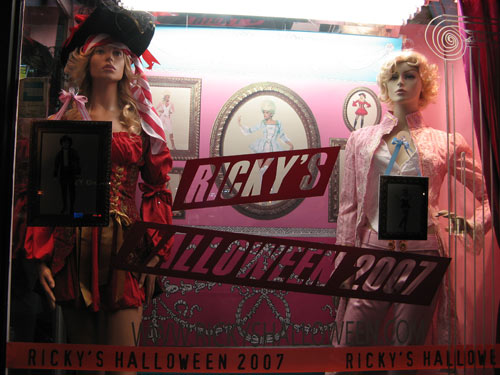
Ricky’s NYC beauty shop–36 locations and growing!–carries an impressive line of cosmetics and hair care products, but they are perhaps best known as one of the city’s prime sources for body glitter, temporary tattoos, wigs, and uh… let’s just say “novelties.” The days leading up to Halloween are the chain’s busiest, and tonight on the way home from my weekly CSA pick-up, I passed the Upper West Side store to find it packed with last minute costume shoppers scouring the aisles to a pounding dance music soundtrack.

If Ricky’s is the “paramount venue to discover your inner drag queen,” then judging from the store and window displays around town, October 31 is apparently the paramount day for every girl to discover her inner vixen. When did Halloween costumes become so aggressively sexy?

Ricky’s Halloween

Ricky’s Halloween

Increasingly, what passes for women’s “costumes” seem to fit the mold of headgear + exposed undergarments and/or skimpy skirt. (And it’s not just the case for big girls either. “Major Flirt Child“? French Maid Child“?! So. Wrong.) A cat becomes a sexy cat. A devil becomes a red, hot devil. Goldilocks is naughty Goldilocks. And Wonder Woman… well, I guess that one’s pretty much the same, but you get the idea.

At least Wonder Woman gets to wear a cape sometimes.

The Rest is Noise

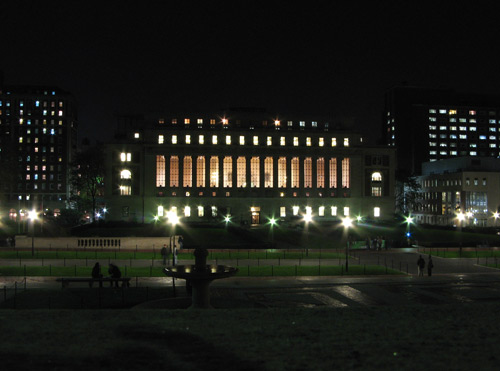
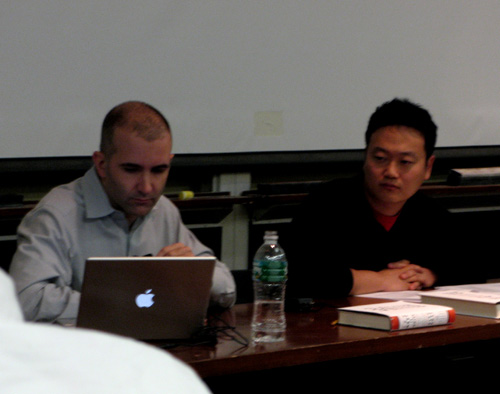
I always feel a little nostalgic being back on campus, and this night, seated at a desk inside 501 Schermerhorn, I could not help but be reminded of lectures past. Tonight, though, I was here to sit in on an interview with Alex Ross, the classical music critic of the The New Yorker, whose long-anticipated history of music in the twentieth-century was released on October 16. The talk was led by Casper Mao, founding member of The Blue Notebooks, a student-run group presenting interviews with leading writers, artists, and intellectuals at Columbia University.

The Rest Is Noise: Listening to the Twentieth Century addresses the basic question of why when works of Picasso and Pollock are mass-printed on posters, and lines from T. S. Eliot and Robert Frost are known to teenagers across the county, is twentieth-century classical music still considered elite, obscure and inaccessible? Yet despite these seemingly widespread attitudes, classical music seems to have experienced a resurgence in recent years. The United States now has 125 opera companies — more than opera-loving Germany or Italy — whereas fifty years ago there were only a handful. Roughly as many Americans attend live opera performances as attend NFL football games. The reports of the death of classical music, to paraphrase Mark Twain, are greatly exaggerated.

Columbia University

Ross is an engaging writer, and The Rest Is Noise (first chapter here) is his attempt at a whirlwind tour of the last century’s composers and major musical developments. Among the organizing principles is to place music in a wider cultural and political context: not just the (in)famous incidents like the scandals over Arnold Schoenberg‘s atonal works or the riots reacting to the visceral rhythms of Igor Stravinsky’s “The Rite of Spring,” but also for example, Dmitri Shostakovich’s consultations with Joseph Stalin, the inflection of Aaron Copland‘s music by the fashionable communism of New Deal America, and Richard Strauss’s work under the spell of Hitlerian aesthetics. Steve Reich and Philip Glass’s minimalist compositions were inspired by the freestyle independence of jazz and early rock and roll, which in turn later influenced acts like David Bowie, The Velvet Underground and Aphex Twin.

Alex Ross

Ross is one of my favorite music critics, and in person as in his writing, he is wittily informative without being judgmental or pedantic. (Above, cuing the severe, brooding bass and cello opening of Jean Sibelius’ Symphony No. 4 to challenge musicology’s general dismissal of the composer as a traditionalist among his “modern” contemporaries.) Ross’s ambitious undertaking has received generally excellent reviews. How can you not like a guy who displays such an unabashed affinity for Björk (she even blurbed his book; Ross met the Icelandic singer-songwriter in 2004), and has championed the likes of Radiohead and 1990s indie rock band Pavement? Plus how many people can effectively work in a “Beavis and Butt-Head” reference when writing about rock chord progression and Jonny Greenwood’s slashing guitar?

Radiohead have stopped playing “Creep,” more or less, but it still hits home when it comes on the radio. When Beavis of “Beavis and Butt-head” heard the noisy part, he said, “Rock!” But why, he wondered, didn’t the song rock from beginning to end? “If they didn’t have, like, a part of the song that sucked, then, it’s like, the other part wouldn’t be as cool,” Butt-head explained.

I could not have said it better myself.

Where there's smoke...

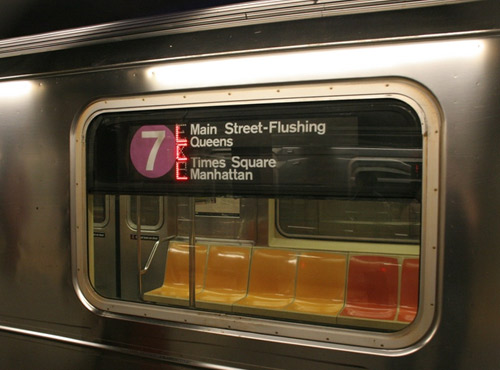
On the way out to Sunnyside Gardens this evening, I noticed these new LED displays on the 7 train. The purple circle and diamond symbols were never very effective in distinguishing between train routes; certainly these new signs are a vast (and long overdue) improvement over the old system of popping your head into a subway car ­– careful to avoid the guillotine action of the closing doors — and yelling “Express or Local?” only to be met with stony stares or indecipherable grumbles. “Lxprzl”?

7 signage

Out on RM’s patio, SYB and I were tasked with starting a fire for the barbecue. Even armed with a box full of matches, the autumn winds posed quite a challenge. It’s situations like these when I think that Girl Scouts training would have been far more useful than piano and violin lessons. We finally managed to get things going after several false starts; the orange flames (and copious wine) provided wonderful warmth against the chilly falling darkness.

Our gracious host brought out a tray of chicken burgers from The Butcher Block, a popular local Irish delicatessen which in 2004 reopened in a new location after its original long-held spot across the street was virtually destroyed the year before in a major fire along Queens Boulevard. I’ll admit that I’m generally not a huge fan of chicken burgers — beef being my usual patty preference — but these were quite good: more like chicken sausage patties. We rounded out the eats with grilled steak and (not grilled) couscous, and over our new friend TD‘s Astoria cherry pie, the talk turned to matters like the rivalries among NYC specialized high schools. Riveting for the non-NYC natives, I’m sure, but when it came out that there were two Science alums in the house, what could we do? As we watched the Sunnyside kindling-fed fires slowly die down to embers in the cold moonlight, I wished I had thought to bring supplies for s’mores — pretty much the only situation in which I prefer Hershey’s milk chocolate bars. Next time.

I had no idea how insidiously the soot had permeated my pores and clothing until on the way home when I was caught in one of those dreaded “sick passenger” delays at Times Square. As more commuters piled into the already crowded subway car, the woman behind me, whose nose was probably no more than three inches from my hair, asked her friend in an alarmed tone, “Do you smell smoke?” I cringed inwardly as I heard the two of them sniffing the air behind my head frantically for the next few seconds, until one muttered a revelatory “Oh.” I sensed, rather than saw, her gesture toward smokey me in disgust.