vip in the city, page 21

Found in Translation

JL (who knows all about such things) had alerted us to this food event taking place at NYU’s Cantor Film Center tonight: Found In Translation: An Exploration Of How Asian Cuisines Become Part Of The American Culinary Landscape. The evening was billed as an examination of three Asian cuisines (Chinese, Indian, Filipino) and how they each have been “translated” into mainstream American culture. The sell-out event was co-sponsored by the university’s Asian/Pacific/American Institute and the James Beard Foundation, with support from the Food & Wine program at NYU’s School of Continuing and Professional Studies, the Black Culinarian Alliance and the Museum of Chinese in the Americas.

After a brief introduction by author and A/P/A Institute founding director John Kuo Wei Tchen, each of the three panelists gave a 15-20 minute presentation on her respective cuisine of expertise, ordered more or less from the most assimilated (Chinese) to the least (Filipino). Grace Young, author of The Breath of a Wok and The Wisdom of the Chinese Kitchen, gave a brief history of Chinese food in America, a subject no doubt of considerable interest to fellow HCHS alum Jennifer 8. Lee, who sat tapping away on her keyboard behind us, and whose book on a related subject is due out in March, 2008.

Next up: Maya Kaimal [Macmillan], author of Curried Favors: Family Recipes from South India. Kaimal focused her presentation on how the majority of Indian restaurant offerings do not reflect Indian home cooking, and how despite a trend towards increasing sophistication, most menus continue to be rather limited in their regional representations. My impressions of Kaimal’s talk were marred somewhat by the blatant shilling of her eponymous line of jarred chutneys, pastes, glazes and sauces — available at Williams-Sonoma stores near you!

Rounding out the group: Amy Besa, owner of Cendrillon, a Filipino restaurant on Mercer Street, and co-author of Memories of Philippine Kitchens. Throughout the evening it was suggested that the cuisine of the 7100-island archipelago is poised to become the next Asian food to be “discovered.” Most of this self-selecting crowd, though, seemed already quite familiar with the unique joys of Sinigang, Adobo and Kare-Kare. (I was definitely among the novices, having only just made it out to Ihawan for the first time a few weeks ago.)
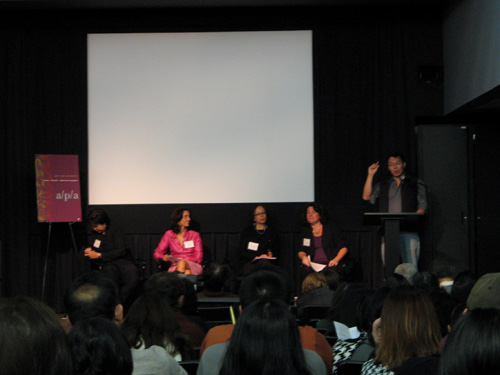
A/P/A panel

Afterwards, there was a brief panel discussion and a Q&A, moderated by food writer and personality Kathy Gunst. We slipped out after one particularly insufferable question from the audience. You know the type: a “question” that doesn’t seek actual information, but is rather a prelude to some overlong commentary whose sole purpose is to show off how very much the “asker” knows. Ugh. We exchanged a few eye rolls amongst ourselves, and telepathically communicated our mutual willingness to skip the post-event nibbles in favor of some heartier fare.
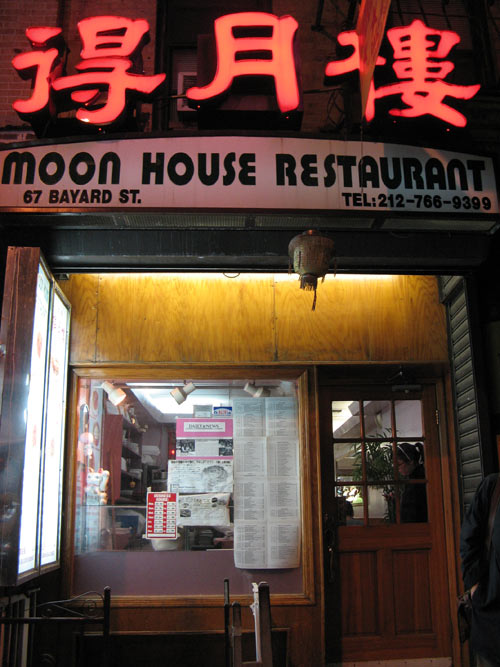
Moon House

After such a build-up, where else would we go but Chinatown? JL had suggested dinner at Moon House on Bayard, a restaurant I’d yet to hit despite near weekly visits to the neighborhood. Once again, we were happy to hand over the ordering reins to his capable hands. Despite the notable lack of green on the table — prompting an amused comment from our waitress — JL did a stellar job hooking us up with a rich representation of Shanghai specialties.

Fried Tiny Buns (Sheng Jian Bao) — similar to the soup-filled Pork Steamed Buns (Xiao Long Bao), a tray of which we also ordered, but with a doughy, pan-fried outer skin:
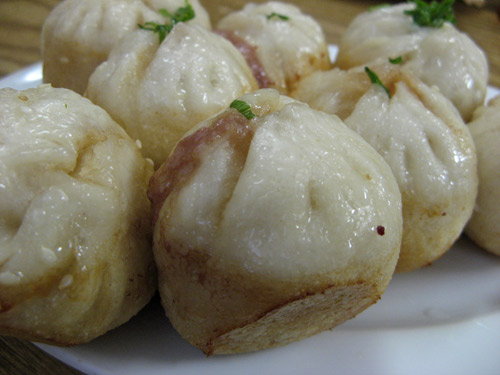
Moon House bao

… a wonderfully flavorful Salty Pork with Bamboo Shoot soup, somewhat misleadingly listed on the menu as a “casserole.” (Those are tofu skin knots breaking the surface.):
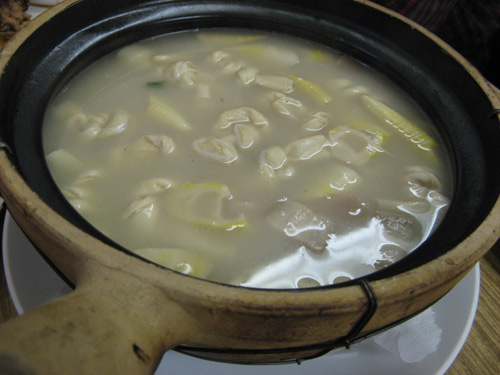
Moon House soup

… a Lion’s Head — so named for the plated appearance of these oversized pork meatballs ringed with a “mane” of braised bok choy:
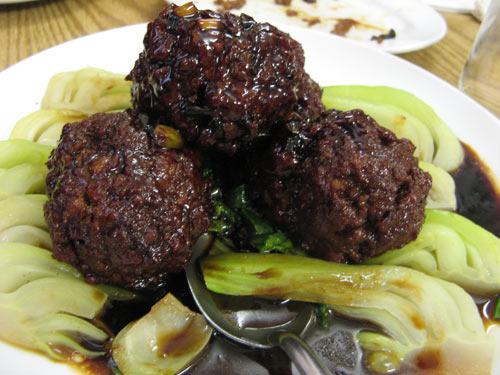
Moon House lion’s head

… and a plate of Fresh Bacon with Preserved Vegetable — meltingly tender (read: fatty) and sweet:
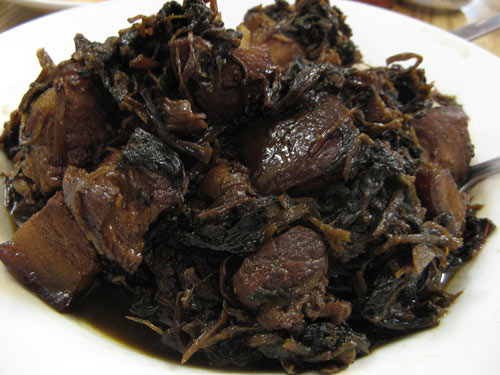
Moon House pork belly

Is it any wonder that despite a tempting post-meal visit to the Chinatown Ice Cream Factory next door — accept no substitutes! – I could not eat another bite?
Broadway Sings the Phone Book

Broadway stagehands went on strike over the weekend, effectively shuttering 27 Broadway shows, and crippling a $939 million local industry. 8 shows playing in theaters that have separate contracts with the union remained open, including The Ritz — playing at Studio 54, where tonight’s event was scheduled. (The strike would last 19 days, and cost the city some $38 million in lost revenue.)

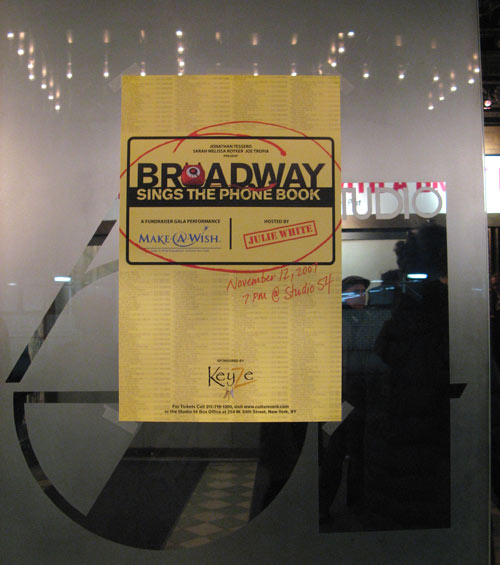
Broadway Sings the Phone Book” was created by a trio of young producers (Sarah Melissa Rotker, Joe Tropia and Jonathan Tessero), inspired by the sentiment that fans would be willing to listen to their favorite stars “sing the phone book.” The gala concert was sponsored by the KeyZe Company and organized as a fundraiser for the Metro New York Chapter of the The Make-A-Wish Foundation. Since its founding in 1983, the Metro New York chapter has granted nearly 7,000 wishes; in 2007, the organization granted 481 wishes for local children, and facilitated 238 wish assists for children from Make-A-Wish chapters around the world whose wishes involved travel to New York City.

Studio 54

Julie White emceed the festivities. The actress is best known to television audiences for her supporting role as Nadine, the quirky neighbor on ABC’s mid-90s sitcom Grace Under Fire, and was last seen on stage in The Little Dog Laughed for which she won the 2007 Tony Award. I didn’t see White in either of those roles, though I did catch her turn as the mom in this summer’s Transformers movie — Autobots, roll out!

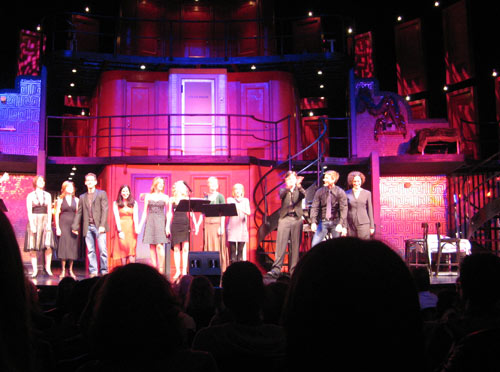
Tonight’s line-up included Avenue Q’s Stephanie D’Abruzzo, Sunset Boulevard’s Alan Campbell, The Drowsy Chaperone’s Mara Davi, Grey Gardens’s Erin Davie, The Threepenny Opera‘s Brian Charles Rooney and Brooke Sunny Moriber, and two eliminated contestants from television’s Grease: You’re the One That I Want! : Austin Miller and Kate Rockwell.

Broadway Sings cast

The cast of Broadway stars (and would-be stars) sang familiar songs… with the lyrics replaced either Mad Lib style (the word game, not the DJ/producer) or with the contents of pages ripped randomly from a phone book or dictionary. Performers were given the option of experimenting, or delivering their selections straight; most chose to embrace the challenge of spontaneity, to varying levels of success and hilarity. Hence: “Suddenly Sanchez.” “There’s a Fine, Fine Line” (one of my favorite songs from Avenue Q) became “There’s a Hot, Hairy Line.” And “Maria” from West Side Story segued into a listing of Marias in the Manhattan phone book (names and addresses only).

Maria.  Say it loud, and ten thousand Marias will answer.”

Candy everybody wants

Veterans Day was one day earlier, but my office was observing the holiday today, which gave me another reprieve on a day when almost everyone else I knew had to work. My afternoon of leisure consisted of a vegan lunch at NoLIta’s Wild Ginger followed by a visit to the new Papabubble shop to watch the pretty candies being made.

Once we entered the rather plain storefront on Broome, we were enveloped by a wonderful smell: that steam-cooked mixture of corn syrup and sugar. Inside the shop had the appearance of a sleek candy laboratory: all white subway tiles, brushed metal counters and beakers of colored oils.

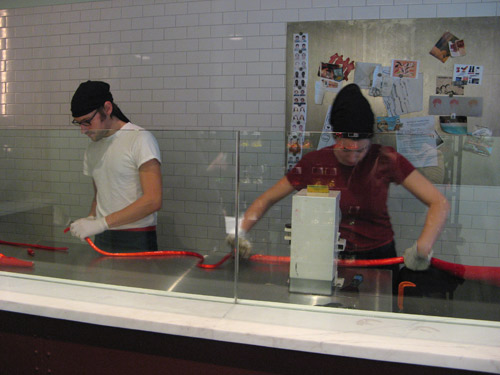
Papabubble was empty this afternoon but for us and three employees: one cashier, and two candy makers who were hard at work, pulling and shaping large, malleable blocks of sugar. As the pair moved quickly in tandem to run the candy through the extruder, the woman looked up from her work. No doubt sensing our fascination through the plexiglass barrier, she asked if we’d like to sample some fresh candy. Would we?! She obligingly cut off a couple pieces from the end with a pair of scissors, and I popped the warm, chewy, cherry-flavored piece into my mouth. Holy moly, what do they put in these things… crack cocaine?

Papabubble

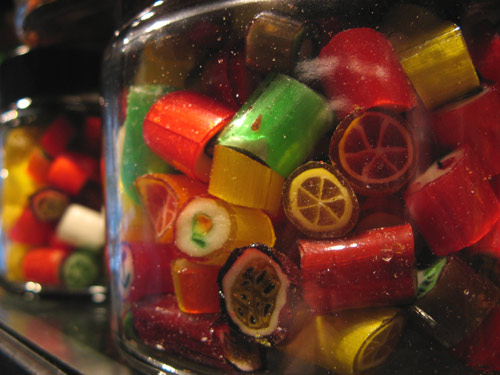
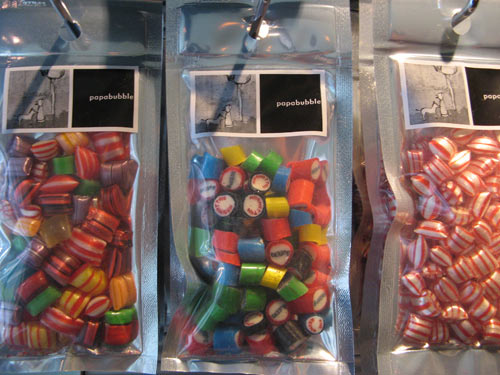
Maybe, because I was hooked. (First one’s always free, right?) Afterwards, I spent an inordinate amount of time perusing the shop’s left wall, where shelves of the cheery-looking glass jars ($14.50 and $25 — refillable at a discount) and bags ($7.50 for 4 ounces) of hard candies were spotlit to glittering effect, like bits of Venetian Murano glass.

Papabubble

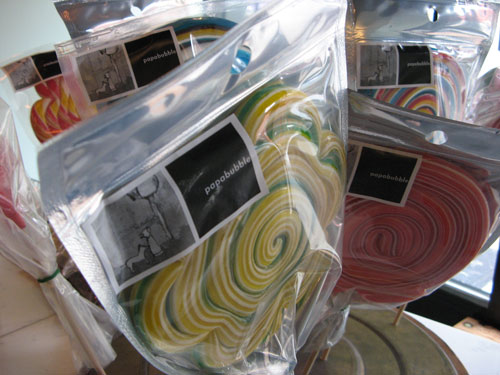
At the front counter, gorgeous lollipops of varying sizes — $4 to $15:

Papabubble

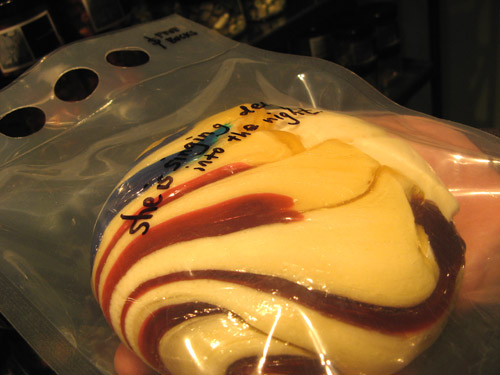
For the more economically-minded, the shop had a few aesthetically-inferior candy “irregulars,” ranging in size from a golf ball to wider than a palm. (This hefty disk was marked “$ five bucks.”)

Papabubble

I wonder how they get the letters inside the candy for the New York mix (center)? And is each borough represented by a different flavor?

Papabubble

Scenes from Providence

On the way back to New York City, we spent a few hours in Providence, since none of us knew when we would be driving this route again any time soon. All those years to and from the Cape, and I don’t think we ever made this stop.

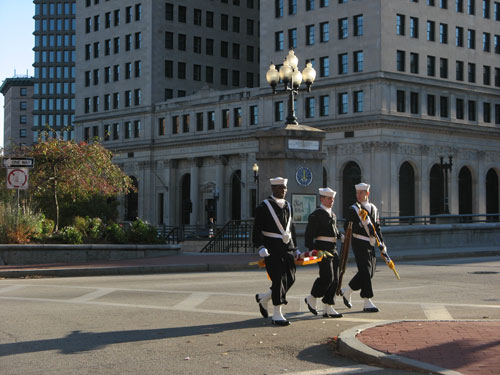
We hit downtown just as the Veteran’s Day celebrations were winding down; the day’s highlight was the dedication of the newly constructed World War II Monument for which several news vans were on site. The $1.3 million memorial features a main columned rotunda, flanked by two angled walls of granite, engraved with the names of the 2,562 Rhode Islanders who died while serving during World War II.

A parade, which began at the Rhode Island State House, had preceded the dedication ceremony but by late afternoon, most of the crowds had already dispersed.

Providence parade

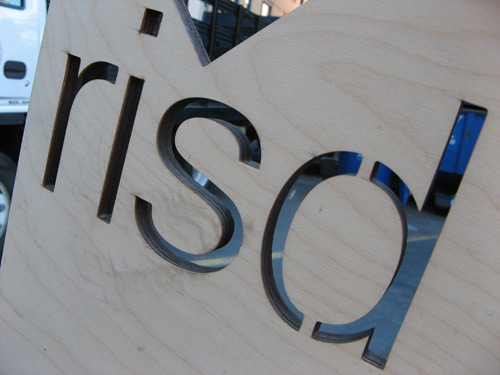
We came across this random bit of risd detritus in an abandoned shopping cart:

RISD

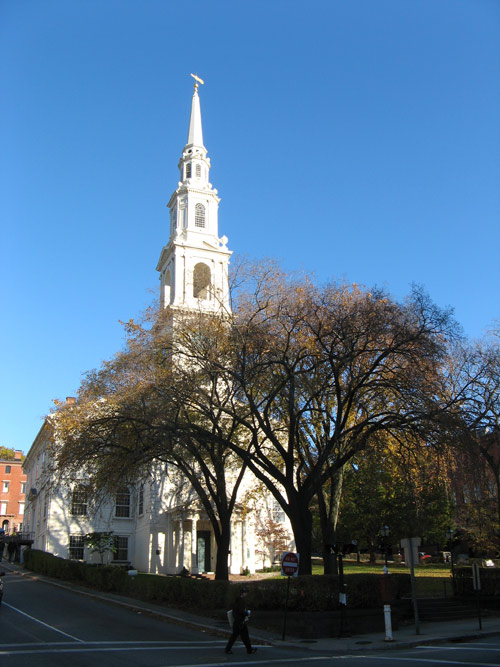
The First Baptist Church in America, founded by Providence-founder Roger Williams; his National Memorial is located just a few blocks north. The 80-foot square church, completed in the Spring of 1775, was the largest building project in New England at that time. (The 185-foot steeple was added after completion.)  Its construction benefited greatly from the British closing of Boston’s ports in retaliation for the Boston Tea Party, which freed up many shipwrights and carpenters who eventually made their way to Providence in search of alternate work. Capacity of the meeting house was 1,200 people, then equal to one third the entire population of Providence.

First Baptist Church

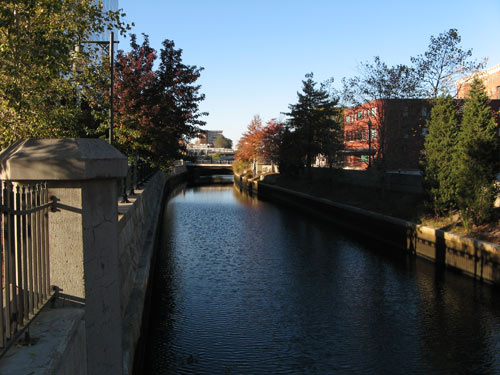
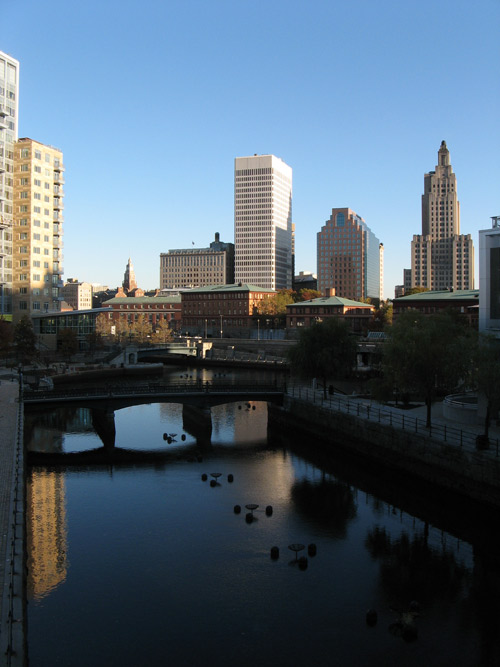
Views of architect/planner William D. Warner’s $270 million 10-year waterfront project, which began as a 1982 study into reconnecting Providence with its lost waterfronts. Warner’s “Waterplace Park” (with its dozen low, graceful, arched river-spanning bridges), the nearby $435 million 1.3-million-square-foot Providence Place shopping and entertainment complex, and the NBC television series ”Providence” (er, seriously?) all have been credited with giving this city of 175,000 a new cachet.

Providence River

Providence River

Clams on the Cape

This weekend, we revived the Cape Cod tradition for what may be the last time for a long while.

J and J drove in to pick me up just as the sun was rising over Central Park this dreary, chilly morning. As we made our way north, we stopped just once, somewhere in Connecticut — all the excuse I needed to pick up an Egg McMuffin on the road. No matter how I feel about the rest of McDonald’s menu, the McMuffin retains a soft spot in my heart. Something about the synergy of warm, chewy English muffin, salty Canadian bacon, day-glo melted cheese and unnaturally round griddled egg.  It’s a classic breakfast combination I’ve come to associate with traveling, since I rarely indulge in these mini-sandwiches outside of rest stops and airports.  Now if the fast food chain would just bring back the deep-fried apple pie

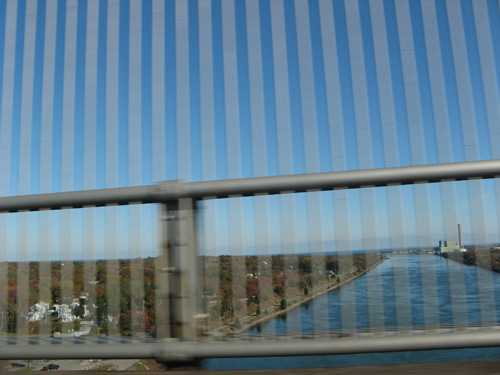
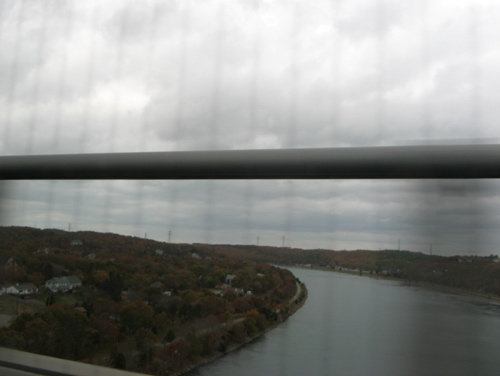
Over the Sagamore Bridge and onto the cloudy Cape:

Cape Cod

At the Cove, we attended to the business of our weekend. Strange to think with how little fanfare two decades of tradition is dispatched.  (Hawaii, here we come!)

I was struck by how different Cape Cod is in the quiet season. The usually bustling Route 28 was half deserted. The seafood shacks, ice cream parlors, salt water taffy stands and mini-golf courses regularly teeming with families in the summer, were all closed for the season, leaving behind an eerie landscape of empty parking lots. Happily, our old standby Seafood Sam’s was still open for business.

We couldn’t bid adieu to the Cape without at least one more visit. Locals and visitors have been flocking to this place for some of the best fried seafood in the area since 1974, when the first Seafood Sam’s opened in a tiny, former laundromat with just six employees. Three decades later, three of those original six now own and operate the mini-chain of Sam’s restaurants. In the years since we’ve been going, we’ve seen the Yarmouth location evolve from a glorified shack with several open-air benches to a full casual-dining restaurant. There’s still no table service, but the airy main seating area is now enclosed within solid walls (vs. the former combination of sturdy canvas and clear plastic) and the bathroom was moved from outside and around the corner, to just down the hall from the dining room.  What hasn’t changed: food orders are still placed with the cashier, and arrive piping hot on disposable plates; the faux-wooden trays are scattered with clear plastic cups of tartar sauce and wedges of lemon.

Seafood Sam’s

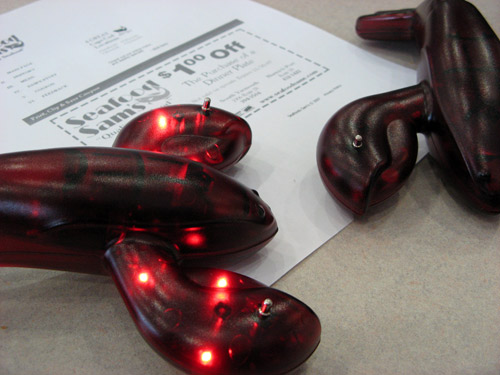
Another advantage of visiting off-peak: no lines, no waiting.  Well, no waiting to place your order, anyway; the seafood is still fried fresh — sure they have broiled items on the menu, but why? — but now instead of hovering by the formica-topped counter as you wait for your food, the cashier hands you a red plastic lobster that flashes when the order is ready for pick-up.  Like this:

Seafood Sam’s lobsters

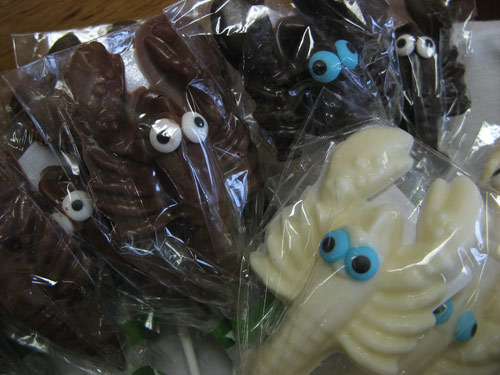
No lobsters were harmed in the making of these lollipops:

Seafood Sam’s chocolate lobsters

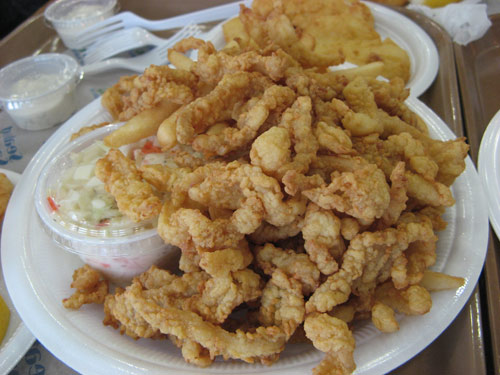
Fried clam strips. These decidedly aren’t the fancy, succulent whole bellies version, but more the shack-on-the-beach variety, best suited for serving in a paper boat (or here, on a paper plate, over fries).  I still love them.  J conjectured that it may be that perfect proportion of hot, crispy fried batter to chewy clam center that I find so appealing.  She may be right.

Seafood Sam’s clam strips

Orlando Magic @ New York Knicks

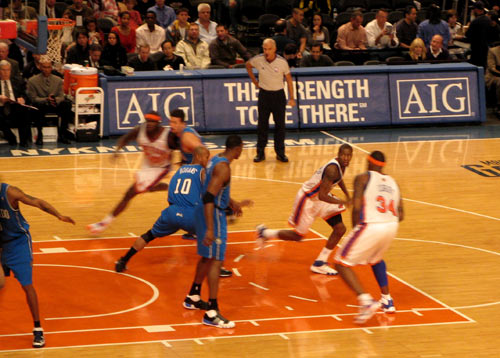
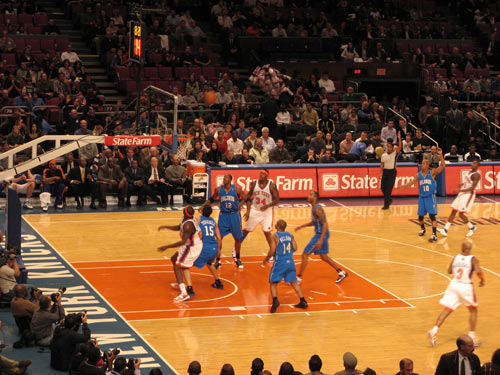
A spontaneous afternoon offer from SC, and we found ourselves at the Knicks-Magic game at Madison Square Garden this chilly, rainy night. The Knicks may be the most valuable basketball franchise in the United States, valued at approximately $592 million, but after six straight losing seasons and an off-season plagued by scandal, all around expectations are low and their fan support has eroded steadily. Even the local press has gotten in on the bashing, reporting on the team’s embarrassments with seeming relish (though it seems they have their reasons.)

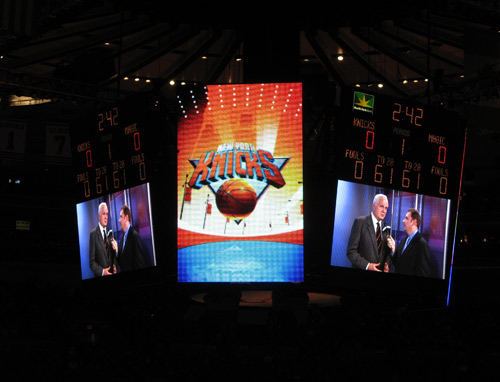
I hadn’t really followed the team since Patrick Ewing was traded to Seattle after the 1999–2000 season. The former center, who has been an assistant with the Magic since June, was at the game tonight; before the jumbo screens late in the game, Ewing rose to standing cheers in the arena that displays his retired #33 Knicks jersey. (Also in attendance: Carlos Beltrán who, by contrast, was booed.) The most recent team-related story I’d read had nothing to do with basketball at all, but with the immensely popular $15 sneakers in Stephon Marbury’s Starbury Collection at bargain sportswear chain Steve & Barry’s (which also sells Sarah Jessica Parker’s Bitten and Venus Williams’s EleVen budget fashion lines.)

But sitting there in our fancy seats inside The Garden, I remembered what it was I enjoyed about pro basketball. The fast-pacing, the physicality… and watching the action unfold live was an entirely new experience. It’s a simple, but costly pleasure: the face value on our seats, one level up from the floor, approached $100 apiece, which made me wonder how it is that families can attend these types of sporting events together. My guess is that, for the most part, they can’t: even seats in the Mezzanine nosebleeds–five floors up–can run $45 apiece (not including Ticketmaster fees); courtside tops out around $3,000.

Tonight, though, we were there courtesy of SC’s connections, which meant that we still had money in our pockets for a full bag of pink and blue cotton candy, served up in an oversized Knicks felt top hat. Pure unadulterated sugar rush… and darn near irresistible.

Knicks

Knicks

Knicks

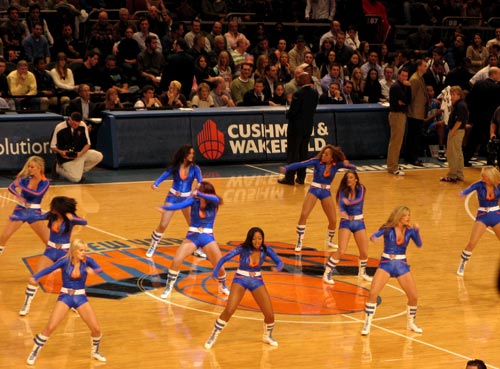
The Knicks City Dancers:

Knicks City Dancers

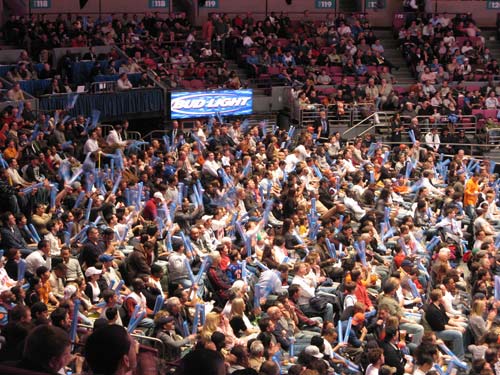
A sea of Knicks fans waving thundersticks behind the Orlando basket; the Magic still shot 82% from the line to the Knicks’s 76%:

Knicks crowd

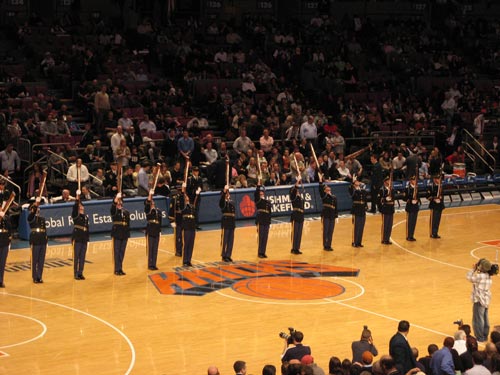
A dangerous-looking rifle-toss “wave” by the color guard on “Military Appreciation Night”–recruiting tables were set up just outside:

Knicks military night

It was a tight game for the first three quarters… but early into the fourth, things quickly began unraveling for the home team. It came flooding back then, all the reasons I had stopped watching the Knicks those many years ago: it was just too demoralizing. As the Magic lead grew to double digits, the mood of the crowd shifted palpably. Exasperated grunts degenerated into increasingly louder boos… by the end buzzer, fewer than half the fans remained in their seats.

Tonight’s 112-102 loss kickstarted what would become an eight-game losing streak for the Knicks–the NBA’s longest this season.

Check out the rest of the flickr set for more of the Knicks dancers and a kiddie dunking contest.

Ice, ice baby

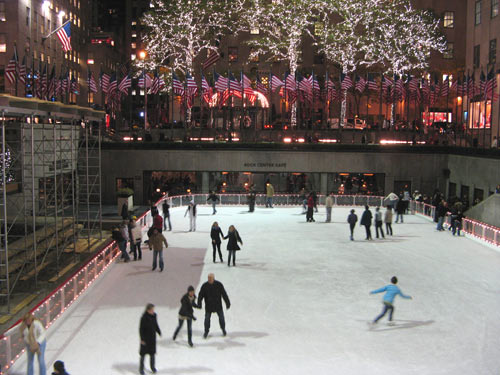
On the way to my party at The Sea Grill, I peeked in on the skaters at the Rockefeller Center rink. Autumn in New York was finally settling in, making it much more appropriate weather for skating than the last time I was here. Reminds me that I really want to try to get to The Pond at Bryant Park this year.

Rockefeller Center ice rink

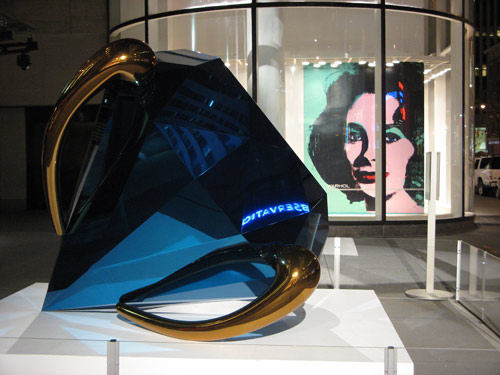
It’s not every day that one comes across a giant blue diamond on the street. Specifically, it was Jeff Koons’ eight by seven foot sculpture, “Blue Diamond” (2005) sitting outside of Christie’s Auction house. Part of the artist’s famed “Celebration” series, which he began in 1994, the blue “diamond” is in fact made of polished steel and chromium, and is one of a series of five; Koons’ red, pink and green diamonds are in private hands, while a yellow version is currently in production. The eye-catching sculpture was displayed in advance of Christie’s Post-War And Contemporary Art auction on November 13 where it was sold to Gagosian Gallery for $11.8 million. Despite more than doubling Koons’ previous sale record of $5.6 million, the amount still came in somewhat under pre-sale expectations, which had ranged from $12 million to $20 million. (To put this in perspective, last month an actual flawless 6.04 carat blue diamond became the most expensive gemstone in the world [per carat] when it was sold at a Sotheby’s auction in Hong Kong for $8.3 million.)

The next day, the “Blue Diamond”‘s record was obliterated by the sale of Koons’ stainless steel “Hanging Heart (Magenta/Gold)” for $23,561,000, including commission, at Christie’s uptown archrival, Sotheby’s.

It’s been a good season for Koons; his big silver “Rabbit” balloon debuted at this year’s Thanksgiving Day parade a couple of weeks later. He still has nothing on Damien Hirst, though, who in August 2007 sold his much publicized/mocked diamond-encrusted platinum skull for $100 million to an investment group (which included himself).

Blue Diamond

How appropriate that Andy Warhol’s iconic portrait of Elizabeth Taylor–a woman renowned for her love of fine gems, among them the 33.19 carat Krupp Diamond and the 69.42 carat Taylor-Burton Diamond–would overlook Koons’ giant jewel.

Die Zauberflöte

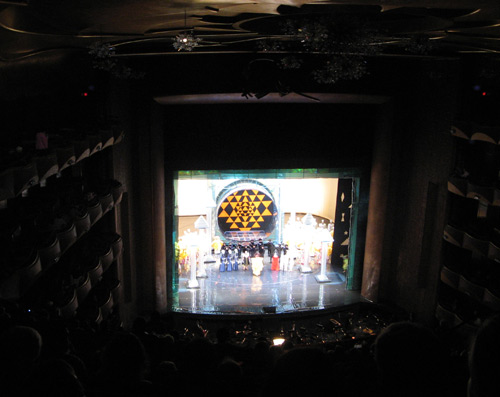
At the Metropolitan Opera House tonight with HYB for Die Zauberflöte (The Magic Flute). Mozart’s final opera is the tenth most frequently performed opera in North America. I’d seen a fairy-tale-like production (with Andrew Porter’s English translation) at the New York City Opera across the plaza a few years ago; this season, the Met brought back Broadway and film director Julie Taymor’s 2004 production.

Set in an imaginary Egypt, the action revolves around a prince and princess overcoming adversity to unite. Along the way, there is a bird-catcher, a high priest, a moor, serpents, beasts, assorted royal attendants and genii and perfunctory ordeals by water and fire. No ninjas, though. It’s all fairly ridiculous, but the music remains sublime. Taymor’s staging features an incredible variety of figures swirling the stage; I especially liked the flying birds, giant kite-like dancing bears and the magnificent star-shimmering Königin der Nacht (Queen of the Night). The puppet animals were created with the input of Michael Curry, who also designed the award-winning creatures for The Lion King on Broadway, adding to the feel of spectacle on the kaleidoscopic, mirror-lined stage.

Not everyone’s a fan, though. Three years ago, New York Times critic Anthony Tommasini found Taymor’s production to be a mishmash of imagery, so cluttered with puppets, flying objects and fire-breathing statues that it overwhelmed Mozart’s music. His review this year focused on 36-year old German soprano Diana Damrau‘s impressive turns in her dual roles as the Queen of the Night and Pamina during the Met’s Die Zauberflöte run–a feat never before attempted at the opera house in a single season. This night Damrau inhabited the ingénue role; after this season, she will be retiring her Queen, one of the most difficult roles in the standard coloratura repertoire, with its two relatively short, but flashy arias O zittre nicht, mein lieber Sohn” (Oh, tremble not, my beloved son) and the famously treacherous Der Hölle Rache kocht in meinem Herzen” (The vengeance of Hell boils within my heart). The role, which amounts to just about twelve minutes of stage time, demands five staggeringly high F6’s–a fourth above “Soprano C,” and the highest note in the standard operatic range.

The Magic Flute

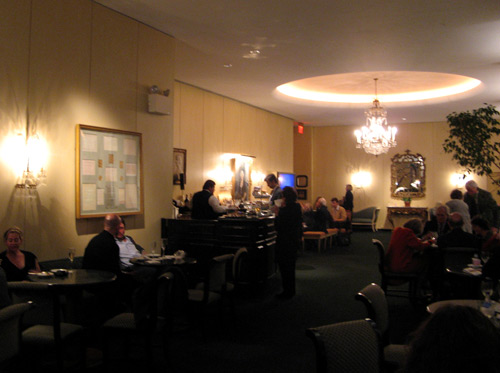
Intermission in the Eleanor Belmont Room, a club used by members of the Metropolitan Opera Guild. We were there courtesy of SYB’s guest passes; the private lounge is otherwise only made available for pre-performance dining and intermission coffee and cocktail service for Contributing Level (or higher) Met Guild donors.

Belmont Room

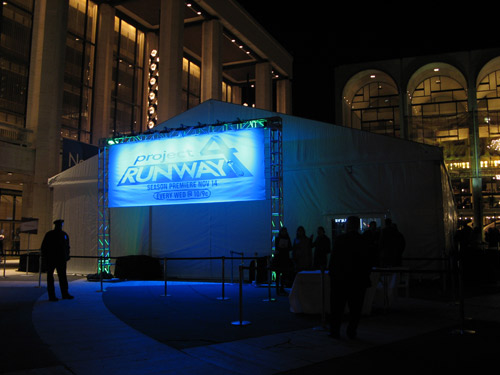
On the Plaza, “it’s sew time”: the launch party for Season 4 of Bravo’s Project Runway. Ever since Top Chef ended its run last month, Project Runway has become my favorite reality show on television right now. The Daily News breaks down the reasons for Runway’s superiority, including “Contestants actually have to do things that take – gasp! – talent,” (the “talent” being something other than, say, “knowing how to snag a man” or “losing 80 pounds“), “It’s just so incredibly gay,” and finally “Who are we kidding? Can there ever really be a full explanation for love?

Project Runway tent

My first real six string

Okay, lesson one: chords. Now, I don’t know the actual names of the chords, umm, but I… I made up names for the way my hand looks while I’m doing them. So then, this is “Bear Claw.” Okay, umm, “Turkey Leg” and… “Old Lady.”
–Phoebe Buffay, Friends, “The One with All the Resolutions

After weeks of conflicting schedules, CF and I were able finally to set aside an evening for our long-awaited guitar lesson, after which, she assured me, I would be able to play a song. Since I’d never so much as picked up a six string, the plan sounded ambitious, but I was game.

We made our way to the Upper West Side, and over light bites and a bottle of wine, the tutorial began. A major (a.k.a. “Bear Claw”), D major, E major. CF, ever patient, walked me through about half a dozen combinations before my mind could hold no more. (In retrospect, wine may not have been the best choice of beverage for this particular activity.)

Armed with my new knowledge, we flipped through the book CF had presented me with to encourage these new musical frontiers. Rise Up Singing claims to contain nearly 1200(!) songs, though that figure is just a little misleading: the format is what’s known in musical parlance as a “fake book,” which is to say, a collection providing the minimal information needed by a musician to make an impromptu, passable arrangement of a song. Enough to “fake it,” as it were. The format is intended to help a performer quickly learn new songs, and usually contains just a melodic line, lyrics and basic chords. Or in this case, just the lyrics and the chords; editors Peter Blood and Annie Patterson seem to assume that users will already know the tune to many of the book’s songs. I didn’t — er… “Rosebud in June (Sheep Shearing Song)“? — but out of the advertised 1200, there are certainly enough familiar ones to keep me busy for a good long time.

To my delight, and just as CF had promised, I actually was able to play through an entire song by evening’s end. Not well, but almost… somewhat… barely recognizably. My finger pads hadn’t been so sore since my years of Suzuki violin.

The song: “Leaving on a Jet Plane,” which was written by a 23-year old John Denver in 1967 during a flight delay at a Washington airport. Peter, Paul and Mary recorded the most well-known version of the song, which became their biggest (and final) single in 1969. Nearly three decades later, Canadian chanteuse Chantal Kreviazuk scored a minor hit with the version she recorded for the wretched Armageddon (1998).

Interesting tidbit: Denver successfully took legal action against New Order over the song, claiming that the guitar break on the band’s “Run 2” (1989) — the third single off their “last great albumTechnique — was based too closely on his “Leaving on a Jet Plane.” An out-of-court settlement against the British rockers ensured that their song would never be re-released in its original form.

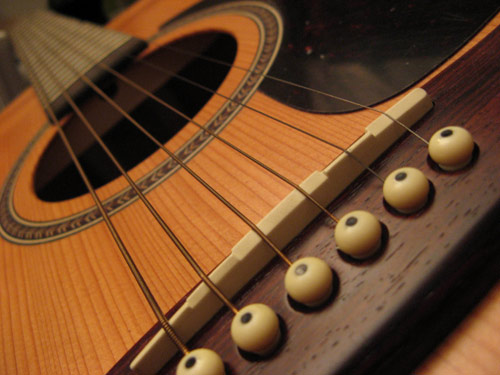
Here’s a shot of my beautiful Seagull S6thanks again, friends and family! Yo-Yo Ma has his Petunia; B.B. King has his Lucille… What shall this one be?

Seagull S6

Start up the campfire, break out the s’mores