vip in the city, page 7

The girl from Łomża

After months — maybe years? — of half-hearted planning, we finally set out in earnest to explore the Polish eats in Greenpoint, before the forces of gentrification (and the models) push the long-time denizens east to Ridgewood. For now, along Manhattan Avenue, there is no shortage of options nestled among the bakeries selling babka, the vodka-stocked liquor stores and shop windows announcing ”Polska Mowa.”

Lomzynianka (lahm-zhin-YAHN-eh-ka) on Manhattan Avenue is considered one of the better options for tasty and authentic Polish food at wallet-friendly prices, in an area where bargains can still be found. The restaurant’s name translates to “Girl from Łomża,” which refers to the restaurant’s chef-owner Janina Grzelczak who hails from that town in Poland, 80 miles northeast of Warsaw. This small, unassuming neighborhood joint is widely-praised for its hefty portions of meat and potatoes — a favorite with locals and food critics alike. Eric Asimov gave Lomzynianka the “$25 and Under” treatment in 2002. With a little planning, that princely sum probably could have fed four. With leftovers. Food blogger NYCnosh managed to satisfy three here with a budget of $20, including wine, tax and tip.

Entering the dimly lit dining room felt like stepping into the home of someone’s Polish grandmother: small lamps on plastic lace “embroidered” tablecloths, chipped and mismatched plates, fake flowers and… um, is that a deer head mounted on the faux brick wall? (Why yes, it is.) The half-Polish/half-English menu lists entrées starting at an astounding $4.25 for roast chicken with sides. The prices are almost impossibly low; there isn’t even alcohol served to help boost the profit margins. (Lomzynianka is BYOB — no corkage fee — and Dunne’s Polemost Liquors is conveniently located just up the block.)

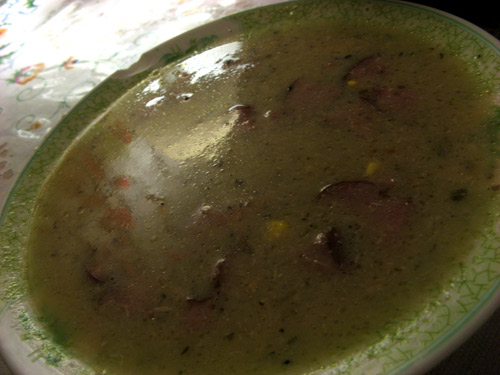
Borscht is one of the specialties here, so I ordered a bowl of white zurek. Unlike in Ukranian-style borscht, beets are not standard; the white borscht is made from a base of fermented rye flour, usually added to a broth of boiled kielbasa. Lomzynianka’s piping hot version was creamy and rich, and buttery and slightly sour all at once, stirred in with a hardboiled egg and generous chunks of smoky sausage. And a bargain for $2.50.

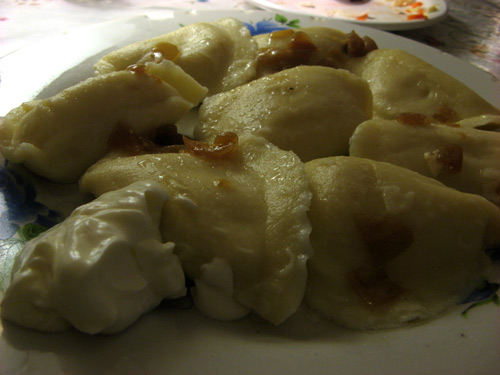
Platter of steamed potato and cheese pierogis with a side dollop of sour cream — so filling, I could only eat a few:

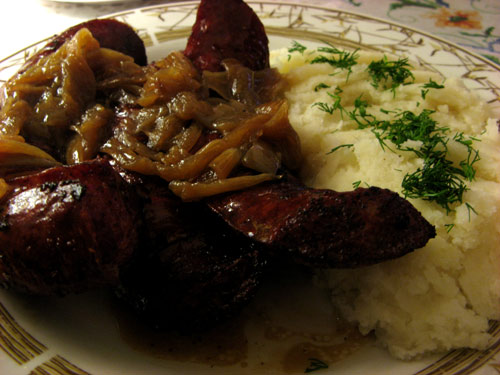
The $4.50 polish kielbasa platter, which included vegetable (stewed cabbage) and mashed potatoes, topped with chopped dill:

This is warming and hearty comfort food but for me, too heavy for every day. Lomzynianka is a neighborhood treasure, though, and for those who crave simple and authentic Polish food — tonight we saw a colorful cross-section of neighborhood families, elderly couples, hipsters, students and young couples on dates — you’d be hard-pressed to find better for less money.

Nada Surf at Terminal 5

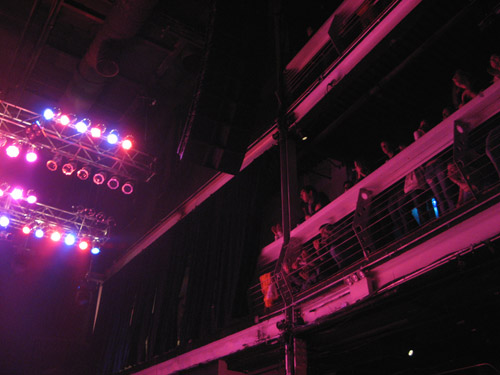
The independent New York City concert-promoters at Bowery Presents opened Terminal 5 in the former Club Exit on far West 56th Street in October 2007. With a capacity of 3,000, this is the newest and largest venue in an empire of club holdings that includes the Mercury Lounge, the Bowery Ballroom, Webster Hall, and the Music Hall of Williamsburg (ne Northsix). The 40,000-square-foot cavern underwent a multi-million dollar industrial-chic renovation by architect Brian Swier, who also led the redesign on the Williamsburg factory space.

The main floor features the performance space, 40-foot ceilings with exposed ductwork (and a disco ball), and two tiers of wrap-around mezzanines. The third floor bar serves empanadas from the swankified Empanada Mama in Hells Kitchen.

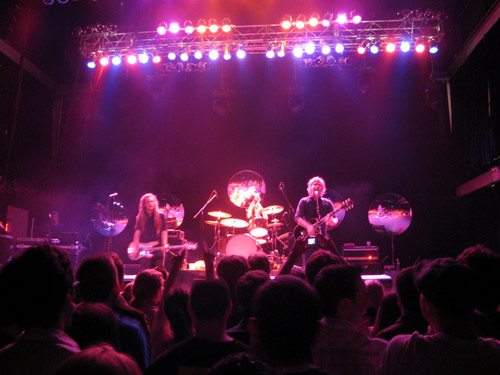
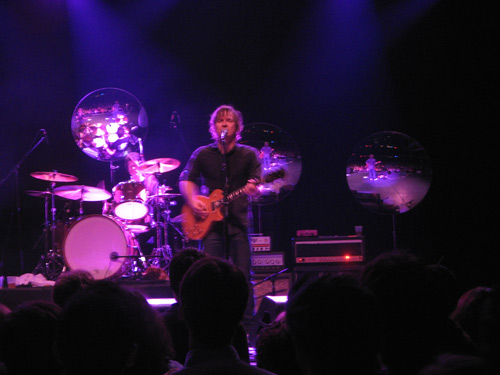
We arrived tonight, catching the last 15 minutes of Superdrag‘s opening set (and encountering at least one very enthusiastic superfan in the process.) We had opted for positions near the front on the floor, in full view of the stage set-up, which involved a series of five large round mirrors that reflected back into the crowd. By the time Nada Surf took the stage it was nearly 10.

The band was on tour to promote their fifth studio album, Lucky. Almost improbably it seems, the Brooklyn-based trio has been around for over a decade: back in 1996, their novelty hit “Popular” was on endless rotation on MTV — amusing in its skewering of teenage romance clichés, if not particularly representative of their later sound. (In his intro to the song, lead singer-guitarist Matthew Caws insisted that the band still enjoys performing it, despite rumors to the contrary.)

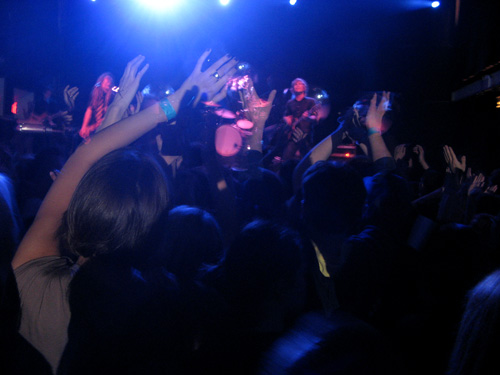
The multi-talented Martin Wenk of Calexico joined bassist Daniel Lorca and drummer Ira Elliot on back-up horns during a cheerful set that ran over 90 minutes. Caws interacted with his audience affably, inviting several sing-a-longs, and at one point, coaxed the crowd into a jaunty arm-waving two-step during what he called the band’s attempt at a Motown song, “Inside of Love.”

Caws dedicated “Beautiful Beat” off of Lucky to his first boss from a “basement record store on Cornelia Street“ (who was watching the concert from the first balcony — I wonder about the acoustics in the upper reaches). At the same time, he worked in a plug for Record Store Day (April 19) — a day to honor independently owned record stores across the country.

The four-song encore included the familiar “Blonde on Blonde” and “Always Love.” And here’s a video of the show’s “Blankest Year” finale. The tunes are not edgy; indeed Nada Surf’s music has a certain generic indie-poppiness that makes it extremely soundtrack-friendly. But sometimes — what can I say? — I’m a sucker for a competently crafted melodic hook. Judging from the loyal fanbase at Terminal 5 tonight, I’m not the only one.

The following night, Nada Surf continued their tour in Washington, D.C. Listen to a live recording of their entire April 12th performance at the 9:30 Club on NPR.

Never gonna give you up

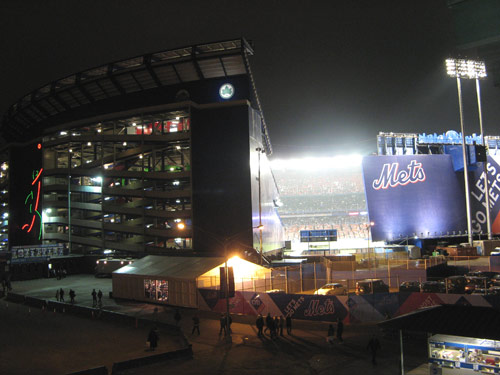
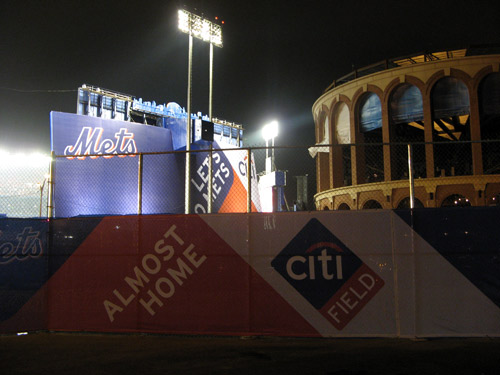
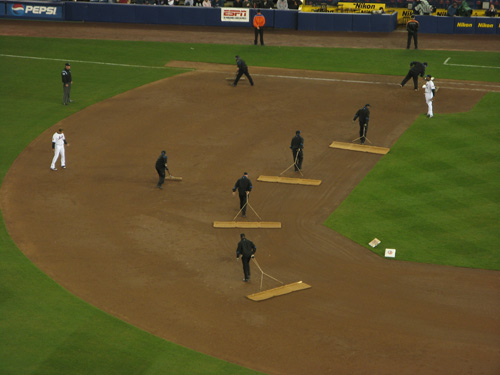
I’d promised myself at least one more trip out to Shea before the Mets move on to the nearly complete Citi Field next season, so when SYB offered up a last minute invitation to the watch the boys in blue, I was there.

Tonight: the second home game of the season, number 2 in a 3-game series against the Phillies. (The Mets fell in Tuesday afternoon’s home opener, 5-2. Apparently, I wasn’t the only one feeling nostalgic for the dingy ugliness of Shea; the day before, two Mets fans were arrested after they kicked a stadium seat to pieces and attempted to smuggle out the “souvenirs” under their shirts. (The Post, in its inimitable way, referred to the bumbling pair as “sit-for-brains fan ‘vandals’.”)

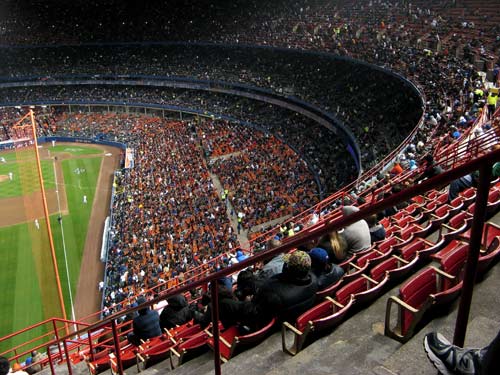
The weather during these early season games can be iffy, and I arrived at Willets Point on a chilly, damp night just in time for the Mets’ 6-run third inning. The thundering cheers, which I could hear from the subway platform, continued as I climbed my way up, up, up to the upper deck nosebleeds to meet my friends, JL and the brothers B.

We huddled under the Mets fleece blanket as best we could as the cold and damp settled into our bones; at some point it actually began drizzling lightly, forcing us to move even farther back and up to seek shelter under the overhang. Not nearly enough precipitation to interrupt play, but enough to make us a little unhappy as we shivered in our seats. We (all of us except HYB) were determined, though, to stick it out at least until the 8th Inning Sing-A-Long.

The week before, the Mets had asked fans to vote on the song which would be used for the Shea sing-a-long. Calls to write in Rick Astley’s “Never Gonna Give You Up” were circulated wildly, and when the voting concluded on April 7, the so-cheesy-it’s-awesome 80s dance song was the overwhelming winner with over 5 million votes. That’s the power of the Internets!

Team officials, though, were having none of the Rickrolling. Citing some loophole language in the online contest rules that the final poll tally would only “help decide” the song to be used, they decided instead to pick a winner based upon in-stadium reaction during the first six home games. Inherently flawed methodology aside — applause-o-meter? adjustments for game attendance? — I take issue with the Mets deciding to undermine the results of the democratic voting method, and their subsequent qualifying of the massive write-in as an “Internet attack.” As a conciliatory gesture, Astley’s tune was the first of the songs to be auditioned. It was booed — heartily! — making it highly unlikely that the song will ever be heard at Shea again. Ah well.

Eighth inning came around, and the first (and probably best) of the runoff songs started up: Bon Jovi’s “Livin’ on a Prayer.” Granted, it’s a lot more Dirty Jerz than New York, but would we rather have say, the theme song from “Friends”?! Good grief!

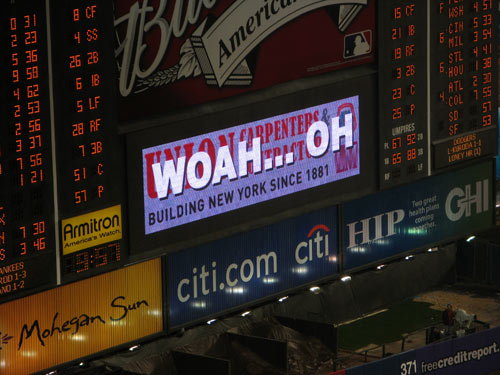
We did our part, belting out the blue-collar plight of Tommy and Gina at the tops of our lungs. Um, I don’t think this is how “Whoa” is spelled… is it?

Most of the online options were pretty horrid so in the end we were left with five song choices, none particularly inspiring. In addition to “Livin’ on a Prayer,” the stadium will be trying out The Monkees’ “I’m a Believer,” Billy Joel’s “Movin’ Out,” Neil Diamond’s “Sweet Caroline,” and The Foundations’ “Build Me Up Buttercup.”

Oh, and the Amazins won, 8-2 — the first of what we hope will be many wins this swan song season at Shea. Check out the rest of the game flickr set here.

incidentally, why isn’t Google commemorating Cinco de Mayo with a festive homepage logo? Is Dennis Hwang on vacation?

Unini? Panuni?

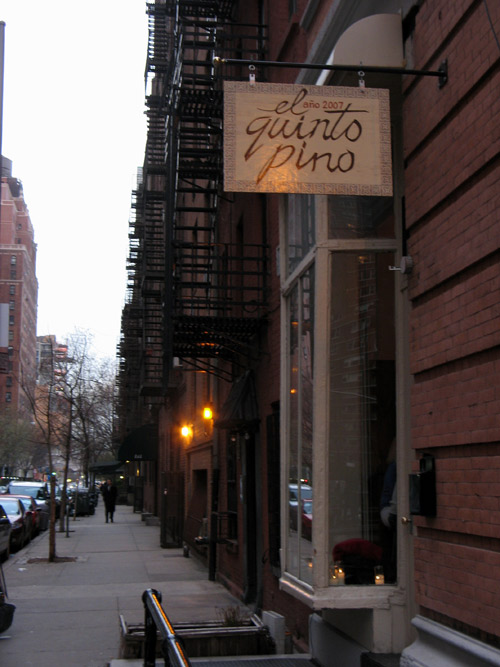
El Quinto Pino — the follow-up effort from the team behind successful tapas bar Tía Pol — has collected raves from just about every media outlet in the city since it opened last year. So it was with great anticipation that I made arrangements to meet MLF at 24th and Ninth this evening. When we arrived, the high-ceilinged room was packed with an after-work crowd, but almost right away, we managed to snap up a pair of seats near the front door. It was a stroke of good fortune: there are stools set up along the curved white marble-topped bar (behind which is tucked the diminutive kitchen) and several more scattered around the shallow-shelved perimeter, but otherwise EQP is standing room only. The food and drink offerings are as heavily edited as the decor: the entire handwritten menu fit on two chalkboards displayed above the bar.

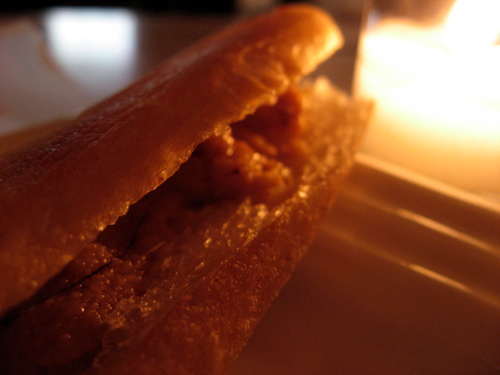
Which brings us to the uni panini. I cannot recall a single menu item that’s been showered with as much praise as chef-owner Alex Raij’s spiny sea urchin creation. (Cumulatively, however, it’s possible that the dishes on the Momofuku Ko tasting menu have received more breathless coverage.) Not everyone’s a fan, though; I’ve read some criticism that this sandwich is overhyped and offers poor value.

Hard to disagree with the first charge — The Times‘s Frank Bruni called it “the sandwich of [his] life” in his 2007 year-end review; food blogger Andrea Strong likened it to “really good, hot, sweaty sex” — and upon analysis, this delicate sliver of a sandwich does seem fairly simple and easily replicated at home: scallops of bright orange uni gently pressed into a slightly crisped ficelle from LIC’s Tom Cat Bakery, that’s been smeared with a kicky Korean mustard oil-spiked butter. Not hearty eats, by any means, but the synergy of briny, delicately sweet, custard-like roe (actually: gonads) and warm crunchy-chewy bread seemed to me the pinnacle of deliciousness. I’ve eaten more — if not necessarily better — for less money, and I’ve eaten worse for more money. Not as often, though, have I eaten less for more money. But is what averages out to about $2.50 a bite really so extravagant? (Sushi, after all, is in this price range… and often more.) I didn’t think so when considering my single $15 panini, though $30 for two panini (or $45 for three… which I could have eaten, happily) might seem to approach exorbitant levels for a place with no true tables. Personally, I didn’t mind, and was happy to wile away the hour and a half, savoring the bites, the good wine and the company of my friend.

Of course there is more to El Quinto Pino’s menu than the uni panini. MLF is not a fan of seafood (so sadly, no Soldaditos de Pavia — salt cod fritters — for us), so she employed the assistance of our friendly bartender in deciding between the two other non-uni sandwiches. Without hesitation, the server recommended the Pringa — a combination of braised meats, morcia (blood sausage) and sautéed onions. (Heartier than the uni panini, for what it’s worth.) Ed Levine may disagree: he named the third, the Serranito (serrano ham sandwich), one of his Ten Most Pleasure-Inducing Dishes of 2007.

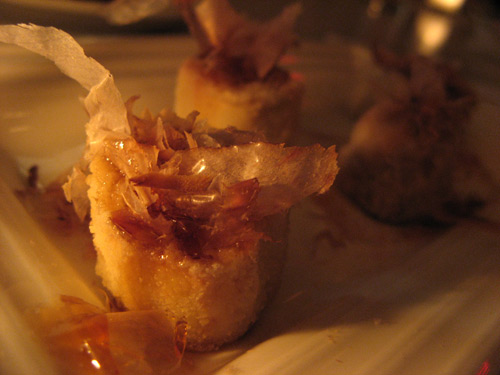
There was a dish of fine olives, and this intriguingly tasty Berenjena con Miel: pillowy cylinders of deep-fried eggplant, drizzled with honey and topped with bonito flakes.

In her recent round-up of seven sandwiches, The Times‘s Julia Moskin deemed Raij’s uni panini “not a real New York sandwich… [lacking] the compressed, complete pleasures of the Cuban sandwich, the heft and chew of a fully loaded gyro, the cool crunch of a Vietnamese banh mi.” New York or no, I’d go back for it… and the salt cod and the Torrezznos — Spanish pork belly cracklings.

Taste of the West Side

With just a few hours left for our West Coast visitors to explore (or is that: devour?) our city and its delights, the question was raised over brunch: What is New York City food? We didn’t attempt to provide an exhaustive answer this afternoon, but we spent a good part of the day walking — lots of walking! — along the West Side, sampling the wares of a few local representatives.

Our first stop: Alice’s Tea Cup to purchase a hostess gift — and okay, one warm pumpkin scone. Just me and BY, though; the place was deemed just a bit too twee for the men, who opted to wait for us on the sidewalk. (LL later claimed not to realize that men were allowed inside the cafe.)

A few blocks north, we spied Thomas DeGeest’s cheery yellow Belgian waffle truck (license plate: WAFEL) parked in front of Fairway Market. A hot (albeit premade and imported) waffle seemed like a perfect lead-in to sorbet and gelato from Grom, which was thankfully free of lines this chilly afternoon.

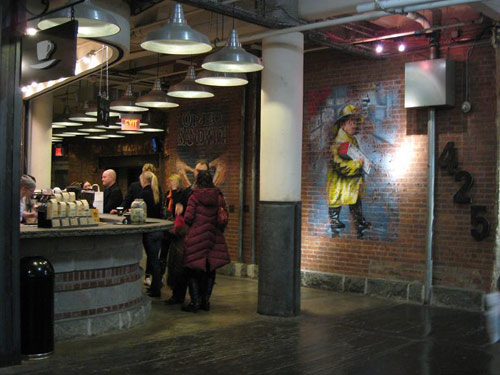
One $115 parking ticket later (ouch!) we set off to meet J & J at Chelsea Market. Presented with all the food options inside, we ended up devoting the next couple of hours to a graze-fest of sorts: brownies from Fat Witch Bakery, (more) gelato samples from L’Arte Del Gelato, a surprisingly tasty lime cornmeal cookie (and an ultimately underwhelming brioche loaf) from Amys’ Bread, a perfect cappuccino from the Ninth Street Espresso kiosk…

While BY and IC considered the prepared foods display outside Buon Italia market for reinforcements to take onto their impending flight, I picked up mangoes at Manhattan Fruit Exchange -– for a curried chicken salad — and a tub of farmer’s cheese from the Ronnybrook Farm Dairy Milk Bar. (J ordered a “Moocachino” from their menu of milky treats.)

Errands done, we wound down the clock in the Meatpacking District — far less objectionable this late Sunday afternoon than on most weekend nights. As we carefully made our way along the uneven, cobblestoned streets, I entertained (or perhaps: disturbed) our guests with the storied, not-so-ancient history of the space currently housing upscale Italian restaurant Vento. Well, as Sam Sifton notes (in the last paragraph of The Times writeup), it was “a different time.” Yes indeed.

The entire neighborhood is changing. Soon, The Hog Pit will be gone, and much-loved late night fixture Florent will be shuttering its doors after 23 years on Gansevoort.

Another sign of the times: the tri-level MePa Apple Store, which opened to great fanfare last December. This corner of 14th Street and Ninth Avenue was once home to supermarket Western Beef (now on Tenth) and then to Belgian brasserie Markt (which moved to Chelsea). Unlike its predecessors, Apple probably has the deep corporate pockets to afford the reported $5-6 million annual rent. (Neighbors Moschino and Hugo Boss coming soon.)

I made the tactical error of first checking out the shiny new Macbook Airs while shopping inside for my laptop replacement. Compared against the Air’s super-slim silver sleekness, the Macbook had the heft and clunky feel of a Zack Morris cell phone. *Sigh*

Congee Bowery

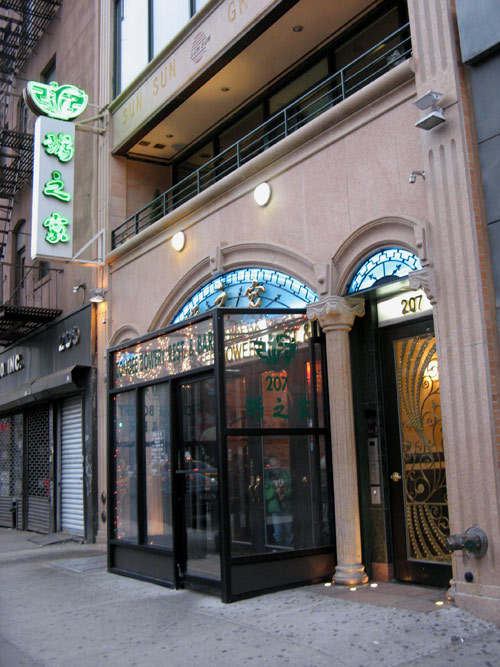
I’d been to the Congee Village on Allen Street several times now — the first visit most notable for our dish of duck tongues — but this was my first time to the smaller Bowery location, just a few blocks away at the edge of SoHo and up the street from BLVD. Similar gaudy-tacky decor as the original, with an emphasis on red and gold, faux-greenery, neon accents, and… well, you can see for yourself.

The website explains the design aesthetic thusly: “Built with all authentic materials imported from China, Congee Bowery presents itself with a gorgeous intricate play of wood and marble, decorated in traditional chinese style, with a fountain of stones, real plants and real gold fish, bamboo trees and original art from the great land of China.” Mmhmm.

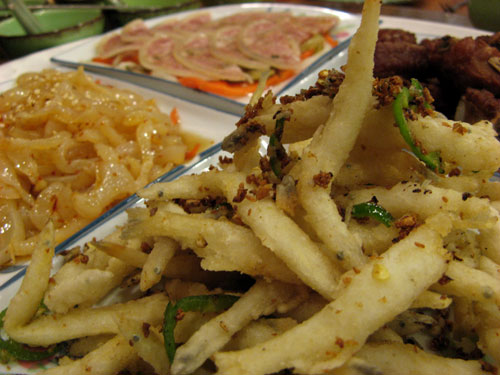
The Cantonese food is well-prepared and authentic, though… a favorite of my family’s, though I’ve yet to introduce them to Amazing 66 on Mott, mostly because my parents don’t make it out to Manhattan’s Chinatown much these days. Two tables were gathered tonight to celebrate J’s birthday with a traditional Chinese banquet. The dishes were part of a pre-set special menu, and followed the usual progression, beginning with a platter of cold appetizers…

…and continuing with a tureen of seafood soup, fish fillets two ways (wok-tossed and battered/fried), a T-bone steak, a steamed whole fish… and of course, no birthday feast would be complete without a whole chicken — symbolic of the phoenix, that harbinger of good fortune. (Congee Bowery serves a very good one, crisp-skinned and topped with flakes of fried garlic.)

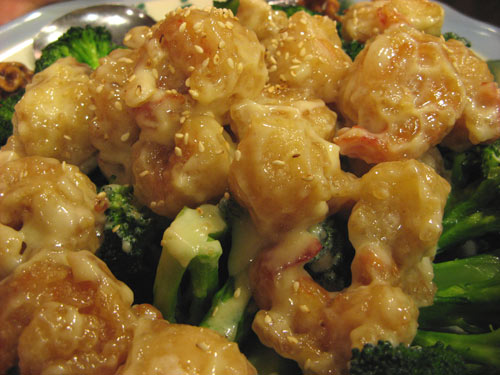
I lost track of the parade of dishes after a while. Here’s the Jumbo Shrimp with Walnut & Broccoli, coated in sweet mayonnaise sauce:

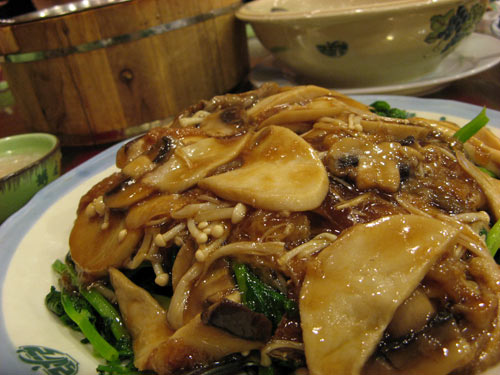
And a dish of what I thought was abalone, but which turned out to be a mix of mushrooms (oyster, shiitake, enoki) over vegetables:

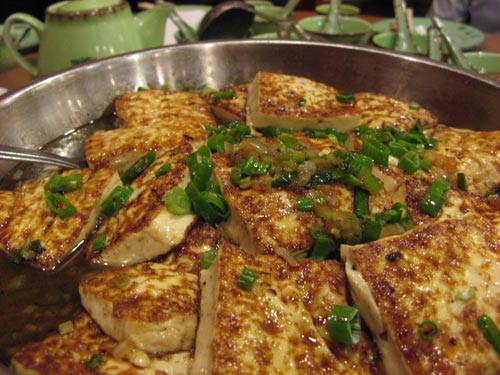
One of my favorites of the evening: Pan Fried Bean Curd with Soy Sauce. A seemingly simple preparation: squares of tofu seared just enough to impart an outer texture, while keeping the insides soft and silky.

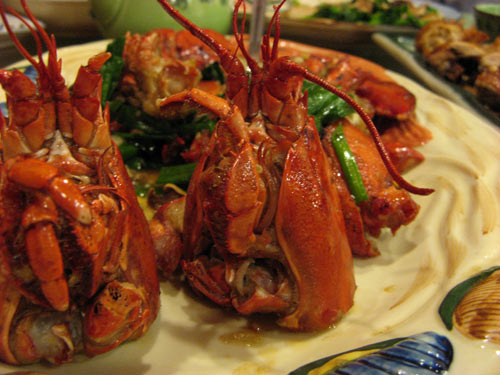
Lobsters with Ginger & Scallion. Congee Bowery also has a version made with Butter & Cheese… which may be good, but I’m too skeptical to find out.

The banquet ended with platters of E-Fu noodles and dried scallop fried rice studded with golden raisins, which I did not have, but heard was rather delicious.

For the more adventurous eaters among you, Congee Bowery’s menu (.pdf) is chock full of exotic-sounding items that push the limits of omnivorousness: Sea Cucumber & Goose Web, Roasted Young Pigeon, Duck’s Blood with Chives, and Baked Fish Intestine In Clay Pot, anyone? Anyone?

After dinner, several of us accompanied the out-of-towners for a night stroll through SoHo — with a pit stop for rice pudding at Rice to Riches — while the New Yorkers debated the relative merits of Eileen’s and Veniero’s. The latter, though far more touristy, maintains the edge at least in terms of operating hours… at 11PM this Saturday night, there was a twenty minute wait for take-out cheesecake.

I'll have what she's having

After wiling away happy hour (and then some) at Stone Creek‘s anniversary party — thanks to owner and Cowboys sympathizer Jon Pirozzi for the invitation — we’d had our fill of bar food and semi-stilted small talk with suited strangers.

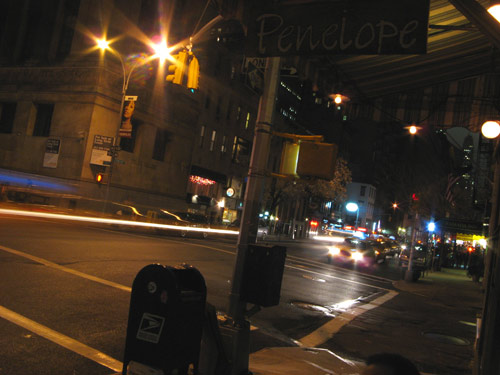
The area around 28th and Lex is known for ethnic eats: Indian and Pakistani mostly, plus the occasional Afghani restaurant. I was in the mood for something different, though… or rather: something not so different. And for straightforward comfort food, one of my favorite spots in this neighborhood is the eminently homey Penelope on the corner of 30th Street and Lexington Avenue.

The low-key restaurant, with its shabby country-chic decor (striped awning, mismatched tables, wooden plank flooring, turquoise wainscoting), first opened in 2003. The menu features homespun favorites, freshly prepared — exactly what one would expect from a place named for owner Jennifer Potenza’s turtle. Popular for brunch and home-baked goods, which are displayed on pedestals under glass. As noted by one recent Yelp reviewer, Penelope seems to draw an overwhelmingly female crowd (“Guys… THE ENTIRE CLIENTELE WAS FEMALE. I’m not joking. Really not joking“) … a fact my two male dining companions this evening can happily confirm.

I’m often drawn to Penelope’s warm artichoke and spinach dip, but in slight acknowledgment of our surroundings, l ordered the “Curried Chicken Salad”: grilled chicken, golden raisins, green apple, and peppers in a sweet and spicy curry dressing, garnished with toasted coconut. (I make a similar version at home, using Fairway’s roasted chicken and chopped mangoes.)

I’ve enjoyed just about all the salads here, actually… particularly the “When Veggie Met Sally” (chopped greens with red onion, grilled veggie burger, and green apple tossed with goat cheese in a roasted garlic balsamic vinaigrette) — a tribute to that quintessential New York film, which MC would refer to consistently and mistakenly as “When Harry Met Salad.” Which actually would have made for a better play on the movie title, don’t you think?

Ko, continued

So now that I’ve digested a bit – mentally and physically – I can fill in some more details about SC’s and my dinner at Momofuku Ko.

The restaurant’s overloaded, but entirely democratic online reservations system has been the subject of breathless coverage since it went live on March 11. No special treatment: earlier today, The Times restaurant reviewer bemoaned his inability to nab one of the 32 reservations that go up every morning at 10AM. (New York magazine’s Adam Platt and his “many diligent assistants” fared better and rated his meal a rare and rapturous four stars.) Earlier in the week, I was in the throes of my own Ko-fueled frustration, but unlike Frank Bruni I got lucky, scooping up a just released cancellation for a prime Wednesday evening dinner slot.

Behind the metal latticework-wrapped façade is a minimalist, utilitarian interior; the space was formerly home to Momofuku Noodle Bar, which moved to larger digs up the block in November. SC had already checked in by the time I arrived at 7:30PM. Despite prior warnings made to discourage a secondary market for reservations, the hostess did not check for photo ID.

The set-up remains essentially unchanged from the restaurant’s noodle bar days. While backless wooden seats may be fine for Noodle Bar and Ssäm Bar, they are perhaps less suitable for Ko’s 2+ hour tasting menu format. Fortunately, most of the patrons (like the staff) seemed to be in their 20s and 30s — a demographic used to wiling away hours on hard, backless barstools.

To keep track of all of the courses — 8 actual courses, plus a handful of amuse-bouche and a pre-dessert of sorbets — there were tickets printed up with the list of the night’s dishes: Amuse, Fluke, Consommé, Egg, Scallop, Foie, Rib, Miso, Pre, and Apple. Also on the tickets were notes about drinks and menu substitutions or dietary restrictions, e.g., Ebi for Fluke, Pea for Consommé, “No Dairy.”

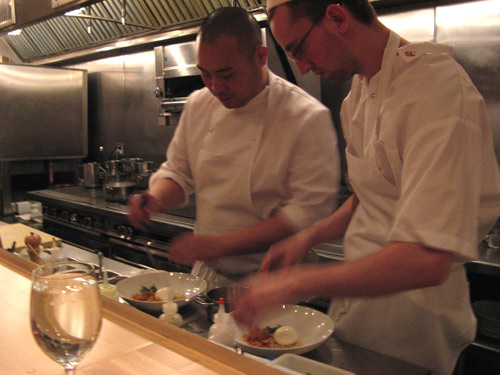
SC and I were seated in positions 7 & 8 tonight, which put us near the front corner of the counter, from which we were able to catch every slice and dice, sprinkle of sea salt, dunk in the deep fryer and more than a few snarky comments from Chang, chef de cuisine Peter Serpico (in foreground) and Co.
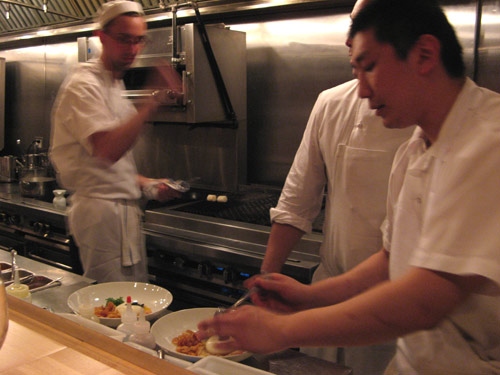
Momofuku Ko chefs

As has been noted, there are no servers at Momofuku Ko: the chefs present all the dishes over the counter, and therefore, are entitled to the tips. The two or three non-chef staffers — all women — were tasked with hostess duties (door management, coat checking and seating), dish clearing and drink serving. There were no printed menus — Chang told us that the dishes “have changed a little every day” since the restaurant opened — so we were reliant on the chefs to describe the plates for us. Most of these interactions felt a bit perfunctory… understandably, as the chefs seemed to have a lot of other duties to concern themselves over. For the most part we resisted the urge to ask follow-up questions, and as a result, several menu details were omitted, or just missed… though sometimes later filled in as we overheard the same dish explained for our fellow diners. (Thanks, by the way, to SC for her quick note-taking on the BlackBerry.)

Amuse-bouche of homemade mini-English muffins, topped with whipped pork fat (oh!) and chives:
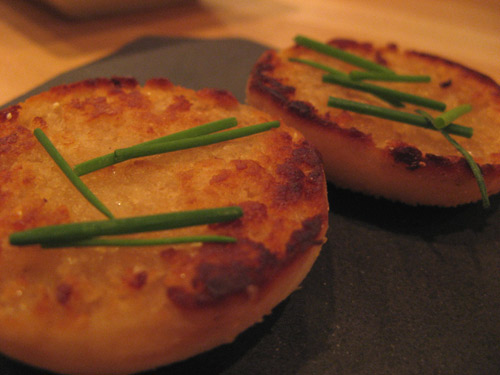
Momofuku Ko English Muffins

Despite his somewhat prickly reputation and known tendency towards outburst, Chang seemed almost jovial this evening, and even found time to check in with me and SC a few times during the meal. During the service, there were stretches during which he would disappear, perhaps to check in on his other nearby restaurants. At one point he returned to show off a newly stuffed baseball bat-sized casing crammed with beef; another time, he came into the kitchen bearing a handful of scallops on the half-shell, which he tossed onto the grill as snacks for himself and the other chefs.

We learned that on his days off, Chang likes to sleep late and order in Chinese food – who doesn’t? – and that he has gotten “pretty sick” of the current Ko menu and its iterations… though when it would be changing, he couldn’t say.

Momofuku Ko’s tasting menu is a more refined implementation of Chang’s culinary aesthetic, which until now, has been best glimpsed on Ssäm’s late night menu. The dishes themselves have been analyzed endlessly — and by those better equipped with the vocabulary than I — so I’ll just note that the standouts for me included the “Foie” (pictured below: a white porcelain boat of lychee, candy-like pinenut brittle and Riesling gelée, buried under a delicate mound of snowy foie gras shavings, which melded into an unexpected, but delicious combination of tastes and textures), the “Rib” (a rare, juicy chunk of beef, braised for 48 hours before being deep-fried to produce a spectacular crust) and the “Scallop” (one of Chang’s favorites, too: perfectly seared, and juicy within.)
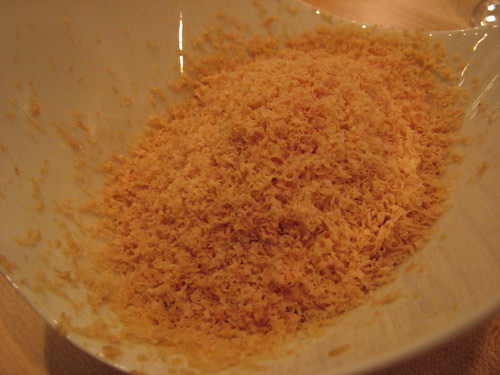
Momofuku Ko Foie Gras

The most ordinary dish, though still good, was probably our final savory dish of the night, the “Miso“: a bowl of soup accompanied by a grilled rice cake slathered in… butter, maybe? and served over stewed cabbage. Coming off the ultra-rich Scallop-Foie-Rib stretch, it served as a palate cleanser. Speaking of which, the pre-dessert cantaloupe sorbet over candied pineapple was packed with more cantaloupe flavor than any fruit I’ve ever eaten. To finish: the fried apple pie — oh, fried pie! — with a quenelle of sour cream ice cream and a smear of salty toasted miso hit all the right crispy, creamy, savory and sweet notes. (SC and I noted that a couple of other diners had received what appeared to be a panna cotta dessert, served with chocolate and avocado mousse.) By that point in the evening, though, we were experiencing serious feasting fatigue, and couldn’t manage more than a few bites before we reluctantly allowed the hostess take our plates.
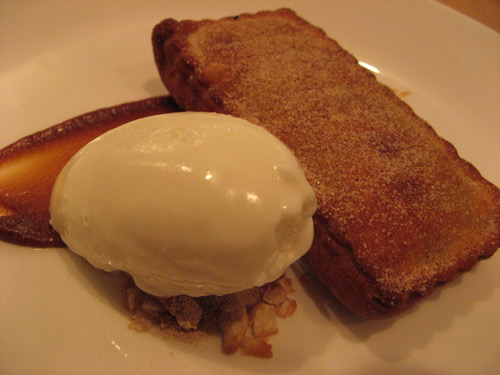
Momofuku Ko Apple Pie

Previous diners’ reports have claimed problems with the pacing of the dishes — with the chefs rushing them through their meals — but we found the opposite true. And although we were more than happy to linger and take in the spectacle of food preparation, there were several gaps in the service during which our stomachs’ fullness receptors had ample time to kick in and inform us that we had eaten entirely too much food.

For us, the 7:30PM start time was ideal: midway through the dinner service, as the chefs were easing into their evening’s routine. But at two hours and forty minutes, our meal did run long, and by the time we rose, staggering, from our seats, the couple with the 9:30PM final reservation had long been waiting. This morning, in navigating through the reservations system (out of curiosity only — really!) I noticed that instead of 15 minute intervals, the seating times have been adjusted to allow for two-hour seatings in staggered groupings at 6PM, 8PM and 10PM, with a gap between 6:30PM and 8PM.

Good to know, if ever I get lucky again.

Momofuku Ko photo set on flickr.
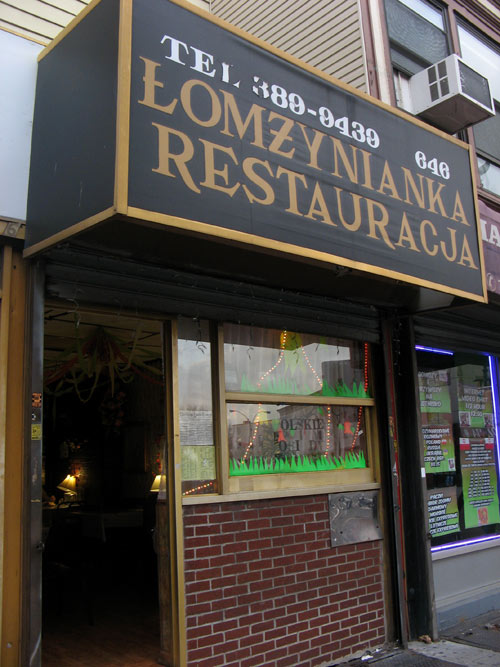
Ko yes!

Just returned from the tasting menu at Momofuku Ko — easily the most transcendent meal I’ve had in recent memory. After a couple weeks of obsessively monitoring the reservations website, where new spaces at the 12-seat counter go up 7 days in advance promptly at 10AM, I managed to snare a reservation for 2 at 7:30PM tonight. (Not even Bruni is exempt from the scrambling madness.) And just as critics Ruth Reichl and Ed Levine, bloggers like Kathryn Yu and Tina Wong (a.k.a. The Wandering Eater) and several other members of the food community have said it would be, it was divine.

Fuller description of our 2½ hour+ experience will follow — all my focus now is on processing this glorious meal… and catching up on tonight’s Top Chef — but in the meantime, here are a few photos of the twelve courses we sampled at David Chang’s newest venture.

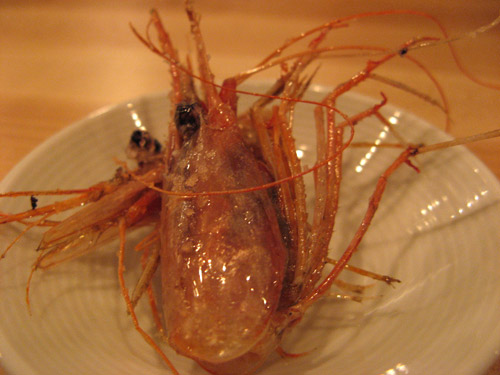
Deep fried sweet shrimp heads:

Momofuku Ko Ebi

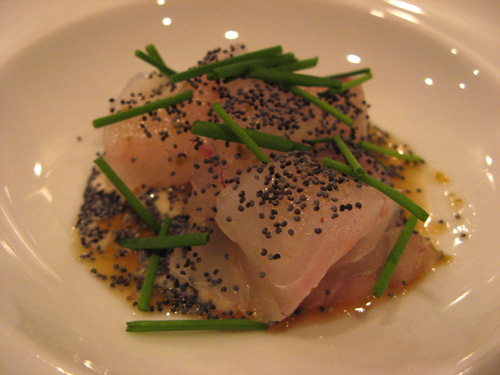
Fluke sashimi with spicy buttermilk sauce, poppy seeds and chives:

Momofuku Ko Fluke Sashimi

Chef Chang, who wandered in and out of the open kitchen throughout the service:

David Chang

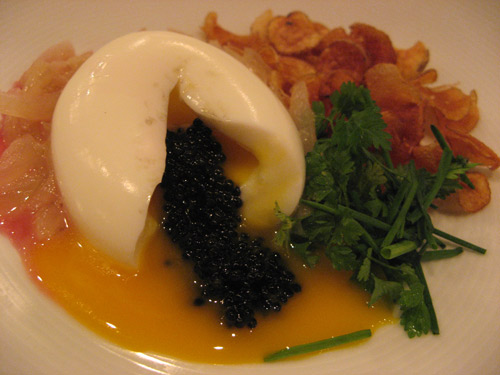
Smoked coddled “hen egg” with Hackleback caviar, onion soubise, sweet potato vinegar, fingerling potato chips and fines herbes:

Momofuku Ko Caviar Egg

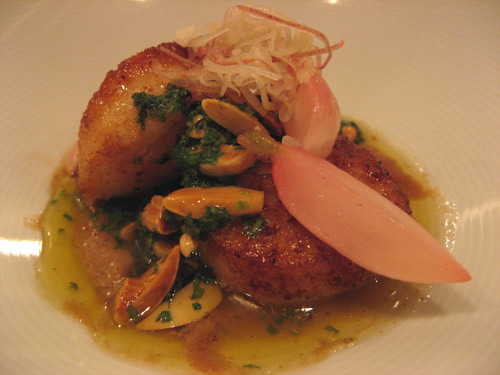
Seared scallops, with almonds, pickled radish and bacon puree:

Momofuku Ko Scallops

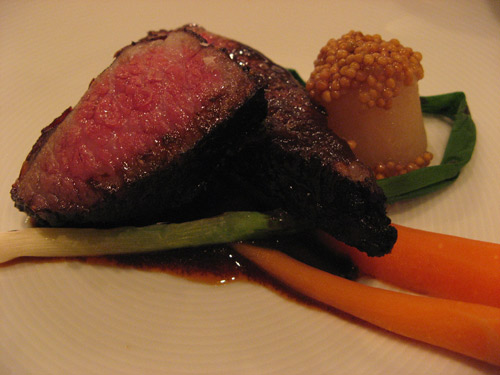
Braised and deep-fried short rib, grilled scallion, pickled carrots, stewed daikon and mustard seeds:

Momofuku Ko Short Rib

Check out my full Momofuku Ko photo set on flickr.
Totto eclipse of the heart

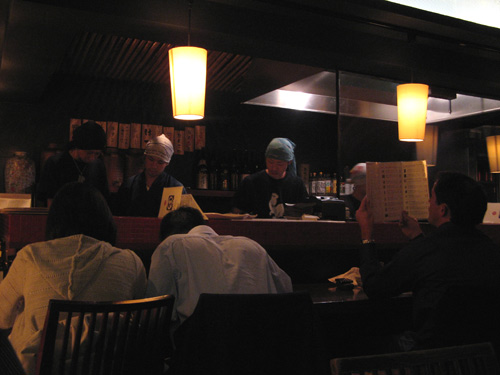
B — always on the prowl for new places — had read a lot of good things about Yakitori Totto on West 55th. The location makes it easy to miss; the small, low-key restaurant overlooks the middle of a quiet street, and is reached by ascending the narrow staircase adjacent to Japanese restaurant Sugiyama.

As the name indicates, their specialty is yakitori — bite-sized pieces of chicken (meat or organs) skewered and grilled, usually over charcoal. Japanese street fare, served in a dining room setting. (As an alternative to the small tables, a number of seats are set up around a counter in front of the smoky grill.) Quite a lot has been made about the default traditional chicken preparation — medium rare to raw — but I figured that there were far more dangerous things to eat than not-quite-cooked chicken, and perhaps the looming threat of salmonella poisoning would add an extra edge to the overall experience. Besides, this restaurant opened in January 2004, and surely would have been shut down by now if it posed a serious public health threat… and just as surely would not have been named to New York magazine’s Cheap Eats list in 2006 (#61)… right?

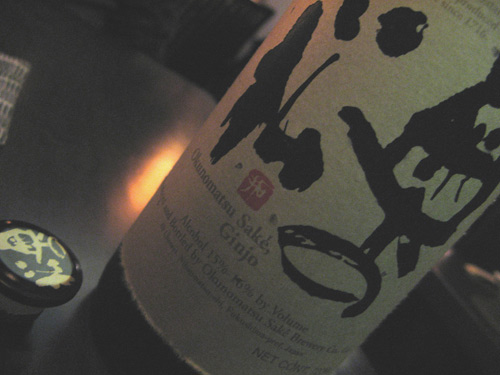
First, some sake for courage. B put in the order of Okunomatsu ginjo sake, and we were both a little taken aback with this supersized bottle arrived in a chilled bucket. It was easily twice the size we were expecting. In retrospect, I guess we could have sent it back…

We started our meal off tamely enough with the Hamachi Ceviche (yellowtail sashimi with citrus dressing) and a simple Totto Salad (Totto’s special mix salad, with shiso leaf dressing). From there, we pored over the truly impressive assortment of chicken part options, the familiar and the less so: wing and thigh… liver and skin… gizzard, heart, “soft bone,”(?) “soft knee bone”(??)…

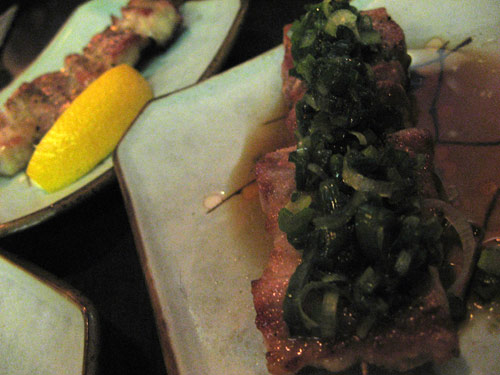
I insisted on ordering the heart — the little chunks of muscle arrived three to a bamboo skewer, and were delightfully juicy — and B piled on the rest: the Shishitou Tsukune (chicken meatball and asparagus wrapped in thinly sliced breast), Sasami Shisomaki (shiso leaf wrapped in sliced chicken breast with plum sauce), some other non-chicken skewers: the Enoki Bacon (mmm… bacon), the Kuro Buta Negi Pon (organic pork with scallion and ponzu)…

I lost track. I blame the sake. But I do recall that it was all delicious.

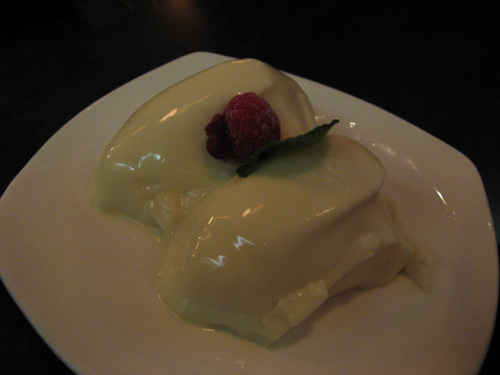
Things ended on a sweet note with the Yawaraka Annin Tofu (creamy apricot kernel tofu) — similar to the dessert I sampled at Kyotofu, and just as tasty. No lingering, though… as we were licking the last creamy bits off our spoons, our server came over and in an apologetic tone that nonetheless left little room for negotiation, reminded us that there was a growing crowd of hungry diners waiting for our seats.