vip in the city, page 38

Shanghai Cafe

Happy Brooklyn-Queens (and Manhattan, Bronx and Staten Island) Day!

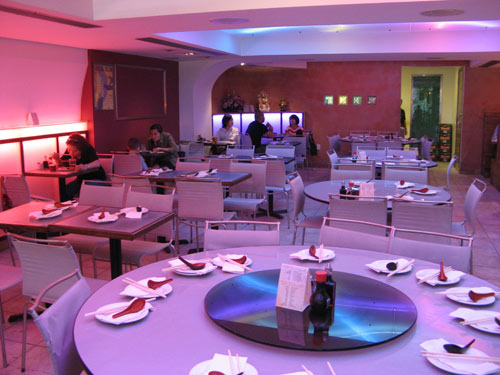
Somebody really liked this place, so we made a return visit for the xiao long bao. This time, at my request, we ordered a fresh bamboo steamer full of the pork with crabmeat and crab roe soup dumplings. We were seated at the same pink-flooded table as last time, so no photos: by now, though, you know what these “little basket buns” look like anyway.

Shanghai Cafe

These really are delicious. It occurs to me that although I generally prefer a thinner dumpling skin, Shanghai Cafe’s heartier version may be better suited for take-out, minimizing the leaking and breakage that I imagine would otherwise claim a couple of dumpling casualties.

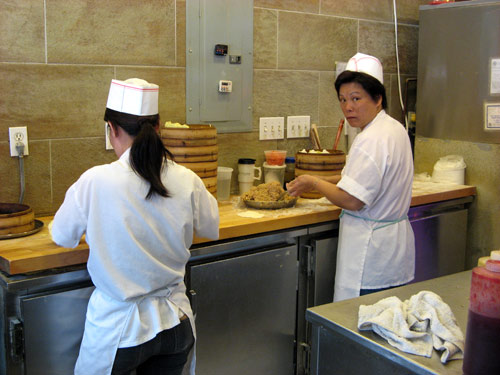
dumpling makers

Calvin Trillin, in a New Yorker  piece that was later included in his book Feeding a Yen, wrote that Jewish connoisseurs sometimes refer to these pork and crab soup dumplings as “double-trayf specials” (trayf, or tref, is the Yiddish term for “not kosher.”) Cloven-hooved animals AND shellfish… hard to get much more off-limits than that.

Free Love in Central Park

The Summer 2007 production of Shakespeare in the Park at the Delacorte Theater began previews tonight. The first show had been scheduled originally for June 5, but was postponed until tonight by the recent rains, which threatened the al fresco performance and cut short the actors’ rehearsal time. (The remainder of the five-week run will continue as scheduled.)

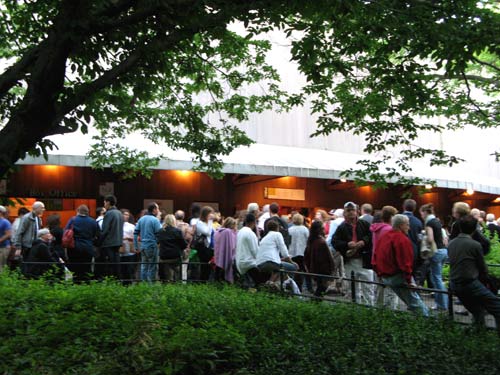
You know the drill: free tickets are distributed on a first-come-first served basis in two locations (at the Delacorte Theater and at the Public) beginning at 1:00PM the day of the show. The line, of course, forms earlier – usually much, much earlier – and continues to grow throughout the production run. Last year, snagging second row seats to see Meryl Streep and Kevin Kline star in Mother Courage was a 12-hour test of endurance (for SYB.) This year, with a somewhat less high-profile cast, the line for opening night tickets formed hours before dawn. Once again SYB stepped up to the task, taking the day off from work to arrive at Astor Place at 6:00AM, for which we were rewarded prime seats in the center of the seventh row.

For those without such intrepid and generous friends, there’s the Summer Supporter route (where a $150 donation will reserve one seat to either of this summer’s Shakespeare in the Park productions) or… Craigslist.

After a stop at Zabar’s for some intermission reinforcements (read: Carr’s table water crackers and spreads), I headed toward the Park for a night of Romeo and Juliet.

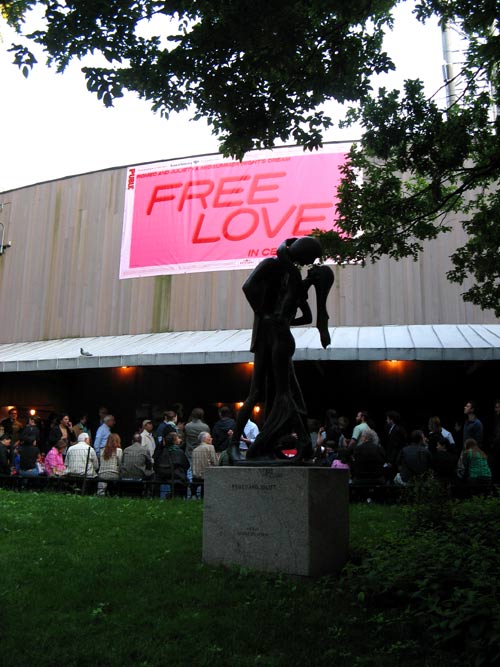
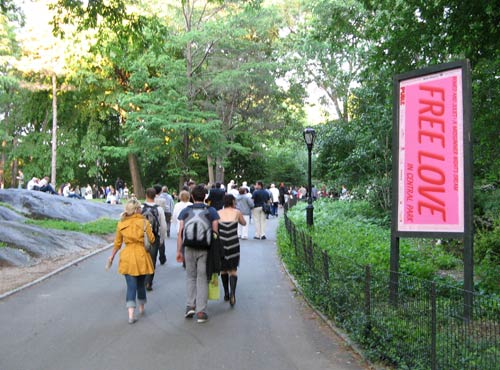
The pink, Pentagram-designed “Free Love” posters were up all over the park – a nodding reference to this, the 40th anniversary of the Summer of Love.
R+J in the Park

R+J in the Park

R+J in the Park

This production of Romeo and Juliet marks only the second time that the star-cross’d lovers have taken the Delacorte stage; the first was in 1968 with Martin Sheen(!) and Susan McArthur in the leading roles. This time around Lauren Ambrose and Oscar Isaac head up the cast, which includes Emmy winner Camryn Manheim (Ellenor Frutt in ABC’s “The Practice“) as the bawdy Nurse and SITP regular Austin Pendleton as Friar Laurence.

Ambrose, who beat out Sienna Miller for the role, is of course best known for her role as angst-ridden teenager Claire in HBO’s “Six Feet Under; Isaac counts among his stage, screen and television credits, the role of Porteus in the Public’s 2005 production of Two Gentlemen of Verona – a role he snagged just weeks out of Juilliard.

This being opening night, there were some rough edges – a few flubbed lines, intermittent audio difficulties – but nothing show-stopping. The audience seemed to enjoy Ambrose and Isaac’s portrayal of teenagers in the wild throes of infatuation — others, I hear, were less impressed: distracted by Ambrose’s incessant, emphatic head-shaking.

Christopher Evan Welch in the showy role of Romeo’s sidekick Mercutio, elicited many laughs from those who didn’t mind his scenery-chewing antics – me, among them. (Who doesn’t prefer Mercutio, after all?)

Most striking was this year’s set: a round, shallow pool of water, over which criss-crossed planked foot bridges and doorways, and a large, segmented arching stairway. The resulting tableau made a bold, if curious, impact, this being Verona, not Venice, after all. Director Michael Greif (the director behind Rent and this year’s Tony-nominated Grey Gardens) employed the open space fully: sending his actors over, through and into the water for their scenes. The air tonight was unseasonably chilly: by nightfall, I was shivering in my winter scarf; Ambrose in her wet, flimsy, white nightgown must have been suffering mightily for her art. The set changes involved some complicated-looking rotating, moving parts, which were as impressive as they were noisy (think: water + metal hinges), and made for their own series of logistical challenges: soggy torches and slippery surfaces. I was nervous watching Isaac scale the heights of that balcony ladder in his slick-soled shoes.

No doubt the summer law firm associates in tonight’s audience had worker’s compensation and liability claims on their mind as well. Mercutio’s line, “O’er lawyers’ fingers, who straight dream on fees” (from his famous “Queen Mab” speech) sent quite a chuckle through the crowd.

Romeo and Juliet, which runs through July 8, will officially open June 24, 2007.
Ian McEwan at the Y

Tickets to see Ian McEwan at the 92nd Street Y were sold out well before the Tuesday night event. I’d secured my own spot months ago, and thought this appearance by “the supreme novelist of his generation” (as dubbed by The Sunday Times of London) a thrilling finale to my season of Unterberg Poetry Center Reading Series events.

McEwan was in town to promote his 13th and most recent novel, On Chesil Beach, which was published in his native U.K. in April, but which arrived in the United States just that day to generally favorable reviews.

Colum McCann, Esquire magazine’s “Writer of the Year” in 2003 and himself the author of two short story collections and three novels, introduced McEwan in adulatory terms, as a master of finely observed detail, richly fulfilling Vladimir Nabokov’s vision for literature as expressed in A Guide to Berlin (1925):

….to portray ordinary objects as they will be reflected in the kindly mirrors of future times; to find in the objects around us the fragrant tenderness that only posterity will discern and appreciate in the far-off times when every trifle of our plain everyday life will become exquisite and festive in its own right: the times when a man who might put on the most ordinary jacket of today will be dressed up for an elegant masquerade.

McEwan seemed to shy, ever slightly, under the praise as he took the podium, and after a few droll remarks, proceeded to read three lengthy excerpts from his novella about two educated, British virgins on their highly fraught wedding night in 1962.

What is it about posh British accents? (Note to self: McEwan himself reads the On Chesil Beach audiobook, which unfolds over just 200 pages, as he noted, “almost in real time.”)

The audience sat riveted as McEwan’s lilting tones underscored the lyrical beauty of his language in setting the scene and laying bare the characters’ inner worlds. To be able to write like this! After almost 45 minutes, we — like at least one of the book’s protagonists — were left wanting more.

The post-reading Q&A with McCann covered the usual topics — McEwan’s childhood, his inspirations as a writer, his writing process – all of which the author tackled with considerable self-effacing charm. As at past events, there were submissions from the audience on white index cards. Although I had not intended to purchase yet another book, the temptation proved too great: I slipped out about halfway through the questions to pick up just one more from the tables outside the Kaufmann Concert Hall, joining the throng of devotees already lining up for the signing.

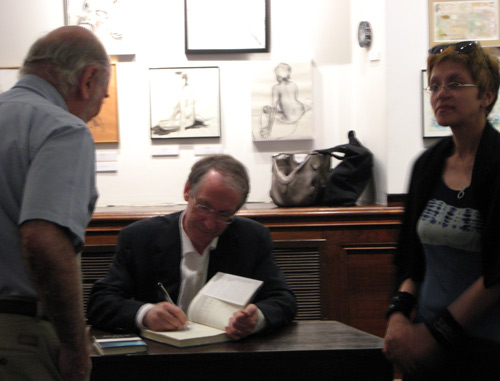
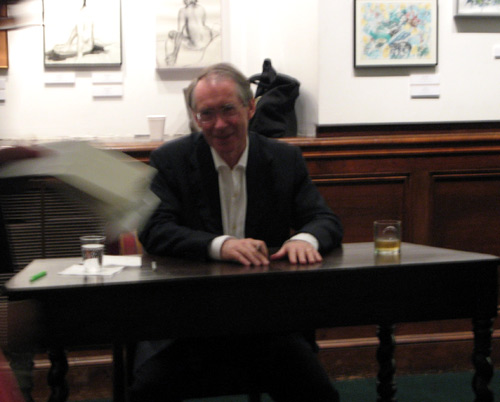
Ian McEwan

Ian McEwan

McEwan will not be touring the United States to promote On Chesil Beach; during the interview, he dryly observed that he had not toured to promote Atonement, which went on to become his best selling work, leading him to the conclusion that his personal appearances may actually have a depressive effect on book sales. Tonight’s reading at the Y would be his only major U.S. appearance.

Instead, in a unique marketing move, McEwan has teamed with famed Portland independent bookseller Powell’s Books, to launch their “Out of the Book” film series. The “On Chesil Beach” documentary collages film of McEwan shot over four days in England and the United States, commentary and footage of the book’s locale, and discussions with lit editors, critics and fellow writers. The 30-minute film will be screened at independent bookstores in 54 cities and towns across the country.

Press for this book/film tour has been quite positive; I was disappointed to miss the June 15 New York City event — so much to do, so little time! — which included a literary panel discussion and an after party at Mo Pitkin’s House of Satisfaction. The DVD is available for purchase through Powell’s, though, and I was thrilled for this rare opportunity to meet McEwan in person, and did not at all regret adding another volume to my ever-growing pile of books at home.

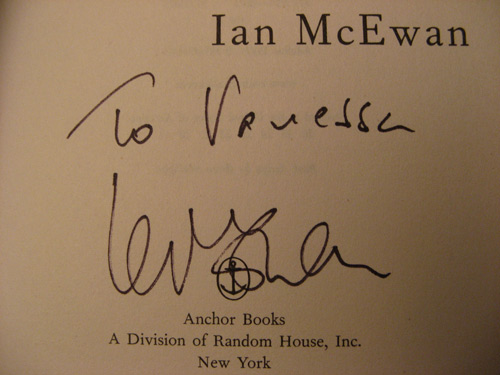
Ian McEwan dedication

The burdens of genius

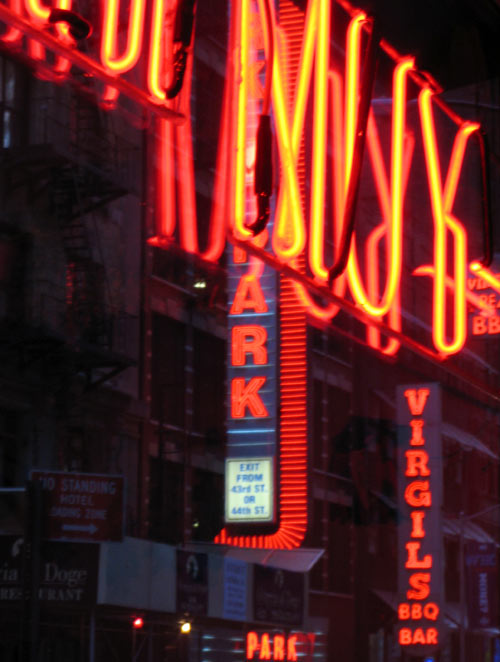
Looking out the window of Yum Thai on West 44th Street:

Times Square neon

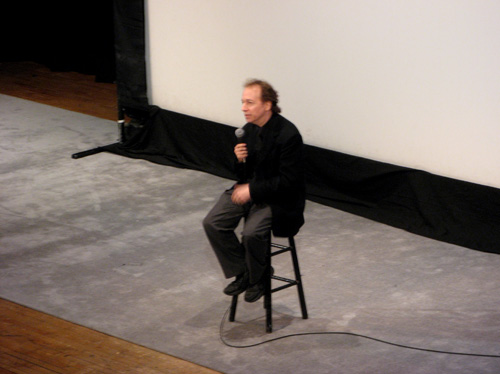
The penultimate film seminar of the season. Tonight: Vitus, Switzerland’s shortlisted submission to the 2006 Academy Awards. The dialogue is in Swiss German with English subtitles, making it the third consecutive foreign film shown this year. As with our last non-American film, there was no guest speaker, so host Scott Siegel led tonight’s post-screening discussion solo.

Scott Siegel

Childhood is often a struggle, but for Vitus (pronounced: VEE-tus), the highly precocious boy of the title, it is more complicated than for most. As a young piano prodigy, with an off-the-charts IQ, he is forced from an early age to figure out how to live with a gift that has become a burden.

He is preciously portrayed as a wide-eyed six-year old by Fabrizio Borsani in his acting debut. By the time he turns twelve, much of the joy seems to have been drained from young Vitus, now played by real-life Canadian-Romanian prodigy Teo Gheorghiu (who also happens to speak perfect Swiss-German.) Vitus’ well-meaning parents (Swiss stage actors Julika Jenkins and Urs Jucker), aggressively cultivate their only child’s talents, at the seeming expense of his personal development. In a lesser film, the couple would have been portrayed as nightmarish caricatures of stage parents; not so here. One senses quite vividly, that theirs is a close familial unit, borne of much love and (albeit sometimes misguided) support. In his classes, among teenagers who regard Vitus as a freak of nature, the boy alternates between arrogant and sullen – defense against his internal struggles with social awkardness and loneliness. Vitus’ primary companionship comes in the form of his kindly, eccentric grandfather, played by Bruno Ganz, an award-winning Swiss actor heretofore best known for his portrayal of Adolf Hitler in 2004’s Der Untergang – Hitler und das Ende des Dritten Reichs (The Downfall: Hitler and the End of the Third Reich). It is during their afternoons together that the germ of an idea forms in Vitus’ mind: as his grandfather advises, to decide what you must be, you sometimes have to part with things you love.

What follows is an elaborate ruse, in which Vitus feigns a head injury which renders him no longer gifted, or rather: absolutely normal. His mother, who has invested her entire life in nurturing his special genius, is bitterly disappointed. Vitus, however, is liberated, finally making friends his own age, and reveling in his new freedom. Almost imperceptibly, the film shifts tone from drama to almost comedy, to fantasy, as Vitus and his grandfather (his only co-conspirator) devise ways to employ their secret to the family’s financial advantage.

Along the way, there are some delightful scenes between the boy and his grandfather, and a few between Vitus and Isabel (Tamara Scarpellini), his former babysitter, now 19. When he invites her to a fancy restaurant to propose marriage, his argument is serious and utterly rational: informing her that she is the love of his life, and attempting to convince her that their seven-year age gap coincides perfectly with the difference in life expectancy between men and women, and with the discrepancy in the ages of their respective sexual peaks.

Haha, go, cougars!

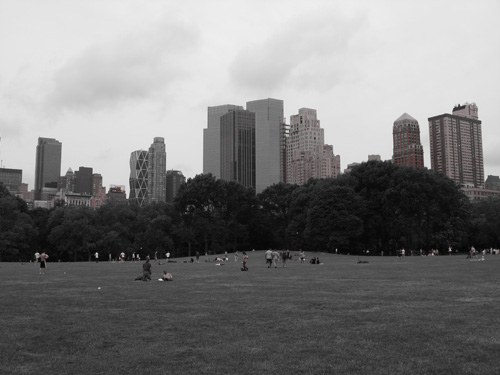
Sheep Meadow

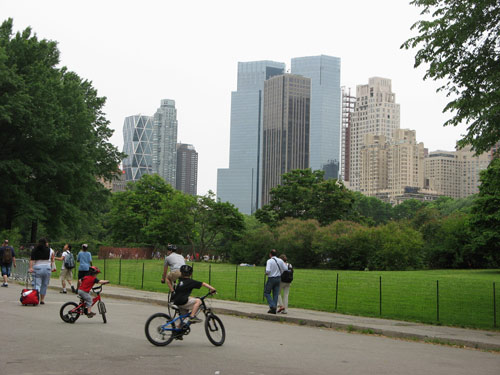
Central Park’s Sheep Meadow served as home to a couple hundred Southdown sheep for seventy years, until 1934, when Parks Commissioner Robert Moses had the sheep transferred to Prospect Park in Brooklyn. (Their shepherd was assigned to the lion house in the Central Park Zoo.)

The rural Victorian Gothic structure which had been the sheep’s pen was transformed into Tavern on the Green, host to countless events and film shoots (and the occasional high school prom.)

Central Park

Central Park

Nowadays, the expanse of lawn is popular with picnickers, sunbathers, and bare-torsoed frisbee players.

Japan Day 2007

At SummerStage for Japan Day at Central Park, an event organized by the city’s Japanese community, with the support of the Consulate General of Japan, to showcase Japan’s contemporary and traditional cultures. The day kicked off in the early morning with a traditional Shishimai (lion dance), followed by a 4-mile “Japan Run” race.

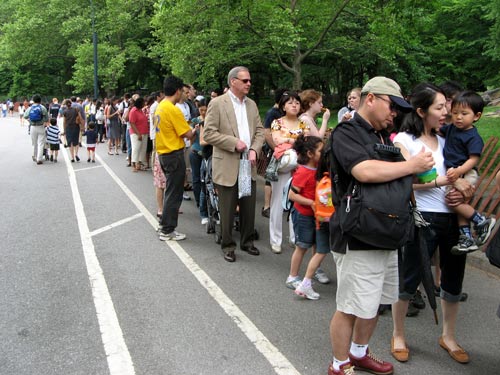
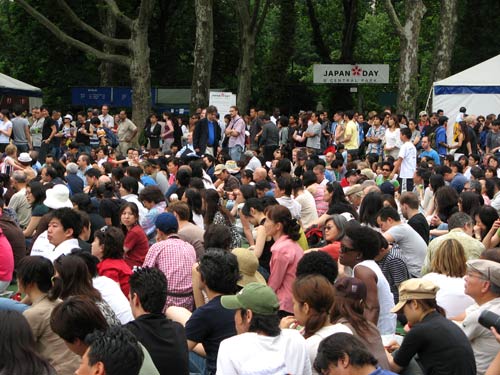
By mid-afternoon, 14,000 New Yorkers had descended upon the park – check out the line to get in – to take part in the day-long program, which included food, activity and exhibition stalls, karaoke and anime costume contests, live music and cultural performances.

Japan Day line

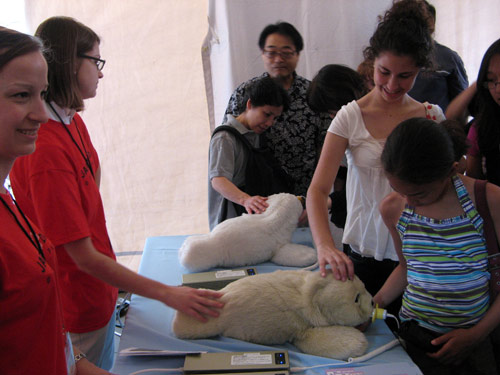
Inside the “Video Game and Robots” tent, there was a somewhat predictable gender split among the attendees.: boys and young men were huddled around the flashing, beeping game consoles; girls gravitated toward Paro, the furry white, robotic baby harp seal. The award-winning robots, which were developed by Japan’s National Institute of Advanced Industrial Science, respond to human touch, and are used for elder therapy in Japanese nursing homes and in hospitals by autistic and handicapped children.

Japan Day robots

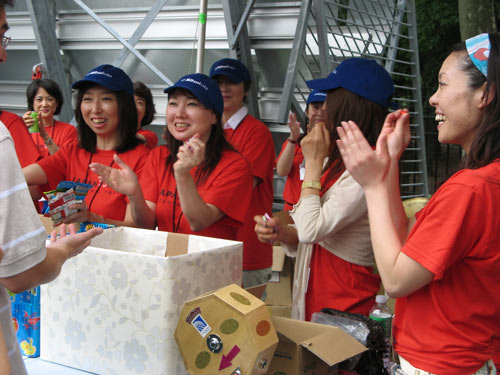
The enthusiastic women of the Japanese Candy tent. Other food tents included Gyudon (Beef Bowl), Gyoza , Soba Noodle, and Temaki Hand Roll Sushi.

Japan Day candy tent

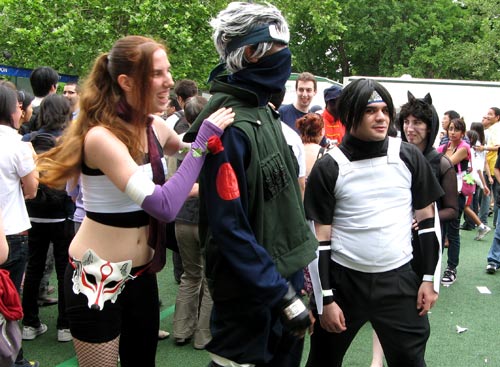
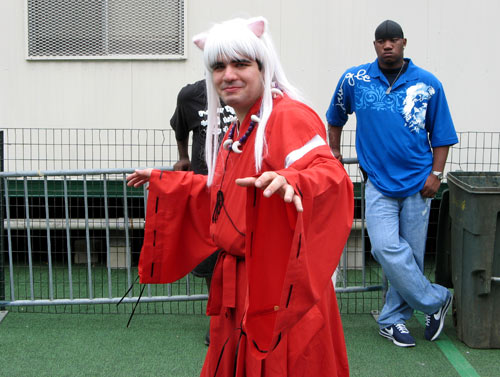
I spied several people whom I assumed were Anime Costume Contest participants, but given some of the outlandish Japanese street fashion, and the eclectic attire adopted by the East Village “freeters” — it’s not always easy to tell the difference.

Japan Day anime

Japan Day anime

Japan Day crowd:

Japan Day audience

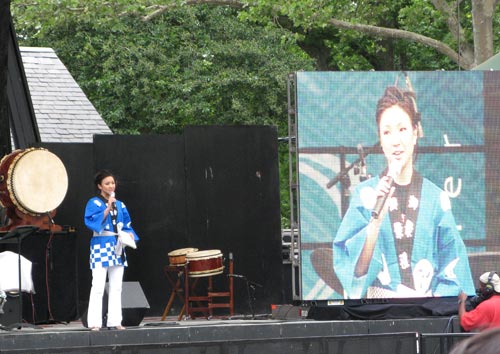
NY1 political reporter Sandra Endo emceed the main stage events, including a surprise appearance by the newly crowned Miss Universe (and Heroes  hopeful) Riyo Mori, who earlier in the week won the title handily over the USA’s balance-challenged entrant, Rachel Smith.

Sandra Endo

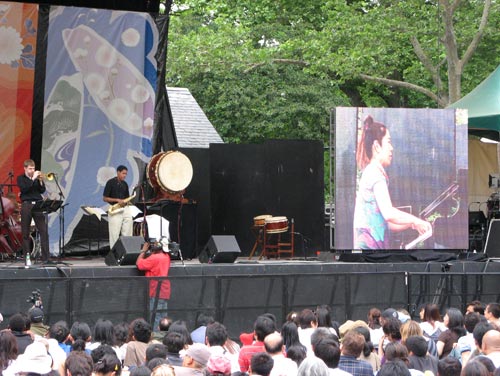
And just before the rains: a musical performance by Miki Hayama, jazz pianist.

Japan Day music

Airport food

Mom and Dad were off to Tahoe and San Francisco for the week so C, J and I piled in with the luggage for the drop-off run to LGA.

Theirs was not a direct flight to Reno, and since airlines have eliminated meal service on all except transcontinental domestic flights, we knew Mom and Dad were in for a long foodless haul. C insisted that they have a light meal before boarding, but the options at the airport’s Central Terminal Building were not all that inspiring.

LGA art

The pride of the food court – if there can be such a thing – is Figs Café, celebrity chef Todd English‘s first New York City venture. Months before he seduced Manhattan with his David Rockwell-designed Olives at The W Hotel in Union Square (and years before he flamed out with his peculiarly-named English is Italian), English imported a branch of his award-winning Boston-area pizzerias to LaGuardia Airport. Dad, though, may be the only person I know who doesn’t like pizza(!) so we opted instead for a couple of combination plates from the Asian Chao kiosk. We weren’t familiar with this particular chain, but years of encounters with its suburban mall brethren Wok N Roll, Manchu Wok and Panda Express had set our expectations pretty low. And indeed the “eclectic” menu had a few surprises in store: Beef with Broccoli, Lo Mien, Egg Rolls… Bourbon Chicken? Fried Bananas?

It’s a hackneyed bit of classic Seinfeld observational humor, but so true:

Do you think that the people at the airport that run the stores have any idea what the prices are every place else in the world? Or do you think they just feel they have their own little country out there and they can charge anything they want? You’re hungry? Tuna sandwich is nine dollars. You don’t like it; go back to your own country. I think the whole airport airline complex is a huge scam just to sell the tuna sandwiches. I think that profit is what’s supporting the whole air travel industry. I mean think about it; the terminals, the airplanes, it’s all just a distraction so that you don’t notice the beating that you’re taking on the tuna.

Aside from the obvious dating of the 1992 prices (Così tuna sandwiches run at least close to $9 now), substitute “sesame chicken” for “tuna” and you get the idea of the sticker shock we experienced at the airport. It was, hands down, the most expensive Chinese take-out we’d ever had in our lives.

On the subject of airports: check out the new Sydney post.

"Young" alums

Our high school’s alumnae/i association organized a “Young Alums Happy Hour” for graduates in their early 20s through early 30s. Although I’d never attended these events in the past, I sensed that my window of opportunity to do so as a “young” alum was rapidly closing. The next age bracket up would encompass alumni in their 30s and 40s, and I knew without being told these events probably would be a whole lot less fun.

Which is worse: being the youngest people in the room, or the oldest?

I met SYB, JL and HYB (who was crashing) for dinner near the event. Despite the impending threat of rain, Blockheads already had a crowd spilling onto the sidewalk outside — $3 margaritas may have had something to do with it; we opted for quick and cheap Chinese food instead.

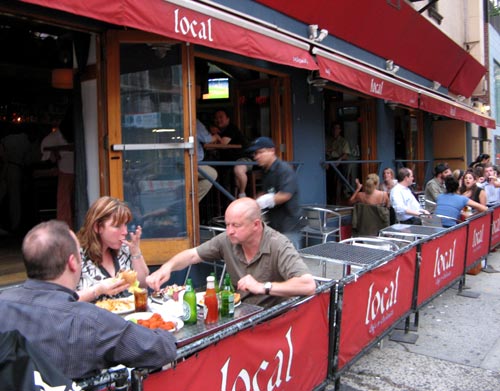
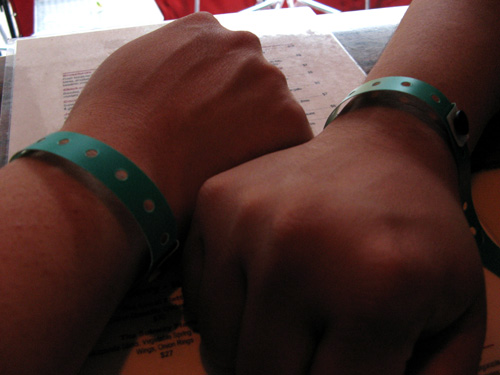
Tonight’s happy hour was hosted by Local, a bar/cafe (but mostly a bar), part owned by a member of the Class of ’98. After identifying our school affiliation, we were each tagged with a snap-on green vinyl wristband, of the kind usually seen at clubs, rock concerts or music festivals. My, these are  young alums. (They didn’t look so young to fellow classmate PL, whose intended joke fell flat when he directed it to a couple of the bar’s regular [non-alum] customers.)

Local East

bar bracelets

Local had Blue Moon on tap, which I’ve noticed cropping up in bars around town more recently, though the Belgian-Style “white beer” — so called due to the suspended yeast and wheat proteins which cause the beer to look hazy, or white — has been around for more than a decade. Some wheat beers are served with a slice of lemon, which, according to some, accentuates the tart, refreshing character of the beer. (Others think that “fruiting” the beer actually kills the taste and the head.) Blue Moon’s creator, Keith Villa, came up with the ingenious marketing strategy of suggesting that bars serve their beer with an orange slice, to accentuate its coriander and orange peel notes. More importantly, the unusual garnish would pique interest among bar patrons, looking to try something a little different.

Worked for me.

53rd Street

Chanoodle fried rice

For today’s Chinatown lunch we met at Chanoodle on Mulberry — or “Chan Noodle,” as I’ve seen it referred to, as in the New York  magazine mention for best late night Chinatown “under the radar spot.”

The restaurant is known for its straightforward, simply-prepared Cantonese cooking; the head chef hails from Ping’s Seafood (itself named on New York  magazine’s late night Chinatown piece for “best blowout banquet.”)

Chanoodle

We started with a plate of tender baby bok choy studded with fried chopped garlic. (Ming Tsai offers a similar recipe here.)

Chanoodle bok choy

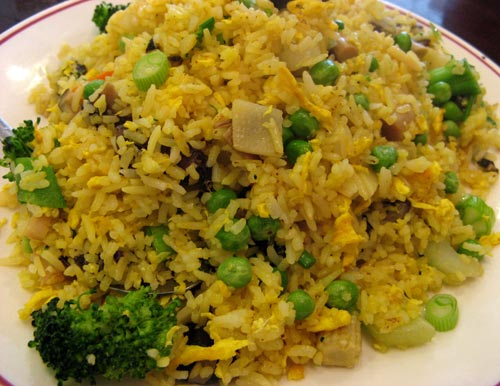
The fried rice, usually not a standout dish, gets noticed here. The version with “two kinds of sausage” prompted Times  reviewer Eric Asimov “to re-examine a long-held distaste for fried rice, formed through years of takeout misery.” Robert Sietsema likes it, too; the Village Voice named Chanoodle’s “gold and silver fried rice” the city’s “Best Fried Rice” in 2004. “Salty fish tidbits, onions, golden raisins, and egg drops”… I may just venture to try this dish after being pleasantly surprised by a similar seafood/raisin rice combination last year. (This afternoon, we shared the vegetable version.)

Chanoodle fried rice

I prefer “Chanoodle” to “Chan Noodle,” if only because Chanoodle reminds me of “canoodle” — a fun word of indeterminate origin. William Safire noted in a 1998 Times piece, available now only to Times Select members, that the derivation theories fall into two disparate camps: the first from the German verb knudeln, “to cuddle,” which has an alternate suggestion of “to pat, or to knead,” as when making Knödel  dumplings; the second draws British origins from the Nottingham dialect for “to cuddle,”‘ or from a Somerset noun meaning “donkey” — used figuratively for “one who makes love [in the original sense] foolishly.”

Barbecue at the big house

SC and JG organized another group together for a visit to Kunjip (in English: “big house”) on West 32nd Street, for “authentic Korean cusine [sic] in the middle of Korean town [sic].

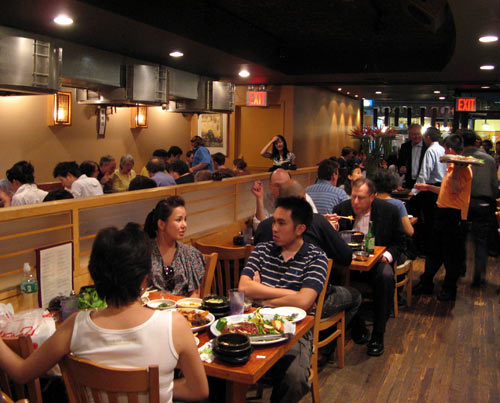
Kunjip dining room

Our party this evening was about half the size it was at the previous Korean barbecue outing, but without the ordering restrictions in place for our last visit to Kunjip, we delved pretty well into the extensive menu.

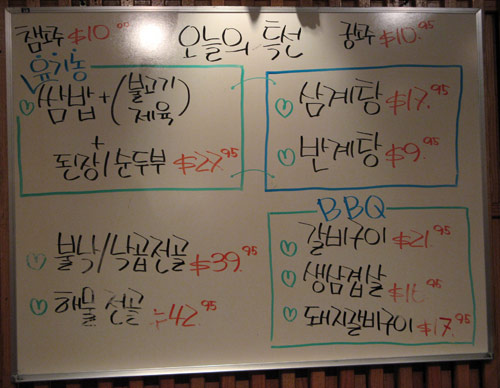
A quick perusal of the menu board didn’t offer us much direction – though the hearts did add a festive touch! – but we fared somewhat better with the picture menu.

Kunjip menu

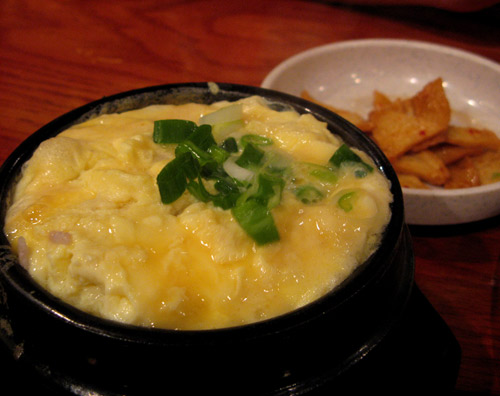
Gyeran Jjim (steamed eggs):

Kunjip panchan

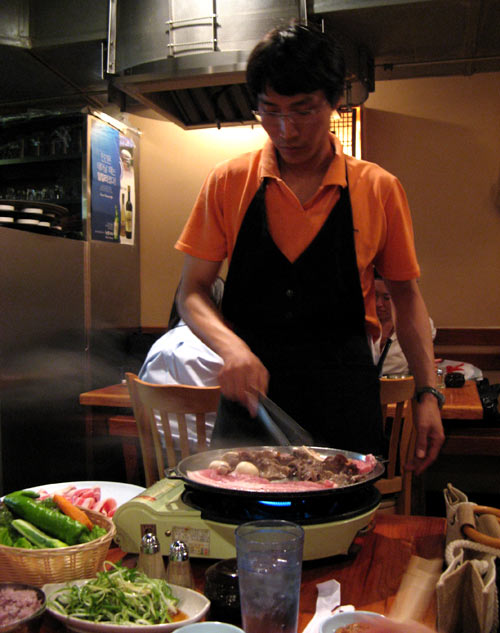
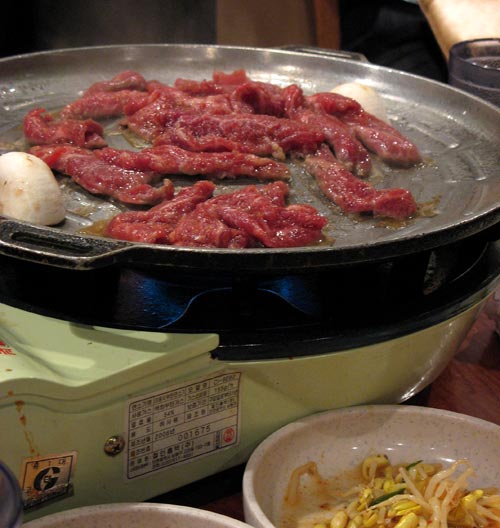
An order of “BBQ Combination for 2,” a.k.a. “Carnivore’s delight,” was made up of a heaping platter of fatty pork belly, thin sliced beef brisket, and ox tongue. To supplement, we could not resist adding on the Gal Bi Gui  (marinated short ribs) and Bul Go Ki  (marinated prime ribeye), all of which the restaurant staff helpfully grilled for us tableside. No smokeless grills this time out; the heavy scent of grilled meats permeated everything.

Kunjip grill

Kunjip grill

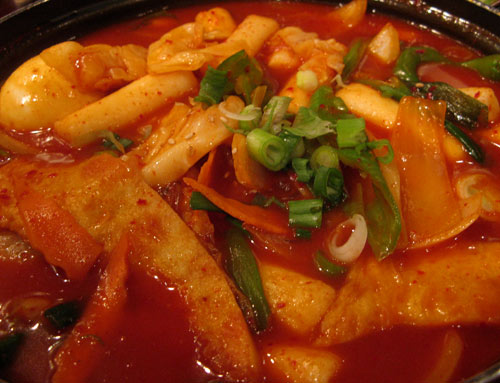
Rounding out the non-meat items: the Hae Mool Pajun  (seafood pancake), the Chap Jae, a bowl of Soon Doo Boo Chigae, the Mae Woon Dduk Boki  (spicy pan-fried Korean rice cake with vegetable — pictured below) and one curious-looking bowl of purple (forbidden?) rice.

Kunjip rice cake

For dessert, cool bowls of Sujeonggwa, the traditional Korean sweet drink flavored by ginger and cinnamon, and dried persimmon – aha, the mystery ingredient! – garnished with pine nuts. The aromatic brew had the color of tea, but was technically not a tea, i.e., based on tea shrub leaves, but an infusion or a tisane.