vip in the city, page 11

St. Pats for All Parade 2008

Happy St. Patrick’s Day!

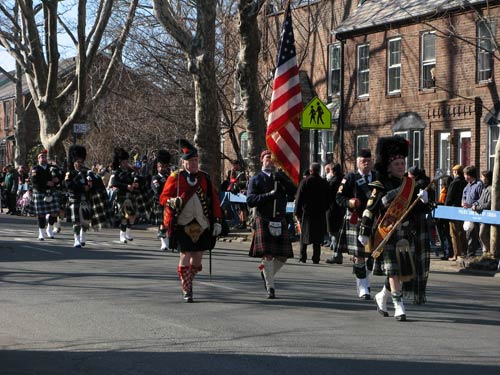
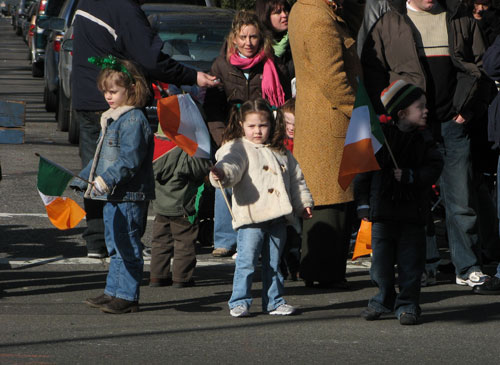
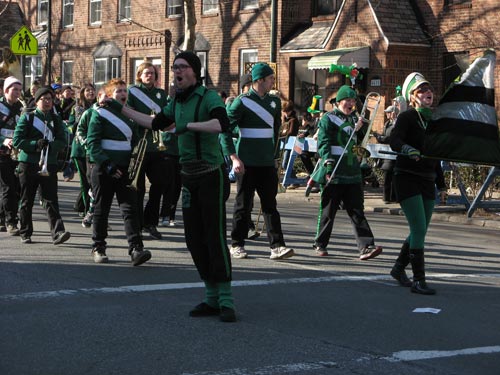
Everyone knows about the city’s main St. Patrick’s Day parade that takes place along Fifth Avenue on March 17. Since 2000, though, another smaller St. Patrick’s Parade & Irish Fair — dubbed St. Pat’s for All — is held along Skillman Avenue in western Queens weeks earlier. The parade begins in the traditionally Irish community of Sunnyside and ends in Woodside.

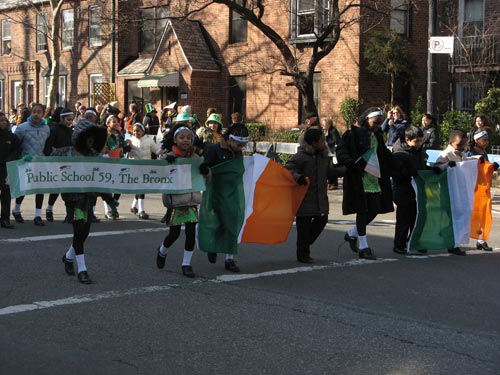
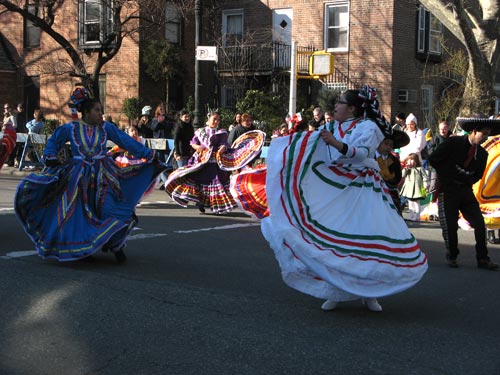
Brendan Fay, founder of the Lavender and Green Alliance, a group serving the needs of the Irish GLBT community, organized the inclusive parade after being arrested at the city’s main St. Patrick’s Day festivities in 1999. This year’s St. Pat’s for All took place on Sunday, March 2 and featured the usual Irish heritage groups (bagpipers, the Irish Arts Center, step dancers from The Niall O’Leary School of Irish Dance, whom we saw perform last fall at CultureFest) as well as local politicians, community and labor groups, gay rights organizations, Protestant, Muslim and Jewish groups, and not-obviously (or obviously not) Irish groups like Sunset Park’s Quetzalcoatl Group with its colorfully attired Mexican folk dancers and the wonderfully charming Keltic Dreams, a clogging troupe from P.S. 59 in the Bronx, whose student body is 71 percent Hispanic and 27 percent black.

St. Pat’s for All parade

St. Pat’s for All parade

St. Pat’s for All parade

St. Pat’s for All parade

St. Pat’s for All parade

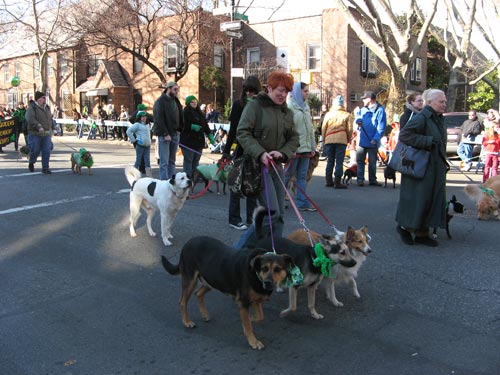
Even canines got to participate, courtesy of S.U.D.S., the Sunnyside United Dog Society:

St. Pat’s for All parade

There was constant music in the air, and I was probably most surprised (and psyched) to hear “Hit Me Baby One More Time” for marching brass band… though in retrospect, I would have saved myself some embarrassment if I’d kept that sentiment to myself. No “Danny Boy though.

Check out the full photo set on flickr!

Setagaya at last

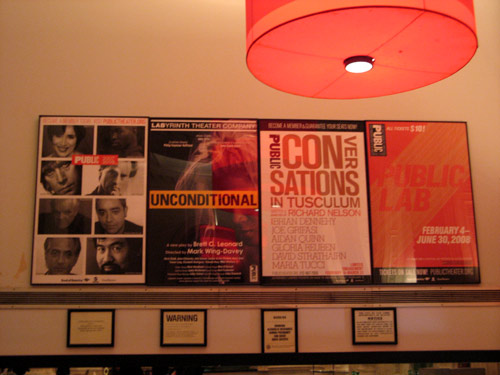
At the Public Theater tonight for Unconditional, a new production by Philip Seymour Hoffman and John Ortiz’s LAByrinth Theater Company. The play, written by Brett C. Leonard and directed by 1992’s OBIE Award winner Mark Wing-Davey, is a study in racial tensions and urban isolation, played out in the overlapping stories of nine New Yorkers. Any synopsis of the complicated relationships would best be conveyed by diagram; the play’s natural comparison would be to the 2004 film Crash… another entry in the “everyone hates everyone else” genre. In Unconditional, though, the tensions are mostly confined to between blacks and whites, with one fiery Latina thrown into the mix — probably the most entertaining of the miserable bunch.

The staging was in the round, with scenes played out amidst sliding panels and in every nook and corner of the stage, which made for interesting, if occasionally obstructed views. It all began with a jolting bang (a Confederate flag burning and a hanging) and ended on a somewhat more hopeful note (a wedding). In between there were all kinds of brutality, and quite a bit of sex and swearing. The sprawling cast and rapid-fire series of vignettes made it difficult to invest much emotion into any of the characters’ plights; as a result, the violence and loss did not resonate as intended. What should have been horribly shocking, felt contrived, or worse: gratuitous.

Variety called the play “clever, attention-getting and not very nice”; The New York Times assessed that “the whole adds up to less than the sum of its parts.”

Unconditional

After such depressing fare, we went in for the comfort of ramen noodles. Months ago, we were thwarted in our first attempt to visit much-hyped Ramen Setagaya; this time out, the newness had worn off sufficiently for us to be seated with no wait. (Well, also, it was 10:30PM.)

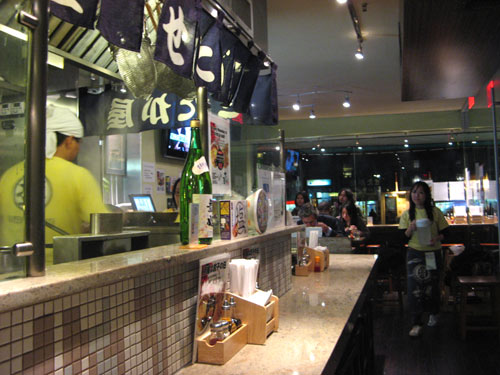
The narrow glass-enclosed restaurant on First Avenue is the first U.S. location of a popular Japanese ramen chain — just part of a larger Ramenaissance afoot in the city. (See also: newly-opened Ippudo.)

Setagaya Ramen

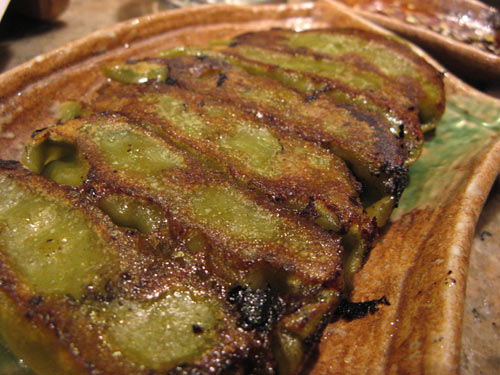
To start, vegetable gyoza. Store bought (beware!), but nicely pan crusted:

Setagaya Gyoza

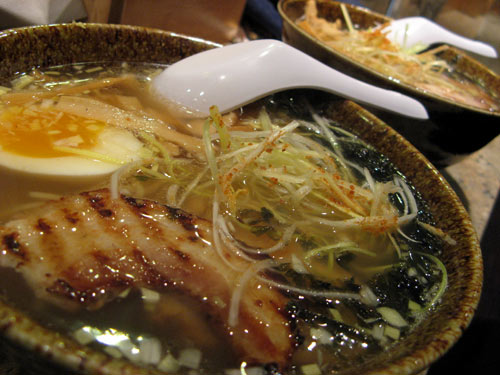
Setagaya’s signature ramen is the shio, or salt, ramen. I found the noodles pleasingly firm (there is a row of cooking timers on the kitchen wall to ensure this) and the toppings fresh — grilled-to-order pork slices (which I removed), seaweed, marinated bamboo shoots, julienned green onion, and half a soft-boiled egg, which had just the right custardy consistency. The super-authentic broth is “10 percent meat and 90 percent ingredients such as dried anchovies, clams, scallops, mushrooms, ginger, garlic, and (the secret weapon) Vietnamese salt, all boiled for five to six hours every morning.” It was light, with a complex, distinct seafood flavor which I rather enjoyed; those like my friend who prefer a heartier broth may be better served at Minca. (For what it’s worth, New York magazine likes Setagaya’s ramen the best.)

Setagaya Ramen

Oh, and on the way home, I met my first ever Academy Award winning director — riding the 2 at midnight with his son and Academy Award winning wife, no less.  Stars… they’re just like us!

Busy scissors

As usual, I left the salon this evening feeling that my cut was too short. But it’s worth going in just for the head massage that comes with getting my hair washed.

New York ran a feature last November about the dramatic expansion of the spa/salon industry, and the attendant mushrooming (and exploitation) of workers in this relatively new field of labor. Services that were once considered luxuries are now “social imperatives” and deemed necessary for maintaining an overall sense of well-being.

There may be something to that latter point; another theory not espoused in the article is that all these massages, mani-pedis and waxes have become, in part, a symptom of urban isolation, of individuals growing increasingly beyond the reach of one another, despite such close proximities. An entire (legal) industry built up around providing human touch and connections.

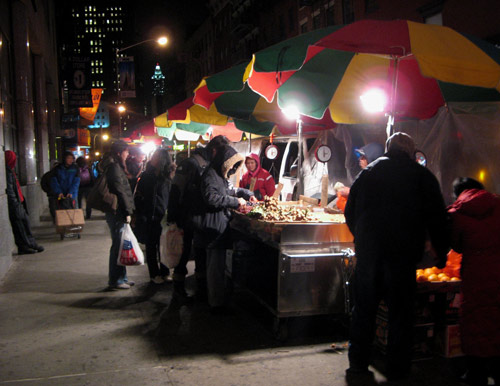
Chinatown produce stands:

Chinatown stands

Celebrating citizenship

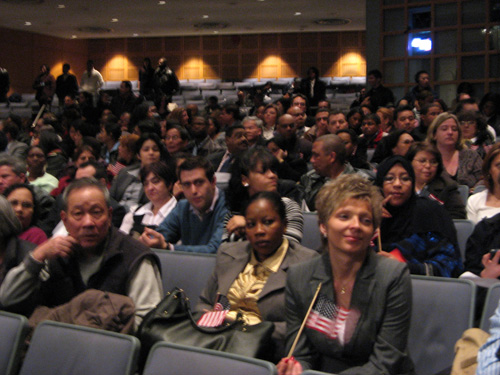
At CL’s invitation, I attended my first ever naturalization ceremony this Wednesday morning. Over 350 people from 55 countries (including one active member of the U.S. Armed Forces) were sworn in as United States citizens at Stuyvesant High School’s Murray Kahn Auditorium. The event was hosted by the Director of the United States Citizenship and Immigration Services, Emilio T. González (himself a naturalized citizen); the keynote address was delivered by Taiwanese-born U.S. Secretary of Labor Elaine L. Chao, who with her father Dr. James S. C. Chao, was being presented with an Outstanding American by Choice Award. According to the USICS, a division of the Department of Homeland Security, the award is designed to recognize naturalized citizens who have made significant contributions to both their community and their adopted country.

Stuyvesant’s principal Stanley Teitel (at the podium) offered the welcoming remarks.
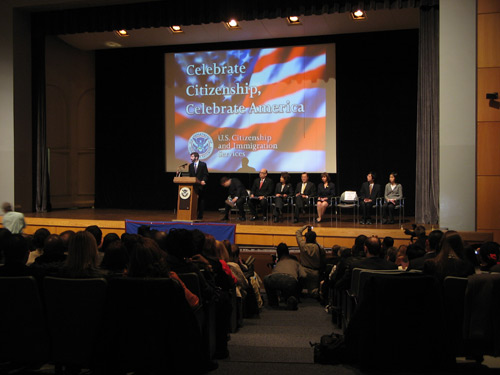
Naturalization Ceremony

After the Honor Guard from Lt. B.R. Kimlau Chinese Memorial Post 1291 presented the colors, the Stuyvesant Concert Chorus performed a selection of patriotic songs, including “The Star Spangled Banner,” “This is My Country” and “Give Me Your Tired, Your Poor,” a tune with lyrics drawn from Emma Lazarus‘ 1833 sonnet “The New Colossus,” whose famous lines appear on a plaque at the base of the Statue of Liberty.
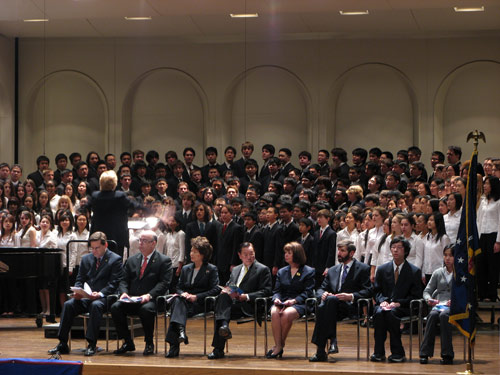
Naturalization Ceremony

And then, the moment most had been waiting for: the ceremony itself. As the names of each country represented were read aloud, the range of nations stood as testimony to the richness of America’s variety and its continuing status as a country of immigrants.

The oath was administered solemnly, with the new citizens raising their right hands to repeat the words:

I hereby declare, on oath, that I absolutely and entirely renounce and abjure all allegiance and fidelity to any foreign prince, potentate, state, or sovereignty of whom or which I have heretofore been a subject or citizen; that I will support and defend the Constitution and laws of the United States of America against all enemies, foreign and domestic; that I will bear true faith and allegiance to the same; that I will bear arms on behalf of the United States when required by law; that I will perform noncombatant service in the armed forces of the United States when required by the law; that I will perform work of national importance under civilian direction when required by the law; and that I take this obligation freely without any mental reservation or purpose of evasion; so help me God.

It was all very moving. When it was done, there were smiles, tears, and cheers as the newly naturalized citizens waved miniature American flags amidst hearty applause and the flashing of cameras. Several leaped out of their chairs and hugged, and many turned to the rear auditorium where their friends and family were seated, beaming broad smiles.
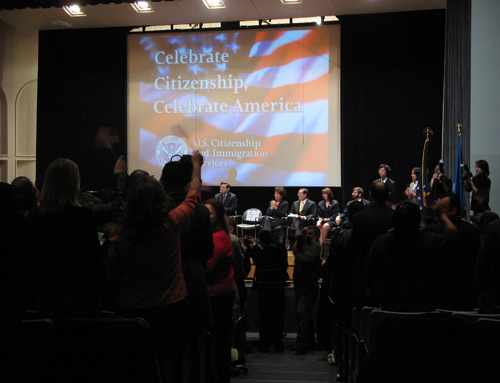
Naturalization Ceremony

Two of Stuy’s own, Chinese immigrants Minglian Pan, 17, and Yimei Hu, 15, (standing far right on stage in the photo above) were naturalized that morning, and after being presented with their certificates of citizenship, led the audience in the Pledge of Allegiance.

Secretary Chao (not always the most sympathetic of characters) delivered a heartfelt speech as she accepted her award as the first Asian-American woman to be appointed to a presidential cabinet. In it, she related part of the story — just one of hundreds in the room — of how her Taiwanese parents came to make their lives in the United States through struggle and hard work, driven by the desire to better the lot of their children.

Chao’s voice choked with emotion as she dedicated her award to her mother, Ruth Mulan Chu Chao, who passed away last August after a 7-year battle against lymphoma.
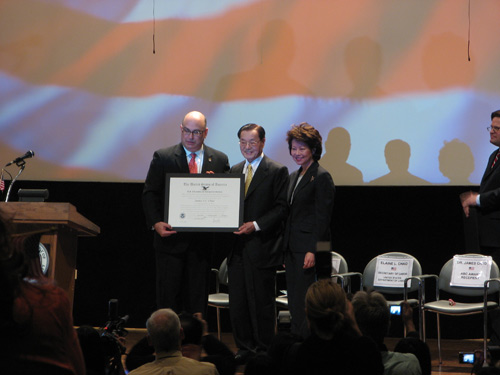
Naturalization Ceremony

America’s newest citizens:
Naturalization Ceremony

Love and the Tudors

This Monday our film seminar series screened a somewhat more mainstream feature than usual: Sony Pictures’ The Other Boleyn Girl, based on Philippa Gregory‘s bestselling novel of the same name.

The Other Boleyn Girl draws its inspiration from the rise and fall of the two Boleyn sisters Mary and Anne (played by Scarlett Johansson and Natalie Portman, respectively), rivals for the attentions of King Henry VIII (who, continuing the onscreen tradition of hunky Henry Tudors, is portrayed by Eric Bana). The young women are portrayed like opposites: sweet blonde, scheming brunette. In their world, nubile female flesh is leveraged for financial and political favor; the girls are quite literally pimped out to the king by their father and uncle. Anne, of course, eventually wiles her way into becoming queen to the already married king, and loses her head to ambition.

The film is intended as a tale of sexual intrigue and family betrayals, set against the backdrop of the King of England’s break with the Catholic Church — an act with far-reaching consequences for the course of modern English history. Ideal for those who want a little eye candy with their history and, as very little is known of the real-life Mary Boleyn, who aren’t overly concerned with factual details. Screenwriter Peter Morgan, acclaimed for his work on The Last King of Scotland and The Queen, stumbles a bit this time out, glossing over the huge historical impact of the king’s divorce (and subsequent founding of The Church of England) and almost entirely loses inspirational steam once Anne takes her place on the throne.

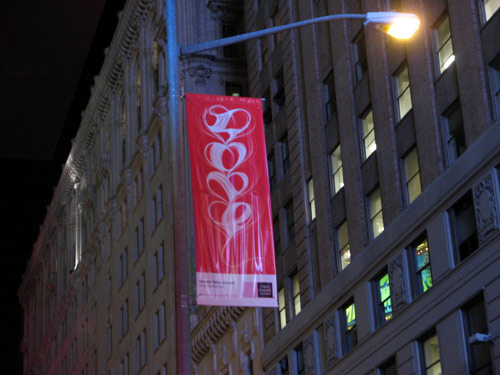
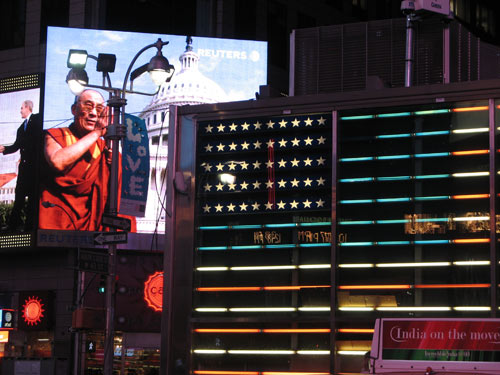
More free love (banners) in Times Square. Marian Bantjes, Canadian designer, artist, illustrator and typographer. Remember Saks’ 2007 “Want It!” campaign?:

Love banner

Chip Wass, New York-based award-winning illustrator and designer:

Love banner

A week later, a small bomb would be set off steps from here, in front of the military recruitment center in Times Square.

Pinch & S'MAC

At Pinch & S’MAC on Columbus – a punny collaboration between the now-closed Pizza by the Inch and the East Village Sarita’s Macaroni & Cheese, the mac n’ cheese emporium which last year earned the Oprah stamp of approval on “Gayle’s New York Minute.”

Just as it had at its former Park Avenue South location, Pinch offers thin pies in four-inch widths, sold by length in four-inch increments, with choice of toppings. Personally I couldn’t say how their product stacks up against the offerings in a city full of superlative pizza, though they did seem to have a following. (Incidentally, Arthur Avenue’s Zero Otto Nove, which we visited a couple of weeks ago, was just named best in the Bronx by New York magazine.) The joining of these two cheese and carb forces is a coup, though, and last month’s opening of the Pinch & S’MAC joint venture, minutes’ walk from the Amsterdam Avenue frat bar scene, was met with considerable anticipation.

S’MAC offers variations on the cheesy pasta classic: from the “All American” (American and Cheddar – add seasoned ground beef to make it a “Cheeseburger” or sauced chicken pieces for the “Buffalo Chicken”) to more complicated, gourmet versions like the “Parisienne” (Brie, Figs, Roasted Shiitake Mushrooms and Fresh Rosemary) and the “Masala” (Cheddar and American cheeses, Tomatoes, Ginger, Onions, Cilantro, Cumin & Indian Spices.) Alternatively, you can pick any combination of offered toppings to customize your own dish. The elbow macaroni is served in cast-iron skillets of varying sizes — Nosh, Major Munch, Mongo and Partay! – with decent crust on top, but overall a bit soupy for my tastes. Breadcrumb topping optional.

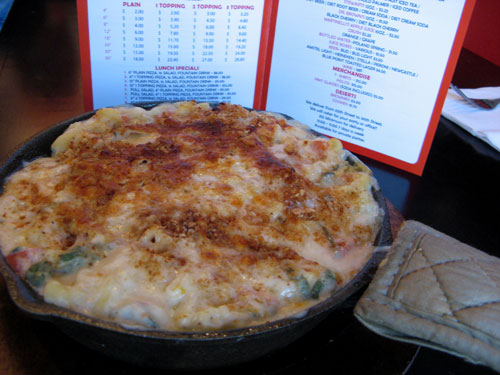
The “Napoletana” (Fresh Mozzarella, Roasted Tomatoes, Roasted Garlic and Fresh Basil) — better in theory, perhaps, than in execution:

Napoletana

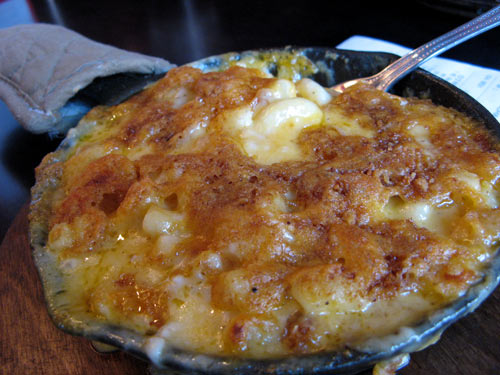
And the classic “All American”:

All American

To me, mac n’ cheese is one of those comfort dishes that doesn’t require a lot of tinkering, so I would be partial to S’MAC’s American and Cheddar-based versions. In 2006, The Times’s Julia Moskin went in search of the ultimate home cook’s recipe, eventually foregoing the temptation towards fancier cheeses (Swiss Gruyère, Parmigiano-Reggiano, Italian fontina and Welsh Caerphilly) in favor of two straightforward cheddar-based recipes, divided into creamy and crusty preferences.

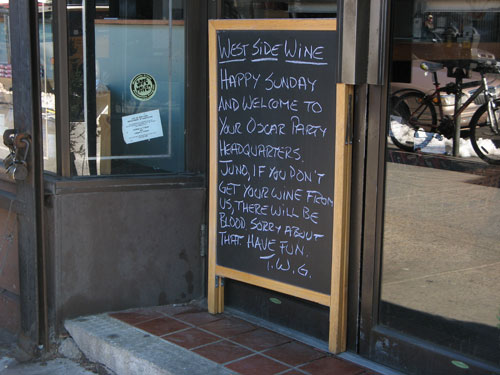
More wordplay across the street at West Side Wine. (No milkshake reference? I guess it’s over already.) The 80th Annual Academy Awards broadcast later that night, and would become the first since 1964 that all four main acting awards were won by non-Americans. That year, “Sexy Rexy” Harrison took home the Best Actor Oscar for his career-defining role as “Henry Higgins” in George Cukor’s screen adaptation of My Fair Lady. (The classic Lerner and Loewe musical is playing this week at MoMA as part of Sir Harrison’s “Centenary Tribute.”)

West Side Wine

French star Marion Cotillard on her Oscar win: “I’m totally overwhelmed with joy and sparkles and fireworks and everything which goes like bom-bom-bom.

What a charming sentiment!

Seneca Village

On a walking tour organized by the Central Park Conservancy this clear and chilly Sunday afternoon.

Our group of about a dozen met a pair of guides inside the Park at the Mariner’s Gate entrance at 85th Street. From there, we set off to tour the lands that once made up Seneca Village, Manhattan’s first known community of African American property owners. The village, founded in 1825, once occupied the land between what is now the Great Lawn to Central Park West and from 82nd to 89th Streets — an area of about five acres. Within a few years, the community developed into a stable settlement of over 250 working-class residents, with its own churches, school and cemetery. African Americans owned more than half the households in the village — an unusually high percentage of property ownership for any New York community. By the 1840s, Irish and German immigrants, and perhaps Native Americans, owned several land plots as well; in total, during its over three decades in existence, approximately 1,600 people owned property, lived and/or worked in Seneca Village.

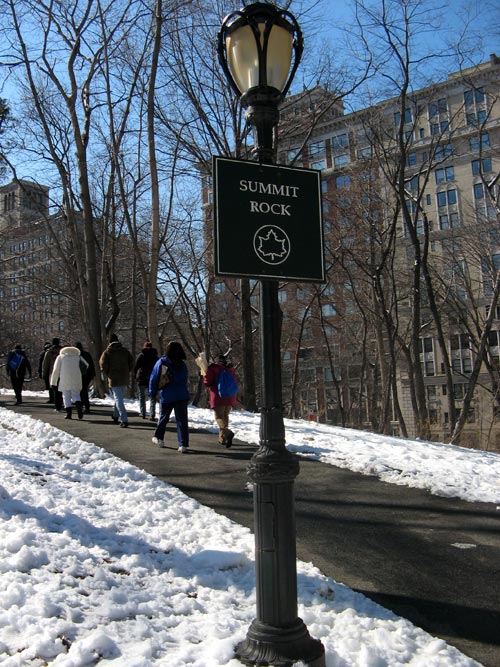
Up the trail to Summit Rock — at 141.8 feet, the highest elevation in Central Park (but not the highest point in Manhattan.)

Summit Rock

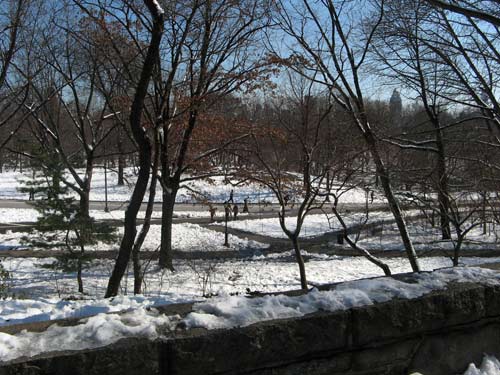
The guides explained the challenges of this particular park tour, as nothing of note remains of the original community, save for the trickling remnants of an abundant natural spring near 82nd Street which would have served as the village’s main source of fresh drinking water. Instead, we were given photocopies of historic maps, and shown artists’ renderings of the structures that would have existed in the mid-19th century. This view overlooks what would have been the heart of Seneca Village.

Seneca Village

In 1855, the New York State Census reported approximately 264 residents in the semi-rural village, at a time when most of the city’s immigrant population was concentrated in slums below 14th Street. Two years later, after the state legislature authorized the use of eminent domain to publicly acquire private land for the purpose of creating Central Park, the entire village was razed without a trace. Landowners living within the boundaries of the proposed park were compensated financially for their property, though several filed claims in New York State Supreme Court, protesting the city’s valuations of their land. Little is known of the outcome of those lawsuits, or where the hundreds of residents may have relocated. What is known is that once scattered, the community of Seneca Village was not re-established.

This spot of red is a cardinal, hidden among the trees:

Cardinal

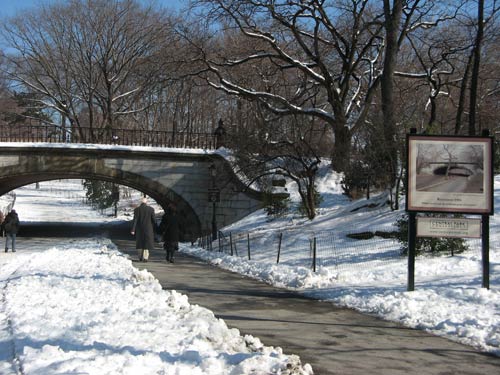
Winterdale Arch at 82d Street, a pedestrian underpass and bridle path. The 1994 restoration included the award-winning recreation of the original cast-iron fencing along the top of the arch:

Winterdale Arch

Don't let's start

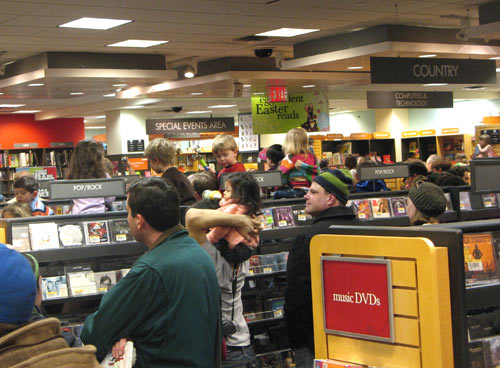
They Might Be Giants, a.k.a., John Flansburgh and John Linnell, were scheduled to perform at the Borders at the Time Warner Center this Saturday afternoon to promote their newest children’s CD/DVD Here Come the 123s — follow-up to 2005’s Here Come the ABCs. It had been quite a while since I’d seen the Brooklyn duo live, and it seems that in the intervening years, they’ve become better known for their children’s projects and television theme song work.

Very well known, in the former case, if this afternoon’s crowds were any indication. It seemed that the entire stroller brigade population of the Upper West Side had convened on the bookstore at Columbus Circle, where dozens of toddlers were propped up on adult shoulders, their little faces peering above the stacks like rows of prairie dogs.

TMBG crowd

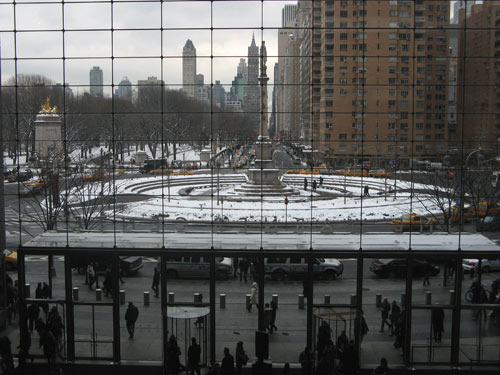
Columbus Circle snow

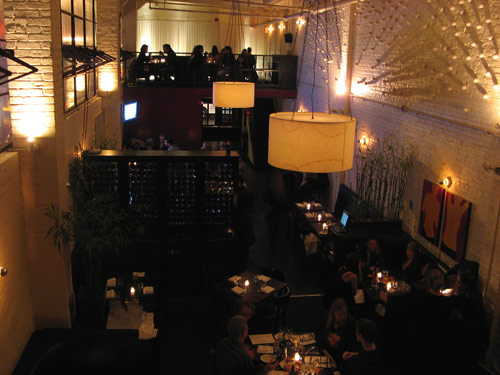
Later that night, CF’s birthday dinner at Ghenet — a “particularly vegetarian friendly” Ethiopian restaurant on Mulberry. The yellow banner outside touts it as the place “Where Angels Eat”; “ghenet” is an Amharic word meaning “paradise”. Turns out that CF and MT are something of Ethiopian food aficionados, having made the rounds at most of the Ethiopian restaurants in New York: Meskerem, Queen of Sheba, Awash… though as of that night, not yet Marcus Samuelsson‘s newly opened Merkato 55. Ghenet is their favorite of the bunch, though.

While the rest of the party dug into the meat dishes, we three split the vegetarian combo platter, which seemed to consist of a bit of every vegetarian dish offered at the restaurant. I counted at least eight scoops in all, served up on a palette of moist, tangy injera flatbread whose torn off pieces doubled as utensils. About half of the items were bean-based, the rest were combinations of potatoes, carrots, onions, cabbage, collard greens and beets, with variations on seasoning, textures and spiciness.

It had been a couple of years since I went out for Ethiopian, and in the midst of such tasty food, I made the amateur error of eating just to the point of satiety. Note: that spongy injera will, and did, grow to several times its original size in the stomach — an expansion that no amount of tej (Ethiopian honey wine) would tamp down, making for some moments of uncomfortable fullness later at Sweet & Vicious.

Snow day

The first major snowstorm of the season hit New York City today, forcing the cancellation of over 1,100 flights, including that of our friends SC and JG. (Weekend in Boca!) By 2PM, 5.6 inches of snow had accumulated in Central Park, the city’s biggest snowfall in two years; until that Friday, just 5.7 inches in total had fallen all winter, due in large part to the snowless stretch in January.

The Parks Department held a “Snow Day,” providing free sleds and Urban Park Ranger-led nature walks at selected park locations across the city. Almost 2,000 people participated in the event, in which 1,700 free cups of hot chocolate were served.

As adults, we don’t get many snow days. I put on my Doc Martens boots and trudged into the office.

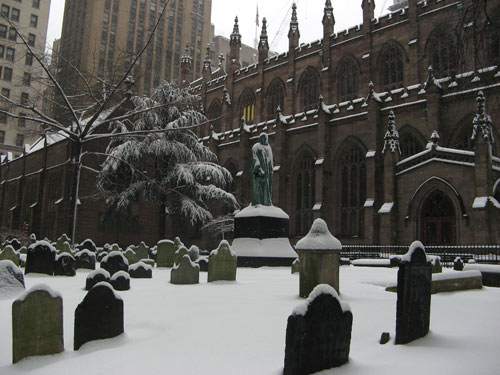
Trinity Church snow

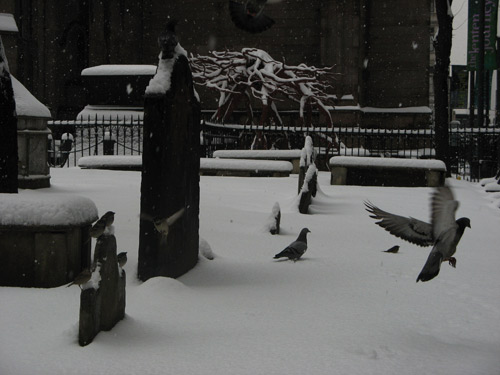
Trinity Church snow

Later that night, I met CS at the Laugh Lounge on Essex for the “L.E.S. is Indulgence” party, organized by The Lower East Side Business Improvement District. The organization, established in 1992, is dedicated to revitalizing Orchard Street’s historic shopping district.

No hot chocolate here; the beverages were of a decidedly more adult nature. Event sponsor, Zygo, promotes their signature liquor as “caffeine-spiked vodka.” Hmm, sounds familiar. More precisely, though, Zygo’s active ingredients are Yerba Maté (South American holly, used for tea), Guarana (South American berry, containing a substance chemically similar to caffeine), D-Ribose (naturally occurring sugar that is a component of RNA) and Tuarine (amino acid, best known as the stuff that gives Red Bull its wings.) If you’re looking for more flavor than kick, there are plenty of places around the city that offer infused vodka. Spirited hot chocolate, anyone?

We toured the tables set up by participants from the neighborhood: handmade truffles and caramelized butter toffee samples from Roni-Sue Chocolates, slick polish from Valley Nails, makeovers by MakeUpMania, and um, tips from Babeland…

Candy and vodka do not a meal make, so off we went in search of more substantial fare. Near hour waits at ‘inoteca and Schiller’s Liquor Bar just wouldn’t do. Luckily, there was Essex — at the top of our minds since SC’s birthday brunch — where we enjoyed a comforting repast of mac n’ cheese and potato latkes… just the thing for a snowy day.

Essex dinner

Buddha's delight

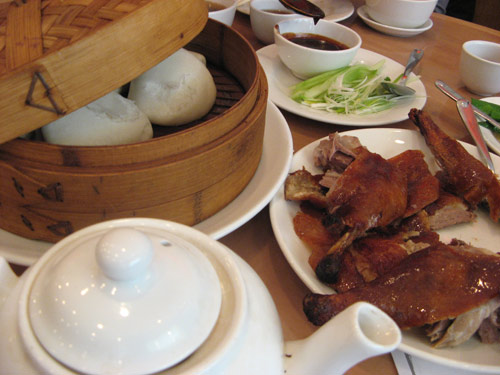
Since that first visit in January, we’ve been averaging a trip to Amazing 66 on Mott Street every couple of weeks.  At the restaurant this Thursday afternoon, we had the serendipity to stumble upon the high-powered board meeting of new Asian American literary journal Kartika Review, i.e., our friends RL and SL. If there is any better way to conduct business than over a whole Peking duck, I do not know it.

We joined them and their fellow editor DW at a large round table, where their meal was already in progress.

Peking duck

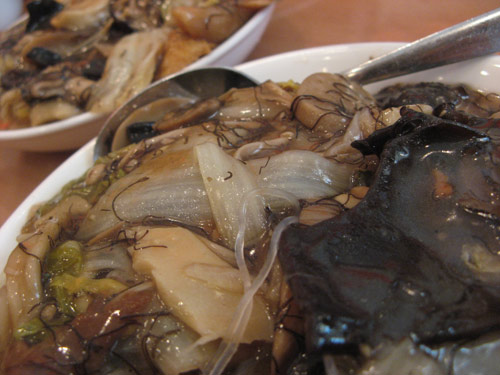
Although the trio did generously offer to share with us some of their delicious-looking duck, I stayed strictly vegetarian with my #62 lunch special: Vermicelli with Buddha’s Delight.

As the name suggests, this dish is enjoyed traditionally by Buddhist monks, most of whom maintain vegetarian diets. (Buddhism’s Five Precepts prohibit killing, stealing, committing sexual misconduct, engaging in false speech and taking intoxicants, to avoid accumulating negative karma.)

Buddha’s delight

This slow-braised dish usually consists of a fairly long list of ingredients, cooked in a soy sauce-based liquid with other seasonings until tender. The specific items used vary greatly both in and outside Asia, and often carry some auspicious significance: black moss (fat choy) is a homonym for prosperity (as in “Gung Hay Fat Choy); ginkgo biloba nuts (bak ko) mimic silver ingots and therefore also bring good fortune; fried tofu and beancurd sticks (foo jook) represent blessings to the house; bamboo piths (jook tseng), wood ear fungus (ha mok yi) and mung-bean threads (fun see) symbolize long life.

No animals were harmed in the making of this delight.