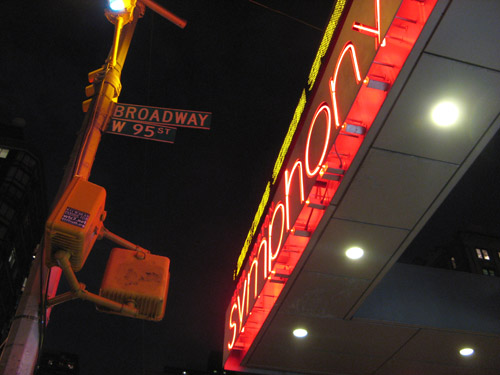
After a light dinner at the not-so-divey Dive Bar on W. 96th Street — hey, I wasn’t about to cross the picket lines at Saigon Grill — we headed over to Peter Norton Symphony Space for the taping of John Oliver‘s upcoming Comedy Central special (scheduled to air on April 20).
We both knew the drill and made sure to arrive early, queuing up for our spots in the cold outside the theatre. And it was a biting, bitter cold, too: the type that chills to the bone, and against which no amount of Starbucks skim chai latte could insulate us. By the time were given the go ahead to file inside, I was in serious need of some warming laughter.
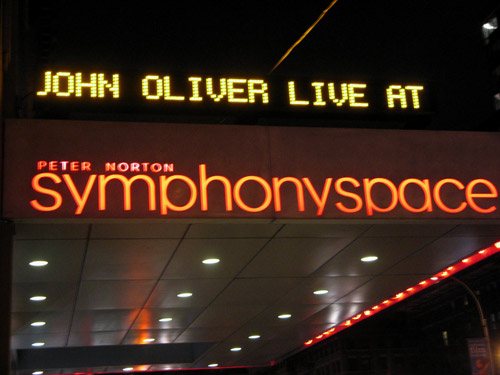
Oliver rose to the occasion brilliantly, delivering the kind of sharp, smirking political commentary — offered in dry British tones, “with more authority than you’re used to hearing” — that makes him such a popular correspondent on The Daily Show. He proved a remarkably good sport, too: about fifteen minutes in, the AV crew lost power to the video screen on stage, requiring Oliver to backtrack and run through a rather lengthy segment of his act several times — with the exact same jokes and “spontaneous” inflection. No doubt a nightmarish scenario for any comedian, but Oliver’s chucklingly rueful gamesmanship earned him an enthusiastic round of applause at the end.
Giving full credit (or blame) to the “10-year old Indonesian boy” to whom he had outsourced his joke-writing, Oliver covered topics ranging from colonialism, how Americans view the rest of the world, the school track incident that led him to pursue a career in comedy over sports, his teary-eyed Pavlovian response to all images backed by cheesy 80s power ballads (looking at you, Divine Miss M) and, with fellow comedian Andy Zaltzman, offered a brilliantly loopy argument on how the erosion of civil freedoms is a valid homeland security strategy, as it eliminates the very thing which the terrorists find most hateful about our country, thereby making us less appealing a target.
Also, some trenchant observations about American culture, as epitomized by the existence of a market for the inflatable floating grill — a barbecuing device used for cooking inside a swimming pool. Oliver cited the ludicrousness of such an invention as definitive proof that in terms of the sheer force of consumerism, America has no peer. Take that, China!
The roots of conspicuous consumption may be traced to post-World War II-era prosperity. We — as Americans, and particularly as New Yorkers — live in a culture driven by “stuff,” where so much of our lives revolves around the acquisition of material things as markers of a certain type of success. I found this recent New York magazine piece particularly resonant: “The Upside of the Downside — Why the Recession May Restore the City We Moved Here For.”
Despite being aware of “how loaded we are, comparatively speaking, and not just loaded in that abstract compared-with-the-developing-world way… loaded compared with most of the people in this city,” I too feel the “psychic effect of living in a place that is so in thrall to money, so dominated by the monoculture of luxury that even if you’re not on the front lines, working for a hedge fund or whatever, the values encroach on your life.”
I don’t know. Maybe that MacBook Air commercial is just getting to me.
3 comments
hyb on
vipnyc on
The title of the article, while attention-catching, is a bit misleading I think. My read is that Joel Lovell isn’t so much wishing recession upon his neighbors so that he can feel better about his own (admittedly comfortable) life, but rather hoping that it returns a bit of pre-boom perspective: a New York where such superficial markers aren’t at the forefront of people’s minds.
Probably not possible, regardless of the state of the economy.
hyb on